If you’re interested in working in a pharmacy, here’s what you need to know:
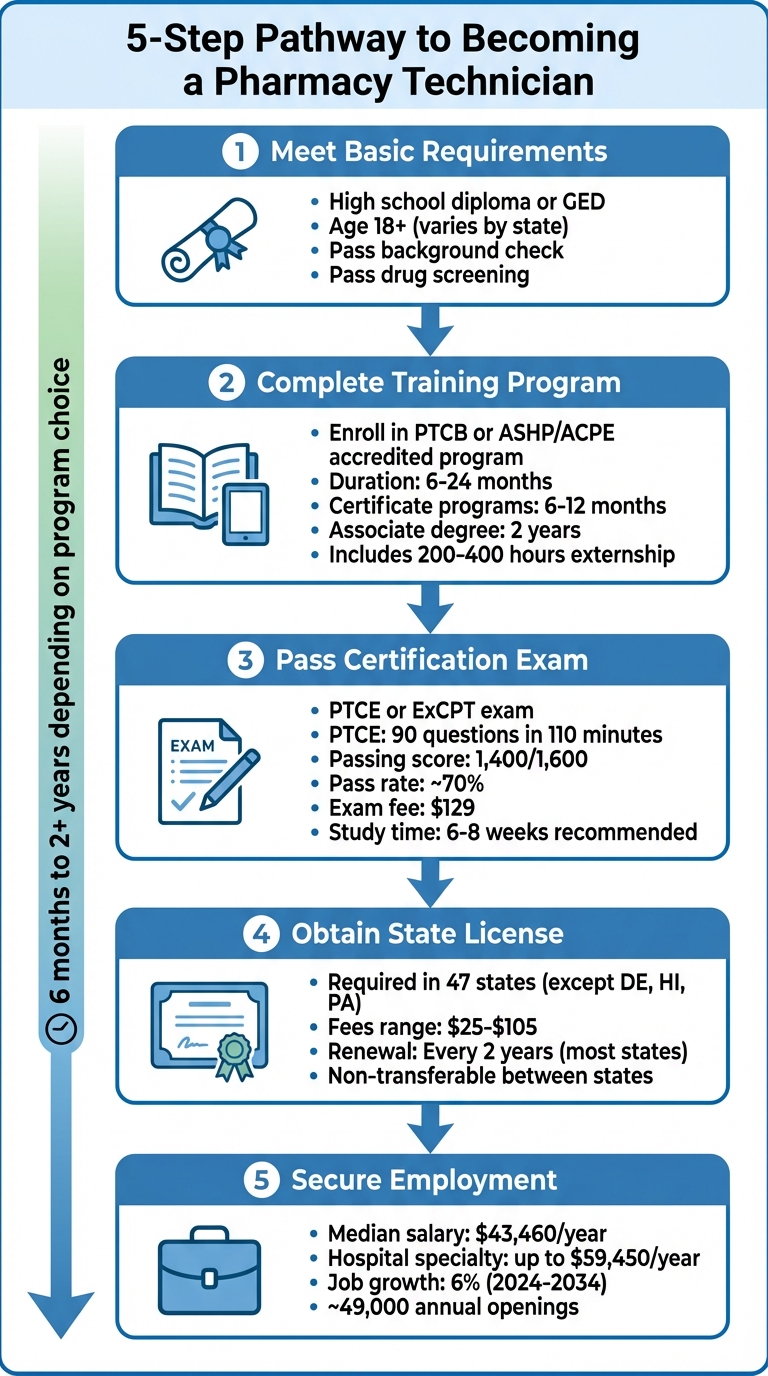
- Basic Requirements: Most pharmacy technician roles require a high school diploma or GED. Some states may also have minimum age requirements (usually 18) and require background checks and drug screenings.
- Training and Certification: Enroll in a pharmacy technician training program accredited by PTCB or ASHP/ACPE. These programs can take 6–24 months. After training, pass a certification exam like the PTCE or ExCPT.
- State Licensing: Most states require a license to work as a pharmacy technician. Licensing requirements vary, so check with your state’s Board of Pharmacy.
- Job Opportunities: Pharmacy technicians can work in retail pharmacies, hospitals, mail-order centers, and more. The median annual wage is $43,460 (as of 2024), and the field is projected to grow by 6% from 2024 to 2034.
To get started, focus on meeting educational and certification requirements, gain hands-on experience through externships or trainee roles, and tailor your job applications to highlight your skills and training.
5 Steps to Become a Pharmacy Technician: Requirements and Timeline
Basic Education and Eligibility Requirements
Educational Requirements
To start a career in pharmacy, the educational entry point is relatively accessible. At minimum, you’ll need a high school diploma or GED. While this is sufficient for some roles, many employers prefer candidates who’ve completed additional training.
"A high school diploma or equivalent is often a minimum requirement for employers looking to hire pharmacy techs." – Penn Foster
Formal training programs can make you stand out. Certificate programs generally take 6–12 months, while earning an associate degree requires about two years. If you’re aiming to become a pharmacist, though, you’ll need a Doctor of Pharmacy (PharmD) degree. This involves 6–8 years of post-secondary education, including 2–4 years of pre-pharmacy coursework in subjects like biology, chemistry, and physics.
For high school students considering a pharmacy career, it’s smart to focus on math, chemistry, and biology. Computer skills are also increasingly important as pharmacies rely more on digital systems for records and billing. Advanced Placement (AP) courses in chemistry, biology, and calculus can give you a head start on college-level classes.
Aside from academic qualifications, there are specific eligibility requirements you’ll need to meet.
Eligibility Criteria
Pharmacy roles come with additional criteria beyond education. Most states require pharmacy technicians to be at least 18 years old, though some states, like Idaho, allow 16-year-olds to work in these roles. Candidates must also have legal work authorization in the U.S., pass background and drug screenings, and, in certain states like New York, demonstrate "good moral character".
Background checks often focus on criminal history, particularly drug-related offenses, which can be a barrier to employment. Before committing to training, it’s important to confirm that your background aligns with your state’s specific regulations, as these can vary widely.
sbb-itb-7a67ffa
Required Training and Certification
Enrolling in a Certified Pharmacy Technician (CPhT) Program
To start your journey as a pharmacy technician, enrolling in a program recognized by the Pharmacy Technician Certification Board (PTCB) or accredited by ASHP/ACPE is often a requirement, as many state Boards of Pharmacy mandate this step.
Online programs are increasingly popular due to their flexibility. For example, HealthCareer Certs offers a self-paced Certified Pharmacy Technician program that you can complete in as little as 4–6 months. This course includes interactive 3D demos, quizzes, flashcards, and even one-on-one Zoom sessions. One standout feature? A guaranteed externship placement to help students gain hands-on clinical experience.
"Every qualified student is placed in an externship to build confidence, strengthen clinical skills, and graduate job-ready." – HealthCareer Certs
Before enrolling, check whether your state requires you to register as a trainee and submit supporting documents. Financial aid options are available – HealthCareer Certs, for instance, offers externship scholarships of up to $2,000 to help offset clinical training costs.
Once your training is complete, the next step is preparing for the certification exam.
Preparing for the Certification Exam
After completing your training, the certification exam becomes your main focus. The two primary exams are the PTCE (offered by the PTCB) and the ExCPT (offered by the NHA). The PTCE consists of 90 multiple-choice questions (80 scored and 10 unscored) to be answered in 110 minutes. To pass, you’ll need a score of at least 1,400 on a scale of 1,000 to 1,600. Historically, about 70% of test-takers pass.
Starting January 6, 2026, the PTCE exam blueprint has been updated. Federal Laws & Regulations, particularly the DSCSA, now account for 18.75% of the exam, up from 12.5%. Areas like Federal Requirements and Order Entry & Processing carry more weight, while Medications and Patient Safety have slightly decreased in emphasis.
Plan to dedicate 6–8 weeks to studying, using active methods like flashcards and practice questions. Focus on mastering the Top 200 Drugs, including their brand and generic names, therapeutic classes, and uses. Grouping medications by class or mechanism of action can make this easier. Additionally, sharpen your pharmacy math skills – dosing calculations, unit conversions, and concentration problems are key areas to review. Note that alligation calculations have been removed from the updated 2026 exam.
For extra practice, the official PTCE Practice Bank is available for $65 and offers over 300 questions and 400 flashcards, which can boost your exam score by about 10%. The Pre-PTCE, priced at $29, has been shown to triple your chances of passing the actual test.
When taking the exam, flag any challenging questions to revisit later. The exam fee is $129, and you can attempt it up to three times without a waiting period between attempts.
State-Specific Licensing Requirements
State Licensing Variations
After earning your certification, the next crucial step is obtaining a state license to legally work as a pharmacy technician. While certification demonstrates your expertise, a license is the official document that allows you to practice in a specific state.
As of 2024, licensing is mandatory in all U.S. states except Delaware, Hawaii, and Pennsylvania. Each state’s Board of Pharmacy sets its own rules, which can vary widely. Some states require formal education and national certification, while others only ask for registration and a high school diploma.
Most states have a few common requirements: applicants must be at least 17 or 18 years old, pass a criminal background check, and complete a drug screening. Licensing fees can also differ significantly – from $25 in Indiana to $105 in Florida. In some cases, states like Alabama charge additional fees, such as $40 for a background check on top of a $60 application fee.
"While PTCB does not set regulations for state boards of pharmacy, this map may be used for informational purposes and guidance… please contact your state board to verify any regulatory requirements." – Pharmacy Technician Certification Board (PTCB)
Licenses are non-transferable, meaning you’ll need to reapply if you move to a new state. However, it’s possible to hold licenses in multiple states simultaneously. Always check with your State Board of Pharmacy for the most up-to-date requirements.
Comparison of Requirements in Key States
Here’s a snapshot of how licensing requirements vary across several states:
| State | License Required | National Certification Required | Key Requirements | Application Fee |
|---|---|---|---|---|
| California | Yes | Yes (PTCB or NHA) | Fingerprints, background check, and application form | Not specified |
| Texas | Yes | Yes | Register as a trainee, complete state-approved training, and pass the certification exam | Varies (includes background check and fingerprinting) |
| Illinois | Yes (within 2 years) | Yes (PTCB CPhT) | Must be 16+ years old, have a high school diploma/GED, and pass a background check | $60 |
| New York | Yes | Yes | Must be 18+ years old and "of good moral character" | Not specified |
| Florida | Yes | No (requires Board-approved program) | Must be 17+ years old and complete a state-approved training program | $105 |
| Delaware | No | No | Only requires a high school diploma or GED to work | N/A |
Some states have additional, unique requirements. For instance:
- In Illinois, you can begin working without a license but must obtain one within two years.
- Louisiana mandates 600 hours of practical experience under a licensed pharmacist.
- Washington requires 8 hours of continuing education focused specifically on state law.
Most states require license renewal every two years, often tied to completing continuing education credits.
Gaining Experience and Securing Employment
Building Hands-On Experience
Once you’ve completed your certification and met state requirements, gaining practical experience becomes the next crucial step in kickstarting your pharmacy career. Externships are a fantastic way to fast-track your path to employment. Many accredited pharmacy technician programs include between 200 and 400 hours of supervised practice in settings like retail pharmacies or hospitals. These rotations aren’t just about learning – they’re an opportunity to showcase your skills to potential employers. In fact, many externs receive job offers right after completing their programs.
If you’re not enrolled in a formal program, there are still ways to gain practical experience. Look into trainee roles or volunteer opportunities at local pharmacies. Some retail chains hire entry-level candidates as "trainees" or "apprentices", offering paid training while you work toward certification. This allows you to earn an income while preparing for your future, with training periods typically lasting three to six months.
The pharmacy technician field is growing steadily, with around 49,000 job openings annually and a projected employment growth of 6.4% from 2024 to 2034. The median annual salary sits at $43,460, but those working in hospitals or specialty areas can earn as much as $59,450. Treat every externship or training opportunity as a chance to impress. Building trust with the pharmacy team during these experiences often leads to job offers once your program is complete. With hands-on experience under your belt, you can shift your focus to a targeted job search to make the most of your skills.
Job Search Tips and Strategies
Your practical training is your greatest asset when searching for your first pharmacy technician role. Start by exploring opportunities where you completed your externship – this is often the quickest route to securing employment. Beyond that, diversify your approach. Use major job boards like LinkedIn and Indeed, but don’t overlook the "Careers" sections of pharmacy chains such as CVS and Walgreens. Local grocery store pharmacies and long-term care facilities can also be excellent places to find openings that may not be widely advertised.
When applying, avoid using generic templates. Customize each application to the specific pharmacy. For example, reference their services or recent news in your cover letter to show genuine interest. Highlight the practical skills you developed during your externship, such as counting medications, processing insurance claims, or using pharmacy management software. Employers value attention to detail and strong customer service skills, so be sure to emphasize any experience you have in handling sensitive information or working under pressure.
Joining professional organizations like the American Association of Pharmacy Technicians (AAPT) or the American Pharmacists Association (APhA) can also help you access networking opportunities and job leads. Before applying, make sure you’ve completed any state-specific registration or licensing requirements through your State Board of Pharmacy, as national certification alone may not be enough. If you don’t hear back within a week or two, follow up to express your continued interest. This small step can set you apart by showing professionalism and enthusiasm. By combining your hands-on training with a strategic job search, you’ll be well-positioned to enter this growing and dynamic field.
How to Become a Pharmacy Technician in 2025 | Get Pharmacy Technician Certification Online
Conclusion
Kickstarting your pharmacy career involves meeting some basic eligibility requirements, completing accredited training, and earning your certification. To work legally as a pharmacy technician, you’ll need to obtain national certification (such as the PTCE or ExCPT) and fulfill your state’s licensing requirements.
This structured pathway isn’t just about meeting regulations – it’s about protecting patient safety. Proper training, certification, and hands-on experience are critical for minimizing errors. Did you know the FDA receives over 100,000 reports of medication errors annually? Pharmacy technicians play a key role in preventing these mistakes. As Corey Clark, Faculty at Chemeketa Community College, explains:
"Pharmacy tech is a great entryway into all health sciences – it can lay down a fantastic foundation in medications in general, which will be widely used in other medical paths".
The field of pharmacy is expected to grow, offering stable and promising career opportunities. HealthCareer Certs provides a Certified Pharmacy Technician (CPhT) program that’s entirely online and self-paced. It includes one-on-one instructor support, interactive tools, and guaranteed externship placements to give you the practical experience employers seek.
Choosing high-quality training is an investment in your future. The pharmacy industry needs skilled and certified technicians who can handle technical responsibilities while prioritizing patient care. By following the steps outlined here and committing to your education, you’ll be ready to build a fulfilling and impactful career in pharmacy.
FAQs
Can I work in a pharmacy without certification first?
In certain situations, it’s possible to work in a pharmacy without certification, particularly if your state doesn’t mandate it or if you’re stepping into an entry-level role that provides on-the-job training. That said, many states and employers either prefer or require certifications like the Certified Pharmacy Technician (CPhT) credential. To ensure you’re on the right path, it’s crucial to review your state’s specific requirements. Certification is often a smart move if you’re aiming to grow in your pharmacy career.
Which exam should I take: PTCE or ExCPT?
The PTCE (Pharmacy Technician Certification Exam), provided by the PTCB, is the most widely recognized certification exam for pharmacy technicians in the United States. While the ExCPT, offered by the NHA, is another valid option, the PTCE tends to be more broadly accepted across the country. Both exams qualify you to work as a certified pharmacy technician, but the PTCE is often the go-to choice for many professionals.
What if I move to another state – do I need a new license?
Whether you need a new pharmacy license largely depends on the regulations of the state you’re moving to. Many states require pharmacists to secure a full license, even if they already hold one in another state. However, some states offer the option to transfer your license through programs like NABP reciprocity. This process often includes passing the state’s law exam, known as the MPJE, and fulfilling other specific requirements.
Before you start practicing in your new location, it’s essential to review the licensing rules of that state. Each state has its own guidelines, so double-checking ensures you’re compliant.