Phlebotomy certification programs can take anywhere from 2 weeks to 6 months, depending on the format and intensity of the program. Here’s a quick breakdown:
- Accelerated Programs: 2–4 weeks for full-time students.
- Standard Certificate Programs: 4–12 weeks with a mix of theory and practice.
- Online/Self-Paced Programs: 4 weeks to 6 months, offering flexibility for busy individuals.
- Community College Programs: 12–16 weeks, often with additional coursework.
Factors like state requirements, externship hours, and your availability impact the timeline. For example, states like California and Washington have stricter licensing rules, requiring more extensive training. Programs with guaranteed externship placements can help streamline the process.
If you’re looking for a flexible option, online programs like HealthCareer Certs allow you to complete your certification in as little as 4 weeks, with tuition starting at $900.
Phlebotomy is one of the fastest ways to enter healthcare, with a growing demand and a median annual salary of $43,660 as of 2024.
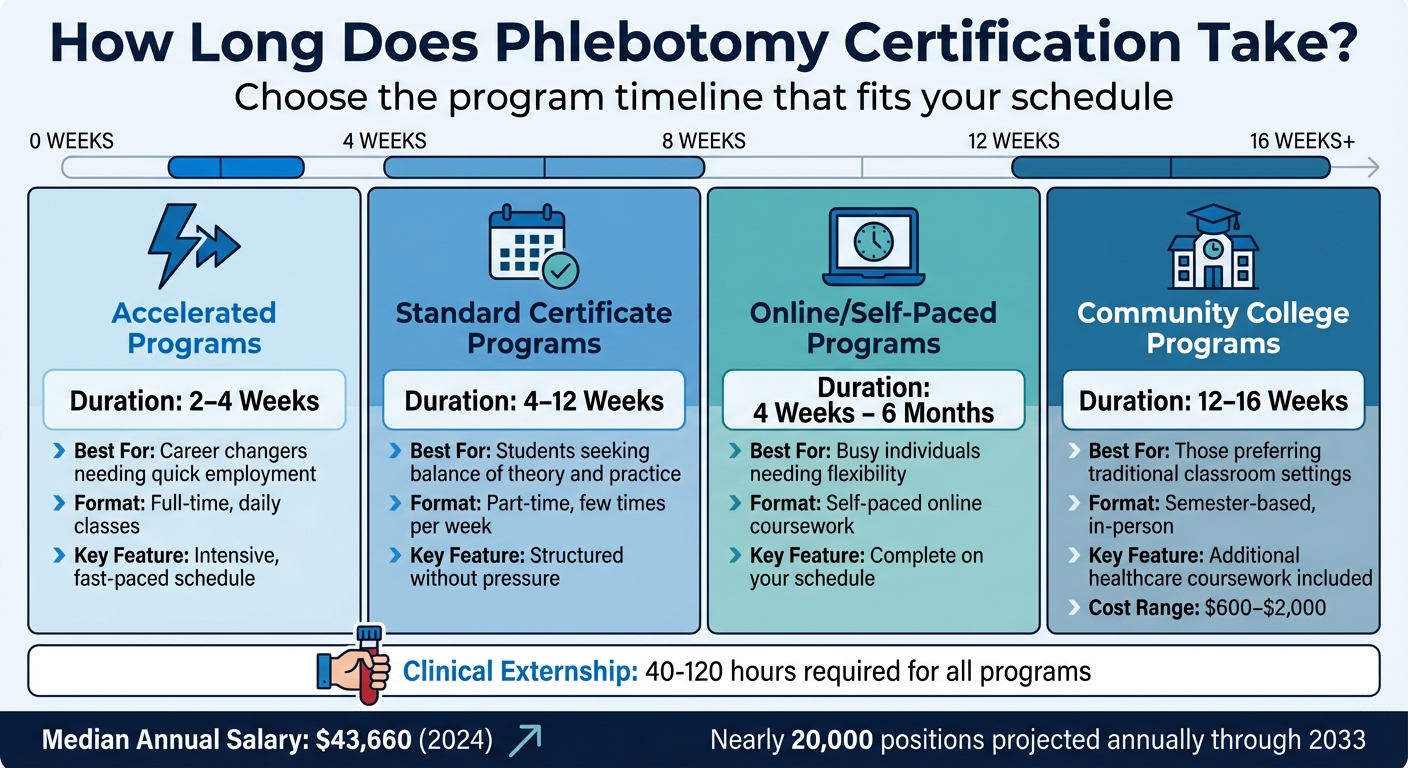
Phlebotomy Certification Program Duration Comparison Guide
How Long Does It Take To Become a Phlebotomist in 2025?
sbb-itb-7a67ffa
How Long Does Phlebotomy Certification Take?
Phlebotomy certification programs generally last between 4 and 12 weeks, though the exact timeline depends on the program’s format and intensity. Accelerated courses can wrap up in as little as 2 weeks, while community college programs may stretch to 16 weeks over a semester.
The right choice for you depends on how quickly you want to start working, your learning style, and your schedule. Full-time students can complete their training faster, while part-time learners may take longer due to other commitments.
| Program Type | Average Duration | Best For |
|---|---|---|
| Accelerated | 2–4 Weeks | Career changers needing quick employment |
| Standard Certificate | 4–12 Weeks | Students seeking a balance of theory and practice |
| Online/Self-Paced | 4 Weeks – 6 Months | Busy individuals needing flexibility |
| Community College | 12–16 Weeks | Those preferring traditional classroom settings |
Here’s a closer look at each option to help you decide what works best.
Accelerated Programs (2–4 Weeks)
Accelerated programs pack all the essential training into 2 to 4 weeks of full-time study. Expect daily classes that cover anatomy, blood collection techniques, safety protocols, and hands-on skills. These courses also include a clinical externship and exam prep. They’re ideal if you need to start working quickly and can handle an intense, fast-paced schedule. The downside? You’ll need to absorb a lot of information in a short amount of time.
Standard Certificate Programs (4–12 Weeks)
Standard programs balance classroom learning with hands-on clinical experience over a 4 to 12-week period. Classes are usually held a few times a week, giving students time to grasp theoretical concepts before applying them in practice. You’ll start with training arms for venipuncture practice before moving on to real patients during your externship. These programs are a great fit if you prefer a structured schedule without the pressure of accelerated timelines.
Online Self-Paced Programs (4 Weeks to 6 Months)
Online programs provide flexibility, allowing you to complete your training in 4 weeks to 6 months, depending on your pace. These are perfect for working professionals or parents juggling multiple responsibilities. While the coursework is online, you’ll still need to complete hands-on requirements, such as performing at least 30 venipunctures and 10 capillary sticks on live subjects. Some programs supply practice kits for at-home use or arrange externships locally to fulfill these requirements.
Community College Programs (12–16 Weeks)
Community college courses typically take 12 to 16 weeks, following a semester schedule. These programs often include additional healthcare-related coursework, such as medical terminology or healthcare fundamentals. The in-person structure is ideal for those who thrive in a classroom setting and value guaranteed clinical placements through established partnerships with healthcare providers. Costs range from $600 to $2,000, making these programs a budget-friendly option despite the longer timeline.
What Affects How Long Certification Takes
Understanding how long certification takes involves more than just knowing the average program durations. Several factors can influence your timeline, and being aware of these can help you pick a program that aligns with both your schedule and your state’s requirements.
State Training Requirements
The length of your training largely depends on your state’s regulations. California, Louisiana, Nevada, and Washington require state-specific licenses that involve more extensive training compared to the national average. For instance, California’s CPT I pathway mandates 40 hours of classroom instruction, 40 hours of supervised clinical practice, and a minimum of 50 venipunctures and 10 skin punctures. Washington takes it a step further by requiring an additional 7-hour AIDS education and training course for all applicants.
In the other 46 states, certification isn’t legally required, but it’s highly recommended. In fact, 96% of employers prefer or require certification, according to the National Healthcareer Association (NHA). These states generally follow national standards, which can be completed within 4 to 16 weeks. If you’re in a state with stricter requirements, expect your certification process to take longer, so it’s crucial to research and align your training with local regulations.
Clinical Externship Hours
Clinical externships are another key factor that can add time to your program. Depending on the certifying organization, these externships typically require 40 to 120 hours of supervised practice. During this time, you’ll need to complete a specific number of successful blood draws. For example, the NHA requires 30 venipunctures and 10 capillary punctures, while the ASCP sets a higher bar with 100 venipunctures.
Delays can occur if your program doesn’t include a built-in externship placement. Students may face weeks or even months of waiting for an available spot at a healthcare facility, or they might need extra time to complete their required draws. Programs that guarantee externship placements can help you transition smoothly from classroom learning to clinical practice, saving you time and reducing uncertainty.
Program Schedule and Student Availability
Your program’s schedule and your personal availability also play a big role in how quickly you can get certified. Full-time programs are the fastest, often wrapping up in 4 to 6 weeks with daily attendance. On the other hand, part-time or weekend programs take longer, sometimes extending to 16 weeks or more.
For maximum flexibility, self-paced online programs allow you to tailor your timeline. You could finish in as little as 4 weeks or take up to 6 months, depending on your work and family commitments. Your motivation and ability to stay on track are especially important with self-paced formats, as you control the pace of your progress.
Each of these factors – state requirements, externship hours, and program structure – can significantly impact how long it takes to become certified. By understanding these variables, you can make informed decisions about your training path.
HealthCareer Certs Certified Phlebotomy Technician (CPT) Program Timeline
Program Features
The HealthCareer Certs CPT program offers unmatched flexibility. It’s entirely online and self-paced, meaning you can access materials anytime, day or night. The curriculum is divided into 8 modules that cover essential topics like anatomy, physiology, medical terminology, law and ethics, and clinical patient care skills.
To make learning engaging, the program includes interactive tools like 3D animations, game-based activities, flashcards, and lab simulations. Plus, you’ll receive a venipuncture and IV practice kit, complete with a life-size adult practice arm featuring anatomically accurate veins. This allows you to refine your technique before working with actual patients. Another major advantage? The program guarantees externship placement, eliminating the stress of finding a clinical site. If an in-person internship isn’t an option, virtual alternatives are available to help you complete the required 30 supervised venipunctures. These features provide the ultimate flexibility for your learning journey.
How Long It Takes to Complete
The program’s flexibility allows you to tailor the timeline to your needs. You can finish in as little as 4 weeks if studying full-time or take up to 6 months with a self-paced approach. With 12-month access to all materials, you have plenty of time to manage your studies alongside other responsibilities. Once you complete the eighth module, you can start your clinical externship. How quickly you finish depends on your progress through the coursework and completing the 30 required venipunctures. With no fixed deadlines, you’re in complete control.
Exam Preparation Resources
After completing the coursework and clinical requirements, you’ll be fully prepared for the certification exam. The program includes over 1,400 practice questions, detailed study guides, and interactive flashcards. Additional tools like audio-narrated content and case study videos help reinforce your understanding. Need extra help? You can book one-on-one Zoom sessions with instructors or practicing phlebotomists. Best of all, the exam registration fee is covered in your tuition, which costs $900 upfront or two payments of $475.
Complete Timeline from Enrollment to Certification
The journey from enrollment to certification follows a clear path. Enrollment itself takes just one day once you choose an accredited program and complete your registration. From there, the timeline depends on how quickly you complete the coursework, clinical training, and certification exam. Below, you’ll find a breakdown of both accelerated and standard paths to certification.
Fast-Track Timeline (2–6 Weeks)
Accelerated programs are designed for full-time students aiming to complete their certification quickly. These bootcamps typically cover classroom instruction on topics like anatomy, safety protocols, and blood collection techniques in just 1–2 weeks. Clinical externships, which involve 40 to 100 hours of supervised practice, are usually finished in 1 to 4 weeks. Afterward, you’ll need to submit your exam application, which takes about 2 weeks to process. The exam itself lasts 2 to 3 hours, and results are available within hours or up to 2 days. This path is ideal for those who can dedicate full days to studying and gaining hands-on experience.
Standard Timeline (6–16 Weeks)
The standard path offers a more flexible schedule, allowing students to balance other responsibilities while working toward certification. These programs stretch coursework over 4 to 12 weeks, giving students more time to absorb the material. For those enrolled part-time, the timeline may extend further. Clinical externships – whether concurrent with coursework or following its completion – generally require completing 30 to 100 successful blood draws over 1 to 4 weeks. After finishing clinical training, students usually spend about 2 weeks preparing for and scheduling their exam. Once certified, many students find employment within 6 weeks, with some starting their job search before completing the program to ensure a smoother transition.
Taking the Certification Exam
The certification exam is the final step after completing clinical training. Applications should be submitted at least 2 weeks before your preferred test date. The exam itself consists of 100 to 200 multiple-choice questions and takes 2 to 3 hours to complete. Unofficial results are often available immediately, while official certification typically arrives within 2 days. The NCCT phlebotomy exam has a passing rate of about 73%. Once certified, you can begin applying for jobs, with nearly 20,000 phlebotomist positions projected to open annually through 2033.
Conclusion
Your phlebotomy certification journey offers flexibility to suit both your personal and professional goals. Whether you’re looking at a quick four-week program for full-time study or a more traditional 6–16 week schedule for part-time learning, there’s an option that can align with your availability. From self-paced online courses to structured community college programs or vocational bootcamps, the choice is yours.
For instance, HealthCareer Certs provides a fully online, self-paced CPT program that takes as little as four weeks to complete. The $900.00 tuition includes interactive learning materials, virtual externship alternatives, and even covers the certification exam fee.
Before enrolling, make sure to check your state’s licensing requirements and confirm that the program is accredited by organizations like the NHA or ASCP. States such as California, Louisiana, Nevada, and Washington have additional licensing requirements beyond national certification. Opting for programs with built-in externship placements can also streamline the process, helping you achieve the 30 to 100 successful venipunctures typically required.
With nearly 20,000 new phlebotomist positions expected each year through 2033, selecting a program that fits your schedule, budget, and learning style can help you quickly start your healthcare career.
FAQs
Do I need a state license or just national certification?
To work as a phlebotomist, a national certification is usually required. However, certain states also mandate a state license or license endorsement. It’s important to review the specific requirements in your state to make sure you’re meeting all necessary regulations.
How long does the externship usually take?
The duration of an externship can vary, usually spanning a few weeks to a few months. Many programs aim to wrap up both the training and certification process within a 3-month period. The exact timeline often depends on the program’s structure and the specific clinical requirements involved.
Can I work while getting certified?
Yes, you can work while pursuing your phlebotomy certification. Many training programs are specifically designed with flexibility in mind, offering part-time or online courses to fit around a busy schedule. Options like evening classes or online modules make it easier to manage both work and studies. Since phlebotomy training is relatively short – usually lasting 4 to 12 weeks – many students find they can quickly transition into the field shortly after completing their program.