Want to make the most of your summer? Online healthcare certifications can help you gain job-ready skills in just 4 to 12 weeks. These programs are affordable, flexible, and designed to fit into your summer schedule, whether you’re working, traveling, or interning. Plus, they offer nationally recognized credentials that boost your résumé and open doors to healthcare careers.
Key Highlights:
- Program Duration: 4–12 weeks, self-paced, online learning.
- Cost Range: $650–$2,995, with options for payment plans.
- Certifications Offered:
- Certified Clinical Medical Assistant (CCMA)
- Certified Phlebotomy Technician (CPT)
- Certified Patient Care Technician (CPCT)
- Certified Pharmacy Technician (CPhT)
- Career Benefits:
- Certified professionals earn 25–30% more.
- Healthcare industry has 1.9M job openings annually (2023–2033).
- Hands-on externships and transferable college credits included.
- Job Growth:
- Medical assistants: 14% growth by 2033.
- Phlebotomists: 23% growth by 2028.
- Pharmacy technicians: 7% growth by 2033.
These certifications are perfect for students in pre-med, pre-PA, or pre-nursing tracks, offering essential experience and qualifications to stand out in competitive fields. With online access, you can study anytime, anywhere – no need to compromise on summer plans.
Ready to kickstart your healthcare career? Let’s dive into the details.
Online Healthcare Certifications for Students
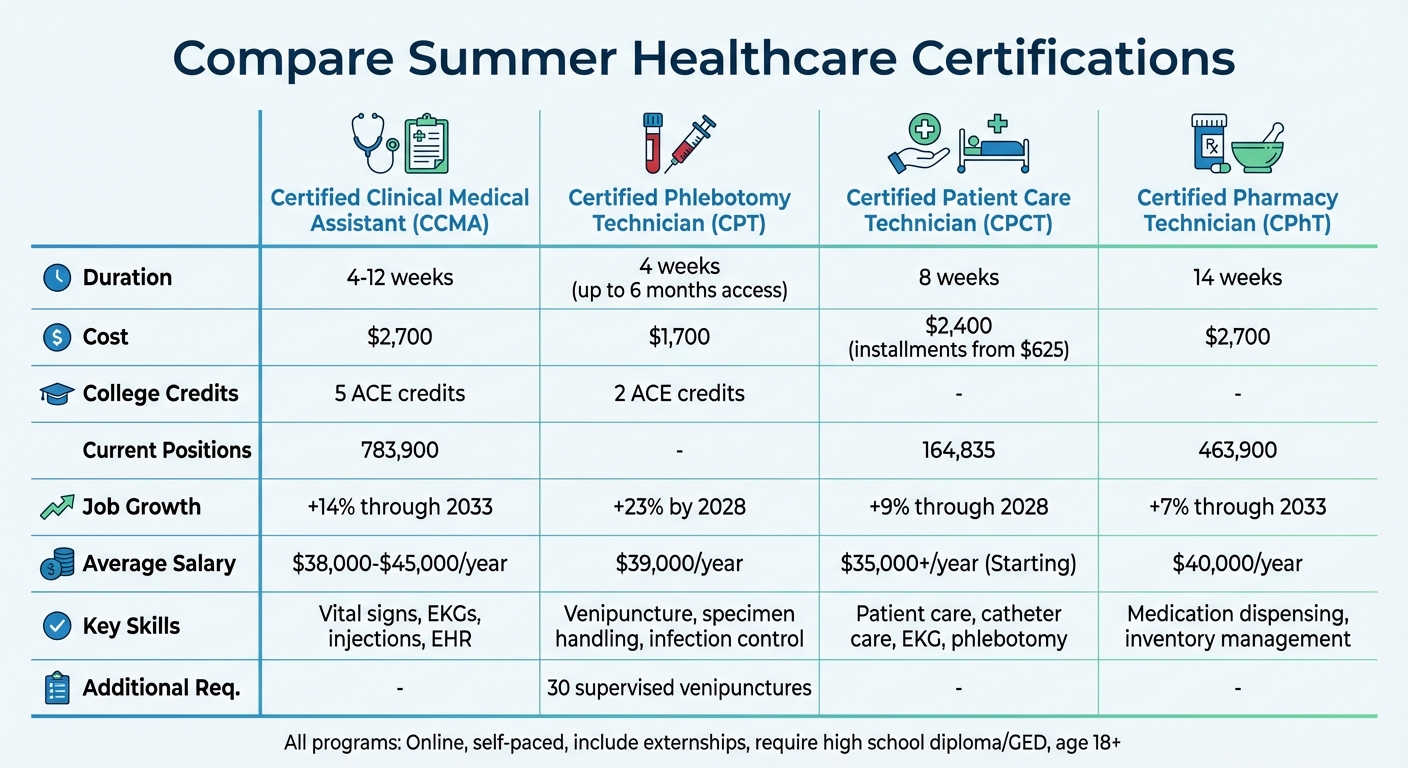
Summer Healthcare Certifications Comparison: Duration, Cost, Salary & Job Growth
HealthCareer Certs offers several online programs designed to prepare students for entry-level positions in healthcare. These programs are ideal for those looking to quickly gain the skills and certifications needed to start a career in hospitals, clinics, or specialty care facilities. No prior experience is required, and students are prepared to take nationally recognized exams that can open doors to rewarding roles in the healthcare industry.
Certified Clinical Medical Assistant (CCMA)
The Certified Clinical Medical Assistant (CCMA) program is entirely online and self-paced, allowing students to complete it within 4 to 12 weeks. The curriculum includes 18 modules covering both clinical and administrative skills. Students learn to handle tasks such as taking vital signs, performing EKGs, administering injections, managing Electronic Health Records (EHR), and understanding medical law. To enroll, students must have a high school diploma or GED and be at least 18 years old.
The program costs $2,700 and includes exam vouchers, study materials, and over 1,400 practice questions to help students pass the National Healthcareer Association (NHA) CCMA exam. Additionally, students gain hands-on experience through a guaranteed externship at local clinics. Upon certification, students earn 5 ACE college credits, which can be transferred to more than 2,000 universities. Medical assistants in the U.S. currently hold 783,900 positions, with a projected job growth of 14% through 2033. Salaries for medical assistants typically range between $38,000 and $45,000 annually.
Certified Phlebotomy Technician (CPT)
The Certified Phlebotomy Technician (CPT) program focuses on venipuncture, capillary punctures, infection control, and specimen handling. This program is also fully online and can be completed in as little as 4 weeks, with access to the coursework available for up to 6 months. Like the CCMA program, students need only a high school diploma or GED to enroll.
Hands-on learning is supported through virtual simulations and a home practice kit that includes a medical-grade practice arm. Students are required to complete 30 supervised venipunctures as part of their clinical training before taking the NHA or NCCT certification exam. Tuition for the program is $1,700, and successful graduates earn 2 ACE college credits. With a projected job growth of 23% by 2028, phlebotomists can expect to earn an average salary of $39,000 per year.
Certified Patient Care Technician (CPCT) and Certified Pharmacy Technician (CPhT)
For those interested in patient care or pharmacy operations, HealthCareer Certs offers streamlined programs for Certified Patient Care Technician (CPCT) and Certified Pharmacy Technician (CPhT) roles.
The CPCT program focuses on essential patient care duties, including bathing, feeding, catheter care, EKG readings, and phlebotomy. This program can be completed in 8 weeks and costs $2,400, with installment plans starting at $625. Students are prepared for the NHA CPCT/A exam and gain practical experience through externships in hospitals, nursing homes, or long-term care facilities. Starting salaries for patient care technicians begin at $35,000+ annually, and employment in this field is expected to grow by 9% through 2028, with 164,835 positions currently available.
The CPhT program, designed for those pursuing pharmacy technician roles, takes 14 weeks to complete and costs $2,700. The curriculum covers pharmacy operations, medication dispensing, and inventory management, preparing students for national certification exams like the PTCB or NHA. With 463,900 positions nationwide and 7% job growth projected through 2033, pharmacy technicians earn an average salary of $40,000 per year. Both the CPCT and CPhT programs include job placement support to help students transition into their new careers.
These certifications provide a fast and efficient way for students to gain valuable skills and enter the healthcare workforce, making them a great option for anyone looking to make the most of their summer break.
sbb-itb-7a67ffa
Benefits of Summer Certifications for Students
Fast-Track Learning and Career Preparation
Summer certification programs are designed to fit into a short timeframe – usually just 6 to 8 weeks. This means students can return to school in the fall with a nationally recognized credential already on their résumé. The quick turnaround allows students to move from training to employment within the same summer, with many even receiving job offers through their externship placements.
Externships are a key part of these programs, especially for pre-health students. They provide hands-on clinical experience, including practicing vital skills like phlebotomy, EKG procedures, and taking vital signs. These experiences are gained in real-world healthcare settings, working alongside professionals. Not only does this provide verified Patient Care Experience (PCE) hours, but it also strengthens applications for pre-med, pre-PA, and nursing programs. As the Clinical Skills Institute explains, "Medical assistant experience is one of the most practical clinical experiences for pre-med and pre-health students… CCMA roles offer active participation, which many medical schools value."
The self-paced, online structure of these programs makes it easier for students to balance certification efforts with work, travel, or other commitments. Completing a certification in such a short time frame also boosts their employability right away.
National Recognition and Employment Value
Accredited certifications are a game-changer for students entering the job market. Employers often require recognized credentials for entry-level positions, and certifications from organizations like the National Healthcareer Association (NHA) are highly regarded. The NHA has issued over 1 million certifications, which are accepted in all 50 states, giving students the flexibility to pursue jobs anywhere in the country. In fact, 80% to 90% of employers prefer or require medical assistants to hold certifications, making it a smart move for students aiming to stand out.
These certifications don’t just open doors – they swing them wide open. A great example is Natalie B., a Pre-PA student at the University of Oregon. In 2025, she landed a job at the Oregon Urology Institute before even completing her final course modules. Just one week after passing her certification exam on the first try, she started her new role. Reflecting on her experience, Natalie said:
"Getting a MA certificate has changed the trajectory of my career!"
Study Tips for Online Healthcare Certifications
Managing Your Study Time
Start by reviewing your course syllabus early on – it’s like your roadmap for the weeks ahead. This helps you identify when your workload will be heavier or lighter, so you can plan vacations, events, or downtime around your studies.
Try the Pomodoro Technique to stay focused: work for 25 minutes, then take a 5-minute break. It’s a simple way to keep your mind fresh and avoid burnout.
Set SMART goals each week. For example, aim to finish specific course modules or reach certain quiz scores. The beauty of online programs? You can study anytime, anywhere. Whether you’re on a road trip, relaxing at the beach, or just at home, the flexibility of 24/7 course access allows you to fit studying into your summer plans while juggling work, travel, and other priorities.
Once you’ve nailed time management, using study tools effectively can take your learning to the next level.
Making Use of Study Tools and Resources
HealthCareer Certs provides a variety of interactive tools to make studying more productive and engaging. These include 3D animations, flashcards, practice quizzes, and case study videos – all accessible through a mobile-friendly platform. As HealthCareer Certs states, "Better engagement leads to better retention and higher pass rates."
Interactive flashcards are perfect for quick study sessions during your day – whether you’re waiting in line, on a lunch break, or winding down in the evening. The platform offers over 1,400 practice questions and 700 self-check activities to help you track your progress and identify areas to improve.
If you run into challenges, don’t hesitate to ask for help. HealthCareer Certs provides one-on-one Zoom sessions with instructors and lets you connect with a personal advisor via text, call, or email. Many students praise this support system for keeping them on track. Additionally, audio narration for each page and video ensures that learners with different styles can absorb information more easily, even during longer study sessions.
Conclusion
Summer break offers the perfect opportunity to earn a healthcare certification and set yourself up for success before the fall semester begins. With programs that can be completed in just 4 to 12 weeks, you’ll have the chance to become job-ready in no time. Whether it’s the Certified Clinical Medical Assistant (CCMA), Certified Phlebotomy Technician (CPT), Certified Patient Care Technician (CPCT), or Certified Pharmacy Technician (CPhT), these certifications provide nationally recognized credentials that can lead to immediate employment and strengthen your applications to medical, PA, or nursing schools.
Thanks to the flexibility of online learning, you don’t have to put your summer plans on hold. With 24/7 access to course materials, you can study wherever you are – whether it’s at the beach, on a road trip, or from the comfort of home. Plus, these programs often include transferable college credits, helping you save both time and money on future degrees. The self-paced modules ensure you can balance your studies with your summer activities while staying on track.
The demand for healthcare workers continues to grow. For example, the Bureau of Labor Statistics projects a 23% increase in phlebotomy jobs by 2028. Additionally, certified healthcare professionals earn 25% to 30% more than their non-certified counterparts. HealthCareer Certs has already helped over 5,000 students reach their goals, boasting a 5/5 Google score and providing guaranteed externship placements to give students the hands-on experience employers look for.
If you’re looking to maximize your investment, you can bundle certifications like CCMA and CPT for $3,800, saving $600 in the process. With a $2,000 externship scholarship and flexible payment options, starting your healthcare career has never been more accessible. This summer, earning a certification could be the first step toward a rewarding future. The only question is – are you ready to take that step?
FAQs
Which certification should I choose for my career goals?
The best certification for you depends on your healthcare career aspirations. If you’re aiming for a hands-on clinical role, the Certified Clinical Medical Assistant (CCMA) certification is a solid option. It equips you with skills for tasks such as taking vital signs, assisting during exams, and performing basic lab procedures. For those seeking flexibility and a quicker path into the workforce, online, self-paced CCMA programs are worth exploring. These programs often include exam preparation and practical training, making them adaptable to a variety of schedules.
How do externships work in online programs?
In online healthcare programs, externships are usually set up at nearby clinics or healthcare facilities. These opportunities give students practical, hands-on experience in real clinical environments while they continue their online studies. During an externship, students might engage in tasks like interacting with patients, performing clinical procedures, and working alongside healthcare professionals. The flexible structure of these externships aligns with the self-paced format of online learning, ensuring students gain practical experience without disrupting their coursework.
Will these certifications count toward my college or grad school applications?
Certifications like the Certified Clinical Medical Assistant (CCMA) can add value to your applications by highlighting your healthcare expertise and commitment. Since many of these certifications are nationally recognized, they emphasize hands-on experience in the field. However, keep in mind that they don’t replace academic metrics such as GPA or test scores. Their weight varies by institution, so it’s a good idea to check with the schools you’re applying to and see how they factor these credentials into their evaluation process.