Want to boost your healthcare career while in college? Online certifications like CCMA, CPT, CPCT, and CPhT are affordable, flexible, and designed to fit into your busy schedule. These programs can be completed in as little as 4 weeks and cost between $800 and $2,000. With healthcare support roles projected to grow by 15% by 2032, these certifications open doors to entry-level jobs and higher salaries.
Key Highlights:
- Popular Certifications: CCMA (Clinical Medical Assistant), CPT (Phlebotomy Technician), CPCT (Patient Care Technician), and CPhT (Pharmacy Technician).
- Cost & Duration: Typically $800–$2,000; completion in 3–9 months.
- Career Benefits: Median salaries range from $38,000 to $54,300, with growing demand for certified professionals.
- Flexible Learning: Self-paced online programs with 24/7 access, practice tools, and externship placements.
- Extra Perks: Earn transferable ACE credits for college and gain hands-on experience through externships.
These certifications not only prepare you for immediate job opportunities but also strengthen applications for advanced healthcare programs like medical or nursing school. Programs like HealthCareer Certs make it easy to get started with features like interactive learning tools, instructor support, and guaranteed externship placements.
Ready to take the first step? Choose your certification, enroll online, and start building your healthcare career today.
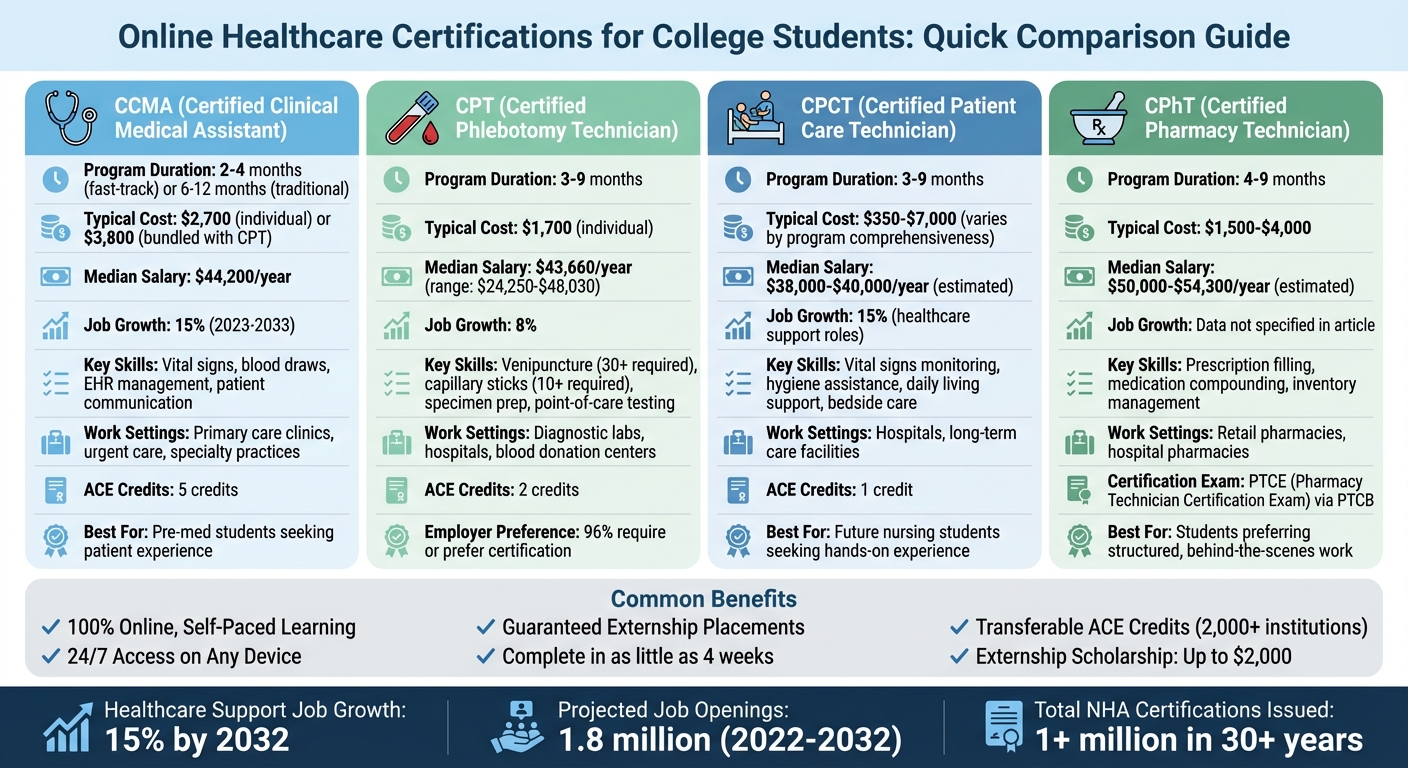
Healthcare Certification Comparison: CCMA, CPT, CPCT, and CPhT Programs
How to Become a Medical Assistant in College
sbb-itb-7a67ffa
Popular Healthcare Certifications for College Students
If you’re a college student eyeing a career in healthcare, certifications like CCMA, CPT, CPCT, and CPhT can help you get started. These programs are designed to teach practical skills for roles in clinical support, lab work, patient care, and pharmacy operations. They’re especially convenient for students, offering a direct path to entry-level jobs while balancing school commitments.
Certified Clinical Medical Assistant (CCMA)
As a Certified Clinical Medical Assistant (CCMA), you’ll gain experience in both clinical and administrative tasks. On the clinical side, you might take vital signs, assist with minor procedures, or perform blood draws. Administratively, you could be updating electronic health records or communicating with patients.
While traditional programs take 6–12 months, there are fast-track online courses that can be completed in just 2–4 months. This certification is particularly appealing for pre-med students, as medical schools often favor applicants with hands-on patient experience over those with just shadowing hours. With this certification, you can work in a variety of settings, including primary care clinics, urgent care centers, and specialty practices.
Certified Phlebotomy Technician (CPT)
If you’re good with needles and lab work, the Certified Phlebotomy Technician (CPT) certification might be a perfect fit. CPTs focus on collecting blood samples, preparing specimens, and performing point-of-care tests like glucose monitoring. To qualify for the exam, you’ll need to complete at least 30 venipunctures and 10 capillary sticks on live individuals.
This role also involves verifying patient identities, explaining procedures, and maintaining equipment. According to the 2025 Industry Outlook, 96% of employers either require or prefer certification for phlebotomy technicians. Salaries typically range from $24,250 to $48,030, and job opportunities are available in diagnostic labs, hospitals, and blood donation centers.
"I love knowing that my work is contributing to a bigger cause. With my NHA Phlebotomy Technician Certification, my patients are reassured they are in good hands." – Brea Rochon, CPT
Certified Patient Care Technician (CPCT)
For those drawn to bedside care, the Certified Patient Care Technician (CPCT) role offers a chance to work directly with patients in hospitals or long-term care facilities. CPCTs handle tasks like monitoring vital signs, assisting with hygiene, and supporting patients with daily activities. Unlike nursing, this certification focuses on basic caregiving skills without requiring a degree.
Programs generally last 3–9 months, with costs ranging from $350 for basic prep to $7,000 for more comprehensive training. This hands-on experience can be a great addition to a nursing school application, showcasing your ability to provide direct patient care.
Certified Pharmacy Technician (CPhT)
If you prefer a more structured and detail-oriented role, consider becoming a Certified Pharmacy Technician (CPhT). Pharmacy technicians work under licensed pharmacists to fill prescriptions, compound medications, and manage inventory.
Certification programs typically take 4–9 months to complete and cost between $1,500 and $4,000. To earn your certification, you’ll need to pass the Pharmacy Technician Certification Exam (PTCE) offered by the Pharmacy Technician Certification Board (PTCB). This path is ideal for students who enjoy working behind the scenes rather than in direct patient care roles.
Why Choose HealthCareer Certs for Your Certification
HealthCareer Certs has become a trusted choice for college students juggling academic responsibilities and certification goals. With over 5,000 students served and a perfect 5.0 Google rating as of early 2026, it’s clear the platform knows how to deliver results. Programs are designed to be completed in just 4 to 12 weeks, offering unmatched flexibility and support. Let’s dive into the features, externship opportunities, and accreditation that make HealthCareer Certs stand out.
Program Features and Learning Tools
HealthCareer Certs provides a fully online, self-paced learning experience accessible 24/7 on any device – desktop, tablet, or mobile. The curriculum is packed with engaging tools, including 3D animated demonstrations that simplify complex procedures, interactive flashcards, and practice quizzes. With over 1,400 practice questions and 700 self-checks, you’ll have plenty of resources to prepare confidently for your certification exam.
For clinical programs like CCMA, the platform goes a step further by shipping practice kits directly to your home. These kits allow you to practice venipuncture and injections through virtual clinical simulations. Plus, you’ll have the chance to schedule one-on-one Zoom sessions with instructors for personalized guidance. Brianna M., a biology graduate, shared her experience:
"HealthCareer Certs was overall 10 out of 10; instructors were kind and answered all my questions."
Externship Placements and Tuition Refund Policy
The program doesn’t just stop at training – it ensures you gain hands-on experience with guaranteed externship placements. Every qualified student is matched with a local hospital or clinic for real-world training, arranged by a dedicated team at no additional cost. These externships are tailored to fit your college schedule while enhancing your resume. To help cover related expenses, students can apply for an externship scholarship of up to $2,000. For those planning to pursue medical school or advanced healthcare programs, these clinical hours and professional connections can significantly strengthen your application.
Not sure about committing? HealthCareer Certs offers a 24-hour return policy. If you change your mind within 24 hours of purchase, you can request a full refund. However, refunds aren’t available after this period, so it’s important to be certain before enrolling.
Accreditation and Industry Recognition
To ensure your certification is respected in the healthcare field, HealthCareer Certs adheres to strict accreditation standards. It’s recognized by the NHA, AMCA, and PTCB, and is licensed by the New Hampshire Department of Education. Additionally, the platform awards ACE credits, which are transferable to over 2,000 institutions. This ensures your certification holds weight with employers across the country.
A standout benefit for college students is the opportunity to earn American Council on Education (ACE) credits after passing your exam. For example, you can earn 5 credits for CCMA, 2 for CPT, and 1 for CPCT. To transfer these credits, simply email collegecredits@healthcareercerts.org once you’ve passed your exam.
How to Enroll in a Certification Program with HealthCareer Certs
You can enroll online and get started right after making your payment. The process is straightforward, helping you quickly transition from signing up to diving into your training.
Step 1: Choose Your Certification
Decide on the certification that aligns with your career goals. You can pick from individual courses, like the CCMA for $2,700 or the CPT for $1,700. Alternatively, opt for a career bundle, such as the CCMA + CPT package for $3,800, which offers a cost-effective option. Most courses come with a free preview, allowing you to review the curriculum before committing. It’s also important to check your state’s licensing requirements, especially if you’re pursuing certifications like Phlebotomy, as these can vary depending on where you live.
Step 2: Complete Your Enrollment
After selecting your program, click on the "Enroll Now" button found on the course page. You’ll need to provide basic information along with a government-issued ID. Payment options include full payment or an installment plan, such as splitting the CPCT cost into two payments of $1,200 or four payments of $625. Keep in mind that refunds are only available within 24 hours of enrollment.
Step 3: Start Your Online Training
Once payment is complete, you’ll gain immediate 24/7 access to the mobile-friendly student portal. This portal includes features like 3D animated demonstrations, interactive flashcards, and lessons organized into modules. The program is entirely self-paced, meaning there are no deadlines, so you can study whenever it fits your schedule. Be sure to save the contact details for your advisor and instructor for ongoing support. Olivia, a recent graduate of the program, shared her experience:
"I was able to get certified and pass the NHA exam on the first try in only 6 weeks, and I appreciated the ease of the entire process".
Take the first step today and fast-track your journey toward a rewarding healthcare career.
Balancing Certifications with College Life
Balancing college responsibilities with certification goals might seem challenging, but with the right approach, it’s entirely doable. The flexibility of the online program makes it possible to stay on track without disrupting your college routine.
Time Management Strategies
Think of your certification as just another class in your schedule. Dedicate specific time slots each week for studying. With HealthCareer Certs’ 24/7 on-demand access, you can make the most of downtime – study between lectures, late at night after assignments, or even during your commute using the mobile-friendly portal.
The key is consistency. Many students succeed by setting regular study sessions that align with their college workload. At the start of the semester, mark your exam dates and major deadlines on a calendar. Then, pinpoint lighter weeks where you can dive deeper into your certification modules. This kind of planning ensures you stay on top of both college and certification goals.
Using Self-Paced Learning to Your Advantage
One of the biggest perks of a self-paced program is the freedom to adjust your learning speed. If midterms or a big project is looming, you can temporarily slow down your certification work. When academic breaks roll around, you can pick up the pace and make significant progress.
The 12-month access window gives you breathing room to learn at your own pace. With no rigid deadlines or scheduled lectures, you’re in full control of your study schedule. This flexibility means you can adapt your learning to fit seamlessly into your college life, reducing stress while staying productive.
Using Support Resources
The program’s support tools are designed to make your learning journey smoother. If you hit a roadblock, schedule a one-on-one Zoom meeting with your instructor instead of spending hours stuck on a difficult concept. Interactive flashcards and 3D animated demonstrations make complex medical topics easier to grasp, saving you time compared to traditional textbook methods.
Don’t forget about the six comprehensive practice tests included in your program. These tests help you identify weak areas early, so you can focus your efforts where they’re needed most. As one student, Shapri, shared:
"I am beyond excited to have found a program that not only helps further your education, but is also flexible enough to fit your schedule".
Need extra help? Your advisor’s contact details are always available in the portal. Whether it’s course navigation or exam prep, reach out via text or email for guidance whenever you need it.
Career Benefits of Online Healthcare Certifications
Earning a healthcare certification during college can give you a strong advantage in a fast-growing job market. With streamlined online programs, you can quickly gain the skills needed to tap into expanding opportunities in healthcare. In fact, healthcare occupations are expected to grow much faster than the average for all professions between 2022 and 2032, with around 1.8 million openings projected. Specifically, healthcare support jobs are set to grow by 15% by 2032, ensuring ongoing demand for certified professionals. These career benefits align perfectly with the skill-building opportunities certifications provide.
Entry-Level Job Opportunities
A healthcare certification can help you land a job right out of training. For example:
- Medical Assistants: Median annual salary of $44,200 with 15% growth projected between 2023 and 2033.
- Phlebotomy Technicians: Median annual salary of $43,660, with 8% growth expected.
- EKG Technicians: Median annual salary of $54,300, with 11% growth forecasted.
The externship component of many certification programs ensures you gain the hands-on clinical experience employers value, allowing you to start working immediately. Plus, these programs are a cost-effective way to begin your career compared to traditional college degrees.
Pathways to Advanced Careers
Certifications don’t just open doors to entry-level jobs – they also provide a solid foundation for advanced roles or further education. For students planning to pursue advanced clinical degrees, certifications like the CCMA (Certified Clinical Medical Assistant) can help fulfill clinical hour requirements for Physician Assistant (PA) or medical school applications. Programs like HealthCareer Certs even guarantee externship placements, giving you the practical experience many advanced programs demand.
Patient Care Technician (PCT) certification, for example, is often the first step toward becoming a Registered Nurse (RN). Similarly, Medical Coding specialists can transition into Health Information Management positions, while Physical Therapy Aides (with a 19% growth rate through 2033) often advance to roles as Physical Therapist Assistants or pursue a doctorate in physical therapy.
Salary Potential and Job Security
Certified healthcare professionals not only enjoy competitive salaries but also benefit from job stability. Here’s a look at some earning potentials:
- Surgical Technologists: Median annual wage of $62,250.
- Medical Interpreters: Median salary of $60,890 in healthcare settings.
- Electronic Health Records Specialists: Median salary of $50,250, with top earners making over $80,950.
- Surgical First Assistants: Top 10% earn more than $102,390.
Certification proves your expertise, often leading to higher starting salaries. As one expert from St. Louis College of Health Careers put it:
"Obtaining an education and certificate in a specific area of medicine can open career doors and make you a more attractive job candidate to employers." – St. Louis College of Health Careers
With an aging population and increasing rates of chronic illnesses, the demand for specialized healthcare technicians continues to rise, offering long-term job security for certified professionals.
Conclusion
Earning a healthcare certification during college can give you a strong advantage in the job market. Programs like CCMA, CPT, CPCT, and CPhT are tailored to fit into your busy schedule, offering 100% online, self-paced training that can be completed in as little as 4 weeks or a few months.
With healthcare support roles expected to grow by 15% by 2032, these certifications can set you up for a stable and rewarding career. Programs like HealthCareer Certs simplify the process by providing guaranteed externship placements, instructor support, and preparation for exams leading to nationally recognized credentials. Plus, you can earn American Council on Education (ACE) credits – up to 5 for CCMA, 2 for CPT, and 1 for CPCT – that are transferable to over 2,000 colleges and universities, helping you save both time and money on your degree.
Balancing work and study is made easier with flexible tools and resources. Whether you’re starting out in an entry-level position with a median salary of $40,000 to $44,200 or gaining clinical experience for PA or medical school, these certifications can help you get started right away.
The National Healthcareer Association has issued over 1 million certifications in its 30+ years of operation. Additionally, 89% of employers either require or prefer medical assistant certification.
Take the first step by choosing your certification path, enrolling in a program, and building the skills that healthcare employers are actively seeking. Visit HealthCareer Certs to explore affordable, flexible programs starting at $1,700 and kickstart your healthcare career while pursuing your degree.
FAQs
Which certification should I choose first?
The best starting certification depends on what you’re aiming for and how much time you have. If you’re looking for a fast track, Phlebotomy Technician or Certified Nursing Assistant (CNA) programs are great choices – they typically take just 4-6 weeks to complete. Want something that offers a wider range of skills? The Certified Clinical Medical Assistant (CCMA) program might be a better fit. It runs 8-12 weeks and includes training in both patient care and medical procedures. Think about your interests and availability to decide what works best for you.
Do I need an externship if the program is online?
Externships aren’t a requirement for becoming a medical assistant, but they can be incredibly useful. Many online programs include externship opportunities, giving you the chance to gain supervised, hands-on clinical experience. This practical training can help you develop the skills you’ll need in a real-world healthcare setting.
Will the ACE credits transfer to my college?
Yes, ACE credits for certifications like CCMA may transfer to your college if the program is recognized by the American Council on Education (ACE). While many colleges and universities accept these credits, it’s always a good idea to check directly with your institution to confirm their transfer policies.