
If you’re in Wisconsin and considering a career as a medical assistant, earning certification is a smart move. Certified medical assistants enjoy better job prospects, higher starting salaries (averaging $43,152), and access to roles with top employers like UW Health and SSM Health. With the healthcare job market in Wisconsin projected to grow by 19.6% through 2026, now is a great time to get started.
Key Steps to Certification:
- Complete an Accredited Program: Enroll in a one-year technical diploma program, costing around $5,659.32.
- Hands-On Training: Gain practical experience through 2,000 hours of on-the-job training and 400 classroom hours.
- Pass a Certification Exam: Choose between the CMA (AAMA) or RMA (AMT) exams, which have high pass rates in Wisconsin.
- Meet State Requirements: Pass a caregiver background check, update immunizations, and obtain CPR certification.
Certification opens doors to specialized roles like EKG Technician or Medical Office Manager and increases earning potential by up to 10%. Accredited programs like those at Madison College boast a 90% job placement rate, making certification a solid investment for your future.
For those needing flexibility, online programs like HealthCareer Certs‘ CCMA offer self-paced courses with guaranteed externship placements. Whether through in-person or online options, certification is your pathway to a rewarding career in Wisconsin’s growing healthcare sector.
Why Choose the Medical Assistant Program at Mid-State Technical College?

sbb-itb-7a67ffa
Eligibility Requirements for Certification in Wisconsin
If you’re aiming to take a national certification exam in Wisconsin, you’ll need to meet specific eligibility requirements. These guidelines ensure you’re properly educated and legally cleared to work in healthcare settings across the state.
Education Requirements
To start, you’ll need a high school diploma or GED to enroll in a Wisconsin medical assistant program. Most people then pursue a technical diploma from an accredited program, such as those offered by schools in the Wisconsin Technical College System (WTCS), including Madison College. These programs usually require 28 credits and take about a year to complete.
It’s essential to enroll in a program accredited by either CAAHEP or MAERB to qualify for national certification exams. Before diving into core courses, you’ll also need to demonstrate English and reading proficiency. This can be done through placement tests, prior coursework, or even a bachelor’s degree.
Wisconsin also offers an apprenticeship option, which combines practical experience with classroom learning. However, this route requires you to first complete the WTCS Medical Assistant diploma program.
Other Prerequisites
Beyond education, there are a few additional requirements. You’ll need to pass the Wisconsin Caregiver Background Check, which is required by law for anyone working with patients. You’ll also need Healthcare Provider CPR certification before starting clinical training.
Finally, ensure your immunizations are up to date and provide proof before beginning any hands-on patient care. These steps are crucial to ensuring both patient safety and your legal ability to work in the field.
Certification Options: CMA (AAMA) and RMA (AMT)
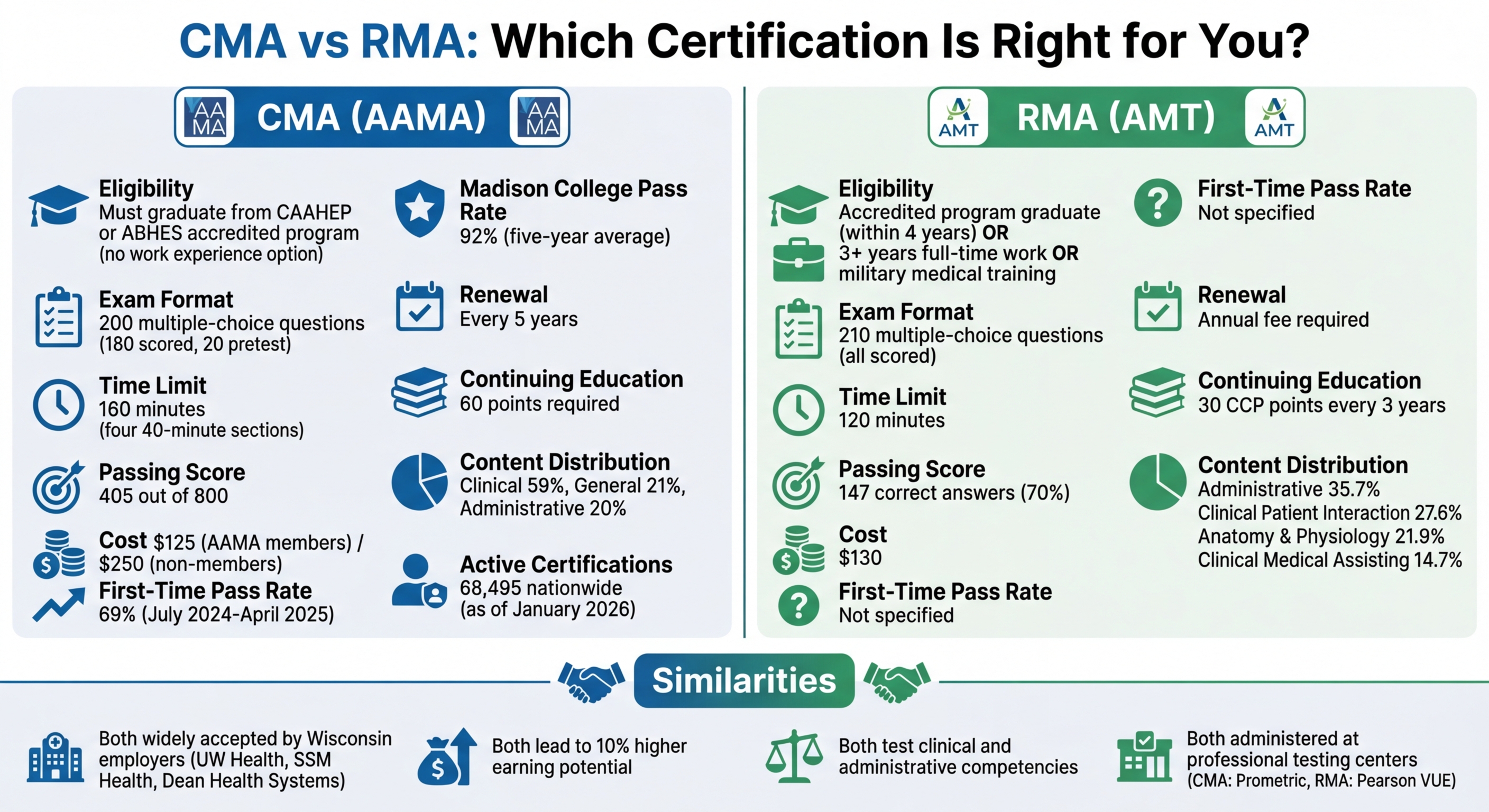
CMA vs RMA Medical Assistant Certification Comparison Wisconsin
Once you’ve met the educational and prerequisite requirements, the next step is choosing a national certification exam. In Wisconsin, medical assistants often pursue either the Certified Medical Assistant (CMA) through the American Association of Medical Assistants (AAMA) or the Registered Medical Assistant (RMA) offered by American Medical Technologists (AMT). Both certifications are widely respected by employers like UW Health, SSM Health, and Dean Health Systems.
Comparing CMA and RMA Eligibility
The main difference between these certifications lies in their eligibility requirements. To take the CMA exam, you must graduate from a program accredited by either CAAHEP or ABHES – there’s no option to qualify through work experience. On the other hand, the RMA is more flexible. You can qualify if you’ve graduated from an accredited program within the past four years, completed at least three years of full-time work as a medical assistant, or completed military medical training.
Exam Structure and Costs
Both exams are rigorous but differ slightly in their format. The CMA includes 200 multiple-choice questions and takes three hours to complete. The RMA, by comparison, has 210 questions. Exam costs also vary: the CMA fee is about $125 for AAMA members or $250 for non-members, while the RMA exam costs $130.
Renewal Requirements
For the CMA, certification renewal happens every five years and requires 60 continuing education points. The RMA, however, has an annual renewal fee and requires 30 Certification Continuity Program (CCP) points every three years. The CMA is often seen as a more rigorous credential due to its educational prerequisites, but both certifications can lead to higher earning potential. Certified medical assistants typically earn 10% more than those without certification.
Below is a closer look at each certification:
Certified Medical Assistant (CMA) by AAMA
The CMA is a great choice for graduates of accredited programs in Wisconsin. For example, Madison College’s CAAHEP-accredited Medical Assistant Technical Diploma makes you immediately eligible for this exam. The AAMA describes this credential as one that prepares individuals for a broad range of general, clinical, and administrative duties:
"The CMA (AAMA) has been educated and tested in a wide scope of general, clinical, and administrative responsibilities".
The exam is divided into four 40-minute sections, totaling 180 minutes. Scores range from 200 to 800, with a passing score of 405. Between July 2024 and April 2025, the first-time pass rate was 69%. As of January 2026, there were 68,495 active CMAs nationwide. Madison College graduates boast an impressive 92% five-year average pass rate for this exam.
If you don’t pass, you can retake the exam up to six times per year, but each attempt requires a new application and fee. Employers across Wisconsin, including Access Community Health Center, SSM Health, UW Health, and others, actively seek CMA-certified professionals. Madison College graduates reported an average starting salary of $43,152, with 91% employed within Wisconsin.
Registered Medical Assistant (RMA) by AMT
The RMA provides a more flexible pathway, especially for those with work experience but no formal education from an accredited program. You can qualify for the exam through one of three routes: graduating from an accredited program within the past four years, completing at least three years of full-time work as a medical assistant, or finishing military medical training.
The RMA exam consists of 210 multiple-choice questions and costs approximately $130. While it may not have the same level of recognition as the CMA, it’s still accepted by most healthcare employers in Wisconsin, including major health systems. The credential demonstrates your proficiency in both clinical and administrative tasks.
Renewing your RMA certification requires an annual fee and 30 CCP points every three years. This shorter renewal cycle and the lower initial cost make the RMA an appealing option for those looking to advance their careers without returning to school.
Choosing the Right Certification
Both certifications offer distinct advantages depending on your background and career goals. The CMA is ideal for those who have completed accredited programs and want a credential with stricter educational requirements. The RMA, with its more flexible eligibility criteria, suits career changers or those with significant work experience. Understanding the renewal requirements and long-term benefits of each option can help you make the best decision for your future in Wisconsin.
HealthCareer Certs CCMA Program for Wisconsin Residents
The HealthCareer Certs CCMA program offers a fully online, flexible learning option designed specifically for Wisconsin residents. With a mobile-friendly platform available 24/7, the program allows you to progress at your own pace. Most students complete the course in 4–12 weeks, though you can take up to six months if needed.
Program Highlights
The program includes 18 modules that focus on both clinical and administrative skills, such as phlebotomy, EKG, medical law, and patient care coordination. To help you prepare for the NHA CCMA exam, the course provides:
- Over 1,400 practice questions
- Six practice tests
- 700 self-checks
Tuition covers everything you need – NHA exam fees, study materials, interactive flashcards, and 3D animated demonstrations. There’s no need for extra textbooks or hidden costs.
One standout feature is the guaranteed externship placement. Every qualified student gets hands-on clinical experience at a Wisconsin hospital or clinic. Plus, an Externship Scholarship of up to $2,000 is available to help offset training expenses. After passing the CCMA exam, you’ll earn 5 ACE credits, which can be transferred to over 2,000 colleges and universities. With a perfect 5/5 Google rating from more than 5,000 students, this program is a strong stepping stone into Wisconsin’s healthcare field.
Enrollment Process
Getting started is simple. Head to the HealthCareer Certs website, find the CCMA course page, and preview the course for free. When you’re ready, choose your payment option and click "Enroll Now." Once registered, you’ll gain instant access to all course materials for 12 months.
There’s also a 24-hour money-back guarantee. If you cancel within 24 hours after accessing the first lesson, you’ll receive a full tuition refund (minus any non-refundable registration fees).
Accredited Training Programs and Online Courses in Wisconsin
Finding Accredited Programs in Wisconsin
The Wisconsin Department of Workforce Development (DWD) has an Eligible Training Programs List (ETPL) to help you find state-recognized medical assistant programs. This searchable database makes it easier to locate programs across Wisconsin. Make sure to confirm the accreditation status of any program directly with the provider.
Accreditation is crucial because it determines whether you qualify to take national certification exams. For example, if you’re aiming for the CMA (AAMA) credential, look for programs accredited by the Commission on Accreditation of Allied Health Education Programs (CAAHEP). A good example is Madison College’s hybrid Medical Assistant Technical Diploma. This program is CAAHEP-accredited, costs about $5,659.32 for 28 credits, and boasts impressive certification exam pass rates and job placement statistics.
Before enrolling, check for additional requirements like background checks, immunizations, and CPR certification. Keep in mind that some programs in the Wisconsin Technical College System may have waitlists ranging from a few months to a year, so plan ahead.
Online Learning Options
For those needing more flexibility, online programs are another excellent option. The University of Wisconsin-Green Bay offers an online Certified Clinical Medical Assistant (CCMA) program through its Division of Continuing Education and Community Engagement. This program includes the certification exam voucher in its tuition cost and covers a wide range of skills, such as medical terminology, HIPAA compliance, vital signs, laboratory testing, and phlebotomy.
Before signing up for an online course, ensure your computer meets the program’s technical requirements. Also, pay close attention to refund policies – some programs offer full refunds only within the first 10 calendar days of the start date, while others may have different terms.
These in-person and online training options provide the tools you need to prepare for certification exams and build a successful medical assisting career in Wisconsin.
Preparing for and Passing the Certification Exam
Exam Content and Format
Once you’ve chosen between CMA and RMA certification, understanding the exam structure is key to effective preparation. Here’s a breakdown of what to expect:
The CMA (AAMA) exam includes 200 multiple-choice questions, divided into four 40-minute sections, for a total of 160 minutes. Only 180 questions are scored; the remaining 20 are unscored pretest items. To pass, you need a scaled score of 405 out of 800. Clinical competency is the largest focus, making up 59% of the total score, followed by general domains (21%) and administrative tasks (20%).
The RMA (AMT) exam features 210 multiple-choice questions, all of which must be completed within two hours. This gives you about 34 seconds per question. A passing score requires correctly answering at least 147 questions (70%). The content distribution is different from the CMA exam: Administrative Medical Assisting accounts for 35.7%, Clinical Patient Interaction for 27.6%, Anatomy and Physiology for 21.9%, and Clinical Medical Assisting for 14.7%.
Both exams have competitive first-time pass rates and are administered at testing centers – CMA exams are typically held at Prometric locations, while RMA exams are conducted through Pearson VUE.
With these details in mind, you can tailor your preparation to meet the demands of each exam.
Study Resources and Tools
Once you understand the exam format, plan to dedicate 55–65 hours of focused study over 4–6 weeks. Allocate your time strategically: spend about 55% on clinical topics, 22% on general domains, and 18% on administrative content. Key clinical areas to prioritize include vital signs, injection techniques (e.g., intradermal, subcutaneous, intramuscular), wound care, and CLIA-waived lab tests.
Leverage official study materials from the certifying organizations. For example:
- The AAMA offers a practice exam for $30.
- AMT provides practice exams priced around $175.
Additionally, third-party resources like Kaplan’s Medical Assistant Exam Prep: Your All-in-One Guide to the CMA & RMA Exams (about $25.50 on Amazon) can be a great supplement. Online platforms such as ExamEdge and OpenExamPrep also offer tools to enhance your preparation. OpenExamPrep, for instance, provides a free 2026-updated study course with an AI tutor rated 4.8 out of 5.
Timed practice tests are invaluable. Use your results to identify weaker areas and focus your efforts there. On exam day, arrive at least 30 minutes early with two forms of ID – one must be a government-issued photo ID and the other must include your signature. Take advantage of the optional 15-minute tutorial to get comfortable with the testing software.
State Regulations, Background Checks, and Certification Renewal
Wisconsin State Requirements
In Wisconsin, practicing as a medical assistant involves more than just meeting educational and exam benchmarks – it’s equally important to understand the state’s regulations. While medical assistants in Wisconsin aren’t individually licensed, they operate under the direct supervision of a physician, who assumes legal responsibility for their actions.
Oversight comes from the Wisconsin Medical Examining Board (MEB) and the Department of Safety and Professional Services. However, medical assistants are not classified as a separately licensed profession. Authorized clinical tasks – like drawing blood, administering medications, recording vital signs, and preparing patients for exams – must be carried out under the direction of a physician.
Before starting a training program or clinical practicum, Wisconsin law requires caregiver background checks, proof of immunizations, and Healthcare Provider CPR certification. Additionally, employers must ensure that medical assistants operate within their legal scope of practice and maintain current certifications. To help manage this, many healthcare facilities use automated systems to track certification renewal deadlines and prevent lapses.
With these requirements in mind, staying up to date with your credentials is a key part of working as a medical assistant in Wisconsin.
Renewing Your Certification
Since Wisconsin doesn’t issue state-level licenses for medical assistants, certification renewal is tied to your national credential. Depending on whether you hold the Certified Medical Assistant (CMA) credential from AAMA or the Registered Medical Assistant (RMA) credential from AMT, the renewal process and continuing education requirements will vary.
Employers play a vital role in ensuring certifications remain valid, often using centralized systems to monitor expiration dates. However, it’s your responsibility to stay on top of renewal deadlines. Being proactive not only ensures compliance with state and employer requirements but also supports your career growth and ability to work within your legal scope of practice.
Conclusion
If you’re aiming to become a certified medical assistant in Wisconsin, the steps are clear: earn your high school diploma, complete an accredited program or apprenticeship, and pass a recognized certification exam. These foundational steps set you on the path toward a rewarding healthcare career.
According to recent data, the top training programs in Wisconsin boast a 92% exam pass rate and a 90% job placement rate. These numbers highlight how thorough preparation can lead to real success in both certification and employment.
For those seeking flexibility, HealthCareer Certs’ CCMA program offers a fully online, self-paced option tailored to Wisconsin residents. This program not only prepares you for the certification exam but also guarantees externship placements, allowing you to transition quickly into the workforce upon completion.
Whether you opt for a technical diploma through the Wisconsin Technical College System, an apprenticeship, or an online certification program, earning your certification is a crucial step. It validates your expertise in clinical and administrative tasks, giving you a competitive edge in Wisconsin’s healthcare job market. With the right training and certification, you’ll be ready to work under physician supervision in various healthcare environments across the state.
Take the first step today by exploring accredited programs that fit your schedule and career aspirations. Your journey toward a fulfilling career in Wisconsin’s healthcare sector starts here.
FAQs
Do I need state licensure to work as a medical assistant in Wisconsin?
State licensure isn’t a requirement for medical assistants in Wisconsin. However, if you’re aiming for specific roles in the field, you’ll need to pass a certification exam to qualify.
Which certification should I choose in Wisconsin: CMA (AAMA) or RMA (AMT)?
In Wisconsin, the CMA (AAMA) and RMA (AMT) credentials are both nationally recognized and can improve job prospects in the medical field. Employers often lean toward the CMA due to its alignment with professional standards and the potential for broader career opportunities. However, the RMA is also valued as it reflects a strong level of competency. While certification is not mandatory in Wisconsin, earning either credential can open doors depending on your career goals and what local employers prioritize.
How can I get clinical experience if I complete an online medical assistant program?
After finishing an online medical assistant program in Wisconsin, you can build real-world skills through a Medical Assistant Apprenticeship. This opportunity offers a mix of paid on-the-job training – totaling at least 2,000 hours – and over 400 hours of related classroom instruction. During the apprenticeship, you’ll handle tasks like taking vital signs, drawing blood, and preparing patients, all under supervision. It’s a great way to gain practical experience while starting your career.