To work as a medical assistant in Washington State, you must hold a valid credential issued by the Department of Health (DOH). Here’s a quick breakdown of the process:
- Credential Types: Washington offers five credential options, with the Medical Assistant-Certified (MA-C) being the most versatile.
- Key Steps: Complete an accredited training program (720 hours + 160-hour externship), pass a national certification exam, take a 7-hour HIV/AIDS course, and submit a $115 state application.
- Certification Benefits: MA-C credential holders can perform advanced clinical tasks, work statewide (not tied to one employer), and enjoy broader career opportunities.
- Renewal: Credentials must be renewed every two years for $110, with no continuing education requirements.
This guide covers everything you need to know, from eligibility to application and renewal.
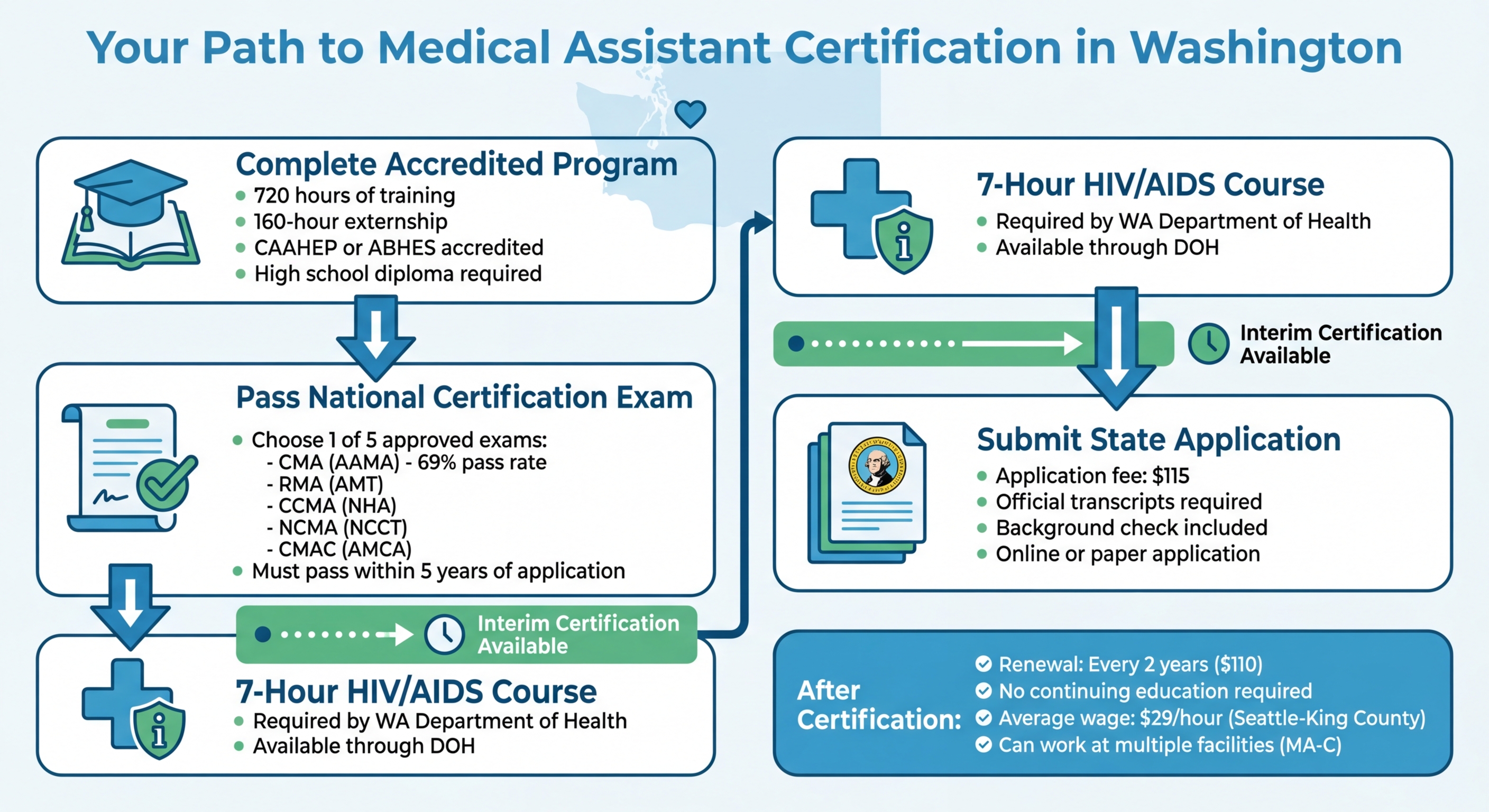
Medical Assistant Certification Process in Washington State
Medical Assistant Apprenticeship with Providence Health Care

sbb-itb-7a67ffa
Education Requirements and Training Program Selection
To pursue the MA-C credential – or similar roles like Medical Assistant-Registered, Phlebotomist, or Hemodialysis Technician – you’ll need a high school diploma (or equivalent) and must complete an accredited training program.
Accreditation Standards Explained
Accreditation plays a key role in qualifying for state certification. In Washington, the recognized accrediting bodies for medical assistant programs are CAAHEP (Commission on Accreditation of Allied Health Education Programs) and ABHES (Accrediting Bureau of Health Education Schools). These organizations ensure that programs meet curriculum standards, maintain instructional quality, and prepare students for national certification exams.
If your program isn’t accredited by CAAHEP or ABHES but has accreditation from another organization recognized by the U.S. Department of Education, it must meet these criteria:
- Include at least 720 clock hours of medical assisting training.
- Provide a 160-hour externship.
- Cover all clinical duties outlined in RCW 18.360.050 to gain approval from the Secretary of Health.
Before enrolling, check if the school sends official transcripts directly to the Washington Department of Health. Self-submitted or unsealed transcripts won’t be accepted. Additionally, registered apprenticeship programs administered by the Washington State Department of Labor and Industries may be accepted if they meet state standards.
Once accreditation is confirmed, choose a training format that best fits your schedule and career objectives.
Training Program Formats: Traditional, Online, and Hybrid
Traditional programs at community colleges or vocational schools provide in-person instruction and access to physical simulation labs. For instance, Seattle Central College offers a full-time, 4-quarter certificate program with a dedicated simulation lab. Known for its high exam pass rates and positive graduate feedback, the program accepts applications from March to June for Fall starts and September to December for Spring starts.
Hybrid and online programs are ideal for those balancing work or family responsibilities. While coursework can often be completed online, all valid programs must include an in-person clinical component to meet Washington’s 160-hour externship requirement. If you choose a hybrid format, make sure the school has partnerships for externship placements and that the schedule works with your availability. It’s also a good idea to gather immunization records and titers early, as these are mandatory for the clinical portion of your training.
How to Evaluate Program Quality
Once you’ve reviewed accreditation and training formats, take a closer look at program quality by considering exam preparation, externship support, and costs.
Check if the program prepares students for one of the five state-approved national exams: AAMA (CMA), AMT (RMA), NHA (CCMA), NCCT (NCMA), or AMCA (CMAC). Confirm that externship support meets the 160-hour requirement and find out if the school helps secure placements or if you’ll need to arrange this yourself.
Factor in additional expenses like $107 for compliance services and $115 for the initial state application. Compare these costs with the local average wage for Medical Assistants, which is approximately $29 per hour in Seattle–King County.
Eligibility Criteria and Prerequisites
Once you’ve completed your training, it’s essential to ensure you meet the necessary eligibility criteria before applying for certification.
Basic Eligibility Requirements
To apply for certification, you must fulfill a few baseline requirements. First, you need to confirm that you have at least a high school diploma or equivalent. Additionally, you must complete a training program that aligns with Washington’s state standards. Finally, passing a state-approved national exam is a mandatory step in the process.
Washington’s 7-Hour HIV/AIDS Training Requirement
The Washington State Department of Health includes AIDS Training Resources as part of the credentialing process for medical assistant applicants. Depending on the certification pathway you choose, you may need to complete a 7-hour HIV/AIDS training program. This training is available through the Department of Health (DOH), so it’s a good idea to confirm the requirement with your training program or directly with the DOH.
Out-of-State Credential Verification
If you have healthcare credentials from another state, there are additional steps you’ll need to take to verify them.
For applicants who currently hold or have previously held credentials in another state, it’s necessary to disclose this information on your Washington application. This applies even if you applied for a credential in another jurisdiction and were not granted one. A Credential Verification form must be sent directly from the licensing board of the other state. Additional steps include completing a fingerprint background check and paying any applicable fees.
Out-of-state training programs must also meet Washington’s standards, which include a minimum of 720 training hours and a 160-hour externship. Military training or experience typically fulfills these requirements unless the Secretary of Health decides otherwise. If you’re a military spouse or registered domestic partner, you may qualify for expedited processing. Applicants without a Social Security number should submit a paper application for certification.
Certification Exams and Exam Preparation
Once you meet the eligibility criteria, the next step is preparing for and passing the required certification exam. Here’s what you need to know about the approved exams and how to get ready.
5 Approved Certification Exams in Washington
The Washington State Department of Health has approved five national certification exams for those seeking the Medical Assistant-Certified (MA‑C) credential. To qualify, candidates must pass one of these exams within five years before applying. The approved exams include:
- CMA (AAMA) – American Association of Medical Assistants
- RMA (AMT) – American Medical Technologists
- CCMA (NHA) – National Healthcareer Association
- NCMA (NCCT) – National Center for Competency Testing
- CMAC (AMCA) – American Medical Certification Association
The CMA (AAMA) exam, for example, includes 200 multiple-choice questions scored on a scale of 200 to 800. A passing score is 405 or higher. Between July 2024 and April 2025, 4,171 candidates took the exam, with a first-time pass rate of 69%. As of January 5, 2026, there were 68,495 active CMAs (AAMA).
It’s important to note that exam scores must be sent directly from the testing organization to the Department of Health – personal copies won’t be accepted. Knowing the exam details is the first step in preparing effectively.
Study Resources and Preparation Strategies
Preparation starts with using the official content outlines provided by the certifying boards. For instance, the American Association of Medical Assistants offers a comprehensive outline for the CMA (AAMA) Certification Exam. This exam takes 180 minutes, divided into four 40-minute sections, with 20 minutes allocated for administrative tasks. Candidates receive immediate pass/fail feedback, and official score reports are available within 24 hours.
If you don’t pass on your first attempt, don’t worry – you can retake the CMA (AAMA) exam up to six times per year. However, each attempt requires a new application and fee. To stay eligible, be sure to apply for the state credential within five years of passing the national exam.
For those who need extra time to prepare, there’s an option to start working under interim certification.
Interim Certification for Recent Graduates
Recent graduates who have finished their training but haven’t yet passed the certification exam can apply for interim certification. This allows them to begin working immediately while they prepare for reexamination. Interim certification provides the same scope of practice as a fully certified medical assistant and is valid for up to one year or until the exam is passed.
Keep in mind, interim certification is non-renewable. It expires either after one year or upon passing the exam, whichever comes first. The application fee for interim certification is $115.
This temporary solution can help bridge the gap between completing training and earning full certification, allowing graduates to gain valuable experience while they finalize their credentials.
Application Process and State Certification
Once you’ve passed your certification exam, it’s time to apply for your official Washington State credential. While the process requires careful attention to deadlines and documentation, following the steps closely can simplify things.
Required Documentation Submission
Start by submitting the necessary documents to the Department of Health (DOH). Official transcripts must be sent directly from your educational institution in a sealed envelope, confirming your program completion date. Additionally, you’ll need to provide proof of passing one of the five approved exams within the past five years. These scores must come straight from the testing organization to the DOH.
If you were credentialed in another state, include verification forms for those credentials. You’ll also need to confirm that you’ve completed high school or an equivalent education. For applicants who answer "yes" to questions about criminal history or professional liability claims, a written explanation and supporting legal or medical documents are required. To avoid delays, request your transcripts as early as possible since applications won’t proceed until all required documentation is received. These steps form the foundation of your certification process.
Completing the State Application
Washington State provides two application options. The online portal through SecureAccess Washington (SAW) is the faster route, but it requires a Social Security Number (SSN) and that you answer "no" to questions about criminal history, substance abuse, or conditions affecting your ability to practice. If you don’t have an SSN or need to answer "yes" to any of these questions, you’ll need to use the paper application instead.
Once your application is submitted, you can find your pending credential number using the DOH’s "Provider Credential Search" tool. This number is essential for any future correspondence. If you’re applying for the Medical Assistant-Registered credential, you can work for up to 60 days while your application is being processed, provided you submit it within seven days of starting your job. For Medical Assistant-Phlebotomist and Hemodialysis Technician roles, the work-while-pending period extends to 180 days after filing. Be sure to review the application fees and background check requirements to complete the process.
Application Fees, Background Checks, and Processing Times
After your documentation is accepted, you’ll need to address the financial and background check requirements. The application fee is $115 for Medical Assistant-Certified (MA-C) and $145 for Medical Assistant-Registered (MA-R). Online applications include an additional convenience fee, and all fees are non-refundable.
All applicants undergo an automatic background check. If you’ve lived out of state or have a criminal record, a fingerprint-based background check through the Washington State Patrol and FBI will be required, and you’ll need to cover the cost.
"Washington State law authorizes the Department of Health to obtain fingerprint-based background checks for licensing purposes. This check may be through the Washington State Patrol and the Federal Bureau of Investigation (FBI)."
If fingerprints are necessary, the DOH will send you instructions. The processing timeline largely depends on how quickly you respond to any DOH requests for additional information. To avoid delays, monitor your email closely and reply promptly. Keep in mind that if the 60-day or 180-day work-while-pending period ends before your credential is issued, you must stop working until it’s officially granted.
Certification Maintenance and Renewal
Once you’ve earned your certification, staying informed about the renewal process is key to keeping your credentials active and advancing your career. These renewal steps ensure your qualifications remain valid and help you maintain forward momentum in your profession.
2-Year Renewal Requirements
In Washington, medical assistant credentials expire every two years on your birthday. The renewal period begins 90 days before your expiration date, giving you ample time to submit your application. Starting January 1, 2025, all healthcare professionals must also complete a demographic data survey as part of the renewal process.
Washington has shifted to a fully digital system. As of May 1, 2025, paper notices and certificates are no longer issued. Instead, you’ll receive email notifications, and your certificate will be accessible via the HELMS portal. To stay updated, it’s essential to keep your email address current.
The table below outlines renewal fees and late penalties. Active military personnel are exempt from these fees if they submit their service orders annually.
| Credential Type | Renewal Fee | Late Penalty |
|---|---|---|
| MA‑Certified | $110 | $60 |
| MA‑Registered | $145 | $75 |
| MA‑Phlebotomist | $110 | $60 |
| MA‑Hemodialysis | $110 | $60 |
You can renew online through the HELMS portal using your Secure Access Washington (SAW) account, which updates your credential immediately. Alternatively, mail-in renewals take about two weeks, while payments made in person at the Tumwater location are processed within three to seven business days. If you choose to pay online with a credit card, a 2.5% convenience fee applies. However, using ACH electronic check payments avoids this fee.
Continuing Education Hours and Approved Courses
Washington State does not require continuing education hours for medical assistant credential renewal.
"No, there are no continuing education requirements for renewal of any of the medical assistant credentials in Washington."
- Washington State Department of Health
While a national certification exam is mandatory for initial licensure, maintaining that certification is not required for state renewal. However, if you wish to keep a national title, like CMA through the AAMA, you must meet that organization’s separate requirements, such as earning 60 CEUs every 60 months.
With minimal state renewal requirements, you can focus on broadening your clinical skills and opportunities.
Scope of Practice and Career Growth Opportunities
Holding a Medical Assistant‑Certified credential gives you the widest scope of practice in Washington. Recent changes in legislation (Engrossed Substitute House Bill 1073) now allow certified medical assistants to start intravenous lines and administer injections for diagnostic or therapeutic purposes under direct visual supervision. In contrast, Medical Assistant‑Registered holders are limited to tasks explicitly approved by their employer.
The Medical Assistant‑Certified credential offers greater flexibility by enabling you to work at multiple facilities without needing separate credentials for each employer. On the other hand, the Medical Assistant‑Registered credential is tied to a specific employer and becomes invalid if you leave that job. In such cases, you must notify the Department of Health within 30 days of leaving your endorsing employer.
Since 2021, medical assistants can also be supervised during telemedicine visits via interactive audio and video technology, provided the supervising practitioner actively participates in the session with the patient. Additionally, Washington has introduced the Medical Assistant‑Emergency Medical Technician (MA‑EMT) credential for EMTs or paramedics who want to work in hospital settings.
Conclusion
Getting your medical assistant certification in Washington sets you up for a fulfilling career in healthcare. The process is straightforward: complete an accredited program (which includes 720 hours of training and a 160-hour externship), pass an approved exam, and submit a $115 application fee. If you’re a recent graduate, you can even start working right away using the interim certification option while you prep for your exam.
This certification does more than just meet legal requirements. The MA‑Certified credential allows you to perform additional tasks, like starting IV lines, and work across multiple facilities – something the employer-specific MA‑Registered credential doesn’t offer.
The career outlook is promising, with strong national job growth and competitive pay. Washington also makes it easy to maintain your certification, requiring only a $110 renewal fee every two years and no continuing education requirements.
FAQs
Which Washington medical assistant credential should I choose?
In Washington State, the go-to credential for medical assistants is the Medical Assistant – Certified (MA-C). To qualify, you’ll need to pass an approved exam, provide transcripts and proof of program completion, and clear a background check. The process also involves submitting an application to the Department of Health. This certification is widely recognized as the standard route for medical assistants aiming to practice in Washington.
Can I qualify in Washington with out-of-state training or certification?
In Washington, you can’t qualify without completing the required training or obtaining certification. The state mandates that applicants meet specific credentialing standards and submit official transcripts or proof of completed training to demonstrate compliance with these requirements.
How long does the MA-C process take from school to credential?
Earning the Medical Assistant–Certified (MA-C) credential in Washington is a multi-step process that usually spans several weeks. After finishing your program, your first step is to set up a profile with the NCCT. Then, submit your exam application, including your transcripts and fees, and schedule your exam – this requires at least two weeks’ notice. Once you pass the exam, you’ll need to send your official transcripts to the Washington State Department of Health and apply for the credential. Be sure to account for processing time during this final step.