Here’s what you need to know:
- Certification is not required by Texas law, but most employers prefer or demand it.
- Top certifications include CMA (AAMA), CCMA (NHA), and RMA (AMT).
- Training programs accredited by CAAHEP or ABHES are essential for taking national exams.
- Texas employed 72,280 medical assistants in 2024, with job growth expected at 25% from 2022 to 2032.
- Median salary is $38,930, with higher pay in cities like Austin ($45,220) and Houston ($42,930).
- Certification boosts job opportunities and can increase earning potential by up to 35%.
- Training options include online (cost: $1,250–$3,250) and in-person programs ($3,900–$4,500), both requiring clinical externships.
Quick Steps to Certification:
- Earn a high school diploma or GED.
- Complete an accredited medical assistant program.
- Pass a national certification exam (like CMA, CCMA, or RMA).
- Maintain certification with continuing education (renewal timelines vary by organization).
Certification isn’t just a credential – it’s a pathway to better pay and more career opportunities in one of Texas’s fastest-growing fields.
Texas Certification Requirements for Medical Assistants
Basic Eligibility Requirements
If you’re aiming to become a medical assistant in Texas, there are a few key steps to get started. First, you need a high school diploma or GED, and you must be at least 17 years old. Next, you’ll need to complete an accredited medical assisting program. Programs approved by either the CAAHEP (Commission on Accreditation of Allied Health Education Programs) or ABHES (Accrediting Bureau of Health Education Schools) are essential for earning credentials like the CMA (AAMA) or RMA (AMT). Additionally, many clinical externship sites require a clean background check and current immunizations before you can begin hands-on training. These steps lay the groundwork for entering the profession and understanding how certification works in Texas.
How Texas Differs from Other States
Texas stands out when it comes to regulations for medical assistants. Unlike many other states, Texas does not mandate state licensing, registration, or certification for medical assistants. Instead, under Texas law, medical assistants are considered "qualified and properly trained persons" who operate under the supervision and delegation of licensed physicians or nurses. This means that tasks like administering medications, performing EKGs, or drawing blood can be assigned to medical assistants at the discretion of supervising healthcare professionals.
That said, while certification isn’t legally required, most employers in Texas strongly prefer – or even require – national certification. Credentials like the CMA (AAMA) or RMA (AMT) show that you’ve met nationally recognized standards, signaling your readiness to take on professional responsibilities. Having these certifications can also lead to better pay and more opportunities for career growth.
sbb-itb-7a67ffa
How to Choose a Medical Assistant Training Program
Online Programs vs. In-Person Classes
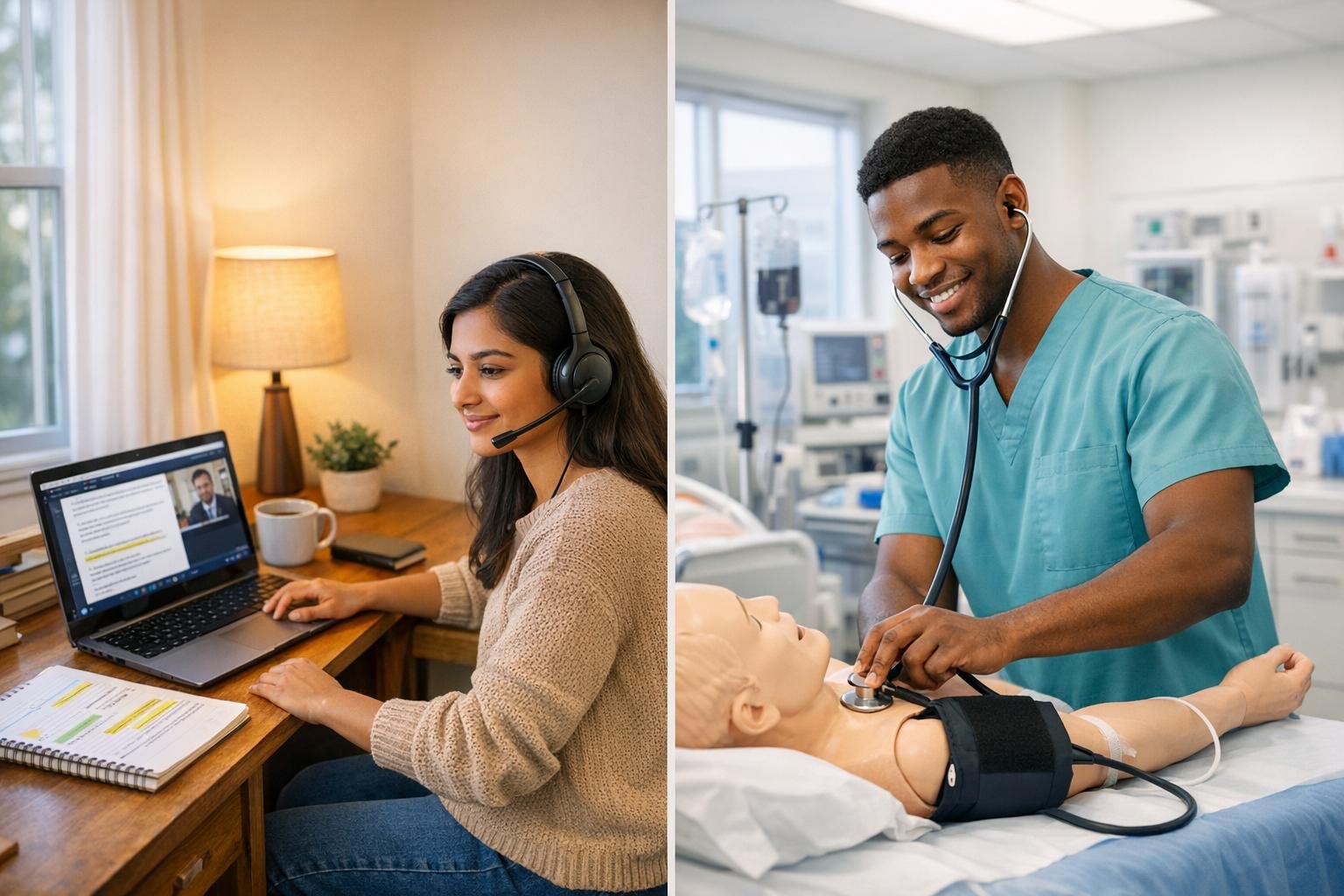
Deciding between online and in-person training depends on your schedule, learning preferences, and budget. Online programs, such as HealthCareer Certs, allow for self-paced learning with flexible scheduling, making it easier to juggle work and personal responsibilities. These programs typically take 4 to 12 months to complete and are often more affordable, with tuition ranging from $1,250 to $3,250. In contrast, in-person classes can cost between $3,900 and $4,500.
Regardless of the format, clinical externship hours are required to meet national certification standards. Online students still need to complete their externships in person, usually during standard weekday hours (9 a.m. to 5 p.m.). Some online programs provide clinical kits with tools like venipuncture trainer arms and stethoscopes, allowing students to practice key skills at home before their externship.
For those who thrive in a structured environment with direct instructor interaction, in-person programs might be the better choice. Schools like Dallas College or Laredo College offer face-to-face instruction and integrate hands-on lab sessions into their curriculum, which can be valuable if you prefer a fixed schedule and more immediate support.
What to Look for in a Training Program
When evaluating a program, it’s important to focus on quality and support services. Start by checking if the program is accredited by CAAHEP or ABHES. Accreditation is essential for eligibility to take the CMA (AAMA) exam, which is highly regarded by employers in Texas. Without accreditation, your certification and job opportunities could be limited.
Look for programs that provide externship placement assistance. Securing a clinical site on your own can be challenging, so having this support can save you time and effort. Additionally, programs offering exam preparation materials, such as practice tests and study guides, are a plus. Some even include the certification exam voucher in their tuition, saving you $160 or more. Strong national exam pass rates are another indicator of a program’s effectiveness.
Finally, consider programs that offer specialized training in skills like phlebotomy and EKG. These skills are highly sought after in Texas, where medical assistant jobs are expected to grow by 25% between 2022 and 2032. Specialized training can make you stand out to employers and may lead to higher-paying roles. Some schools also offer dual-certification options, combining Medical Assisting with credentials like Electronic Health Records Specialist.
National Medical Assistant Certifications
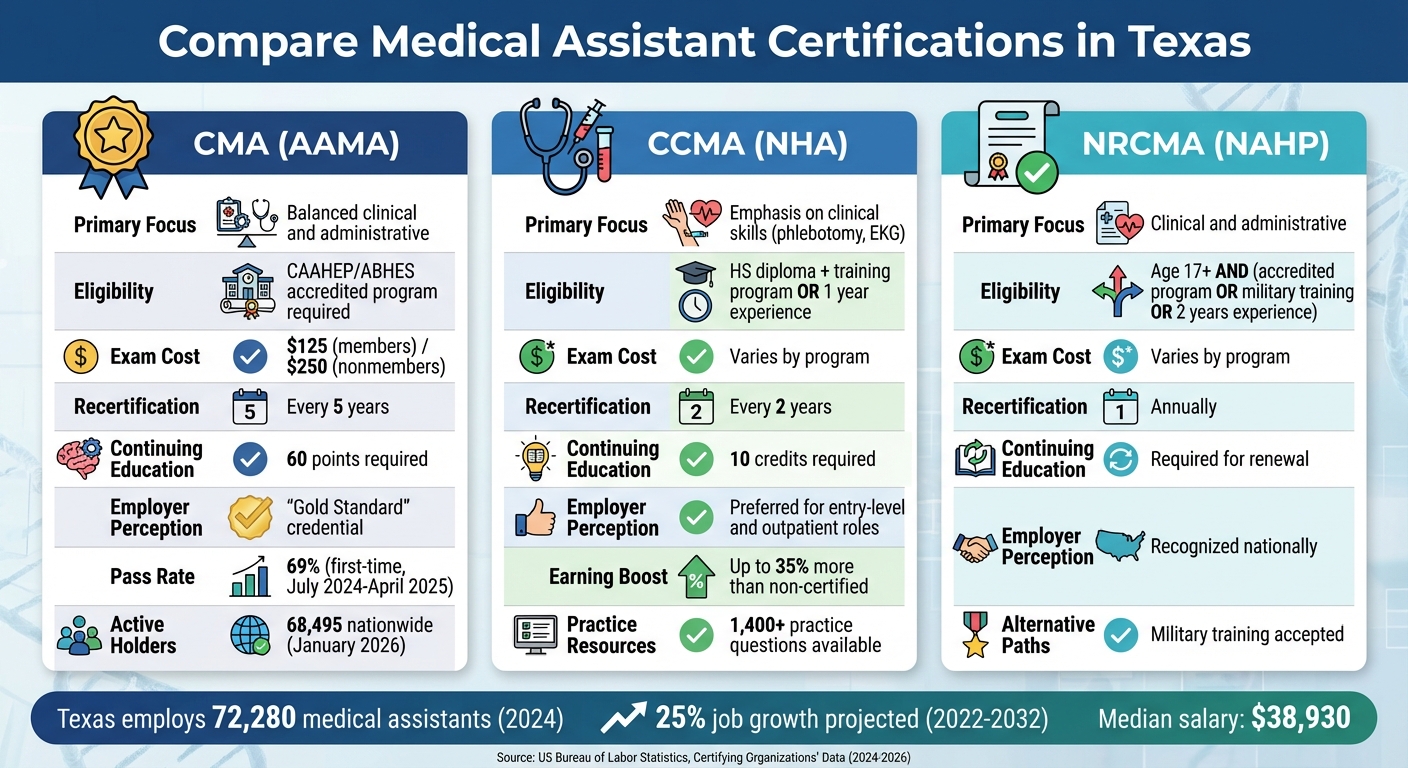
Texas Medical Assistant Certification Comparison: CMA vs CCMA vs NRCMA
Main Certification Organizations
In Texas, medical assistants have the option to pursue several nationally recognized certifications, each offering unique benefits. While certification isn’t legally required in the state, it holds significant weight in the job market – 83% of employers consider it a hiring preference. The four primary certifications sought after in Texas are the Certified Medical Assistant (CMA) from the American Association of Medical Assistants (AAMA), the Certified Clinical Medical Assistant (CCMA) from the National Healthcareer Association (NHA), the Registered Medical Assistant (RMA), and the Nationally Registered Certified Medical Assistant (NRCMA) from the National Association for Health Professionals (NAHP).
The CMA (AAMA) is often regarded as the "gold standard" in medical assisting [4,5]. To qualify, candidates must complete a program accredited by either the CAAHEP or ABHES. The exam fee is $125 for AAMA members and $250 for nonmembers. The test includes 200 multiple-choice questions, covering clinical skills (59%), general topics like legal and ethical issues (21%), and administrative tasks (20%). Between July 2024 and April 2025, the first-time pass rate stood at 69%, and as of January 2026, there were 68,495 active CMAs nationwide. Notably, candidates can register for the exam after completing classroom coursework, even if their practicum isn’t finished.
The CCMA (NHA) places a stronger focus on clinical skills, such as phlebotomy and EKG administration [4,22]. Programs like HealthCareer Certs offer self-paced online training and ensure externship placements to prepare students for the CCMA exam. Eligibility requirements are more flexible, requiring a high school diploma and either completion of a training program or one year of relevant work experience. Certification can also boost earning potential – certified medical assistants earn up to 35% more than their non-certified peers. With Texas’s median annual wage for medical assistants at $38,930, this financial advantage is worth considering.
The NRCMA (NAHP) offers another pathway, requiring candidates to be at least 17 years old and meet one of three criteria: completion of an accredited program, two years of military training, or two years of full-time healthcare experience. Recertification schedules vary between certifications: CMA requires renewal every five years, CCMA every two years, and NRCMA annually.
Certification Comparison Chart
Here’s a quick breakdown of how these certifications stack up:
| Feature | CMA (AAMA) | CCMA (NHA) | NRCMA (NAHP) |
|---|---|---|---|
| Primary Focus | Balanced clinical and administrative | Emphasis on clinical skills (phlebotomy, EKG) [4,22] | Clinical and administrative |
| Eligibility | CAAHEP/ABHES accredited program | HS diploma + training program or 1 year experience | 17+ years old; accredited program, military, or experience |
| Exam Cost | $125 (members) / $250 (nonmembers) | Varies by program | Varies by program |
| Recertification | Every 5 years [22,23] | Every 2 years [4,22] | Annually |
| Continuing Education | 60 points required | 10 credits required [4,22] | Required for renewal |
| Employer Perception | "Gold standard" credential [4,5] | Preferred for entry-level and outpatient roles | Recognized nationally |
With Texas employing 72,280 medical assistants in 2024 and anticipating a 25% job growth from 2022 to 2032, choosing the right certification can make a significant difference in your career trajectory. Researching local employer preferences will help you determine which certification aligns best with your goals.
How to Prepare for the Certification Exam
Study Materials and Practice Resources
Kick off your preparation with reliable study tools. The AAMA provides an online practice exam with 200 questions split into 10 modules of 20 questions each, complete with a timer to help you manage your pace effectively. If you’re preparing for the CCMA certification, you can access over 1,400 practice questions, interactive flashcards, and self-assessment quizzes tailored for the NHA exam.
Make sure to review the exam content outlines provided by the certification boards. These outlines act as a guide, showing how many questions are dedicated to each topic area. Additionally, the AAMA offers 50 free practice questions specifically for anatomy/physiology and medical terminology. On the other hand, the NHA allows candidates to take practice tests up to five times, helping them measure their progress.
A well-structured three-month preparation timeline often works best. In the first month, focus on building a solid foundation by studying core subjects for 1–2 hours daily. During the second month, incorporate weekly full-length, timed practice exams and track your mistakes in an error log. By the third month, increase your practice exam frequency to enhance your endurance and pacing skills. This approach aligns with the comprehensive nature of certification exams.
Once you’ve covered the core material and feel confident in your preparation, focus on strategies to ensure success on exam day.
Tips for Exam Day Success
To minimize nerves on the big day, mimic your exam-day routine ahead of time. Wake up at the same hour, eat a similar breakfast, and complete a full-length practice test under timed conditions. This practice can help you feel more comfortable and prepared.
During the test, use the elimination method to cross out obviously wrong answers, which can improve your chances on more difficult questions. Watch out for keywords like "EXCEPT" or "NOT", as they can completely change the meaning of a question. If you come across a particularly tricky question, flag it and move on instead of wasting too much time. For example, the CMA exam from the AAMA is divided into four 40-minute segments, totaling about three hours, while the RMA exam from AMT includes 210 questions to be completed in just two hours. Aim to finish each section with enough time left to review flagged questions.
How to Maintain Your Medical Assistant Certification
Recertification and Continuing Education Requirements
In Texas, medical assistants don’t require state-level licenses, so it’s the national certification bodies that oversee credential maintenance. Each organization – AAMA, AMT, NHA, or NCCT – has its own guidelines for renewal and continuing education:
- CMA (AAMA): Renewal occurs every five years, either by retaking the certification exam or earning CEUs, along with paying a fee.
- RMA (AMT): Requires renewal every three years, which includes earning CEUs and paying an annual membership fee.
- CCMA (NHA): Needs to be renewed every two years.
- NCMA (NCCT): Requires annual renewal.
It’s important to start tracking your CEUs as soon as you become certified. Also, make sure your certifying board has an up-to-date email address – preferably one that won’t expire after graduation. Letting your certification lapse can lead to extra costs for reinstatement and may even require retaking the exam. For those stepping back from active practice, the AAMA offers a retired status option for a one-time $50 fee, allowing the use of the "CMA (AAMA)–Retired" designation.
Staying on top of recertification not only keeps your credential valid but also demonstrates your dedication to professional growth and value as an employee.
Why Employers Care About Active Certification
National certification serves as a benchmark for high standards, which is why many Texas employers prioritize it. For instance, in February 2026, the Texas Health Physician Group ran a 15-week Medical Assistant Apprenticeship Program. Participants were required to pass a national certification exam, and those who succeeded transitioned into full-time CMA roles. Maintaining an active certification was a condition for continued employment in these positions.
Texas Health Resources highlights the importance of medical assistants as:
frontline caregivers
who play a:
vitally important role in the spectrum of care
they provide. This underscores why keeping your certification current is so crucial.
An active certification showcases your dedication to maintaining competency and adhering to professional standards. Many organizations now issue digital badges for certifications, making it easier for employers to verify your credentials quickly. If you’re considering a specialization – like podiatry or ophthalmology – using your recertification period to gain advanced credentials could also increase your earning potential.
Conclusion
Start by ensuring you meet the basic requirement of a high school diploma or GED, then choose an accredited training program that fits your schedule. Options like one-year certificate programs and accelerated bootcamps are widely available and often affordable. If you’re aiming for the CMA credential, make sure your program is accredited by CAAHEP or ABHES. Once you’ve completed your training and externship, you’ll be ready to sit for a national certification exam such as the CMA, RMA, or CCMA.
Texas offers a strong job market for certified medical assistants, with steady growth projected through 2030. In cities like Austin, Dallas, and Houston, you can expect competitive pay and approximately 11,640 new job openings each year.
While state licensure isn’t mandatory, earning a national certification is crucial for advancing your career. Certification not only boosts earning potential but also opens doors to specialized roles and opportunities across the country. Programs like apprenticeships can further enhance your hands-on experience and provide direct pathways to full-time positions.
FAQs
Which certification is best for Texas employers?
In Texas, medical assistants aren’t required by state law to hold certifications. However, earning one can significantly boost career opportunities. One of the most recognized credentials is the Certified Medical Assistant (CMA) from the AAMA. This certification is highly regarded by employers and often seen as a stepping stone for career growth. To obtain it, candidates usually need to complete an accredited program and pass an exam. While not mandatory, many employers prefer hiring certified professionals, especially for more advanced roles or promotions.
How do I confirm a program is CAAHEP or ABHES accredited?
To ensure a medical assistant program is accredited by CAAHEP or ABHES, start by checking the official accreditation directories provided by these organizations. Alternatively, you can ask the program provider for proof of accreditation. Another reliable resource is the American Association of Medical Assistants, which can help verify a program’s status. Confirming accreditation is essential to meet certification requirements and guarantees the program adheres to established quality standards.
Can I work as a medical assistant in Texas before I’m certified?
Yes, in Texas, you can work as a medical assistant without certification since the state does not mandate it for this position. That said, earning a certification could boost your chances of landing a job or advancing in your career.