
Medical assistant certification in Pennsylvania can boost your career in healthcare. While not legally required, certifications like CMA or CCMA are highly preferred by employers. Certified professionals earn between $16 and $28 per hour, with opportunities for advancement into supervisory roles or healthcare management.
Key Takeaways:
- Eligibility: High school diploma/GED, English/math skills, and health/background checks are required.
- Certification Options:
- CMA (AAMA): Requires accredited program completion; renew every 5 years with 60 CEUs.
- CCMA (NHA): Flexible entry paths (training or 1 year of clinical experience); renew every 2 years with 10 CEUs.
- Training: Accredited programs include classroom, lab, and externship experience, with options like online or community college courses.
- Exam Details:
- CMA: 200 questions, $125–$250 fee.
- CCMA: 180 questions, $165 fee.
- Career Growth: Certification enables roles in private practices, hospitals, and specialty clinics, with potential earnings up to $62/hour in management positions.
Whether you choose CMA or CCMA, certification equips you with essential skills and opens doors to Pennsylvania’s growing healthcare job market.
Eligibility Requirements for Pennsylvania Medical Assistants
Basic Eligibility Requirements
To become a medical assistant in Pennsylvania, applicants must meet some basic criteria. You need to be at least 18 years old, have a high school diploma or GED, and possess fundamental English and math skills to handle both clinical and administrative responsibilities.
If you’re aiming for the Certified Medical Assistant (CMA) credential through the AAMA, you’ll need to graduate from a program accredited by the Commission on Accreditation of Allied Health Education Programs (CAAHEP) or the Accrediting Bureau of Health Education Schools (ABHES). Only graduates from these accredited programs are eligible to sit for the CMA exam. The good news? You can register for the exam as soon as you complete your coursework, even if you haven’t finished your externship hours yet.
On top of these educational requirements, Pennsylvania has specific health and background clearances that must be completed before you can begin clinical training.
Required Health and Background Checks
Meeting state-mandated health and background checks is a critical step for clinical placements in Pennsylvania. First, you’ll need to complete an FBI Criminal Background Check, either directly through the FBI or via an approved channeler. Make sure the check is dated within 180 days of your application. If you have a history of criminal charges, disciplinary actions, or malpractice complaints, you’ll need to provide a written explanation along with supporting legal documentation.
Another key requirement is completing three hours of Board-approved continuing education on child abuse recognition and reporting. When registering for this course, indicate that you’re applying for Pennsylvania licensure so the Board receives confirmation directly.
Most externship sites and healthcare employers will also require the following:
- A physical exam
- Proof of immunizations, including hepatitis B, MMR, and flu shots
- Active health insurance
- Current CPR certification
Since CPR certification is a standard requirement for certification and employment, it’s a good idea to get certified early. Many healthcare facilities won’t allow you to start clinical work without it.
sbb-itb-7a67ffa
How to Become a Medical Assistant PA
Certification Options Available in Pennsylvania
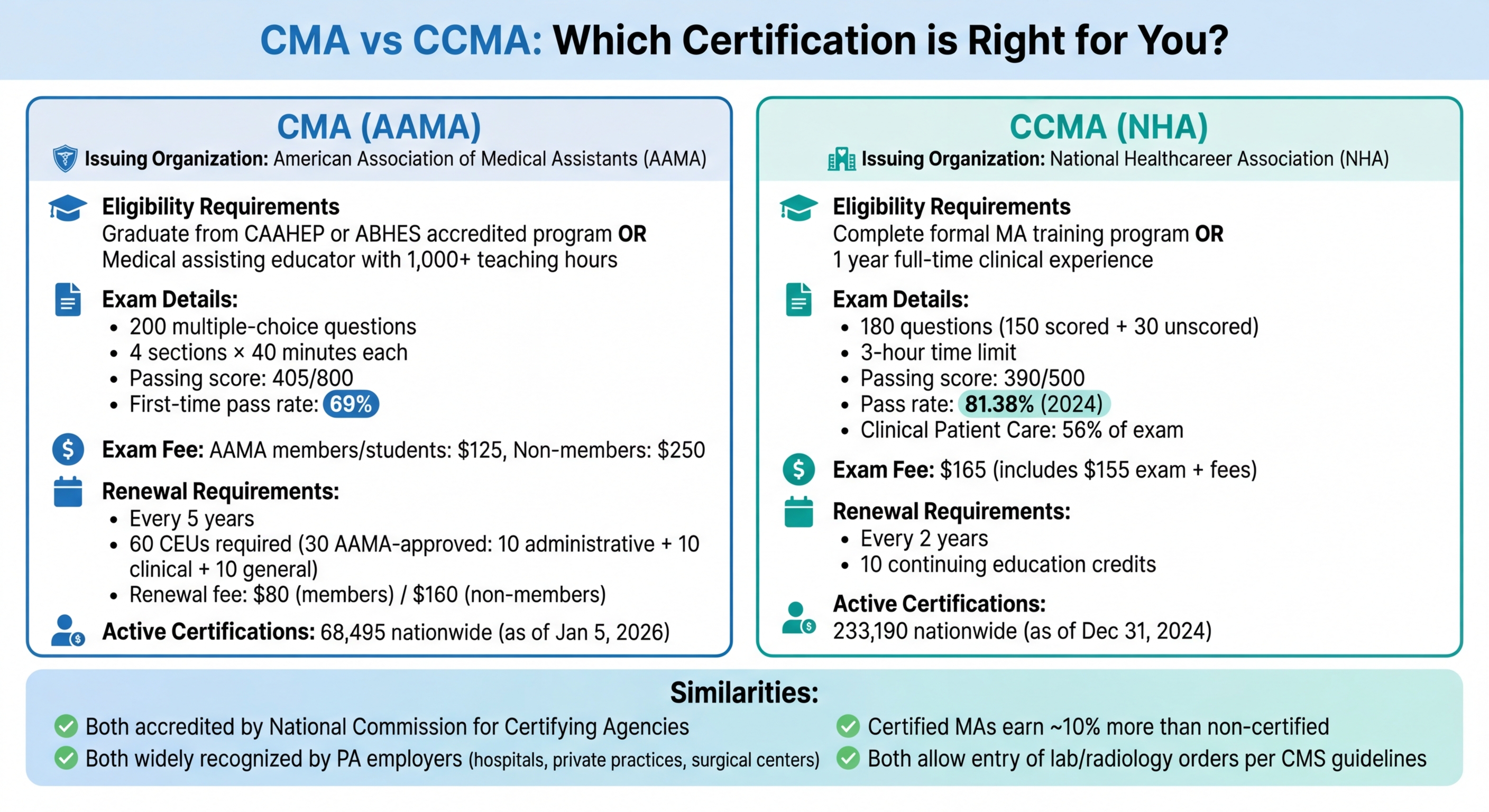
CMA vs CCMA Certification Comparison for Pennsylvania Medical Assistants
In Pennsylvania, medical assistants have two primary certification options: the Certified Medical Assistant (CMA) from the American Association of Medical Assistants (AAMA) and the Certified Clinical Medical Assistant (CCMA) from the National Healthcareer Association (NHA). Both certifications are accredited by the National Commission for Certifying Agencies and are widely recognized by employers, including private practices, hospitals, and surgical centers throughout the state.
These certifications differ in their eligibility criteria and renewal requirements. The CMA requires candidates to graduate from a program accredited by either CAAHEP or ABHES, while the CCMA offers more flexibility, allowing applicants to qualify through formal training or at least one year of full-time clinical experience. Here’s a closer look at each certification pathway.
Certified Medical Assistant (CMA) by AAMA
The CMA credential is often considered a benchmark for medical assistants because of its rigorous educational prerequisites. In addition to graduates of accredited programs, the AAMA also provides eligibility to medical assisting educators with at least 1,000 hours of teaching experience in an accredited program.
The CMA exam includes 200 multiple-choice questions, divided into four 40-minute sections. A passing score is 405 or higher on a scale of 200 to 800. From July 2024 to April 2025, the first-time pass rate was 69%, with 4,171 candidates taking the exam during that period. As of January 5, 2026, there were 68,495 CMAs nationwide. Exam fees are $125 for AAMA members and students or recent graduates of accredited programs, while non-members pay $250. To maintain certification, CMAs must renew every five years by completing 60 continuing education units (CEUs).
Certified Clinical Medical Assistant (CCMA) by NHA
The CCMA certification offers a more flexible entry point for aspiring medical assistants in Pennsylvania. Applicants can qualify by completing a formal medical assistant training program or by gaining at least one year of full-time clinical work experience.
The CCMA exam also consists of 200 questions and costs around $155. Unlike the CMA, the CCMA certification has a simpler renewal process, requiring renewal every two years with just 10 continuing education credits. Research indicates that certified medical assistants often earn about 10% more than their non-certified counterparts, highlighting the financial benefits of certification. Additionally, many professionals enhance their career prospects by earning additional specialty certifications, such as Phlebotomy (CPT) or EKG (CET), to increase their marketability in Pennsylvania’s healthcare job market. These certification options provide a strong foundation for taking the next steps toward becoming a certified medical assistant in the state.
How to Get CCMA Certification in Pennsylvania
Earning your CCMA certification in Pennsylvania is a straightforward process with five key steps. Depending on your chosen path – whether a fast-track online program or a traditional community college course – it can take anywhere from four weeks to a year. By following these steps, you’ll meet Pennsylvania’s certification requirements and be ready to launch your healthcare career.
Step 1: Complete Prerequisites and Clearances
Before starting a medical assistant training program, you’ll need a high school diploma or GED. If you’re a recent graduate, ask your advisor if credits from AP, IB, or dual enrollment courses can count toward your program.
Some schools, like Northampton Community College, require attendance at a Medical Assistant Program Orientation before enrolling in clinical courses. Missing this could delay your start, so plan accordingly. You’ll also need to complete the college admissions process and explore financial aid options early – many community colleges offer scholarships to help with costs.
If you have prior military service, certifications, or workplace training, a Prior Learning Assessment (PLA) may allow you to earn college credit and shorten your timeline. Additionally, since you’ll need to complete a clinical externship in Pennsylvania, make sure to handle all required background checks and health screenings well in advance. This ensures compliance with state regulations and avoids delays.
Step 2: Choose an Accredited Training Program
Once you’ve met the prerequisites, select an accredited program designed to prepare you for the NHA’s CCMA exam. Look for programs that include guaranteed clinical externship placements, as hands-on experience is critical for building practical skills. The curriculum should cover areas like phlebotomy, EKG, vital signs, medical terminology, and patient care coordination.
For example, HealthCareer Certs offers a 100% online, self-paced CCMA program with 12-month access to materials. Their program includes six practice exams, 3D animations, lab simulations, and one-on-one Zoom sessions. They also provide tutoring, career coaching, and resume preparation, and guarantee externship placements at local healthcare facilities in Pennsylvania.
Alternatively, traditional community college programs typically require about 37 credits over three semesters, equating to one year of full-time study. Whichever route you choose, confirm that tuition covers all materials and exam fees upfront to avoid unexpected costs.
Step 3: Complete Training and Externship Hours
Your training will combine classroom lessons, lab practice, and externship hours. Online programs offer flexibility, allowing you to finish coursework in 4–12 weeks, while traditional programs follow a semester schedule with externships in the final term.
During your externship, you’ll gain supervised, hands-on experience performing essential tasks. Completing this phase is crucial, as the practical skills you develop will prepare you for Pennsylvania’s growing healthcare job market. To avoid issues, ensure all health screenings and background checks are completed before starting your externship.
Step 4: Study for and Pass the CCMA Exam
The CCMA exam includes 180 questions (150 scored and 30 unscored) with a three-hour time limit. A passing score is 390 out of 500. Clinical Patient Care is the most emphasized section, making up 56% of the scored questions.
In 2024, the exam had an 81.38% pass rate across 78,681 tests, with 233,190 active CCMA certifications nationwide as of December 31, 2024. To prepare, download the NHA CCMA Test Plan to identify weak areas, and use the NHA’s "Focused Review®" tool for tailored study recommendations.
Programs like HealthCareer Certs provide extensive prep materials, including over 1,400 practice questions and 700 self-checks. Use tools like the NHA Mobile app for flashcards to reinforce your knowledge.
To register, create an NHA account and choose between taking the exam at a PSI testing center in Pennsylvania or remotely via live proctoring. The exam fee is $165. If you don’t pass on your first try, you must wait 30 days to retake it. After two failed attempts, a one-year waiting period applies.
Step 5: Launch Your Job Search in Pennsylvania
After passing the CCMA exam, you’re ready to enter Pennsylvania’s healthcare workforce. Entry-level medical assistants typically earn $16–$28 per hour, depending on experience and employer.
Being credentialed opens doors to higher-paying roles, as only certified medical assistants can enter lab, radiology, and medical orders into computerized systems per CMS guidelines.
Start applying to private practices, hospitals, urgent care centers, and surgical facilities across Pennsylvania. Use the resume preparation and career coaching resources from your training program to strengthen your applications. You might also consider earning additional certifications, like the Certified Phlebotomy Technician (CPT), to increase your competitiveness. With your certification and hands-on experience, you’ll be well-equipped to meet the needs of local employers.
HealthCareer Certs Online CCMA Program
HealthCareer Certs offers an online CCMA program designed for those looking to take their careers to the next level in Pennsylvania. With over 5,000 students trained and a perfect 5/5 rating on Google, this program delivers flexibility, real-world experience, and career support. The tuition includes the exam fee, 12 months of course materials, and six practice tests. Here’s a closer look at the standout features of this program.
Self-Paced Online Learning
This program provides 24/7 access to a mobile-friendly portal, so you can study whenever and wherever it suits you. The curriculum is broken down into 18 modules, featuring 3D animated demonstrations, interactive flashcards, lab simulations, and virtual peer engagement. To help you master the material, you’ll have access to over 1,400 practice questions and 700 self-checks.
Need extra help? Instructors are available for one-on-one Zoom sessions and email support, ensuring you’re never left to tackle challenges on your own.
Guaranteed Externship Placement
Every eligible student is guaranteed an externship placement at a healthcare facility close to their home in Pennsylvania. This clinical experience is crucial for developing the hands-on skills that employers value. The program handles all placement arrangements, but be sure to complete any required clearances early to avoid potential delays.
100% Tuition Refund Guarantee
HealthCareer Certs stands by its program with a 100% tuition refund guarantee if you earn your certification but don’t land a healthcare job. It’s worth noting, though, that enrollments using scholarships, discounts, or special offers may not qualify for this refund.
As an added bonus, passing the CCMA exam earns you 5 American Council on Education (ACE) credits, which can be applied at over 2,000 colleges and universities. This means you could save both time and money if you decide to further your education in healthcare.
Exam Preparation and Certification Renewal
How to Prepare for the Certification Exam
Getting ready for your certification exam takes focus, planning, and the right tools. The CMA (AAMA) exam includes 200 questions to be completed in 160 minutes, requiring a passing score of 405. On the other hand, the CCMA (NHA) exam has 180 questions (150 scored, 30 unscored) with a three-hour time limit. Importantly, 59% of the CMA exam focuses on clinical topics like patient care, lab procedures, and pharmacology.
A six-week study plan, dedicating a total of 55–65 hours, is a solid approach to cover all the key areas. Pay close attention to clinical details, such as injection angles (90° for intramuscular and 45° for subcutaneous) and standard vital sign ranges – these frequently appear on the test. If you come across tough questions, mark them for review later, and always prioritize patient safety in your responses.
For study resources, look for tools that offer free guides, AI-driven tutoring, practice questions, and timed mock exams that simulate the real testing environment. Comprehensive preparation not only helps you pass the exam but also builds a solid knowledge base for advancing in Pennsylvania’s healthcare field.
Maintaining Your CMA or CCMA Certification
Once you’ve earned your certification, keeping it active through continuing education is essential for staying current in Pennsylvania’s healthcare industry. For CMA (AAMA) certification, renewal is required every 60 months (five years). This can be done by earning 60 continuing education units (CEUs) or retaking the exam. The 60 CEUs must include 30 AAMA-approved credits: 10 each in administrative, clinical, and general categories. The remaining 30 can be from any combination of these areas. Renewal fees are $80 for AAMA members and $160 for non-members.
For CCMA (NHA) certification, renewal is required every two years, and you’ll need 10 continuing education credits. Keep track of your CE credits immediately after certification. If your CMA credential lapses for more than three months, you’ll lose the option to renew through CEUs and will need to retake the exam. To check your certification’s expiration date or review your earned CEUs, simply log into your AAMA account online.
Conclusion
Earning a certification can open doors to fulfilling career opportunities in Pennsylvania’s healthcare industry. Whether you pursue the CMA (AAMA) or CCMA (NHA) certification, you’ll develop the clinical and administrative expertise needed to work in physicians’ offices, clinical labs, and medical facilities across the state.
The certification process – covering prerequisites, health clearances, training, exam completion, and ongoing maintenance – sets you up for immediate job placement and long-term career advancement. Entry-level medical assistants typically earn between $16 and $28 per hour. With experience and additional education, wages can increase significantly. Supervisory roles for those with an Associate degree offer $23–$37 per hour, while management positions with a Bachelor’s degree can range from $39 to $62 per hour. Many accredited programs also allow you to transfer credits toward higher degrees, expanding your future prospects.
Think of certification as the beginning of your professional journey. By meeting renewal requirements and pursuing continuing education, you’ll stay competitive and keep your career options open.
This certification is more than just a credential – it’s a launchpad for a rewarding career in healthcare. With the right preparation, accredited training, and a commitment to lifelong learning, you’ll be well-equipped to succeed in Pennsylvania’s growing healthcare sector.
FAQs
Which certification is better in Pennsylvania: CMA or CCMA?
In Pennsylvania, pursuing a CMA (Certified Medical Assistant) or CCMA (Certified Clinical Medical Assistant) certification can be a smart move for advancing your career. The CMA, offered by the AAMA, is well-regarded for its wide-ranging focus on both administrative and clinical skills. On the other hand, the CCMA, provided by the NHA, leans more toward clinical expertise. Many employers tend to favor the CMA due to its broader skill set and higher standards, which can open up more job opportunities.
Can I work as a medical assistant in Pennsylvania without certification?
In Pennsylvania, working as a medical assistant usually requires certification. Most entry-level positions look for candidates with a recognized certification to ensure they possess the qualifications and skills needed for the role.
What can delay my externship or clinical placement in Pennsylvania?
Delays in externships or clinical placements in Pennsylvania can crop up for several reasons. Common issues include not completing the required hours, logistical hurdles with healthcare facilities, or administrative and scheduling conflicts. Additionally, failing to meet specific program requirements can also lead to setbacks. Since externships are unpaid and require close collaboration with healthcare professionals, ensuring all prerequisites are met and maintaining clear coordination is key to keeping things on track.