If you’re considering becoming a medical assistant in New Jersey, here’s what you need to know:
- Certification isn’t legally required for all roles, but 81% of employers in the state prefer or require it.
- Certification is legally mandatory for tasks like administering injections.
- Medical assistants in New Jersey earn an average of $42,080 annually, slightly above the national average.
- The field is growing fast, with 16% job growth expected over the next decade, creating about 2,590 openings annually.
To get certified, you’ll need to:
- Complete an accredited program (CAAHEP or ABHES) lasting 14 weeks to 2 years.
- Fulfill requirements like background checks, drug screenings, and immunizations.
- Pass a national certification exam, such as the CMA (AAMA) or RMA (AMT).
Accredited programs often include clinical internships, and resources like HealthCareer Certs offer flexible online training with externship placements. Certification not only improves job prospects but also allows you to perform advanced clinical duties, earn higher pay, and access stable work schedules.
With New Jersey’s growing healthcare sector, now is the perfect time to begin your journey.
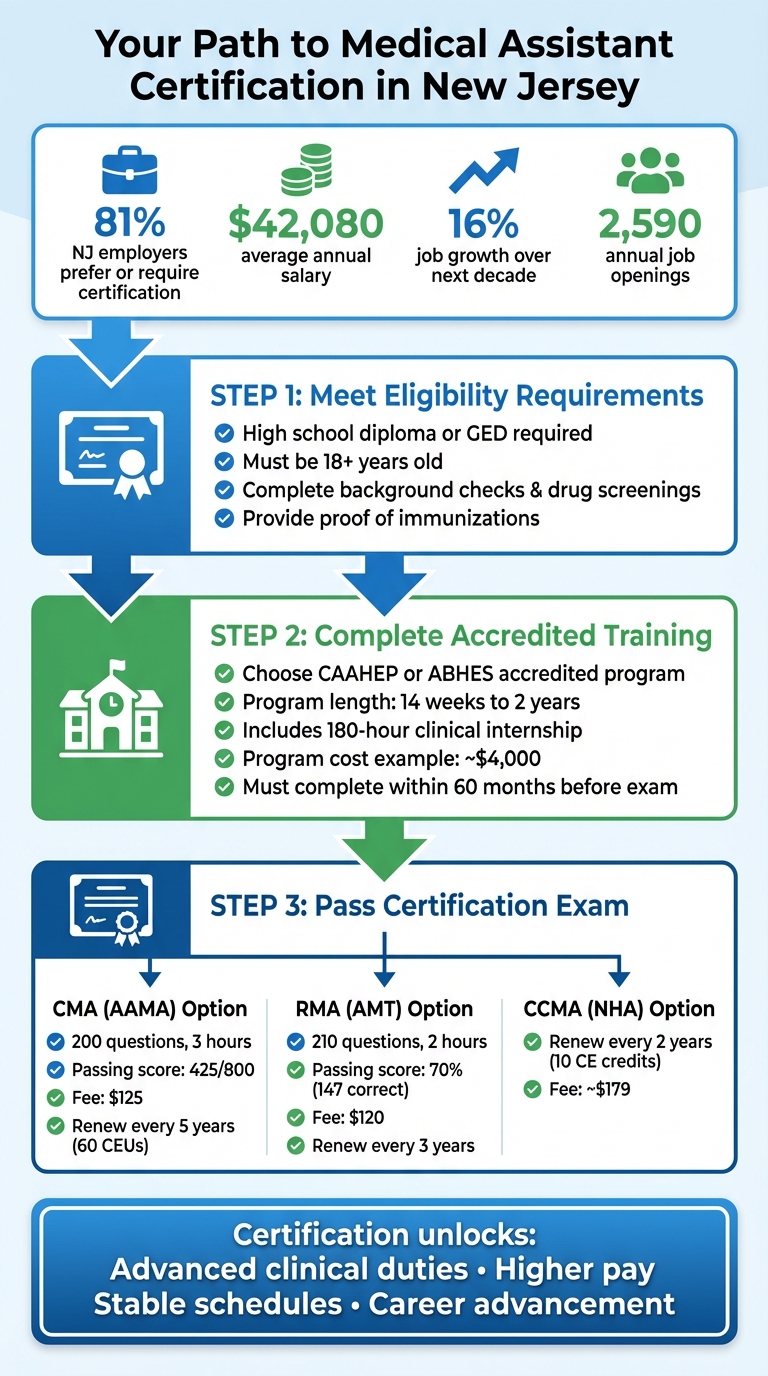
Steps to Become a Certified Medical Assistant in New Jersey
Eligibility Requirements for Medical Assistant Certification in New Jersey
Educational Background and Qualifications
To start your journey as a medical assistant in New Jersey, you’ll need a high school diploma or GED as a baseline requirement. After that, enrolling in a medical assisting program from an accredited institution is the next step. These programs, available as certificates, diplomas, or associate degrees, typically range from 14 weeks to 2 years in length. It’s essential to choose a program accredited by CAAHEP or ABHES, as this ensures eligibility for widely recognized certifications like the CMA or RMA.
Most reputable programs include a 180-hour clinical internship, giving you hands-on training in key areas such as taking vital signs, performing phlebotomy, and conducting EKGs. For instance, New Jersey City University offers an online program priced at around $4,000, which includes tuition and a voucher for the certification exam. Once you’ve selected a program, make sure you understand any additional requirements to be fully prepared for success.
Additional Requirements
In addition to meeting educational standards, there are practical qualifications to consider. Certification programs typically require candidates to be at least 18 years old. Before starting your clinical internship, you’ll likely need to complete background checks, drug screenings, and provide proof of up-to-date immunizations. Physical readiness is also important, as the role involves standing for extended periods, assisting patients, and performing CPR.
If you’re a New Jersey resident, you might want to explore funding options through your local One-Stop Career Center, which could help cover training costs. These resources can make the certification process more accessible while ensuring you meet all necessary criteria.
sbb-itb-7a67ffa
Medical Assisting Program | Lawrenceville, NJ | Fortis
Finding an Accredited Training Program
Once you’ve met the eligibility requirements, the next big step is choosing a training program that aligns with state regulations and accreditation standards.
Why Accreditation Matters
Accreditation isn’t just a formality – it directly impacts your ability to sit for national certification exams. In New Jersey, for example, state regulations require that you graduate from a program accredited by either the Commission on Accreditation of Allied Health Education Programs (CAAHEP) or the Accrediting Bureau of Health Education Schools (ABHES) to qualify for these exams. Without this accreditation, even the most thorough education won’t make you eligible for certifications.
"Unlike many other states, New Jersey has strict guidelines over medical assisting and even requires graduation from an accredited CAAHEP or ABHES MA program and earning a national certification of CMA or RMA." – Medical Assistant Guide
Accredited programs follow nationally recognized standards, ensuring you learn key skills like anatomy, medical law, and pharmacology. They also include supervised clinical training, which is a requirement for certification. For instance, if you’re planning to take the CMA exam, remember it must be completed within 60 months of graduating from your accredited program. Always double-check a program’s accreditation status with the appropriate state agencies. Choosing an accredited program is not just about meeting certification requirements – it also boosts your future career opportunities.
HealthCareer Certs CCMA Program
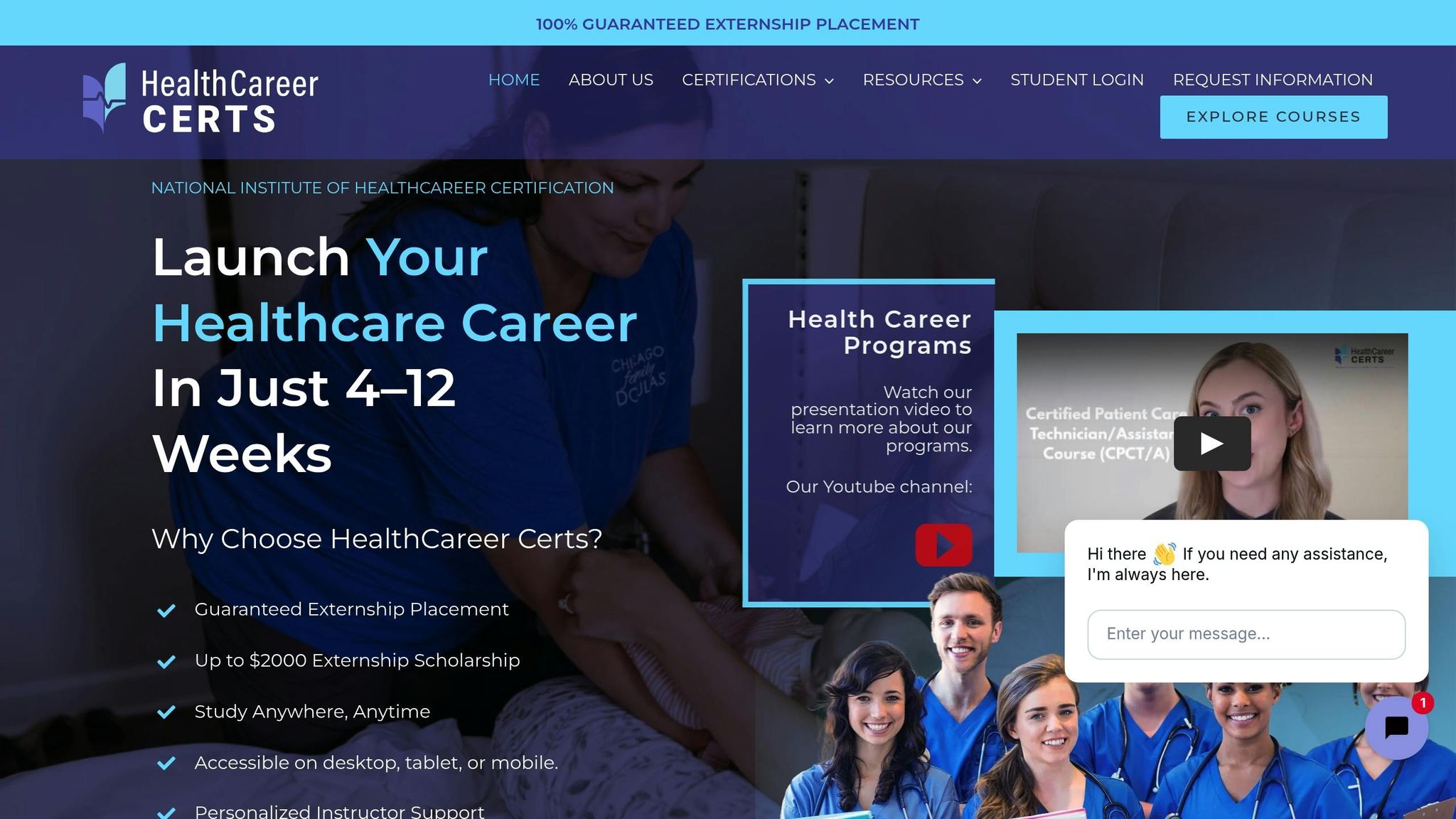
HealthCareer Certs offers a completely online CCMA program tailored to fit your schedule while preparing you for certification exams. The self-paced structure allows you to finish in as little as 4 weeks or take up to 12 weeks, depending on your availability. Plus, they include a guaranteed externship placement, ensuring you get the hands-on clinical experience required for certification.
The program includes one-on-one Zoom sessions, interactive 3D demonstrations, and over 1,400 practice questions to prepare you for the NHA exam. You’ll also have access to mobile-friendly materials, 700 self-checks, quizzes, and flashcards to reinforce your learning. On top of that, HealthCareer Certs offers a 100% tuition refund guarantee if you don’t land a healthcare job after completing the program, showing their commitment to your success in the job market.
Preparing for and Passing the Certification Exam
After completing your accredited training program, the final step to becoming a certified medical assistant in New Jersey is passing the certification exam. With the right preparation and mindset, you can walk into the testing center feeling ready to succeed.
Study Resources and Tools
Start by reviewing the official exam content outline provided by your certification body. This will help you understand which topics to focus on and how much weight each section carries. For example:
- CMA (AAMA) Exam: This test includes 200 questions (180 scored) divided into Clinical Competency (59%), General Studies (21%), and Administrative (20%) sections .
- RMA (AMT) Exam: This exam has 210 questions, and you’ll need to score at least 70% (147 correct answers) to pass.
To prepare effectively, take advantage of the following resources:
- AAMA Practice Exams: The American Association of Medical Assistants offers an online practice exam with 200 questions across 10 modules. They also provide 50 free practice questions covering anatomy, physiology, and medical terminology.
- AMCA Study Materials: If you’re pursuing the RMA through the American Medical Certification Association, you’ll receive PDF study guides, online practice tests with five attempts, and Quizlet-based "Study On-The-Go" resources, including flashcards and games. Be sure to review the feedback provided for each practice question to understand the reasoning behind correct answers.
- HealthCareer Certs Resources: Students preparing for the NHA exam have access to over 1,400 practice questions, 700 self-checks, quizzes, flashcards, and interactive 3D demonstrations. These tools are mobile-friendly and designed to reinforce clinical knowledge.
Create a daily study schedule leading up to your exam. Simulate the testing environment by practicing with a timer to improve time management. Focus on key areas like anatomy and physiology, medical terminology, pharmacology (especially the top 50 most commonly used medications), medical law and ethics, and clinical procedures .
Once you’ve built a strong foundation, shift your attention to practical strategies for exam day.
Exam Day Tips
Being prepared for the logistics of exam day can help ease nerves and set you up for success. Here’s what you need to know:
- CMA (AAMA) Exam: This test lasts 3 hours, divided into four 40-minute segments. A minimum passing score of 425 out of 800 is required, and you’ll find out immediately whether you passed .
- RMA (AMT) Exam: This exam has a 2-hour time limit.
In New Jersey, you can take the CMA exam at Prometric centers located in Laurel Spring, Hamilton, Clark, and Fairlawn. The RMA exam is administered by Pearson VUE at centers in Lawrenceville, Princeton, Lincroft, Piscataway, South Plainfield, and Iselin. Application fees are $125 for the CMA and $120 for the RMA.
To maximize your performance, follow these tips:
- Arrive early with proper ID and any required documentation.
- Get a good night’s sleep before the exam.
- Read each question carefully and manage your time wisely.
- Stay calm and focused during the test.
Keep in mind that you must complete the CMA exam within 60 months of graduating from your accredited program to remain eligible for certification. Plan your exam date accordingly to avoid any issues.
Meeting New Jersey’s Certification Standards
Becoming certified as a medical assistant in New Jersey involves more than just passing an exam. While the state doesn’t legally require certification, around 81% of employers in New Jersey do, making it a crucial step for securing long-term employment stability. This section outlines what comes next after exam preparation, from applying for certification to ensuring your credentials stay current.
How to Apply for Certification
The certification process starts even before you take your exam. Applications are submitted through the website of your chosen certifying organization – such as the American Association of Medical Assistants (AAMA) for the CMA or American Medical Technologists (AMT) for the RMA. To apply, you’ll need to gather several documents, including:
- Your high school diploma or GED
- Transcripts from a CAAHEP- or ABHES-accredited program
- A birth certificate (required by some organizations)
Submit these documents along with the application fee – $125 for the CMA or $120 for the RMA – to receive approval for scheduling your exam. If you’re applying for the CMA, you’ll also select a 90-day window during which you’ll take the exam.
Maintaining Your Certification
Certification isn’t a one-and-done deal – you’ll need to renew it periodically by completing continuing education requirements. Here’s a quick breakdown of renewal timelines, required credits, and fees:
| Certification | Renewal Period | CE Credits Required | Renewal Fee |
|---|---|---|---|
| CMA (AAMA) | Every 60 months (5 years) | 60 CEUs (30 must be AAMA-approved) | $80 (members) / $160 (non-members) |
| RMA (AMT) | Every 3 years | Compliance with the CCP program | Varies |
| CCMA (NHA) | Every 2 years | 10 CE credits | Approximately $179 |
For CMA recertification, the required 60 continuing education units (CEUs) must include 10 credits each in administrative, clinical, and general categories, with the remaining 30 credits coming from any category. Programs outside the AAMA must last at least 50 minutes to count as 1 CEU. To avoid lapses, it’s a good idea to apply for recertification at least 30 days before your certification expires.
Letting your certification lapse can lead to extra costs and additional steps. For example, if your NHA certification has been expired for over a year, you’ll need to retake the exam. The AAMA charges a $50 reactivation fee on top of the renewal cost for expired certifications. Keep copies of your CEU certificates for at least one renewal cycle, as you may need them for an audit.
Career Opportunities for Certified Medical Assistants in New Jersey
Job Market and Growth Potential
New Jersey’s healthcare industry is booming, creating a thriving job market for medical assistants. The state is projected to experience an impressive 18% growth in medical assistant positions by 2032, significantly outpacing the national average of 13% growth in this field. This translates to more than 20,000 medical assistant roles by 2032, with approximately 2,590 new positions opening each year due to factors like retirements, career changes, and the creation of new jobs.
"In New Jersey, demand for medical assistants is even higher than the national average with more than 20,000 jobs anticipated by 2032."
- Lincoln Team, Lincoln Tech
One major driver of this demand is the state’s aging population. By 2034, New Jersey will have more residents aged 60 and older than school-aged children, leading to increased demand for routine medical care and chronic disease management services. At the same time, healthcare delivery is shifting away from hospitals to outpatient centers, urgent care clinics, and specialty practices – settings where medical assistants play a critical role. Additionally, a predicted national shortage of up to 86,000 physicians by 2036 highlights the growing reliance on certified medical assistants to handle both clinical and administrative tasks.
Prominent employers in New Jersey actively seeking medical assistants include RWJBarnabas Health (the state’s largest healthcare system with over 20,000 staff members), Hackensack Meridian Health, Cooper University Hospital, Summit Health, and urgent care chains like AFC Urgent Care and Excel Urgent Care[32,33,34,35]. Keeping an eye on their career portals can help you explore opportunities in diverse settings, such as primary care offices, specialty clinics, and outpatient surgery centers[32,35].
How Certification Helps Your Career
Earning a certification as a medical assistant can significantly improve your career prospects and earning potential. With New Jersey’s healthcare sector expanding rapidly, certification positions you as a competitive candidate for roles in major healthcare systems and specialty practices. Certified Medical Assistants in New Jersey earn an average annual salary of $49,726, with top earners reaching up to $58,531. Beyond financial benefits, certification often leads to stable work schedules – typically 8 a.m. to 5 p.m. – and opens doors to specialized fields like pediatrics, urgent care, and cardiology. Many professionals further enhance their skill sets with additional certifications in areas like EKG and Phlebotomy, increasing their versatility and value in the workplace[2,5,12].
"Credentialed [professionals] will have an easier time commanding a higher salary, which lets you improve your quality of life and ability to care for your family."
- Phlebotomy Career Training
Certification also creates pathways to advanced roles such as Phlebotomy Technician, EKG Technician, or Patient Care Technician. To broaden your professional network and stay updated on industry trends, consider joining organizations like the New Jersey State Society of Medical Assistants (AAMA) or the New Jersey State Society of AMT. These groups provide valuable networking opportunities and access to continuing education resources, helping you stay competitive in this growing field.
Conclusion
Getting certified as a medical assistant in New Jersey sets you up for success in the state’s thriving healthcare industry. With an estimated 2,590 new job openings annually and 81% of employers preferring or requiring certification, having the right credentials gives you a strong advantage in this competitive field.
Certification doesn’t just meet employer expectations – it also allows you to take on advanced clinical duties, such as administering injections and performing venipunctures independently. This can lead to better pay and improved work-life balance compared to uncertified, entry-level roles. Programs like HealthCareer Certs’ CCMA course make the process manageable, offering self-paced online learning, externship placements, and tools to help you prepare for certification exams.
As New Jersey’s healthcare system adapts to an aging population and the growing focus on outpatient care, the demand for skilled, certified medical assistants is only expected to rise. Hospitals, clinics, and other healthcare facilities are actively looking for professionals who can handle both clinical and administrative responsibilities. By earning your certification, you’re not just stepping into a job – you’re building a career with opportunities to specialize in fields like phlebotomy, EKG technology, or patient care.
Take the first step toward a rewarding healthcare career. Enroll in an accredited program today, prepare for your certification exam, and set yourself up for a future full of possibilities in New Jersey’s healthcare sector.
FAQs
Which certification should I choose (CMA, RMA, or CCMA)?
The Certified Medical Assistant (CMA), Registered Medical Assistant (RMA), and Certified Clinical Medical Assistant (CCMA) are all respected credentials in New Jersey. The CMA is often seen as the most widely recognized and is frequently regarded as the benchmark in the field. However, the RMA and CCMA are also well-regarded and accepted by numerous employers. When deciding which certification to pursue, consider the preferences of local employers and the specific training program you plan to complete.
How do I verify a program is CAAHEP- or ABHES-accredited?
To verify if a medical assisting program in New Jersey is accredited by CAAHEP or ABHES, visit their official websites. Both organizations offer searchable databases of accredited programs. Additionally, you can check resources like the New Jersey Department of Labor or the program’s official website to confirm it aligns with national standards for medical assisting education.
How long does it take to get certified in New Jersey?
The time it takes to become a certified medical assistant in New Jersey largely depends on the program you choose. Most training programs range from 4 to 12 months. For those looking to fast-track their education, some accelerated programs can be completed in as little as four months. Program duration often depends on factors like class schedules and learning formats, so it’s important to pick an option that aligns with your goals and availability.