Medical assistants in Colorado are key to healthcare operations, handling both clinical and administrative tasks. While certification isn’t legally required, most employers prefer certified professionals for roles involving clinical duties like drawing blood or administering injections. Here’s what you need to know:
- Education Requirements: A high school diploma or GED is needed to enroll in accredited programs. Programs must be accredited by CAAHEP or ABHES to qualify for national certification exams.
- Health & Safety Compliance: Background checks, drug screenings, immunizations (MMR, Hepatitis B, Varicella, Tetanus, flu), and CPR certification are mandatory.
- Certification Exams: After completing an accredited program, you can take exams like CMA, RMA, or CCMA. Costs range from $125 to $250.
- Training Programs: Options include in-person, hybrid, or online formats. Examples include Colorado Mountain College (160-hour internship) and HealthCareer Certs’ online CCMA program.
- Job Market: Demand is growing, with Colorado expecting a 28.4% increase in medical assistant positions by 2026. Median salaries range from $34,530 to $44,200 depending on location.
Start by enrolling in an accredited program, complete the required training, and pass the certification exam to boost your career prospects in Colorado’s thriving healthcare sector.
Requirements for Medical Assistant Certification in Colorado
This section breaks down the key steps and qualifications needed to pursue medical assistant certification in Colorado, following an overview of the role and its growing demand.
While certification isn’t a legal requirement in Colorado, most employers strongly prefer or expect it for clinical positions.
Education Requirements
To enroll in an accredited medical assistant program, you’ll need a high school diploma or GED, along with proven skills in English and math.
If you’re aiming for national certification exams, such as the Certified Medical Assistant (CMA), it’s essential to graduate from a program accredited by either the Commission on Accreditation of Allied Health Education Programs (CAAHEP) or the Accrediting Bureau of Health Education Schools (ABHES).
Before starting clinical training, you’ll also need to meet specific health and safety requirements. These include:
- Passing a criminal background check and drug screening.
- Providing proof of immunizations, such as MMR, Hepatitis B, Varicella, Tetanus, and an annual flu shot.
- Holding a current CPR certification.
Once these steps are completed, you’ll be eligible to move forward with certification exam preparation.
Certification Exam Eligibility
Graduating from an accredited program makes you eligible for national certification exams like the CMA, RMA, or CCMA. The CMA (AAMA) exam costs $125 for members and $250 for non-members.
Most programs in Colorado include a supervised externship or internship, typically lasting between 160 and 180 hours, as part of the curriculum. In many cases, you can register for the certification exam after completing all classroom coursework, even if your practicum is still in progress. For example, Colorado Mountain College reported an 80% pass rate for its 2023 graduates who took the certification exam.
Although certification isn’t required by state law, earning it significantly boosts your appeal to potential employers. By meeting these educational and health prerequisites, you’ll be well on your way to enrolling in an accredited program and preparing for certification.
sbb-itb-7a67ffa
Accredited Training Programs and Online Options in Colorado
Colorado offers several paths to becoming a certified medical assistant, ranging from in-person campus programs to fully online courses. Colorado Mountain College (CMC) provides both an Associate of Applied Science (AAS) degree and a Medical Assisting Certificate, both accredited by the Commission on Accreditation of Allied Health Education Programs (CAAHEP). The program blends online coursework with in-person labs, primarily held at the Rifle campus, and includes a required 160-hour internship. Impressively, CMC reported a 100% job placement rate for its 2023 graduates and a 100% retention rate for its 2022 cohort.
At the Community College of Denver (CCD), students can choose between a 12-month Medical Assisting Certificate (33 credits) or an AAS degree (60-63 credits), both accredited by the Higher Learning Commission. The program operates on a cohort model and includes 180 hours of externship work to prepare students for certification and immediate employment. Attendance at a mandatory Information Session, held on the second Wednesday of every month, is required before applying. For those who need more flexibility, CCD also offers a fully online option.
HealthCareer Certs provides a self-paced, fully online program designed around the Certified Clinical Medical Assistant (CCMA) credential through the National Healthcareer Association (NHA). The course includes 12 months of access to training materials, featuring 3D demos, 18 instructional modules, and more than 1,400 practice questions. Depending on their schedule, students can complete the program in as little as 4 weeks or take up to 12 weeks, all while studying from anywhere in Colorado.
HealthCareer Certs CCMA Program Overview
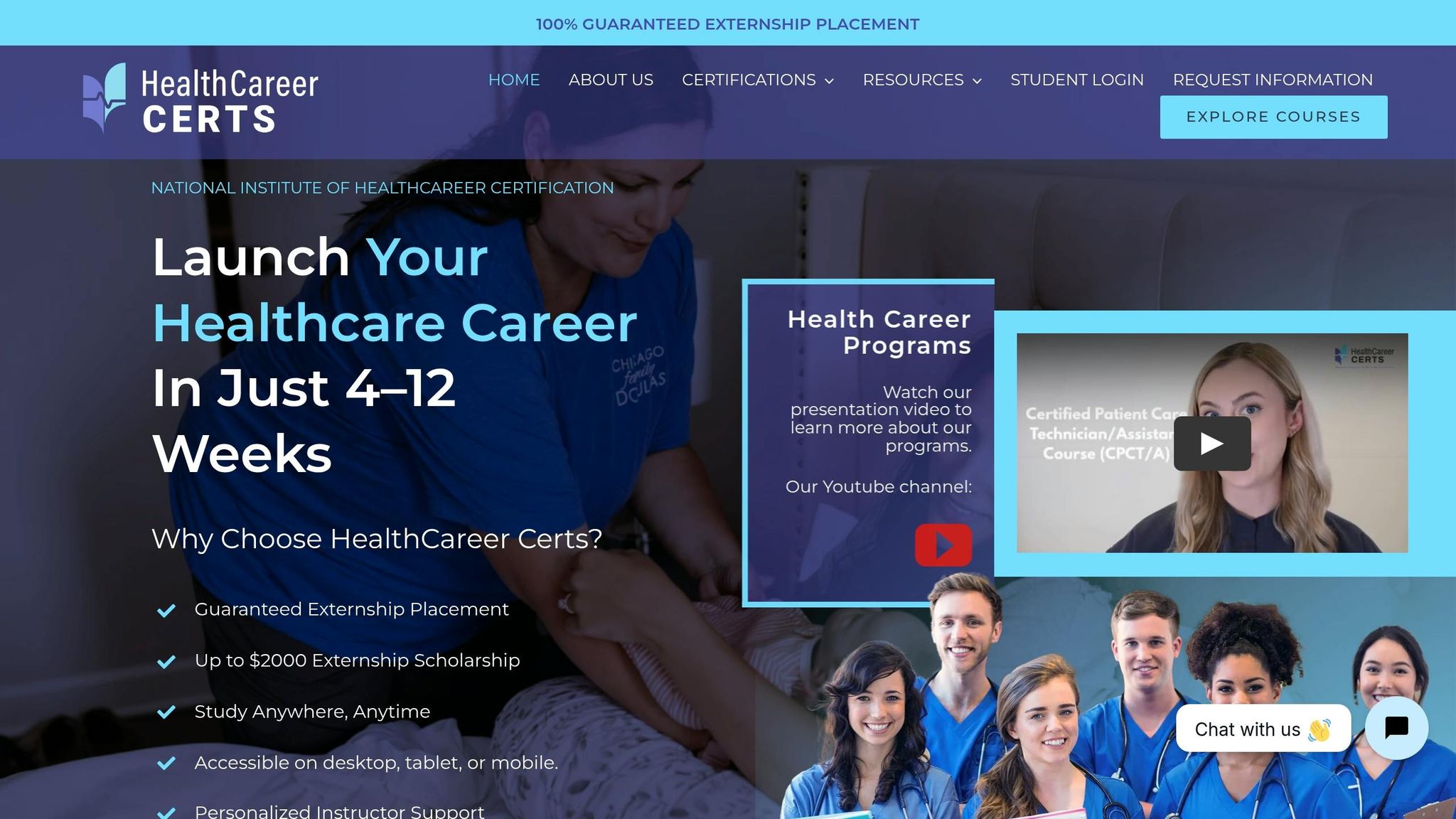
The HealthCareer Certs CCMA program emphasizes flexibility and thorough preparation. Features include one-on-one virtual meetings with instructors, access to 24/7 discussion boards, and dedicated tutoring. The program also covers the cost of the NHA CCMA certification exam with a voucher and guarantees externship placement at a local healthcare facility to meet clinical training requirements.
Graduates who pass the CCMA exam earn 5 ACE (American Council on Education) credits, which can transfer to over 2,000 colleges and universities for future degree programs. The platform is mobile-friendly, making it easy to study during breaks or while traveling. To support career transitions, the program provides services like resume assistance, interview prep, and personalized career coaching.
"I was able to get certified and pass the NHA exam on the first try in only 6 weeks, and I appreciated the ease of the entire process/course and the other support/resources I received." – Olivia
How to Get Certified: Step-by-Step Process
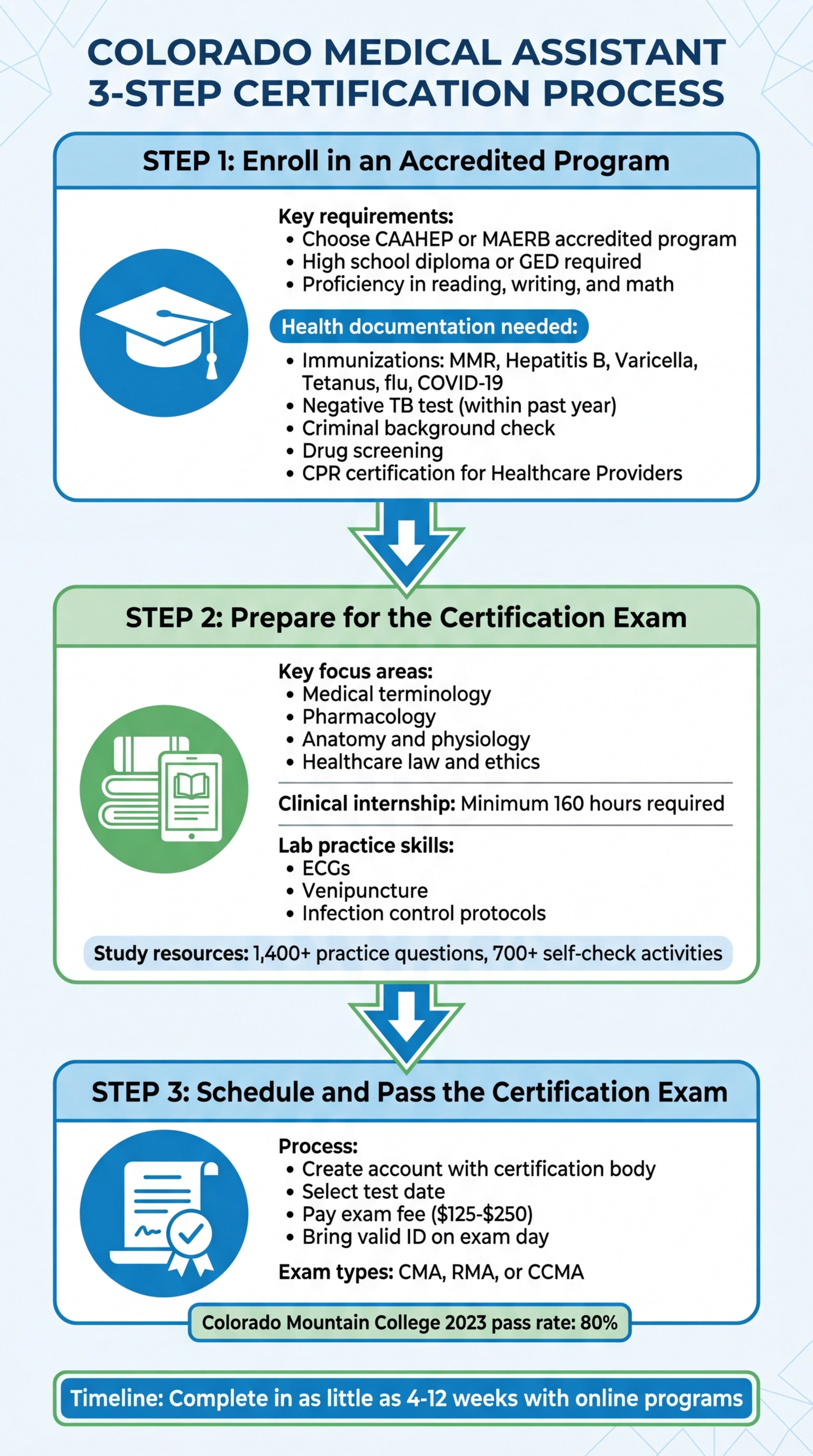
3-Step Process to Become a Certified Medical Assistant in Colorado
Step 1: Enroll in an Accredited Program
The first step is to select a program accredited by the Commission on Accreditation of Allied Health Education Programs (CAAHEP) or the Medical Assisting Education Review Board (MAERB). Accreditation is crucial because it qualifies you to take national certification exams like the American Association of Medical Assistants (AAMA) exam. Make sure you meet the program’s basic requirements, including proficiency in reading, writing, and math.
Once you’re accepted, gather all necessary health documentation. This includes proof of immunizations (MMR, Hepatitis B, Varicella, Tetanus, and seasonal flu), a completed COVID-19 vaccine series, and a negative TB test from within the past year. You’ll also need to pass a criminal background check, complete a drug screening, and obtain CPR certification for Healthcare Providers. Once these steps are done, you’re ready to dive into exam preparation.
Step 2: Prepare for the Certification Exam
With your program underway, shift your focus to mastering the key topics covered on the certification exam. These include medical terminology, pharmacology, anatomy and physiology, and healthcare law and ethics. A clinical internship of at least 160 hours is also required, giving you hands-on experience. Some programs, like those at Colorado Mountain College, even offer a specific "Review for Medical Assistant National Exam" course to help you zero in on exam-related material.
Lab practice is essential for building confidence in skills like ECGs, venipuncture, and infection control protocols – key components of the certification exam. To help you prepare, resources like HealthCareer Certs provide access to over 1,400 practice questions and 700 self-check activities, ensuring you’re well-equipped for test day.
Step 3: Schedule and Pass the Certification Exam
Once you’ve completed your program, it’s time to register for the certification exam. Create an account with the certification body, select a test date, and pay the required fee using a credit or pre-paid card.
On exam day, bring valid identification and be ready to demonstrate both your theoretical knowledge and practical skills. Using all available practice materials and review tools can significantly improve your chances of passing on your first attempt. Preparation is key, so take full advantage of the resources provided by your program and certification body.
Study Resources and Exam Preparation Tips
Study Materials You’ll Need
To prepare effectively, focus on study materials that address clinical, administrative, medical, and legal/ethical skills. Some highly recommended textbooks include Kinn’s The Administrative Medical Assistant: An Applied Learning Approach by Alexander Patricia Adams, Step-by-Step Medical Coding by Carol J. Buck, and Understanding Health Insurance: A Guide to Billing and Reimbursement by Michelle Green. These resources are comprehensive and align well with the knowledge required for certification. Additionally, many programs provide a Student Handbook and Clinic Manual tailored to meet Colorado’s specific requirements.
For more targeted practice, HealthCareer Certs offers a wealth of resources, including over 1,400 practice questions and 700 self-check activities. These tools are designed to mimic the actual exam format, helping you identify areas where you may need extra review.
Hands-on experience through externship work in Colorado medical offices is another essential component. This practical training reinforces classroom learning and builds confidence in key skills like phlebotomy, EKG administration, and patient intake procedures. Combining these resources ensures you’re well-prepared for both the exam and real-world scenarios.
Study Habits That Work
Using these resources is just the first step – your study habits can make or break your preparation. Many Colorado programs include a specific "Review for Medical Assistant National Exam" course (MAP 2069), a 1-credit class designed to consolidate your knowledge and sharpen your focus before the test. This structured approach can be incredibly helpful.
To get the most out of your preparation, create a detailed study plan. Incorporate your externship experience alongside focused review sessions. Since the CCMA exam consists of 180 questions (150 scored and 30 pre-test) to be completed within three hours, practicing under timed conditions is crucial. Full-length practice exams can help you build both speed and accuracy. With a national pass rate of about 77%, honing your skills in areas like medical coding and insurance reimbursement can give you a competitive edge.
If you’re part of a cohort-based program, take advantage of group study sessions. Collaborating with peers can deepen your understanding and provide new perspectives on challenging topics. Combining these strategies with consistent effort will set you up for success on exam day.
Career Outlook and Next Steps in Colorado
Job Opportunities for Medical Assistants in Colorado
Colorado’s healthcare industry is booming, offering a wealth of opportunities for certified medical assistants. The state anticipates a 28.4% increase in employment for medical assistants, with around 1,560 job openings each year. By 2026, Colorado is expected to have a total of 12,930 medical assistant positions available.
"Now more than ever, employers of allied health personnel are preferentially hiring medical assistants who have obtained the necessary training and have successfully acquired the CMA (AAMA) credential." – Community College of Denver
The Denver-Aurora-Lakewood area leads the state with 5,960 positions, offering a median salary of $36,990. Other key areas include Colorado Springs (1,580 positions at $34,530), Fort Collins (730 positions at $34,560), and Boulder (650 positions at $37,040). Across Colorado, the median annual wage for medical assistants was $44,200 as of May 2024.
Medical assistants can find opportunities in various healthcare settings, such as private physician practices, outpatient care centers, surgical hospitals, and diagnostic labs. Colorado Mountain College highlights the demand for medical administrative assistants, noting, "A recent health care survey reported that the career in the Colorado Mountain College District with the most urgent shortage is medical administrative assistant".
These trends highlight the potential to use your training and externship experience to secure a rewarding role in the field.
How to Get Your First Medical Assistant Job
With strong job growth and competitive pay, gaining hands-on experience is key to launching your career. Your externship can be a direct path to employment, as many students receive job offers from their placement sites. Treat your 180-hour externship as a critical opportunity to showcase your skills – local healthcare providers often hire students immediately after graduation.
Before starting clinical placements, make sure all compliance requirements are fulfilled. Use the practical skills gained during your externship to target roles in high-demand metro areas. If clinical positions are limited, consider entry-level roles in related areas to gain experience. If you’re already working in healthcare, explore options for professional development sponsorship through your employer. Focus on metro areas like Denver, Boulder, and Colorado Springs for the best job prospects and competitive salaries.
Conclusion
Earning certification can lead to fulfilling healthcare careers with reliable job security in Colorado. The steps are clear: enroll in a CAAHEP-accredited program, complete your training and externship hours, and pass the national certification exam.
Certification builds on the foundation of your training, giving you an edge in the job market. Employers in Colorado are looking for professionals who can handle both administrative and clinical tasks. Many accredited programs in the state report high exam pass rates and strong job placement, showing how quality training directly impacts career success.
Your externship is a prime chance to make a lasting impression on potential employers. With HealthCareer Certs’ online CCMA program, you could complete your certification in just 4–12 weeks of dedicated study. Considering the competitive wages across Colorado and employer support for growth, certification is an investment that can benefit your career for years to come.
FAQs
Which certification (CMA, RMA, or CCMA) should I choose in Colorado?
In Colorado, the Certified Medical Assistant (CMA) credential from the AAMA stands out as the most widely recognized certification. Employers often prefer it because it aligns with national standards. While the RMA (offered by AMT) and CCMA (provided by NHA) are also valid certifications, the CMA is viewed as the benchmark in the state. Fortunately, accredited programs in Colorado are available to help candidates prepare thoroughly for the certification process.
Will a fully online program still qualify me for the certification exam?
Yes, an entirely online program can prepare you for the certification exam, provided it includes the necessary clinical and hands-on training. This practical experience, often conducted in medical offices, is crucial to fulfilling certification requirements in Colorado.
How long does it take to finish training and get certified in Colorado?
It usually takes about 12 months to complete the training and earn certification as a medical assistant in Colorado. Schools like the Community College of Denver and Colorado Mountain College provide programs that blend online learning with hands-on training, making it possible for students to finish their certification within a year. On average, the process to become certified follows this one-year timeline.