Becoming a Certified Pharmacy Technician (CPhT) as a college student can boost your healthcare career while offering flexible job opportunities. The certification is recognized nationwide and provides practical experience for students balancing academics. Here’s a quick overview of the process:
- Choose Your Path: Take the PTCB exam (500 hours of work experience or training program) or the NHA exam (1,200 hours of work experience).
- Prepare for the Exam: Study for 100–150 hours, focusing on key domains like medications and patient safety. Use official practice tools and flashcards.
- Plan Around Your Schedule: Align study plans with your academic calendar. Consider training programs or work experience based on your availability.
- Understand Costs: Exams cost $129, with additional fees for training programs or recertification. Employers may reimburse expenses.
- Meet State Requirements: Register with your State Board of Pharmacy, complete fingerprinting, and check for trainee status if required.
Certification opens doors to part-time roles in retail and hospital pharmacies, earning $35,100–$59,450 annually. It also strengthens applications for advanced healthcare programs. Start planning now to integrate this credential into your college journey.
CPhT Certification – Ultimate guide on PTCB CPhT Certification
sbb-itb-7a67ffa
CPhT Certification Requirements Explained
PTCB vs NHA Pharmacy Technician Certification Comparison for College Students
Before sitting for the exam, college students can qualify through flexible eligibility options.
For the PTCB certification, there are two main pathways. Pathway 1 involves completing a PTCB-Recognized Education/Training Program, such as a pharmacy degree, or applying within 60 days of finishing the program. Pathway 2 requires at least 500 hours of pharmacy technician work experience. This 500-hour requirement can make the PTCB pathway a more manageable choice for students juggling a busy academic schedule.
The NHA certification, while similar in structure, demands significantly more work experience if you’re not completing a training program – 1,200 hours of supervised pharmacy-related work within the past three years. That’s more than double the experience required by the PTCB, which can be a tight fit for students balancing coursework.
In addition to meeting education or experience requirements, candidates must satisfy general eligibility criteria. This includes residing in the U.S. or its territories, disclosing any criminal history or disciplinary actions from a State Board of Pharmacy, and adhering to certification policies. Most states also require a criminal background check with fingerprinting, which typically costs under $50 and may take up to six weeks to complete. If you’re planning to start an externship or gain work experience soon, scheduling fingerprinting immediately after submitting your state application can help avoid delays.
It’s important to note that national certification is separate from state registration. While the CPhT credential demonstrates your qualifications, you’ll still need to register with your State Board of Pharmacy to work legally. For example, in Texas, you must register as a Pharmacy Technician Trainee before beginning any work experience or externship. This trainee status is valid for two years, allowing you to gain experience and prepare for the certification exam simultaneously. Make sure to check your state’s requirements early, as some states require national certification while others only mandate registration.
PTCB vs NHA: Which Certification Pathway to Choose

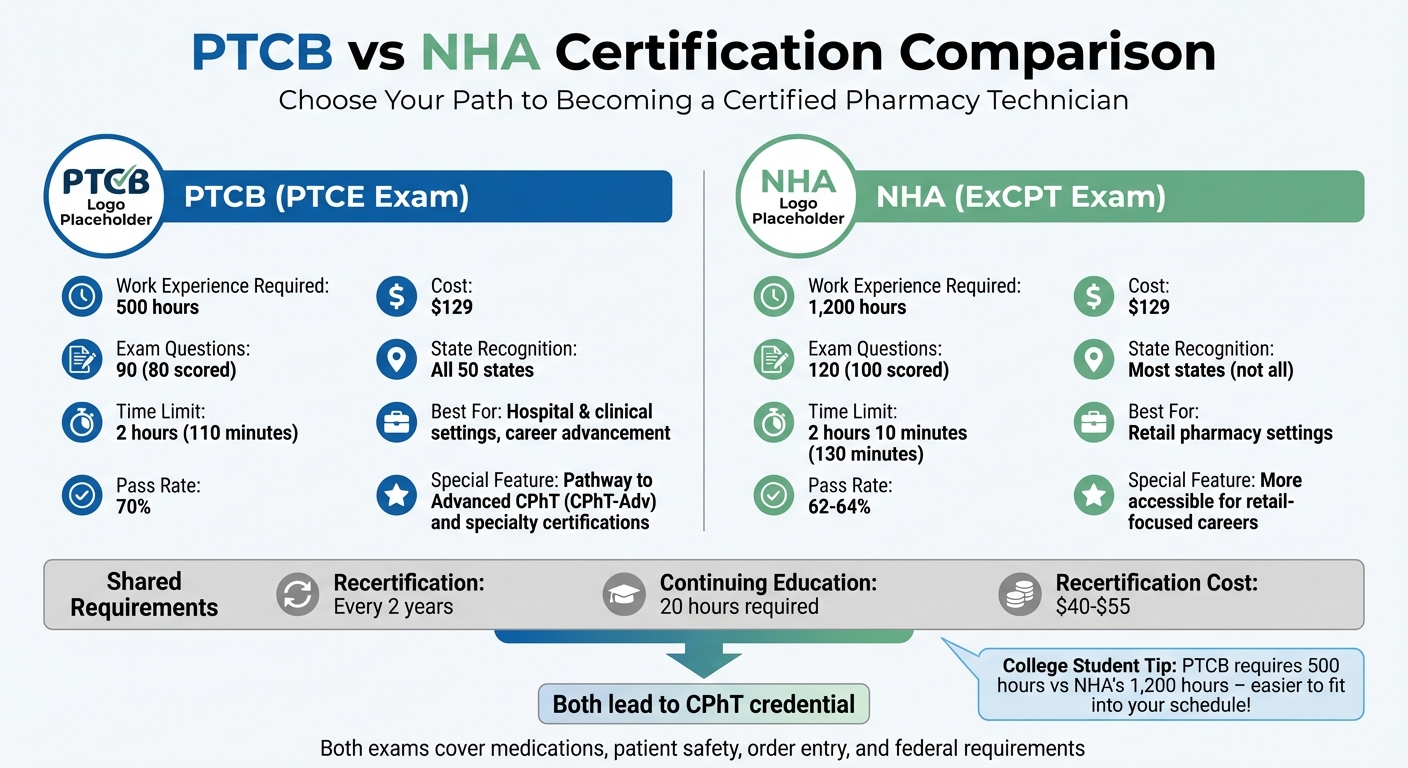
Both the PTCE and ExCPT exams lead to the same CPhT credential, but the two pathways have distinct differences. Choosing the right one depends on your career goals and circumstances.
The PTCE is recognized in all 50 states, while the ExCPT is accepted in most states but not all. If you plan to move after graduation or work in multiple states, the PTCE’s universal acceptance provides greater flexibility. Additionally, the PTCE is often considered the preferred option in hospital and clinical settings. Zachary Green, Director of Professional Affairs at PTCB, highlights its importance:
PTCB’s CPhT truly is the foundation for pharmacy technicians looking to advance their careers. PTCB’s CPhT credential serves as a stepping stone to other specialty and advanced credentials.
In contrast, the ExCPT is often seen as more accessible and focuses more on retail pharmacy operations. If your goal is to work in retail settings, this exam may be a better fit. However, its work experience requirement is 1,200 hours, compared to the PTCB’s 500 hours.
The exams also differ in structure. The PTCE includes 90 multiple-choice questions (80 scored) and has a 2-hour time limit, while the ExCPT features 100–120 questions (100 scored) with a 2-hour and 10-minute time limit. The PTCE had a 70% pass rate in 2024, compared to the ExCPT’s 62–64% pass rate. Both exams cost $129 and require 20 hours of continuing education every two years to maintain certification.
For those considering advanced credentials, the PTCB offers a clear pathway for growth. You can earn specialized certifications, such as in Immunization Administration, or pursue the Advanced Certified Pharmacy Technician (CPhT-Adv) credential. These options aren’t available through the NHA and can be particularly appealing for students aiming for clinical roles or pharmacy school.
State-Specific Requirements
After meeting national certification standards, you’ll need to address state-specific legal requirements.
Each State Board of Pharmacy sets its own rules for pharmacy technicians, which can vary widely. While national certification demonstrates your qualifications, state registration or licensing is what legally allows you to work.
Most states require pharmacy technicians to be at least 18 years old and hold a high school diploma or GED. As a college student, you likely already meet these basic requirements. However, some states have additional steps, such as requiring national certification before registration or having a preference for one exam over the other. It’s essential to verify which certifications your state accepts.
If your program includes an externship or work experience, check if your state requires Pharmacy Technician Trainee status. For example, in Texas, students must register as trainees before starting on-site work. This status lasts for two years and cannot be renewed. The application fee in Texas is $84, plus fingerprinting costs. Applying for trainee status well in advance of your start date can help prevent delays.
One key point to remember: pharmacy technician licenses do not transfer between states. If you move after graduation, you’ll need to apply for a new license in your new state. However, holding a national CPhT credential can simplify this process. As Pharmacy Technician Academy notes:
Holding a national certification (CPhT) often makes it easier to meet licensing requirements when relocating.
Understanding your state’s specific requirements will help you make the most of your certification and ensure a smooth transition into the workforce. Check your State Board of Pharmacy’s website for the latest regulations.
Plan Your Certification Pathway Around Your College Schedule
When juggling college and certification prep, it’s all about finding a plan that works with your academic calendar. Preparing for the PTCE typically takes 100–150 hours of study, so you’ll need to decide on a timeline that fits your course load. For instance, during lighter semesters or breaks, you might opt for a 6-week plan with 3–4 hours of daily study. If your schedule is busier, a 10-week plan with 2 hours a day, six days a week, or a 12–14-week plan with 1.5 hours daily could be more manageable.
Timing your exam is another key consideration. Scheduling it during semester breaks or at the start of a new term can reduce stress. Use downtime – like gaps between classes or your commute – to review materials. Mobile flashcards featuring the Top 200 drugs can be especially helpful for quick study sessions.
To organize your study hours, allocate time based on exam domains:
- Medications: 40% (48–60 hours out of a 120-hour goal)
- Patient Safety: 26.25% (around 32 hours)
- Order Entry: 21.25% (approximately 25 hours)
- Federal Requirements: 12.5% (about 15 hours).
Pharmacy math is an area that requires consistent practice. Start solving 5–10 problems daily at least four weeks before the exam. Additionally, plan to complete 3–5 full-length, timed practice tests to build stamina for the 2-hour exam.
Create a Study Timeline
Your study timeline should align with your academic commitments. Breaks like summer or winter holidays are perfect for an intensive 6-week plan. During regular semesters, a 10-week schedule with two 1-hour sessions – one in the morning and another in the evening – can help maintain focus and energy. If your schedule is packed with classes or work, a 12–14-week plan with shorter daily sessions is a good alternative.
Block off study time in your digital calendar, just like you would for a class. For example, if you plan to take the test in May, start your 10-week study plan in early March and register for the exam during your 90-day authorization window. Once your timeline is set, decide whether you’ll benefit more from a structured training program or hands-on work experience.
Training Programs vs. Work Experience: Which Path to Take
When it comes to certification, you can choose between a structured training program or gaining hands-on work experience. Each option has its pros and cons, and your choice will shape your study and scheduling needs.
- Pathway 1: Training Program
These programs often range from 8 weeks to 12 months and are typically online and self-paced, making it easier to fit them into your schedule. For example, the UTHSC online program requires 164 hours of coursework and costs about $1,800, with a 3-part payment plan available. Programs like this often include exam vouchers in the tuition fee. Dr. James Wheeler, Associate Dean at UTHSC College of Pharmacy, highlights the importance of these programs:
Equipping pharmacy technicians with the skills they need to succeed in a rapidly evolving practice environment is absolutely critical for the pharmacy team to succeed.
- Pathway 2: Work Experience
This option requires 500 hours of pharmacy technician work experience before applying for the exam. It’s ideal for students already working in a pharmacy, as it allows you to earn while you learn without paying tuition fees. However, you’ll still need to carve out time for independent study.
Here’s a quick comparison:
| Feature | Training Program (Pathway 1) | Work Experience (Pathway 2) |
|---|---|---|
| Time Commitment | 8 weeks to 12 months | Minimum 500 hours |
| Cost | Tuition fees (e.g., ~$1,800) | None (earn while you learn) |
| Structure | Organized curriculum with exam prep | Hands-on, self-directed learning |
| Best For | Students with no prior pharmacy experience | Students already working in pharmacies |
| Exam Voucher | Often included in tuition | Paid separately (~$129) |
If you’re new to the pharmacy field and need a clear structure, Pathway 1 might be the better fit. On the other hand, if you’re already working in a pharmacy, Pathway 2 lets you gain practical experience while saving on tuition. For example, working 20 hours a week would help you reach the required 500 hours in about 25 weeks.
Fit Externships or Work Hours Into Your Schedule
Balancing externships or work experience with college classes requires careful planning. If your training program includes an externship, check its schedule. Some programs, like Stepful, separate coursework from the clinical component, requiring 4 months of online classes followed by a 130-hour in-person externship scheduled 1–3 months later. Keep in mind that many externship opportunities operate during standard business hours (Monday–Friday, 9:00 AM–5:00 PM), which might conflict with your classes.
For those pursuing the work experience pathway, plan your hours strategically. Working 15 hours a week would take about 33 weeks to hit 500 hours, while 20 hours a week would reduce that to roughly 25 weeks. Look for evening or weekend shifts to avoid overlapping with your classes. Also, confirm your state’s trainee status requirements before starting any externship or work experience.
Online training programs often offer flexible scheduling. For instance, you might find morning sessions (11:00 AM–12:30 PM) or evening options (5:00 PM–7:00 PM) to accommodate your college schedule. If you’re managing a full course load, consider extending your study timeline to 12–14 weeks with 1.5–2 hours of study each weekday. This approach helps prevent burnout and keeps your GPA intact.
Be realistic about your available time. Overloading yourself can lead to poor performance in both your studies and certification prep. Choose a timeline that fits your schedule and supports your goals effectively.
Prepare for the Certification Exam
With your study plan ready, it’s time to shift your focus to the exam itself. Both the PTCE and the ExCPT are designed to test your ability to perform pharmacy-related tasks with precision and care. To succeed, you’ll need a solid understanding of the exam content, effective study strategies, and a structured schedule. Here’s how you can tackle it step by step.
What’s on the Exam
The PTCE includes 90 multiple-choice questions – 80 of which are scored, while 10 are unscored pilot questions. You’ll have 110 minutes to complete it, and a passing score requires at least 1,400 on a scale ranging from 1,000 to 1,600. Starting January 2026, the exam now includes content on the Drug Supply Chain Security Act (DSCSA) while removing topics like nonsterile compounding (e.g., alligations). The exam is divided into four main sections:
- Medications: 35%
- Patient Safety and Quality Assurance: 23.75%
- Order Entry and Processing: 22.25%
- Federal Requirements: 18.75%
The ExCPT, on the other hand, consists of 120 questions (100 scored and 20 pretest items). You’ll have 130 minutes to complete it, and a passing score is 390 on a scale from 200 to 500. Both exams emphasize key topics like medication safety (e.g., look-alike/sound-alike drugs, high-alert medications), dosage calculations (including unit conversions and days’ supply), and pharmacy laws (covering DEA schedules, HIPAA, and DSCSA).
Math is a crucial part of your preparation. Practice solving unit conversions, concentration calculations, and days’ supply problems efficiently – aim to complete each in under 60–75 seconds.
"Many missed questions are basics: SIG decoding, days’ supply, interactions, and look-alike/sound-alike swaps."
– Pharmacy Tech Scholar
Study Resources That Work
The official PTCB study tools are a great way to simulate exam conditions. For example:
- The Pre-PTCE practice exam costs $29 (or $19 when bundled with your application).
- The PTCE Practice Bank, which includes over 300 questions and 400 flashcards, is available for $65 with 90-day access.
For a deeper review of all exam topics, many candidates turn to resources like Mosby’s Review for the Pharmacy Technician Certification Examination. Flashcard apps like Quizlet are especially helpful for memorizing the Top 200 drugs, focusing on brand/generic pairs that often cause confusion.
AI-driven platforms such as FlashGenius and Open Exam Prep offer tailored learning paths, step-by-step math help, and Pomodoro timers – perfect for busy schedules. YouTube channels like Open Exam Prep provide clear video walkthroughs on challenging topics. Another option is HealthCareer Certs, which offers tools like 3D demos, quizzes, flashcards, and over 1,400 practice questions to help you prepare.
Build a Study Schedule
Treat your study plan like a college course. For a 10-week schedule, aim for two one-hour sessions daily – one in the morning and one in the evening. Allocate your time based on the exam’s domain weightings:
- Medications (35%)
- Patient Safety (24%)
- Order Entry (22%)
- Federal Requirements (19%)
Spend 15–20 minutes daily reviewing drug flashcards and 10–15 minutes practicing pharmacy math. During the last three weeks, take 3–5 full-length, timed practice exams to build your stamina and get comfortable with the test format.
Set a "Go/No-Go" date two weeks before your exam. If your practice scores are consistently below 80%, consider rescheduling to give yourself more time to prepare. Keep in mind, the PTCE has a pass rate of about 71%, while the ExCPT sits at roughly 63%.
Test Day Tips
On the big day, arrive at your Pearson VUE (for the PTCE) or PSI (for the ExCPT) testing center at least 30 minutes early. Make sure to bring a valid, unexpired government-issued ID that matches the name on your exam account exactly, including any middle names or hyphens.
Expect biometric verification, such as fingerprint or palm-vein scans, during check-in. Personal calculators aren’t allowed, but an on-screen calculator will be provided. Familiarize yourself with using one beforehand to avoid surprises.
Use a "Flag and Move" strategy: if you can’t answer a question within 90 seconds, flag it and move on. For math questions, aim to solve each in under 75 seconds to save time for other sections.
"Practice under time: aim for <60–75 sec per math item to protect time for law/safety."
– Dr. Aaron Emmel, Founder, Pharmacy Tech Scholar
Manage Costs and Logistics
Navigating the process of certification requires careful budgeting and planning for tuition, textbooks, and living expenses. Having a clear understanding of the costs involved and the registration process can help you avoid unexpected hurdles.
Budget for Certification Costs
The cost of the certification exam itself is $129 for the PTCE, but that’s just the start. Your overall expenses will vary depending on the training path you choose. For instance:
- Online programs: These can cost anywhere from $500 to $2,000.
- Community college programs: Tuition typically ranges between $700 and $12,000.
- Associate degrees: Expect to pay between $12,500 and $40,000.
On top of tuition and exam fees, you should set aside about $100 for essential study materials like review books, practice exams, or question banks. These resources are worth the investment since retaking the exam costs another $129 – and statistics show that first-time test-takers have a pass rate of 75–78%, compared to just 55–60% for those retaking it.
"The PTCB certification opens more doors with employers. Most job postings specifically ask for CPhT credentials." – Maria Alvarez
If you’re already employed at a pharmacy, check if your employer offers tuition reimbursement or covers exam fees. Many retail chains and hospital pharmacies provide these benefits to employees pursuing certification. Some training programs also offer direct billing or vouchers, which can help reduce upfront costs.
Don’t forget about recurring expenses. Recertification is required every two years, with renewal fees ranging from $40 to $55. You’ll also need to complete 20 hours of continuing education, which often costs around $39 annually if you purchase a membership that grants access to the necessary courses.
Register and Schedule Your Exam
Once your budget is in place, it’s time to tackle the registration process. Start by creating a PTCB account and submitting your eligibility application. After paying the fee and receiving approval, you’ll get an "Authorization to Schedule" email. This gives you a 90-day window to take the exam. If needed, you can request up to two extensions for $20 each, but failing to schedule within the authorization period will result in forfeiting your application fee.
You can schedule your exam through Pearson VUE or opt for online proctoring. A morning time slot is often a good choice, and you should plan for a 2-hour appointment, including check-in time.
Make sure your government-issued photo ID matches the name on your PTCB account exactly, including any middle names or hyphens. Mismatched details could lead to being denied entry and losing your fees. If you’ve had a legal name change, notify PTCB at least 10 business days before your exam date and provide supporting documentation.
For those needing ADA testing accommodations, be sure to request them during your initial application. Submit the required documentation within 30 days to ensure accommodations are arranged. The best part? These accommodations are provided at no extra cost.
Use Your CPhT Certification to Advance Your Career
Career Benefits of CPhT Certification
Using your CPhT certification as a college student can open doors to paid positions, hands-on experience, and better career opportunities. With this credential, you can work part-time in various settings, including major retail chains like CVS and Walgreens, hospital pharmacies, long-term care facilities, infusion centers, or even nuclear pharmacies. The average annual salary for pharmacy technicians is $43,460, with entry-level roles starting around $35,100 and top earners making up to $59,450. Plus, the demand for pharmacy technicians is expected to grow by 6% between 2024 and 2034, making this an increasingly valuable certification.
Beyond earning a paycheck, you’ll gain clinical experience performing advanced tasks like preparing sterile IV solutions, compounding medications, and assisting with vaccinations. These skills not only enhance your resume but also strengthen applications for programs like PharmD, Physician Assistant, or Nursing.
Your certification can also be a stepping stone to specialized credentials. Once you’ve built a foundation, you can pursue advanced certifications in areas such as Immunization Administration, Billing and Reimbursement, or Controlled Substances Diversion Prevention. These additional qualifications make you more appealing to employers and can lead to leadership roles like Pharmacy Technician Supervisor or Educator. Highlight your PTCB digital badge on LinkedIn and your resume to stand out to recruiters and admissions committees.
To stay competitive and maximize your career potential, ongoing education and skill development are essential.
Continuing Education and Recertification
Keeping your certification active is critical to maintaining your skills and career benefits. To renew your CPhT certification, you’ll need 20 hours of continuing education every two years, which must include at least one hour in pharmacy law and another in patient safety. Renewal fees range from $40 to $55, and you can find the necessary courses for about $39 annually through a membership.
Continuing education ensures you stay updated on medication safety, federal regulations, and new pharmacy technologies. It’s a good idea to start earning your required hours early in the two-year cycle to avoid any gaps in certification, especially since many states and employers require an active credential for legal practice. Use these opportunities wisely – attend live workshops or specialized training sessions where you can network with other healthcare professionals and build connections that could lead to future career advancements.
Conclusion
This guide has shown how to incorporate CPhT certification into your college schedule while advancing your healthcare career. To earn your CPhT credential, start by confirming your eligibility: either complete a PTCB-recognized training program or document 500 hours of equivalent work experience. Plan your 90-day exam authorization window to coincide with academic breaks, giving you uninterrupted study time. While both the PTCB and NHA offer certification pathways, the PTCB remains the most widely recognized option.
Commit to a structured study plan over 6–8 weeks, dedicating 100–150 hours to mastering the exam’s core domains. Pay special attention to the Medications section, which makes up 35% of the exam and is the most challenging for many test-takers. Utilize official PTCB tools like the Pre-PTCE ($29) and Practice Bank ($65) to practice in a test-like environment and identify areas for improvement. This focused approach will help you balance your academic and certification goals effectively.
Be mindful of the financial and logistical aspects: the $129 exam fee, $49 biennial recertification cost, and the requirement of 20 continuing education hours. The national pass rate is around 69–70%, and achieving a high scaled score is necessary to pass. If you don’t pass on your first attempt, you’ll need to wait 60 days before retaking the exam. With these details in mind, you can confidently prepare to demonstrate your qualifications to employers and advance your career.
Once certified, you’ll gain access to diverse part-time roles in hospitals, retail pharmacies, and specialized settings, earning an average annual salary of $43,460. These roles provide valuable hands-on experience, which can strengthen your applications for advanced programs like PharmD, Physician Assistant, or Nursing. The field is growing steadily, with 6–7% annual growth and approximately 47,400 to 49,000 job openings projected each year. Certification also opens doors to specialized credentials in areas like sterile compounding, immunization administration, or pharmacy informatics, broadening your career prospects.
FAQs
Can I get certified with no pharmacy experience?
Yes, it’s possible to earn your CPhT certification even if you don’t have any prior pharmacy experience. To meet the requirements, you have two options: either complete a PTCB-recognized education or training program or accumulate at least 500 hours of equivalent work experience. If you’re starting without experience, enrolling in a recognized education program is often the simplest path forward.
Which exam should I take if I may move states?
The PTCB certification exam (PTCE) is a smart choice because it’s recognized across the entire United States. If you ever move to a different state, your certification remains valid, giving you the flexibility to work anywhere in the country.
How do I fit the 500 hours into a semester?
To complete 500 hours of pharmacy technician experience within a semester, aim to dedicate around 25–30 hours per week over a span of 4–5 months. Focus on using weekends, breaks, or free time for hands-on training, ensuring it aligns with your program’s schedule. Be mindful of your overall course load and adjust your weekly hours as needed to stay consistent and meet the requirement without feeling overwhelmed.