- Clinical hour requirements vary by program: Some schools need as few as 500 hours, while others expect 2,000 or more. The national average for admitted students is between 2,500 and 4,000 hours.
- Start early: Building hours takes time. Many students use 1–3 gap years after college to meet these requirements.
- Focus on Patient Care Experience (PCE): Roles like EMT, CNA, or Medical Assistant involve hands-on care and are preferred by PA schools over Healthcare Experience (HCE), which is less direct.
- Paid roles are preferred: Schools value paid clinical work more because it demonstrates responsibility and commitment.
- Certifications help: Becoming certified as an EMT, CNA, or Medical Assistant can open doors to clinical roles that count as PCE.
- Track your hours accurately: Use tools aligned with CASPA to log details like supervisor names and specific tasks performed.
How to get your healthcare/patient care hours for PA School!
sbb-itb-7a67ffa
PA School Clinical Hour Requirements
PA School Clinical Hours Requirements and Averages by Program
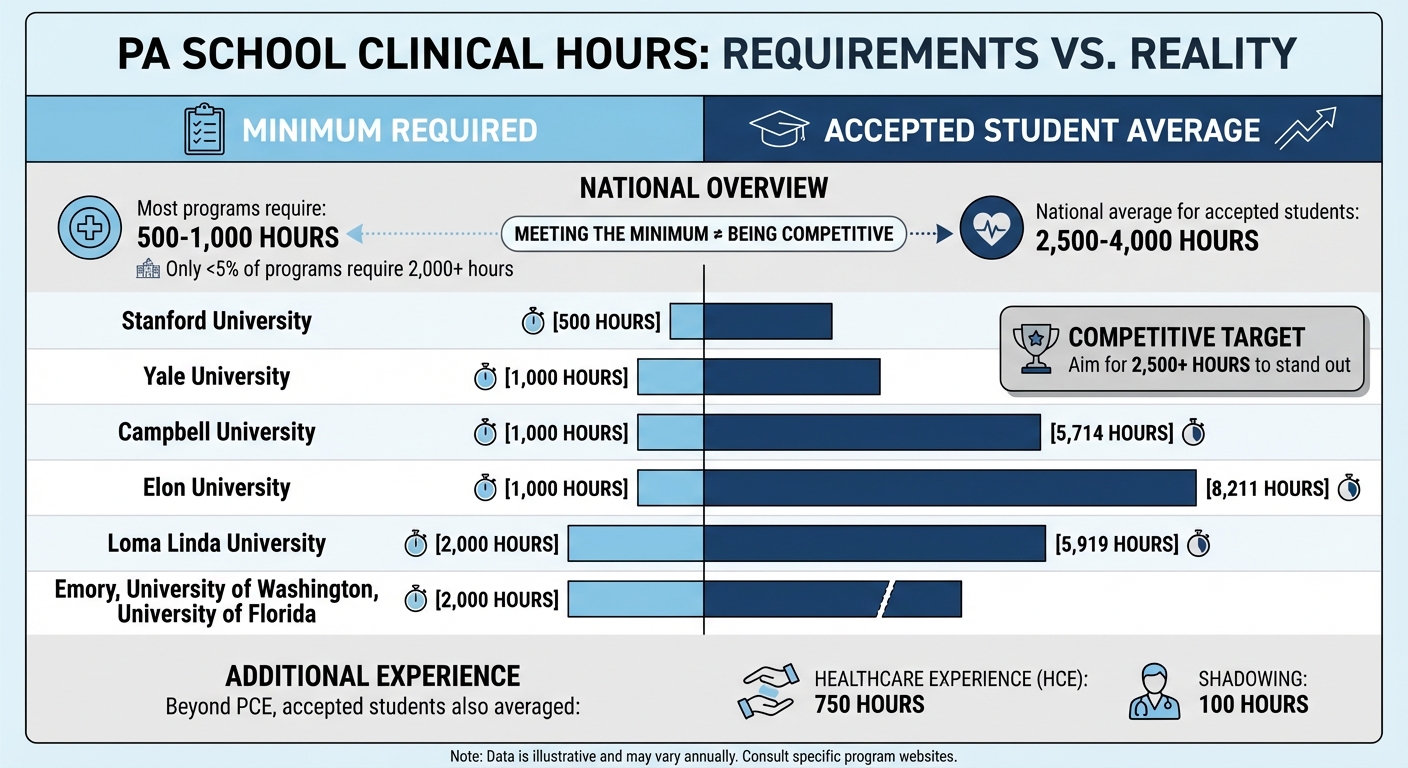
PA programs have a wide range of minimum clinical hour requirements, and knowing these differences can help you focus your efforts on schools where you have a competitive edge. Most programs set their minimum between 500 and 1,000 hours of direct patient care. However, there’s more to it than just meeting the baseline. For example, Stanford requires 500 hours, Yale asks for 1,000, and schools like Emory, the University of Washington, and the University of Florida require 2,000 hours. That said, fewer than 5% of programs actually require 2,000 or more hours, meaning the majority fall comfortably within the 500–1,000-hour range.
But here’s the catch: meeting the minimum doesn’t guarantee competitiveness. Take Campbell University, for instance. While their minimum is 1,000 hours, accepted students average a staggering 5,714 hours. Similarly, Elon University has the same minimum, yet their accepted students average 8,211 hours. Even at schools with higher thresholds, like Loma Linda University (2,000-hour minimum), accepted students average 5,919 hours. Aiming for the national average of around 2,500 hours is a more realistic goal if you want to stand out.
How Requirements Vary Across Programs
The differences in hour requirements often reflect each program’s philosophy and the competitiveness of its applicant pool. Programs with lower minimums tend to attract more applicants, making clinical hours a key factor in setting candidates apart. On the other hand, schools with a 2,000-hour minimum naturally filter for applicants with significant patient care experience. This can be an advantage if you’ve already logged substantial hours.
Interestingly, some programs list clinical hours as "recommended" rather than required. However, competitive applicants almost always surpass these recommendations. Even in these cases, schools typically favor those with extensive hands-on experience. Since each program has its own criteria for acceptable experience, researching individual schools is essential.
What Types of Clinical Experience Count
Understanding what qualifies as clinical experience is just as important as meeting the hour requirements. PA programs generally divide experience into two categories: Patient Care Experience (PCE) and Healthcare Experience (HCE).
- PCE involves direct, hands-on patient care. This includes tasks like taking vitals, administering medications, performing procedures, and assisting with treatments. Common roles include EMT/Paramedic, Certified Nursing Assistant, Medical Assistant (back office), Phlebotomist, and Respiratory Therapist.
- HCE, on the other hand, provides exposure to healthcare settings but lacks the hands-on element. Roles like medical scribe, pharmacy technician, lab technician, medical receptionist, and patient transporter fall into this category.
Recent data shows that accepted students averaged 750 hours of HCE and 100 hours of shadowing, in addition to their direct patient care hours. It’s worth noting that some roles blur the line. For example, medical scribing is typically classified as HCE by CASPA because it doesn’t involve hands-on care, but certain PA programs may count it as PCE. This makes it crucial to check with individual schools to confirm whether your experience meets their PCE criteria.
"Direct patient care experience is one of the most important parts of the PA school application and is highly valued by PA schools." – Admissions Helpers
Paid positions are generally viewed more favorably than volunteer roles because they often require a higher level of responsibility and commitment. For example, an EMT responding to emergencies is likely to carry more weight than a medical scribe documenting patient interactions, even though both involve patient contact. This distinction highlights why prioritizing direct patient care roles is key when planning your clinical hour strategy.
Clinical Roles That Qualify for PA School
Direct Patient Care Positions
The best clinical roles for PA school are those where you’re actively involved in a patient’s care. This means performing hands-on tasks like taking vitals, administering injections, assisting with procedures, or managing treatments – not just observing or documenting.
Roles like EMT and Paramedic require quick thinking and immediate care, skills that PA programs highly value. Certified Nursing Assistants (CNA) often work in hospitals or long-term care facilities, helping patients with mobility, monitoring their health, and assisting with daily activities. Medical Assistants (MA) and Patient Care Technicians (PCT) handle a mix of duties, such as drawing blood, giving injections, recording medical histories, performing EKGs, and prepping patients for exams. If you’ve served as a Military Medic/Corpsman, you’ve likely gained hands-on experience in high-pressure environments. Similarly, Licensed Practical Nurses (LPN) or Registered Nurses (RN) undergo extensive clinical training, though these roles often require more preparation. What these roles have in common is direct involvement in patient care and decision-making, which PA schools prioritize over roles that focus solely on observation or interaction.
In addition to these core roles, there are other specialized positions that can also provide valuable clinical experience.
Additional Healthcare Positions
Some specialized roles might not seem as obvious but still offer hands-on patient care that PA programs recognize. For instance, Phlebotomists focus on drawing blood and processing specimens, a task that’s both practical and widely accepted by PA schools. Respiratory Therapists take on responsibilities like managing ventilators, administering breathing treatments, and monitoring patients with respiratory issues. Surgical Technicians work directly in the operating room, assisting surgeons and maintaining sterile environments during procedures. Even roles like Physical Therapy Aides and Dental Hygienists can count, as they involve assessing and treating patients.
However, some positions may fall into a gray area. For example, Clinical Research Coordinators might qualify if their role includes tasks like drawing blood or conducting physical exams, rather than just enrolling participants or handling data. On the other hand, Pharmacy Technicians are typically classified under healthcare experience, as they lack the direct patient care PA schools look for.
"The more responsibility a patient care role entails, the more favorably it will be viewed by PA schools." – Admissions Helpers
These roles help develop the hands-on skills and decision-making abilities that PA schools value. If you’re unsure whether your role qualifies, check with your target programs. For positions that mix administrative and clinical duties – like a Medical Assistant who splits time between the front desk and back office – be sure to track and document your clinical hours accurately on your CASPA application.
Paid Positions vs. Volunteer Experience
When you’re working on building clinical hours for PA school, choosing between paid positions and volunteer opportunities is an important decision. Both options have distinct benefits, and understanding these can help you make the right choice.
Benefits of Paid Positions
Paid clinical roles are highly regarded by PA schools because they demonstrate a strong sense of accountability and responsibility. These positions not only provide direct patient care experience but also allow you to earn an income while meeting the required hours.
"Paid patient care experience for PA school is preferred because it demonstrates a higher level of responsibility and commitment." – Admissions Helpers
Being part of a professional care team in a paid role shows that patients rely on you for consistent, quality care. Common roles like Medical Assistant, CNA, or EMT offer steady hourly wages, while specialized positions such as Clinical Research Coordinator can pay entry-level salaries ranging from $40,000 to $50,000. Moreover, some PA programs, such as those at Duke, Emory, and the University of Iowa, specifically require paid clinical experience and may not accept unpaid hours toward their Patient Care Experience (PCE) minimums.
"Generally, it is safest to choose a PAID job versus a volunteer opportunity in direct patient care; many schools will not accept unpaid hours." – BYU Pre-Professional Advisement Center
However, paid positions often require certifications like CNA or EMT, which can cost between $700 and $1,400 and typically take about six weeks to complete. Additionally, these roles may come with fixed schedules, which can be challenging to balance with full-time coursework.
Benefits of Volunteer Opportunities
Volunteering offers a level of flexibility that paid positions often cannot match. If you’re juggling prerequisites or another job, volunteer shifts at hospitals, free clinics, or community health centers can provide meaningful clinical exposure without the constraints of a rigid schedule. For instance, short-term opportunities like medical mission trips can provide 150–200 hours of experience in just two weeks.
Volunteering also highlights your dedication to service and altruism – qualities that PA programs value alongside clinical skills. Admissions committees appreciate applicants who demonstrate a willingness to serve vulnerable populations without financial compensation. To complement paid clinical hours, consider dedicating 50–150 hours to community service activities like volunteering at a food bank or crisis hotline. This combination can showcase a well-rounded commitment to both service and healthcare.
That said, volunteer roles may not always involve direct patient care. Tasks might include clerical work, patient transport, or observation, which offer lower levels of responsibility. Additionally, some PA programs may not count unpaid volunteer hours toward PCE requirements. It’s crucial to confirm with your target programs whether your volunteer hours will be accepted.
Paid vs. Volunteer Experience Comparison
Here’s a quick breakdown of the main differences between paid and volunteer clinical roles:
| Feature | Paid Positions | Volunteer Opportunities |
|---|---|---|
| Income Potential | Provides steady wages; specialized roles can pay $40,000–$50,000 | Unpaid; may involve costs (e.g., mission trip fees) |
| Program Acceptance | Widely accepted as direct patient care experience | Accepted by many programs; verify with target schools |
| Responsibility Level | High; involves direct patient care and accountability | Often lower; may be limited to observational or supportive roles |
| Time Commitment | Fixed schedules | Flexible; can be scheduled around other commitments |
| Certification | Typically requires certification (e.g., CNA, EMT) | Generally does not require formal certification |
| Application Category | Considered "Paid Patient Care Experience" | Typically recorded as "Volunteer" or "Community Service" |
To strengthen your application, consider combining both paid work and volunteer experience. This approach not only helps you meet technical requirements but also highlights your dedication to service – qualities PA programs value highly.
Getting Certified to Improve Your Job Prospects
Common Certifications for Clinical Roles
Earning certifications can open the door to clinical roles required by many PA programs. For example, the Certified Clinical Medical Assistant (CCMA) equips you to handle tasks like taking vitals, assisting with procedures, and performing phlebotomy in outpatient environments. Another option, the Certified Patient Care Technician (CPCT), provides cross-training in areas such as phlebotomy, EKGs, and basic patient care, giving you exposure to various hospital departments. If you’re looking for a quicker path, the Certified Phlebotomy Technician (CPT) certification can be completed in just 3–4 weeks. For those interested in high-intensity environments, Emergency Medical Technician (EMT) training includes 120–150 hours of classroom instruction and 24–75 hours of hands-on experience in emergency settings.
Here’s a breakdown of training costs and requirements:
- CCMA: $2,000–$5,000 for training, $165 exam fee, and a 77% pass rate.
- CPCT: $1,000–$4,000 for training, $165 exam fee.
- CPT: 3–4 weeks of training costing $500–$1,400, with a $129 exam fee.
- EMT: 120–150 hours of classroom training and 24–75 clinical hours, costing $1,200–$1,400.
These certifications not only satisfy PA program requirements but also help you build practical skills for direct patient care.
How Certifications Help You Get Better Clinical Hours
Certifications don’t just meet admission requirements – they elevate your application by proving your hands-on skills. They qualify you for roles involving direct patient care, which PA programs value as Patient Care Experience (PCE) over Healthcare Experience (HCE). PCE roles require you to be directly responsible for a patient’s care, a factor that admissions committees weigh heavily.
"PCE is more highly regarded by PA programs than HCE because it involves hands-on, direct patient care." – Ryanne Coulson, PA-C
Beyond meeting prerequisites, certifications show that you’re ready to perform essential clinical tasks and understand current healthcare practices. This is key in a field where roles like medical assistants are expected to grow by 15% between 2023 and 2033 – outpacing many other healthcare jobs. Certified positions also tend to offer higher pay, reflecting the advanced skills that PA programs prioritize. Before pursuing a certification, confirm with your target PA programs that the role qualifies as PCE rather than HCE.
Online Certification Programs with Externship Placements
To maximize the benefits of certification, look for programs that include hands-on training. Online certification courses offer flexibility for students juggling science prerequisites and clinical preparation. For instance, HealthCareer Certs provides self-paced courses that can be completed in 8–12 weeks. These courses include interactive tools, practice materials, and – most importantly – a 100% guaranteed externship placement. This ensures you’ll gain real-world experience in a healthcare setting near you.
Externships help bridge the gap between theoretical learning and practical application, making you job-ready for clinical roles. HealthCareer Certs also prepares you for nationally accredited exams, which are essential for securing positions at top hospitals that often require certification. To make the process more accessible, they offer externship scholarships of up to $2,000. When choosing an online program, prioritize ones that offer clinical simulations and guaranteed externship placements to ensure you’re prepared to step into patient care roles immediately.
Where to Find Clinical Experience Opportunities
If you’re aiming to meet the clinical hour requirements for PA school, here are some practical ways to find meaningful patient care opportunities.
Job Boards and Online Resources
Start by exploring general job boards like LinkedIn, Indeed, and ZipRecruiter. These platforms often list entry-level healthcare roles. For instance, LinkedIn currently features over 92,000 physician assistant-related positions. Use quotation marks (e.g., "medical assistant") to narrow your search results for specific roles.
For more targeted searches, try healthcare-specific boards like DocCafe, Health eCareers, and AAPA Career Central. DocCafe alone lists over 10,000 PA positions across 80+ specialties, helping you avoid irrelevant non-medical listings. Another helpful tool is Google for Jobs, which compiles postings from multiple sources like LinkedIn, Indeed, and Glassdoor. Platforms like Doximity and LinkedIn also let you connect directly with recruiters.
"Posting on industry-specific job boards provides a significant advantage over general purpose job boards because they cater to the unique requirements of the healthcare world." – Robert Truog, PhysEmp
While online searches are essential, don’t underestimate the power of personal connections in the healthcare field.
Networking with Healthcare Professionals
Building a network in the healthcare community can open doors to opportunities that aren’t publicly advertised. Research shows that 70–80% of jobs are filled through networking rather than traditional applications. Reach out to practicing PAs, doctors, or other clinical staff on platforms like LinkedIn or Doximity to inquire about shadowing opportunities or job leads. Your college’s career services and alumni network can also be valuable resources for exclusive clinical placement options.
"Word of mouth is an immensely effective job search tool. Studies consistently show that 70–80% of jobs are filled through networking." – Stephen Pasquini PA-C, Creator of The PA Life
Every clinical rotation, volunteer shift, or shadowing experience is a chance to expand your network. Take the time to ask preceptors about their career journeys, send follow-up thank-you notes, and connect with them professionally on LinkedIn. Joining organizations like the American Academy of Physician Associates (AAPA) or your state PA chapter can also provide access to member directories and events where you can meet practicing PAs.
Contacting Healthcare Facilities Directly
Another effective strategy is to contact healthcare facilities directly. Reach out to inquire about clinical roles or volunteer opportunities. For private practices, call and ask to speak with the practice manager, who often handles staffing decisions. In larger institutions like hospitals, connect with the volunteer services department or human resources to learn about structured pre-health volunteer programs that offer direct patient care experience.
"Contact the practice manager of a local practice to ask if there are any opportunities for shadowing." – APACVS
Don’t limit yourself to hospitals. Consider community health clinics, nursing homes, assisted living facilities, urgent care centers, or even your campus medical clinic if you’re a student. These settings often have volunteer or paid roles that can help you accumulate clinical hours over time. Before committing to a role, confirm with your target PA programs that the tasks you perform will count as Patient Care Experience (PCE) rather than Healthcare Experience (HCE).
How to Track and Complete Your Clinical Hours
Tracking and Documenting Your Hours
Accurate tracking of your clinical hours is essential for PA school applications. The smartest way to do this is by using tools that align with the CASPA (Centralized Application Service for Physician Assistants) format. This makes it easy to transfer your records directly into your application. You’ve got several free resources to choose from, like the AAPA Pre-PA Record Keeper (free for AAPA members) and the Pre-PA Clinic CASPA Record Keeper. If you prefer a more customized approach, Google Sheets or Excel templates like "The Ultimate PA School Applicant Logbook" are excellent options. These tools not only track Patient Care Experience (PCE), Healthcare Experience (HCE), and shadowing hours but also help you organize prerequisite courses in one place.
Make it a habit to update your logs weekly. Include details like your supervisor’s name, title, and contact information, along with specific duties performed. Some PA programs verify hours by reaching out directly to your supervisors, so precision matters. When describing your tasks, use action-oriented language such as "assisted with wound care", "took vital signs", or "documented patient histories" instead of vague terms like "helped patients". Keep separate records for PCE, HCE, and shadowing, as CASPA requires these to be logged individually.
"Poorly tracked hours can lead to discrepancies in your application, which might raise red flags. Accurate logging ensures your experiences are clear, organized, and compelling." – Pre-PA Clinic
Don’t just focus on the numbers. Document meaningful patient interactions or key lessons learned. These notes will prove invaluable when writing personal statements or preparing for interviews.
Balancing Clinical Work with Other Commitments
Once your tracking system is in place, the next challenge is balancing clinical hours with your other responsibilities. Reaching the 2,500+ hours that the average accepted PA student has requires careful planning. Many applicants take 1–3 gap years after college to work full-time in clinical roles, ensuring they don’t sacrifice their undergraduate GPA. Certification programs like Certified Clinical Medical Assistant (CCMA) or Certified Patient Care Technician (CPCT) offer flexible schedules, making it easier to gain clinical experience during school breaks.
It’s worth noting that many PA programs allow you to continue earning hours after submitting your CASPA application, as long as you meet the minimum requirement by the matriculation deadline. This flexibility means you can apply while still building experience, instead of waiting until you’ve reached a specific hour count.
Building Experience Across Multiple Roles
Adding variety to your clinical roles can make your application stand out by showing growth and adaptability. While direct patient care should remain your focus, exploring different roles highlights your ability to take on new challenges. For example, you might start with a non-certified position like Patient Care Technician or hospital volunteer, then transition to a certified role like EMT or Medical Assistant as you gain confidence and skills. This progression demonstrates increasing responsibility, which admissions committees value.
"Diversifying to include volunteer work will help in regards to the personal written statement and eventual talking points during an interview." – Billa the PA
If you’re in a "hybrid" role – like a Medical Assistant who handles both patient care and administrative tasks – be sure to log your PCE and HCE hours separately. Clearly outline your responsibilities for each aspect of the job, and include your supervisor’s contact details to avoid any confusion when filling out CASPA.
Conclusion
Getting into PA school requires careful planning and a solid understanding of what admissions committees are looking for. While some programs accept applicants with as few as 500 clinical hours, competitive programs often favor those with much more experience – the average accepted student has around 2,664 hours of direct patient care. Starting early and prioritizing roles that offer direct patient interaction over administrative tasks can give you a significant edge.
Certification programs can be a game-changer when it comes to bridging the gap between meeting minimum requirements and becoming a standout applicant. Certifications not only open doors to valuable patient care roles but also often lead to paid opportunities – something highly regarded by top programs like Emory University and the University of Washington. For example, HealthCareer Certs offers guaranteed externship placements and scholarships of up to $2,000, providing hands-on training in real healthcare environments to help you build essential skills.
Tracking your clinical hours meticulously from the beginning is crucial. Use tools that align with the CASPA format and make sure to log details like your supervisor’s contact information and a clear description of your patient care responsibilities. Additionally, diversifying your experience – such as starting as a Patient Care Technician and later transitioning to an EMT – can highlight your growth and flexibility. These well-documented, varied experiences can make a strong impression on admissions committees.
Though the road to PA school is highly competitive, early preparation, strategic certifications, and guaranteed clinical placements can help you meet and exceed the requirements. Start gaining clinical experience now to stay on track for application deadlines.
FAQs
How many clinical hours should I aim for to be competitive?
To stay competitive when applying to PA school, aim to accumulate between 500 and 2,000 direct patient care hours. Many programs lean toward applicants with 1,000 hours or more, so it’s a good benchmark to keep in mind. Be sure to review the specific requirements of your target schools to align with their expectations.
Will my job count as PCE or only HCE?
Whether your job qualifies as PCE (Patient Care Experience) depends entirely on the duties you perform. PCE typically involves hands-on tasks like taking vital signs, administering medications, or directly assisting with medical procedures. Positions such as medical assistant, EMT, or phlebotomist often fall into this category. On the other hand, HCE (Healthcare Experience) includes roles focused on non-clinical responsibilities, like administrative tasks. While HCE might not count as PCE, it can still be an important addition to your PA school application.
Can I apply while still earning clinical hours?
Yes, many PA programs let you apply even if you’re still finishing your clinical hours. In fact, some programs appreciate the continued experience in patient care, as long as you’ve completed a substantial portion by the time you apply. Make sure to review the specific requirements of each program to confirm you meet their criteria.