
Balancing a healthcare certification with a full academic schedule might seem overwhelming, but it’s achievable with the right strategies. Here’s how you can manage both effectively:
- Choose the right certification: Consider programs that align with your career goals and time availability. Options like CCMA, CPT, or CNA typically range from 4 weeks to 12 months.
- Opt for flexible learning formats: Online or hybrid programs allow you to study on your schedule. Self-paced courses can help you maximize limited free time.
- Master time management: Conduct a time audit to identify study opportunities in your day. Dedicate consistent blocks of time each week and use tools like the Pomodoro Technique for focus.
- Prepare efficiently: Focus on high-priority topics, use active recall methods like flashcards, and take practice tests to simulate exam conditions.
- Leverage support systems: Use academic resources, join study groups, and communicate with employers or advisors for flexibility.
How to Become a Medical Assistant in College
sbb-itb-7a67ffa
Step 1: Choose the Right Healthcare Certification Program
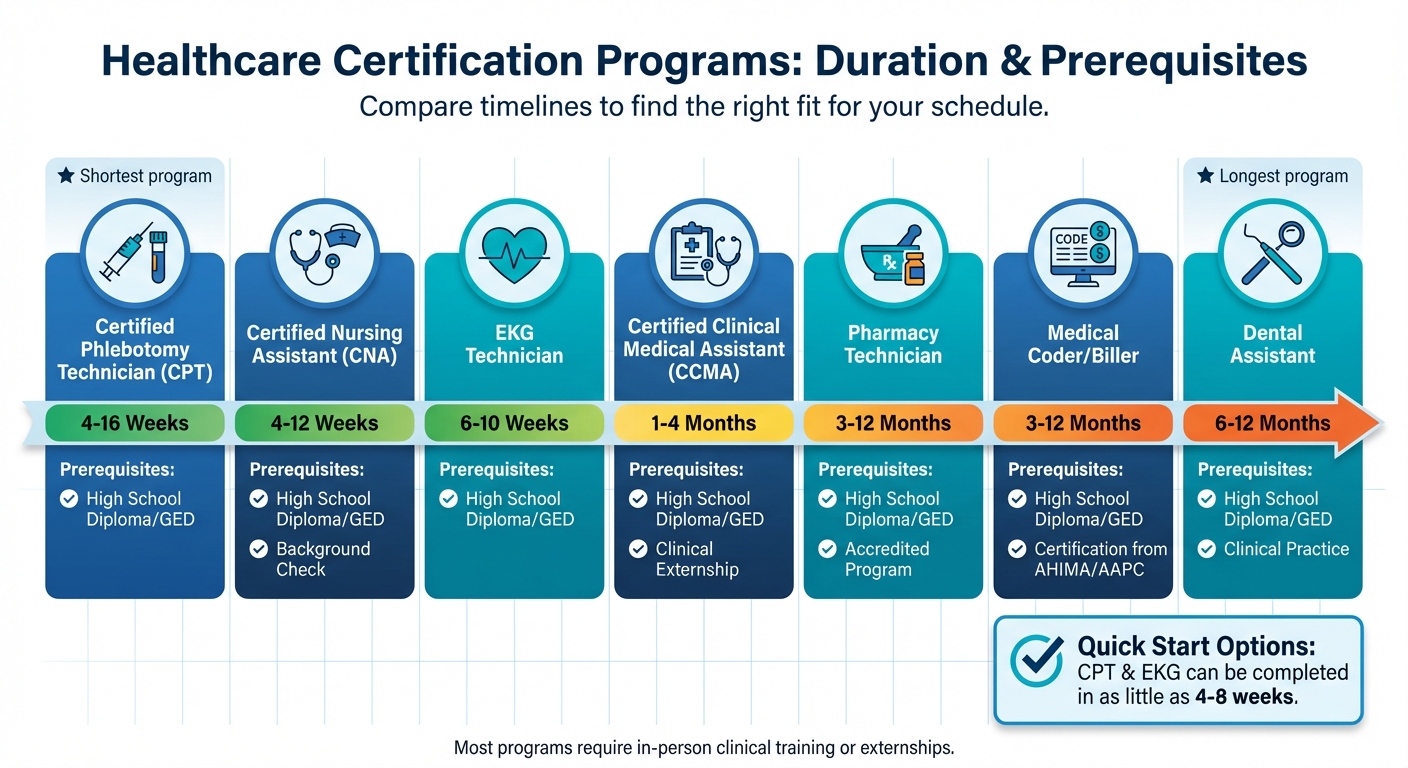
Healthcare Certification Programs: Duration and Prerequisites Comparison
Review Certification Options and Requirements
Balancing certification studies with a packed schedule starts by picking a program that fits both your career aspirations and available time. The healthcare industry offers a wide range of certifications, but not all are the same. Some focus on patient-facing roles, while others are geared toward administrative or technical positions.
If you’re drawn to patient care, certifications like CCMA (Certified Clinical Medical Assistant), CNA (Certified Nursing Assistant), or CPT (Certified Phlebotomy Technician) may be ideal. Prefer working behind the scenes? Consider certifications in medical coding, billing, or pharmacy technology – with medical coding being one of the fastest-growing remote healthcare fields. Most entry-level certifications require only a high school diploma or GED, but it’s essential to check state-specific licensing rules. For example, some states only allow certified medical assistants to input medication and lab orders into electronic systems.
To ensure quality education and better job prospects, choose programs accredited by organizations like the NCCA, CAAHEP, or ACEN. Accreditation not only indicates high educational standards but also prepares you for licensing exams, which employers often prioritize.
Check Time Requirements and Completion Timelines
Certification programs vary widely in duration, from a few weeks to nearly a year. Before committing, it’s crucial to understand these timelines, especially if you’re juggling a full course load.
Here’s a quick look at common certifications and their typical timelines:
| Certification | Average Duration | Primary Prerequisites |
|---|---|---|
| Certified Phlebotomy Technician (CPT) | 4–16 Weeks | High School Diploma/GED |
| Certified Nursing Assistant (CNA) | 4–12 Weeks | High School Diploma/GED; Background Check |
| EKG Technician | 6–10 Weeks | High School Diploma/GED |
| Certified Clinical Medical Assistant (CCMA) | 1–4 Months | High School Diploma/GED; Clinical Externship |
| Pharmacy Technician | 3–12 Months | High School Diploma/GED; Accredited Program |
| Medical Coder/Biller | 3–12 Months | High School Diploma/GED; Certification from AHIMA/AAPC |
| Dental Assistant | 6–12 Months | High School Diploma/GED; Clinical Practice |
For students with limited time, shorter programs like Certified Phlebotomy Technician (CPT) or EKG Technician can be completed in just 4 to 8 weeks. If you have 8–12 weeks before an exam, dedicating about 8–12 hours per week – roughly 1–2 hours daily – might be enough to prepare for certifications like the CCMA. Flexible, self-paced online programs, such as those offered by HealthCareer Certs for CCMA and CPT, are excellent options for fitting studies around your existing commitments.
Keep in mind, even online programs often require in-person clinical training or externships. These hands-on components can range from a few days to several weeks, depending on the certification, so plan accordingly.
Once you understand the timelines, the next step is to explore flexible learning formats that align with your schedule.
Step 2: Select a Flexible Learning Format
Compare Online, Hybrid, and In-Person Programs
Picking the right learning format can make a big difference in how well you manage certification studies alongside a packed schedule. Online programs let you study whenever it works for you, cutting out commuting time entirely. But, they demand a lot of self-discipline since there’s no instructor physically present to keep you on track.
Hybrid programs combine online coursework with in-person labs or clinical rotations. This setup is great for certifications that require hands-on practice, providing access to necessary equipment while still offering some flexibility.
On the other hand, in-person programs provide a structured environment with immediate feedback from instructors. However, their rigid schedules can be tough to juggle with other responsibilities. For students dealing with heavy academic workloads, asynchronous online programs are often the most practical choice. They let you fit in study time during breaks between classes or even over lunch.
Before signing up, check if your certification requires in-person clinical hours. These can’t be done virtually, even though many programs now use virtual simulations – like augmented or virtual reality – to replicate lab experiences. For most patient-facing roles, hands-on externships are still mandatory. If flexibility is key for you, self-paced learning might be the way to go.
Use Self-Paced Online Learning
Self-paced platforms are a game-changer for busy schedules, giving you full control over how and when you study. You can pause lectures to take notes, rewind tricky sections for better understanding, or breeze through topics you already know. This adaptability is especially helpful during exam prep or group project deadlines.
Self-paced learning also makes it easy to squeeze in quick study sessions. For example, you can use a short break between classes to review flashcards or listen to an audio lecture.
HealthCareer Certs offers fully asynchronous programs for certifications like CCMA and CPT. These programs are mobile-friendly and include features like video speed controls, downloadable materials, and self-check quizzes. A smart approach is to dedicate your first weekend to completing initial readings and assignments. This creates a buffer for busier weeks, keeping you ahead of the game. Treat these study sessions as non-negotiable appointments in your calendar.
Even with the flexibility of online learning, remember that most healthcare certifications still require in-person clinical hours or externships. To avoid scheduling conflicts, look for programs offering weekend or evening clinical shifts that won’t interfere with your weekday commitments.
Step 3: Master Time Management and Study Strategies
Build a Realistic Study Schedule
Once you’ve embraced flexible learning, it’s time to make the most of your available hours. Start by tracking your daily activities for a week – everything from classes and meals to your time spent scrolling through social media. This "time audit" can uncover overlooked opportunities, like 30–45 minutes during lunch or 20–30 minutes while commuting, that you can dedicate to studying.
For the CCMA certification, aim for 8–12 study hours per week over a span of 8–12 weeks. Break this into smaller, manageable chunks. For instance, study for 30–60 minutes in the morning, set aside 1–2 hours on a couple of evenings, and reserve one longer 3–4 hour session over the weekend.
Include extra "swing time" in your schedule for revisiting tricky topics or catching up on practice areas where your scores are lagging. Add a 25–50% buffer to your original time estimates to accommodate these adjustments. And don’t forget to take care of your mental health – reserve at least one full day each week to step away from studying. This downtime gives your brain a chance to process and consolidate new information. If life gets hectic, switch to a maintenance mode by doing quick 15-minute reviews with flashcards. Using short gaps like these can increase your overall study time by about 30%.
Focus on High-Priority Study Areas
The CCMA exam isn’t evenly weighted across all topics. Clinical patient care and procedures tend to dominate the question pool, so make these your top priority. Zero in on high-yield topics, group similar study tasks together, and tackle them when your energy levels are at their peak to minimize fatigue.
A two-pass strategy can also be helpful: first, answer the questions you know well to build confidence, then circle back to the tougher ones. And remember, multitasking while studying can cut your productivity by up to 40%. Stay focused and work on one thing at a time.
Use Study Tools and Resources for Efficiency
Make your study sessions more effective with tools and techniques that maximize retention. Active recall methods, like flashcards, can be game-changers. Pair them with the Pomodoro Technique – 25 minutes of focused study followed by a 5-minute break – to stay sharp and avoid burnout. A timer can help you stick to this rhythm and fend off distractions.
Take advantage of resources like HealthCareer Certs, which offers interactive features like 3D demos, self-check quizzes, and over 1,400 mobile-friendly practice questions. These tools make it easy to integrate microlearning – short 15- to 30-minute sessions – into your day. Even your commute can be productive: listen to audio courses while driving or review flashcards and practice questions if you’re on public transit.
To solidify your knowledge, create "memory compression sheets" that condense key points, steps, and visuals onto a single page for each topic. Another effective method is "teach-back" – explain a complex concept aloud in 90 seconds. If you struggle to articulate it clearly, it’s a sign you need to revisit that material.
Step 4: Prepare for and Take the Certification Exam
Learn the Exam Structure and Content
Understanding the structure of your certification exam can help you prepare more effectively. The CCMA exam consists of 180 questions (150 are scored, and 30 are unscored) that you’ll need to complete within 3 hours. To pass, you’ll need a score of 390 on a scale of 200 to 500.
The exam places the greatest emphasis on Clinical Patient Care, which makes up 56% of the test. The remaining 44% covers areas like Foundational Knowledge, Patient Care Coordination, Administrative Assisting, Communication, Anatomy & Physiology, and Medical Law & Ethics.
For the CPT exam, you’ll encounter 100 questions within a 2-hour time limit, and you’ll need to score 70% or higher to pass.
Once you’re familiar with the exam content and time limits, the next step is to plan for the associated costs and registration process.
Plan for Exam Costs and Registration
Budgeting for the certification exam involves more than just the test fee itself. For the CCMA exam, registration costs $165. If you’re using NHA study materials, you can expect to pay $69 for the study guide, $49 for practice tests, or $94 for a bundle with both. Some training programs, like HealthCareer Certs, may include these materials and exam fees in their tuition, so check before purchasing additional resources.
To register, visit the NHA website, create an account, and upload proof of your training completion or documentation of at least one year of work experience. You can then schedule your exam at a local testing center or opt for remote proctoring if available.
If you don’t pass on your first try, you’ll need to wait 30 days before retaking the exam. After three failed attempts, there’s a one-year waiting period before you can try again.
For CCMA recertification, expect to pay $169 every two years, along with completing 10 continuing education credits. Additionally, check whether your employer offers reimbursement for exam fees or study materials – many healthcare facilities provide these benefits once you’ve successfully earned your certification.
Step 5: Use Support Systems and Resources
Access Online Study Guides and Interactive Tools
Digital platforms can make studying more efficient and targeted. Tools like Focused Review™ analyze your practice test results to highlight areas where you need improvement, so you can focus on the right topics. Instead of wasting time guessing what to study next, these tools guide you toward the areas that matter most.
Mobile apps are another great way to turn idle moments into productive study time. For instance, the NHA mobile app offers flashcards you can review between classes or while commuting. Apps that convert text into audio are also helpful, letting you study while doing chores or traveling. Considering that 65% of people learn better with visuals, many platforms offer diagrams, flowcharts, and video tutorials to break down complicated ideas into manageable pieces.
Timed practice exams are another valuable resource – they simulate the real test environment, helping you build stamina and manage your time effectively. Take Exam Edge‘s NHA CCMA practice tests, for example. These tests, rated 4.5 out of 5 stars based on 32 reviews, include "clear explanations" and "step-by-step answers" to deepen your understanding. Plus, you can get a 15% discount by signing up with an email address. These tools are a great complement to academic and peer support systems, providing a well-rounded approach to exam preparation.
Get Academic and Peer Support
Digital tools are incredibly helpful, but don’t overlook the importance of personal and academic networks. Your academic advisor can help you manage your course load and schedule externship hours effectively. Dr. Heather Alonge, a Core Faculty Member at Walden University, recommends taking full advantage of university support services, such as tutoring, library resources, and academic advisors, to sharpen your skills and keep your schedule on track.
Joining study groups can also make a difference. These groups not only keep you accountable but also expose you to fresh perspectives on tricky topics. Teaching a concept to a peer or even a family member can further solidify your understanding. Online communities, like those on Reddit, Discord, or LinkedIn, are another great way to connect with peers, share resources, and pick up tips from those who’ve already passed the exams.
If you’re already working in healthcare, talk to your supervisor about your certification goals. Dr. Alonge suggests that being open about your educational plans can help your employer understand your needs and, in some cases, offer more flexible work hours. Some employers even reimburse exam fees or allow study time during work hours if the certification aligns with the organization’s goals.
Plan for Externships and Clinical Experience
Balancing theory with hands-on experience is key, and externship hours are a critical part of any medical assistant program. Since these clinical hours are required, it’s important to plan them carefully to avoid conflicts with your classes or job. Work closely with your program advisor to map out your schedule. If you’re already in a healthcare job, check if your current responsibilities can count toward clinical or field credits.
Make the most of small breaks during clinical rotations – use lunch breaks or commutes to review flashcards or listen to medical terminology audio. At the same time, be mindful of burnout. Set aside at least one full day each week to step away from both studying and clinical work. Protecting your mental health is just as important as staying on top of your studies. And don’t forget: adults need at least 7 hours of sleep per night to keep their cognitive abilities sharp. Prioritize rest as much as you prioritize studying – it’s a key part of staying focused and retaining what you learn.
Conclusion
Balancing a healthcare certification with a full course load isn’t about having superhuman abilities – it’s about using smart strategies. Think of your certification as a second full-time commitment. Block out non-negotiable study times on your calendar and stick to them. Consistency is key: one focused hour of daily study beats sporadic cramming any day. This approach is especially important when you consider that the average American only has 2 to 4 hours of free time each day after factoring in sleep, work, meals, and chores. Use small pockets of time wisely – listen to educational content during your commute, take advantage of self-paced online modules to cut down on travel, and aim for at least 7 hours of sleep each night to keep your mind sharp.
These strategies not only improve your study habits but also set the foundation for a rewarding healthcare career. The healthcare industry is projected to remain one of the fastest-growing sectors through 2026, with employers increasingly valuing certifications and specific skills. While studying for a certification does require short-term sacrifices, most certifications demand just 80 to 200 hours of study time. That’s about 2 to 5 months if you dedicate 10 hours a week. This investment can lead to a stable, high-growth career.
"Juggling work and school is a marathon, not a sprint. Use your time wisely to meet your responsibilities while taking care of yourself."
To get started, perform a time audit to find hidden opportunities for studying. Begin your certification prep as soon as possible – ideally on the next free weekend – to create a buffer for unexpected challenges. Share your goals with family, employers, and advisors to gain their support and flexibility during busy periods. Protect your mental health by scheduling a lighter study day each week and carving out an hour daily for relaxation. With effective planning and a strong support system, you can balance your healthcare certification and academic responsibilities. The effort is demanding, but the reward of a stable, fulfilling career in healthcare makes it all worthwhile.
FAQs
Which healthcare certification fits my schedule best?
The right healthcare certification for a packed schedule really comes down to your personal priorities and time constraints.
- CPCT/A (Certified Patient Care Technician/Assistant): This certification is perfect if you’re looking for flexible online study options that emphasize hands-on, practical skills.
- CCMA (Certified Clinical Medical Assistant): If you can commit to 1-3 months of consistent daily study, this option is a great fit. It provides a structured yet manageable approach.
- Online Medical Assistant Programs: These self-paced certifications are an excellent choice if you’re juggling a heavy course load or other responsibilities. They allow you to learn at your own speed while maintaining balance.
Each option offers a unique approach to learning, so you can choose one that fits seamlessly into your busy life.
How do I plan clinical hours around my classes?
To manage clinical hours alongside classes, start by creating a detailed schedule that integrates both commitments. Reach out to your clinical site early to arrange flexible hours that fit your needs. Prioritize both your coursework and clinical responsibilities, ensuring neither is overlooked. Use scheduling tools or apps to keep track of your commitments, and stay in regular contact with your instructors and clinical coordinators. This open communication will help you stay organized and maintain balance.
What should I do if I fall behind on studying?
If you’ve fallen behind on studying, the first step is to take a close look at your schedule. Pinpoint where you can carve out dedicated time for focused study sessions. Then, map out a realistic plan that zeroes in on the most important topics. Tools like flashcards or practice tests can be incredibly helpful for reinforcing key concepts.
Stick to consistent, manageable study blocks to avoid burnout, and don’t hesitate to tap into online resources for extra support. Breaking your workload into smaller, bite-sized tasks can make catching up feel far less daunting.