Preparing for the 2026 Certified Phlebotomy Technician (CPT) exam? Here’s what you need to know:
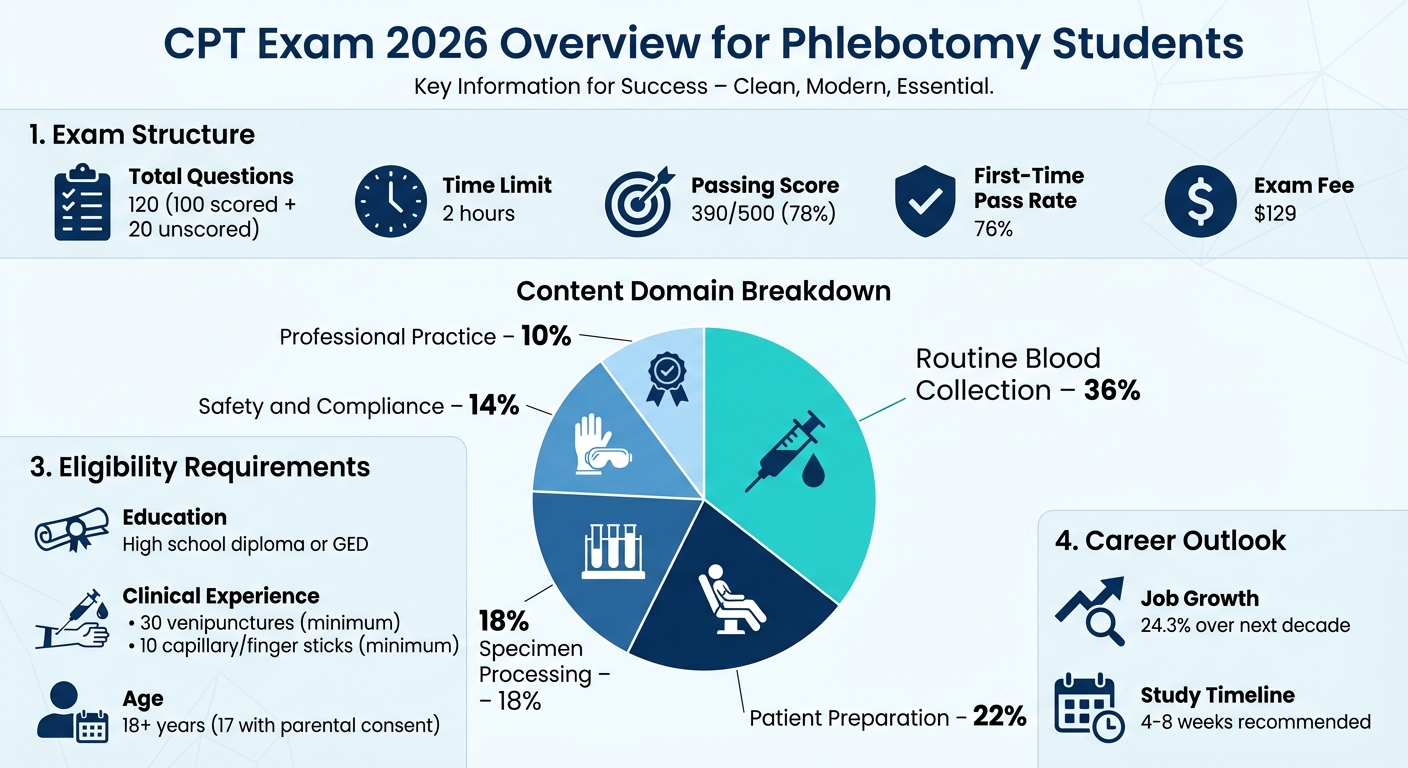
- Exam Updates: As of January 7, 2026, the CPT exam now includes 120 questions (100 scored, 20 unscored) with a stronger focus on case-based scenarios and specimen processing. You’ll need a scaled score of 390/500 to pass.
- Eligibility: Requires a high school diploma or GED, plus completion of 30 venipunctures and 10 finger sticks. Training programs, work experience, or military service can fulfill these requirements.
- Cost: The exam fee is $129.
- Preparation: Focus on the five key domains:
- Routine Blood Collection (36%)
- Patient Preparation (22%)
- Specimen Processing (18%)
- Safety and Compliance (14%)
- Professional Practice (10%)
- Study Tips: Use updated materials labeled "CPT 3.0" or "2026", prioritize high-weighted sections, and practice with full-length timed exams.
With phlebotomy jobs growing by 24.3% over the next decade, passing this exam positions you for better opportunities. Start early, plan your study schedule, and use reliable resources to succeed.
CPT Exam 2026 Content Breakdown and Requirements
Certified Phlebotomy Technician (CPT) Practice Test 2026 (NEW) 50 Real Questions & Answers
sbb-itb-7a67ffa
NHA CPT Exam Requirements
To register for the CPT exam, you need to meet the eligibility criteria established by the National Healthcareer Association. Knowing these requirements ahead of time will help you plan effectively and avoid unnecessary delays.
Educational Background: A high school diploma or GED equivalent is required to qualify. If you’re still in high school, you can begin the process as long as you’re set to graduate within 12 months. Additionally, it’s important to ensure that your practical experience aligns with the clinical competency standards.
Clinical Experience: Candidates must demonstrate they’ve completed at least 30 venipunctures and 10 capillary or finger sticks on live patients. With recent updates, finger sticks are now accepted due to the decline in traditional capillary stick procedures at many healthcare facilities. Your training program or employer must provide a signed log of these procedures, as this documentation is essential when you apply.
Paths to Eligibility: There are three main ways to meet the training and experience requirements:
- Completing a phlebotomy technician training program from an accredited or NHA-approved institution within the last five years
- Having at least one year of full-time, supervised work experience in a healthcare-related role within the last three years (or two years of experience within the last five years)
- Completing formal medical training through military service within the last five years
You’ll also need a current government-issued ID that matches the information on your registration. While most candidates must be 18 years or older, some programs allow 17-year-olds to apply with parental consent. Keep in mind that states like California, Nevada, Washington, and Louisiana have additional licensing requirements at the state level.
Exam Format and Content
The updated NHA CPT exam, introduced on January 7, 2026, consists of 120 questions – 100 scored and 20 pretest. You’ll have 2 hours to complete this computer-based test, which can be taken at a PSI center or through remote proctoring. To pass, you need a scaled score of 390 out of a possible 500. The national first-time pass rate is about 76%.
This latest version of the exam emphasizes case-based scenarios, integrating multiple domains like the order of draw, specimen handling, and safety protocols. This format requires clinical decision-making rather than relying solely on memorization.
The exam is divided into five content areas, each with specific weights:
- Routine Blood Collection: 36% – Focuses on venipuncture techniques, order of draw, and equipment.
- Patient Preparation: 22% – Covers patient identification, consent, and site selection.
- Specimen Processing and Handling: 18% – Includes centrifugation, transport, storage, and rejection criteria.
- Safety and Compliance: 14% – Addresses OSHA standards, infection control, and PPE use.
- Professional Practice: 10% – Covers communication, ethics, and error reporting.
Each domain is essential for effective preparation, and the following sections highlight their key points.
Safety and Compliance
This domain evaluates your understanding of workplace safety and regulatory standards in phlebotomy. You’ll need to know OSHA’s bloodborne pathogen standards, proper PPE usage, and infection control protocols. Additionally, HIPAA compliance is critical, particularly in safeguarding patient privacy during specimen collection and labeling.
A solid grasp of safety measures ensures a foundation for success in other areas, such as patient preparation.
Patient Preparation and Routine Blood Collection
Patient preparation involves critical pre-draw steps. The exam will test your ability to use two unique patient identifiers, such as full name and date of birth, ensuring patients state these themselves rather than merely confirming them. Other topics include explaining procedures, obtaining consent, assessing patient conditions, and selecting appropriate venipuncture sites.
Routine Blood Collection, the most heavily weighted domain at 36%, is a high-priority study area. You must thoroughly understand the order of draw, which follows CLSI GP41 guidelines: Yellow (blood cultures), Light Blue (citrate), Red (no additive), Gold (gel separator), Green (heparin), Lavender (EDTA), and Gray (glucose). An easy way to remember this sequence is the mnemonic: "Boys Love Running Girls Love Going Places".
For those using a butterfly needle, keep in mind that a discard tube (plain red) must be drawn before the light blue tube. This clears dead space and ensures the precise 9:1 blood-to-citrate ratio needed for coagulation tests.
Special Collections and Specimen Processing
This section focuses on specialized collection methods and specimen handling. You’ll encounter questions about capillary puncture, blood culture collection, and glucose tolerance testing. Specimen processing topics include labeling requirements, proper storage temperatures, centrifugation, and transport protocols. It’s also crucial to know specimen rejection criteria, such as underfilled light blue tubes or hemolyzed samples, as these can compromise test results.
A strong understanding of these advanced techniques and processing guidelines is key to excelling in this domain and ensuring accurate test outcomes.
HealthCareer Certs CPT Program for 2026

The HealthCareer Certs CPT Program is designed to align with the updated NHA CPT exam set to launch on January 7, 2026. As an NHA-approved clinical training institute, this program ensures its curriculum meets the latest standards for the Certified Phlebotomy Technician national exam. With over 5,000 students already certified through this program and a perfect 5/5-star rating on Google in early 2026, it’s clear that students value its quality and effectiveness.
The program offers 12 months of 24/7 online access to all learning materials, allowing students to progress at their own pace. Depending on individual schedules, the coursework can be completed in as little as 4 weeks or up to 6 months. Tuition is $1,700 if paid upfront, or you can opt for payment plans of 2×$875 or 4×$450. This fee includes everything you need: study materials, a phlebotomy practice kit, and the $117 NHA certification exam registration fee. Below, we’ll dive into the program’s standout features, from its flexible learning tools to its hands-on support system.
Self-Paced Learning and Interactive Tools
The course is divided into 8 modules, all accessible on mobile and tablet devices. These modules include 1,400+ practice questions and 700 self-checks, giving students plenty of opportunities to reinforce their knowledge. The program also incorporates engaging tools like 3D animations, game-based modules, flashcards, and lab simulations to mimic real-world clinical scenarios.
A standout feature is the hands-on phlebotomy practice kit included with tuition. The kit contains a realistic adult-size practice arm with anatomically accurate cephalic and basilic veins. These self-sealing veins allow for repeated practice, helping students develop muscle memory before starting their externship. Additionally, the program includes six full-length practice tests designed to resemble the 2026 NHA CPT exam format, giving students a solid foundation to prepare for the real thing.
Instructor Support and Externship Placement
Students benefit from one-on-one Zoom sessions with instructors who guide them through the venipuncture kit and answer exam-related questions. Personal advisors are also available throughout the program via text, phone, and email, ensuring students receive consistent support. As one student, Brianna M., shared:
HealthCareer Certs was 10 out of 10, instructors readily addressed all questions throughout the course.
The program guarantees 100% externship placement, ensuring students can complete the required 30 supervised venipunctures. For those unable to find a local internship site, virtual alternatives are provided. Additionally, HealthCareer Certs offers an externship scholarship of up to $2,000 to assist students during their clinical training.
Exam Prep and Certification Readiness
The curriculum is specifically designed to prepare students for the five domains of the 2026 NHA CPT exam: Safety and Compliance, Patient Preparation, Routine Collections, Special Collections, and Processing. Updated study materials, released in late 2025, include advanced digital features like audio readers, annotation tools for highlighting, and timed practice tests that simulate the actual exam environment.
Successfully passing the CPT exam earns students 2 ACE (American Council on Education) college credits, which are recognized by over 2,000 institutions. Olivia, a recent graduate, praised the program:
I was able to get certified and pass the NHA exam on the first try in only 6 weeks, and I appreciated the ease of the entire process/course and the other support/resources I received.
Study Resources and Materials
To help you prepare effectively for the exam, updated study materials are now available. The National Healthcareer Association (NHA) released the CPT 3.0 study materials on October 8, 2025, aligning with the January 7, 2026, exam launch. These resources include interactive modules, case studies, digital flashcards with annotation tools, baseline practice tests to assess your initial knowledge, and formative tests that explain the rationale behind each answer. Together, they offer a structured approach tailored to the updated exam format. The official NHA online practice test is priced at $44.00 and allows six attempts.
For additional study options, third-party guides cater to different learning preferences. The Mometrix NHA Phlebotomy Study Guide (5th Edition), priced at $28.99, includes four full-length practice tests with detailed explanations. A more affordable choice is the PhlebMaster Phlebotomy Exam Mastery Study Guide 2025–2026, available for $14.99, which features order of draw mnemonics, resume templates, and interview tips. Both guides boast Amazon ratings of over 4.6 out of 5 stars.
If you prefer mobile learning, digital platforms offer flexible options. Open Exam Prep provides a free study guide with mnemonics for the order of draw and an AI tutor for instant practice question explanations. They emphasize the order of draw as the most frequently tested topic. Another option is Phlebotomy CPT NHA Prep 2026 by EZ Test Prep, which adapts to your performance level. It has a 4.8 out of 5 rating from 239 App Store reviews and costs between $9.99 (one-week access) and $64.99 (six-month access).
The NHA warns that candidates who fail the exam within 30 days of the January 7, 2026, launch must retake the updated version. Avoid relying on older Quizlet sets, which may include outdated protocols or incorrect answers for the 2026 exam. Instead, focus on materials emphasizing case-based scenarios and specimen processing, which now make up 18% of the exam. Ensure your resources are labeled "CPT 3.0" or "2026" to confirm they align with the current format. With a national first-time pass rate of about 76%, choosing study materials that reflect the actual exam structure – like timed practice tests and clinical scenarios – can greatly improve your chances of success on the first attempt.
Time Management and Study Planning
Start preparing 4 to 8 weeks before your exam to steer clear of last-minute stress. If you’re already familiar with the material, 4 weeks might be enough. However, if you’re new to the field, give yourself at least 8 weeks to build a strong foundation. This timeline works well with the updated exam format and ensures you’re pacing yourself effectively.
Make sure your study plan matches the exam blueprint. Pay extra attention to the most heavily weighted areas, such as Routine Blood Collections (36%) and Patient Preparation (22%). To pinpoint your weak spots, take a diagnostic practice test early on. For instance, if you find specimen processing challenging, dedicate more time to mastering that domain.
Break your workload into manageable daily goals. For example:
- Day 1: Vein anatomy
- Day 2: Order of draw
- Day 3: Tube additives
As EZ Prep puts it:
Start with a calendar, not a wish. Break topics into short sessions and set micro-goals.
Wrap up each study session by summarizing three main takeaways in your own words. This active review method helps confirm your understanding.
Make the most of spare moments by using mobile flashcards alongside your structured study sessions. Take one rest day each week to recharge. Then, about two weeks before the exam, complete a 2-hour, 120-question practice test. This will help you build stamina and get a feel for the pacing.
With a national first-time pass rate of around 76% and a passing score of 390 out of 500 (about 78%), sticking to a consistent, focused study plan aligned with the exam structure gives you the best shot at success.
Practice Exam Tips and Test-Taking Strategies
Mastering the CPT exam requires more than just knowledge – it’s about understanding the format and managing your time effectively. In the week leading up to your test, take 2–3 mock exams under conditions that mimic the real thing. Set aside a full two hours, stay uninterrupted, and stick to the exam’s pacing. Remember, the NHA CPT exam consists of 120 questions – 100 that are scored and 20 that aren’t – so aim to average about one minute per question.
A structured approach to practice exams can make a big difference. Start with a Baseline test under timed conditions to gauge your starting point. Then, move to Formative tests where you can take your time and focus on understanding detailed explanations for each question. Finally, wrap up with a timed simulation to solidify your pacing skills. Always review the rationales for both correct and incorrect answers. This helps you grasp the medical reasoning behind each question and prevents repeated mistakes.
After each practice exam, analyze your errors. Break them down by topic areas, such as Order of Draw, Safety and Compliance, or Patient Preparation, so you can focus on the sections where you need the most improvement. A good benchmark to aim for is consistently scoring 80% or higher on your mock exams before scheduling the real test. Keep in mind that the passing score is 390 out of 500, which is roughly 78%.
Pay close attention to keywords in the questions, especially ones like "except" or "not", to avoid simple misinterpretations. You’ll also have access to a whiteboard during the exam, which can be helpful for jotting down quick notes or calculations.
When test day arrives, preparation doesn’t stop at studying. Show up 30 minutes early to allow time for check-in, bring a valid government-issued photo ID, and secure your personal belongings in a locker. Make sure you’re well-rested the night before, as the exam timer won’t pause for breaks. Managing your time wisely during the test is critical.
Conclusion
Preparing for the 2026 CPT exam requires a combination of early planning, updated resources, and consistent practice. The NHA’s updated version, launched on January 7, 2026, makes it critical to use materials tailored to the latest exam format. With 120 questions to tackle in two hours and a passing score of 390 out of 500 (roughly 78%), having a clear, structured study strategy is non-negotiable. Notably, Routine Blood Collections and Safety and Compliance make up about 55% of the test, so prioritizing these areas is key.
HealthCareer Certs has created a training program designed to address these challenges head-on. Their CPT program includes 12 months of access to interactive study materials, guaranteed externship placement to complete the required 30 venipunctures, and personalized instructor support via Zoom. The program also provides a realistic phlebotomy practice kit featuring an IV training arm, six full-length practice exams, and covers the national certification exam fee – all bundled into the tuition. Flexible payment options starting at $450.00 per installment make it more accessible for a range of budgets.
As demand for phlebotomy technicians continues to grow, earning your CPT certification is a step toward a rewarding career. If a retake is necessary, remember there’s a 30-day waiting period.
To maximize your chances of success, focus on high-weight sections, practice under timed conditions to simulate the two-hour test, and avoid relying on outdated or unofficial resources. With the comprehensive support provided by HealthCareer Certs and a disciplined study approach, you’ll be well-equipped to pass the CPT exam and begin your journey as a certified phlebotomy technician.
FAQs
How do I document my 30 venipunctures and 10 finger sticks?
To track your 30 venipunctures and 10 finger sticks, make sure to maintain a thorough record for each procedure. Include details like the type of collection, date, site used, and any notes about the patient’s response or potential complications. Keeping an organized log or portfolio not only helps meet certification requirements but also showcases your experience during evaluations. Accurate documentation is crucial for both your certification process and your professional growth.
What’s the best way to study case-based CPT 3.0 questions?
To get the most out of studying case-based CPT 3.0 questions, concentrate on practice exams and question banks that feature case scenarios. These resources allow you to apply your knowledge to practical, scenario-based questions. Dive into the detailed explanations provided for each answer – this helps you grasp the reasoning and logic behind correct responses. Make sure to use updated study guides designed specifically for the 2026 exam, as they reflect the latest question styles and focus areas.
How should I pace 120 questions in a 2-hour exam?
Managing 120 questions in just 2 hours can feel overwhelming, but the key is to stick to a 1-minute-per-question pace. Keep an eye on the clock to ensure you’re staying on track. If a question stumps you, don’t get stuck – mark it and move on. This way, you avoid wasting valuable time.
Save the final 10-15 minutes to revisit flagged questions and double-check that every question has an answer. By following this approach, you’ll not only finish on time but also keep your stress levels in check during the exam.