The Certified Clinical Medical Assistant (CCMA) exam is a nationally recognized certification for medical assistants, designed to validate skills in clinical, administrative, and laboratory tasks. Offered by the National Healthcareer Association (NHA), the exam includes 180 multiple-choice questions (150 scored, 30 unscored) and requires a passing score of 390 out of 500. Key updates in 2024’s CCMA 3.0 version emphasize electronic health record (EHR) simulations and professionalism, aligning with evolving healthcare roles.
Key Details:
- Exam Format: 3 hours, 180 questions, $155 fee.
- Content Domains:
- Clinical Patient Care (56%): Practical skills like EKGs, phlebotomy, infection control.
- Foundational Knowledge (10%): Medical terminology, basic science.
- Other Domains (8%-5% each): Patient care coordination, administrative tasks, communication, anatomy, medical law.
- Preparation: Updated study materials include EHR simulations, practice tests, and digital tools. Candidates typically study for 1–3 months.
The certification is increasingly valued, with 96% of employers requiring or encouraging it. Passing the exam can lead to better job opportunities, higher salaries, and even 5 ACE college credits.
🩺 EVERYTHING on the Medical Assistant CCMA Exam 💉 | By a Certified MA
sbb-itb-7a67ffa
CCMA Exam Content Domains Overview
CCMA Exam Content Domain Distribution and Question Breakdown
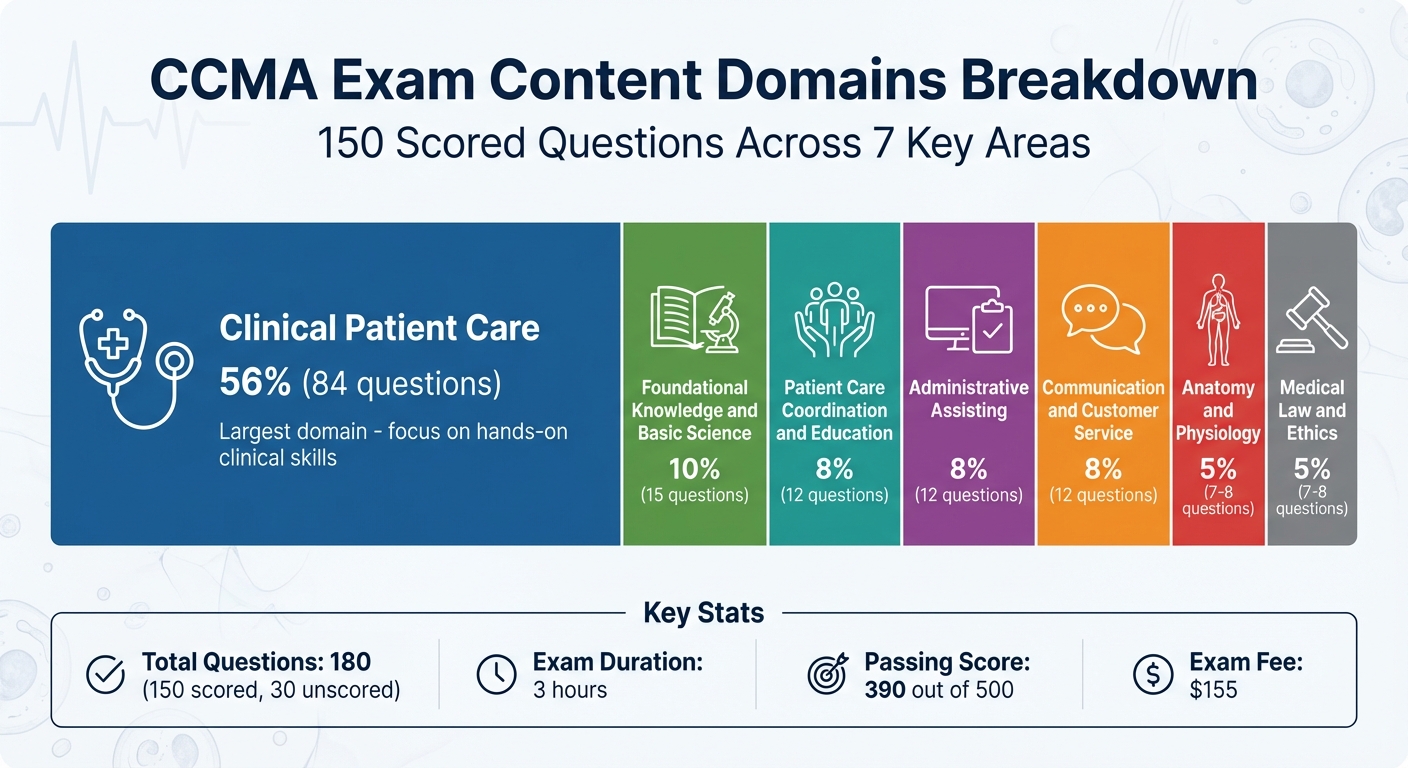
The CCMA exam features 150 scored questions divided across seven content domains, each focusing on critical knowledge and skills for medical assistants. These domains help guide your study priorities. For instance, the Clinical Patient Care domain – comprising 56% of the exam – focuses on hands-on clinical tasks, while smaller domains like Medical Law and Ethics (5%) address essential regulatory principles. Here’s a detailed breakdown of how these domains align with the daily responsibilities of a medical assistant.
Content Domain Percentages
Here’s how the exam content is distributed:
| CCMA Exam Content Domain | Weighting (%) |
|---|---|
| Clinical Patient Care | 56% |
| Foundational Knowledge and Basic Science | 10% |
| Patient Care Coordination and Education | 8% |
| Administrative Assisting | 8% |
| Communication and Customer Service | 8% |
| Anatomy and Physiology | 5% |
| Medical Law and Ethics | 5% |
With Clinical Patient Care taking up 56% of the exam, about 84 of the questions will test practical clinical skills like taking vitals, performing EKGs, phlebotomy, and ensuring infection control. The remaining domains – Foundational Knowledge and Basic Science (10%), Patient Care Coordination and Education (8%), Administrative Assisting (8%), Communication and Customer Service (8%), Anatomy and Physiology (5%), and Medical Law and Ethics (5%) – cover the scientific, administrative, and ethical aspects of the role. Together, these domains reflect the varied responsibilities medical assistants handle daily.
How the Domains Reflect Daily Job Tasks
The exam’s structure mirrors the tasks medical assistants perform on the job. For example, Clinical Patient Care involves direct patient interaction, such as taking vitals, performing diagnostic tests, and infection control procedures. Meanwhile, domains like Administrative Assisting and Communication and Customer Service focus on tasks such as patient scheduling, check-ins, and managing electronic health records (EHR). Patient Care Coordination and Education addresses educating patients and supporting collaborative care efforts, while the smaller domains provide the scientific and ethical framework for safe and effective practice.
Interestingly, 35% of employers report that medical assistants now take on more responsibilities than in the past. Reflecting these shifts, the CCMA 3.0 update – introduced in January 2024 – added EHR simulations and placed a stronger focus on professionalism. These updates enhance skills in areas like Administrative Assisting and Communication, ensuring the exam stays aligned with evolving industry needs.
Detailed Breakdown of CCMA Exam Domains
Now that you know the structure of the exam, let’s dive into what each domain covers.
Basic Science and Healthcare Knowledge
The Foundational Knowledge and Basic Science domain takes up 10% of the exam and includes 34 specific knowledge statements. These statements focus on core concepts like healthcare systems, medical terminology, and basic pharmacology – essential building blocks for clinical success. This domain sets the stage for the expertise needed to operate effectively in a healthcare environment. From here, we move into the Anatomy and Physiology domain, which connects this foundational knowledge to clinical assessments.
Anatomy and Physiology
Making up 5% of the exam, the Anatomy and Physiology domain highlights the structures of the body, organ systems, and disease processes. This understanding is crucial for tasks like performing EKGs or taking blood pressure readings. These concepts directly support the practical skills tested in the next domain.
Clinical Patient Care
The Clinical Patient Care domain is the largest, covering 56% of the exam. It evaluates the practical, hands-on skills you’ll use most often in the workplace. Topics include patient intake procedures, infection control, lab work, phlebotomy, and EKG testing. With the CCMA 3.0 update rolling out in January 2024, the exam now includes simulations for tasks like entering lab orders and documenting vital signs in Electronic Health Records (EHR). This reflects the increasing role of technology in clinical settings and emphasizes the importance of digital proficiency.
Patient Care Coordination and Education
This domain accounts for 8% of the exam and focuses on the coordination and education aspects of medical assisting. It tests your ability to educate patients about their conditions, manage care transitions, and collaborate with healthcare teams. You’ll need to demonstrate skills like explaining treatment plans, providing discharge instructions, and ensuring patients understand their medications and follow-up care. These responsibilities are key to delivering comprehensive patient support.
Administrative Assisting
Administrative tasks play a crucial role in keeping healthcare operations smooth. Also making up 8% of the exam, the Administrative Assisting domain focuses on skills like scheduling appointments, managing medical records, and maintaining accurate documentation. With a growing emphasis on Electronic Health Records, this domain also evaluates your ability to handle tasks like patient registration and medication reconciliation efficiently.
Communication and Customer Service
The Communication and Customer Service domain represents 8% of the exam and assesses the interpersonal and professional skills needed for effective patient interactions. According to the National Healthcareer Association:
"Professionalism and critical thinking are the most important soft skills employers are looking for, when hiring a clinical medical assistant".
This domain covers managing difficult conversations, maintaining professional boundaries, and ensuring positive patient experiences. These skills are essential for balancing clinical tasks with high-quality patient care.
Medical Law and Ethics
Making up 5% of the exam, the Medical Law and Ethics domain includes 9 knowledge statements and 7 task statements. These focus on legal and ethical responsibilities like advanced directives, the Hippocratic Oath, and HIPAA regulations. You’ll need to understand both the theory and practical application of these topics, such as maintaining confidentiality in EHR updates and following legal protocols during patient intake. This domain reinforces the ethical standards that guide every aspect of medical assisting.
Preparing for the CCMA Exam
Study Materials and Resources
The CCMA 3.0 study materials, launched in early 2024, offer a fresh approach to exam preparation with tools designed to make studying more interactive and effective. These resources include practice activities, EHR simulations, and videos on professionalism. The MA Skillsbuilder™ is particularly helpful, focusing on the 39 clinical and 25 administrative skills that employers prioritize. This targeted approach ensures you’re honing the skills that matter most.
Digital tools now cater to different learning preferences with features like audio readers for auditory learners, digital glossaries, and annotation options that let you highlight and bookmark content. The Focused Review® system takes it a step further by analyzing your practice test results to pinpoint areas needing improvement. This way, you can spend your time on the topics where you need the most help. As GoTestPrep puts it:
"The NHA CCMA Study Guide is invaluable for candidates… offering a structured, concise review of complex topics".
Practice tests are essential for building the stamina required for the 3-hour exam. These full-length tests mirror the actual exam format with 180 items and provide detailed explanations for every answer – right or wrong. Instead of just memorizing facts, focus on understanding the reasoning behind each answer. Enhanced digital flashcards also help by letting you separate terms into "study" or "know" categories, so you can zero in on unfamiliar material. Once you’ve got the tools in place, the next step is managing your study time effectively.
Time Management Strategies
Most candidates spend 1–3 months preparing for the exam. If you’ve recently finished a medical assistant program, you might only need 2–3 weeks of review. But if you’re brushing up on older knowledge, plan for 4–6 weeks of dedicated study time. The key is to align your study time with the exam’s content weights. For example, since Clinical Patient Care makes up 56% of the exam, dedicate at least two weeks to this area, while smaller sections like Medical Law and Ethics might only require a few days.
Katie Miller, Co-creator of Smarter MA, highlights the importance of pacing:
"It’s a marathon, not a sprint. This isn’t your typical test that you study for in a month. Most are going to study for 1-3 months".
To avoid burnout, structure your study sessions into 90-minute blocks with breaks in between. Start with a practice test early on to identify your weak spots, then use a detailed day-by-day calendar to map out your study topics. Stick to studying 3–4 hours a day for better retention – longer sessions often lead to diminishing returns.
Focus on high-yield areas like vital signs, EKG lead placement, phlebotomy order of draw, and infection control, as these topics frequently appear on the exam. For every missed practice question, jot down the question, the correct answer, and a quick explanation to reinforce your understanding. Skip last-minute cramming – it’s far better to get 7–8 hours of sleep the night before your exam. These time management strategies set the stage for a thorough and effective preparation process.
Using HealthCareer Certs for Exam Preparation
For a streamlined approach, HealthCareer Certs offers a 100% online CCMA program designed to make your preparation as efficient as possible. The self-paced format allows you to control your schedule, and one-on-one Zoom sessions provide personalized support. The program includes 1,400+ practice questions and 700 self-checks, giving you plenty of opportunities to track your progress.
The platform is mobile-friendly, so you can review materials anytime, anywhere. It also guarantees externship placements, giving you hands-on experience that reinforces what you’ve studied while building practical skills. Approved by the National Healthcareer Association (NHA) and the New Hampshire Department of Education, this program ensures your preparation aligns with current certification standards.
HealthCareer Certs covers all seven exam domains with resources tailored to different learning styles. Whether you prefer visual demonstrations or auditory explanations, the platform has you covered. Plus, with a 100% tuition refund guarantee if you don’t land a healthcare job after certification, HealthCareer Certs backs its commitment to your success and future career.
Conclusion
Preparing for the CCMA exam isn’t just about earning a certification – it’s about equipping yourself for the everyday challenges and responsibilities of being a medical assistant. The exam is designed to reflect the skills and knowledge that 96% of healthcare organizations either require or encourage for this role, making it a true measure of what’s expected in the field.
The seven content domains provide a well-rounded framework, covering everything from core healthcare principles and anatomy to clinical procedures, administrative tasks, and ethical considerations. These aren’t just abstract topics – they’re directly tied to real-world tasks like performing phlebotomy, managing electronic health records, and safeguarding patient privacy. Every question on the exam is crafted to ensure that you’re ready to handle the challenges of a clinical environment.
Success on the CCMA exam requires focused preparation, and with a 77% pass rate, aligning your study efforts with the exam’s priorities is key. The $155 fee is more than just a cost – it’s an investment in a career with strong prospects, as medical assistant jobs are expected to grow by 16% through 2031. For many, this certification is a stepping stone to new opportunities, as highlighted by Jessica Aponte, CCMA:
"My NHA certification has helped me financially advance my career. Most importantly it has given me opportunity to get a job that allows me to be a better mom by being home in the evenings and on the weekends."
The skills you develop while preparing for the exam will shape every patient interaction and decision you make in your career. With the right preparation and resources, you’re not just working toward passing an exam – you’re building the foundation for a successful and fulfilling career as a certified clinical medical assistant.
FAQs
What CCMA domains should I study first?
When preparing for the CCMA exam, it’s smart to prioritize the Patient Care domains. Why? They make up the largest portion of the test and are essential for mastering clinical practices that directly impact patient safety. Here are the core areas you’ll want to dive into:
- Patient Intake and Vitals: Learn how to accurately gather patient information and measure vital signs – foundational skills for any healthcare setting.
- General Patient Care: This includes everything from assisting with daily activities to providing emotional support, ensuring patients feel cared for on all levels.
- Infection Control and Safety: A critical area focused on maintaining a safe and hygienic environment to protect both patients and healthcare workers.
- Point of Care Testing: Covers bedside diagnostic tests, ensuring you can perform and interpret them effectively.
Mastering these topics not only prepares you for the exam but also equips you with the skills needed to provide top-notch patient care.
How do the 2024 CCMA 3.0 EHR simulations work?
The 2024 CCMA 3.0 EHR simulations offer hands-on practice through realistic scenarios, complete with step-by-step video walkthroughs. Designed to match the latest exam updates, these simulations focus on essential areas such as Electronic Health Records (EHR), patient care, and clinical procedures, equipping candidates with the skills they need to succeed.
How many weeks should I study to pass?
You should set aside around 8 to 12 weeks to prepare for the CCMA exam. The exact amount of time you’ll need depends on the study program you follow and your individual study habits.