
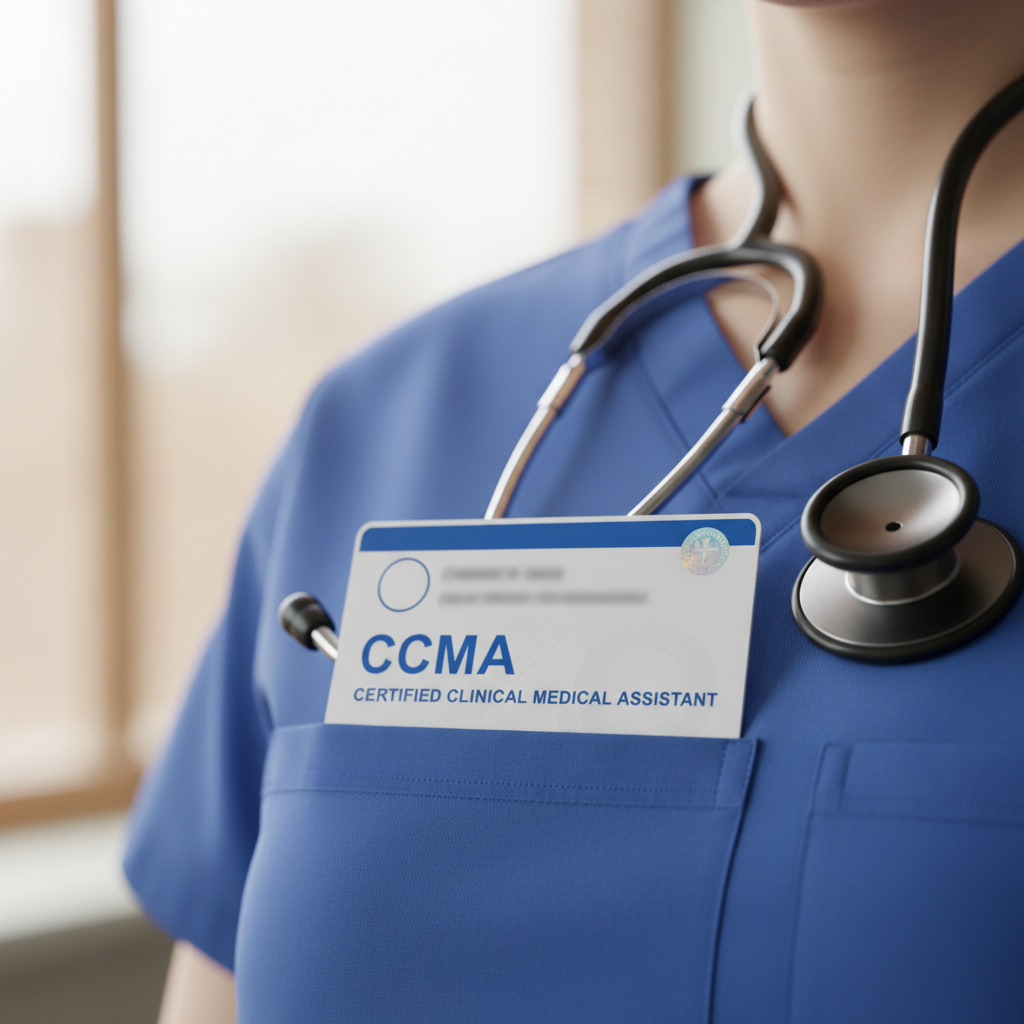
A CCMA — Certified Clinical Medical Assistant — is a nationally credentialed medical assistant who has passed the National Healthcareer Association (NHA) certification exam. The credential signals to employers that you’ve completed accredited training and demonstrated clinical and administrative competency. CCMA is one of the two most-recognized medical assistant credentials in the U.S. (alongside the AAMA’s CMA), is required by most major hospital systems and clinic networks, and typically pays a $1-$3/hour premium over uncertified medical assistant work. Whether you’re researching the what is the ccma for the first time or comparing programs, this guide pulls together what matters.
This post covers what the CCMA credential actually is, how the certification process works, what’s tested on the exam, eligibility, recertification, and how the CCMA compares to the other medical assistant credentials you’ll see (CMA, RMA, NCMA).
Want a faster path to your CCMA?
Earn your NHA CCMA in 8 weeks online with NHA exam fee, externship at a named partner clinic, and a venipuncture practice kit included. 5 ACE college credits.
For students researching what is the ccma options, the practical reality is that the right choice depends on your timeline, budget, and target employer. Many candidates start their what is the ccma research with general questions and narrow down as they understand which credentials each setting accepts. Treat what is the ccma reviews as a comparison exercise, not a single decision.
What the CCMA Credential Means — What Is The Ccma
A CCMA has demonstrated competency across:
- Clinical patient care (56% of the exam) — vitals, phlebotomy, EKG, medication preparation, sterile technique, infection control
- Anatomy, physiology, and pathophysiology (8%) — body systems, common conditions
- Foundational knowledge and basic science (10%) — medical terminology, math, life sciences
- Patient care coordination and education (8%) — referrals, teach-back, health literacy
- Administrative assisting (8%) — ICD-10, CPT, HIPAA, scheduling
- Communication and customer service (5%)
- Medical laws and ethics (4%) — HIPAA, scope of practice, informed consent
Passing the CCMA exam means an employer can be confident you’ve been tested on all of these — the credential is portable and widely recognized.
CCMA Eligibility
To sit for the CCMA exam, you must meet at least one of these pathways:
- Education pathway (most common): Complete an accredited CCMA training program (institutional or online) within the past 5 years that includes both didactic coursework and a clinical externship.
- Experience pathway: Have at least 1 year (1,200 hours) of medical assistant work experience within the past 3 years.
- Military pathway: Complete eligible military medical training within the past 5 years.
For full transparency, our CCMA program is built on the education pathway: 8 weeks online coursework + 160-hour externship at a partner clinic, with the NHA exam fee included.
What’s on the CCMA Exam
- 180 questions (150 scored + 30 unscored pretest)
- 3 hours 10 minutes
- Passing scaled score: 390 (range 200-500)
- Computer-based, delivered at PSI test centers or online proctored
- Cost: $155 for the exam
For a full 50-question practice exam mapped to the 2026 test plan, see our NHA CCMA practice test.
CCMA vs CMA vs RMA — Quick Comparison
| Credential | Body | Eligibility | Pay differential | Recognition |
|---|---|---|---|---|
| CCMA | NHA | Accredited program OR 1 yr experience | $1-$3/hr premium | Widely recognized; common in hospitals + outpatient |
| CMA | AAMA | CAAHEP- or ABHES-accredited program required | $1-$3/hr premium | Widely recognized; preferred by some academic centers |
| RMA | AMT | Accredited program OR 5 yrs experience | Similar | More common in southern + midwestern markets |
| NCMA | NCCT | Accredited program OR 2 yrs experience | Similar | Less common; check local market |
Most employers accept CCMA, CMA, and RMA interchangeably. Choose based on which exam path your training program supports and which credential is most common in your target labor market.
Why Employers Pay More for CCMAs
The 2-3 dollar/hour premium on CCMA-certified MAs over uncertified ones reflects three things:
- Reduced training cost. A certified MA can be productive on day 1; an uncertified hire needs 4-8 weeks of in-house training.
- Reduced liability. Documented certification supports compliance audits and malpractice defense.
- Better patient outcomes. Multiple studies show certified MAs make fewer documentation errors and have higher patient-satisfaction scores.
Over a typical CCMA’s first 5 years, the cumulative pay differential vs. uncertified work is usually $15,000-$25,000.
Career Paths That Build on CCMA
CCMA is intentionally a stepping-stone credential. Common 2-5 year trajectories:
- CCMA → Lead MA / Office Manager: $50-60k median
- CCMA → LPN/LVN: 12-15 month nursing program, $50-55k median
- CCMA → RN (associate’s): 2-year program, $75-85k median entry
- CCMA → Specialty MA (cardiology, dermatology, oncology): $48-55k median
- CCMA → PA school path: requires bachelor’s; PCE hours from CCMA work count toward CASPA
Recertification
The CCMA must be renewed every 2 years. Renewal requires:
- 10 continuing education (CE) credits within the renewal cycle
- Renewal fee (~$179 as of 2026)
- Active practice OR maintained registry status
NHA offers free CE credits via their member portal, plus paid CE through partner providers. Most working CCMAs accumulate 10 CE credits in 12-18 months without dedicated effort.
Ready to stop studying alone? HealthCerts’ Certified Clinical Medical Assistant (CCMA) program is built around a 8 weeks online course with a guaranteed externship at a named partner clinic — so you walk out with both the credential and the clinical hours employers want.
The bottom line on what is the ccma: choose the path that matches your real-world constraints — schedule, financial aid eligibility, and target employer — rather than the cheapest or fastest option in isolation. what is the ccma outcomes vary meaningfully by program quality, so verify accreditation and externship support before enrolling.
Frequently Asked Questions
What is the CCMA?
The CCMA (Certified Clinical Medical Assistant) is a nationally recognized medical assistant credential issued by the National Healthcareer Association (NHA). It certifies clinical and administrative competency across 8 domains and is widely accepted by hospitals and outpatient clinics.
What does CCMA stand for?
CCMA stands for “Certified Clinical Medical Assistant” — the credential issued by the NHA after passing their MA certification exam.
Is the CCMA hard to pass?
The 2026 CCMA pass rate is about 74% nationally for first-time test takers, and 85%+ for graduates of accredited training programs with clinical externships. With 8-12 weeks of focused study, most program graduates pass on the first attempt.
How much does a CCMA make?
National median CCMA pay is $42,000/year ($20.20/hour) in 2026. Range is $32,200 at the 10th percentile to $58,200 at the 90th. See our full CCMA salary breakdown.
How long does it take to become a CCMA?
Typically 8-12 weeks for an accredited online program with externship, plus 1-2 weeks of focused exam prep. Total time from enrollment to certified-and-employable: usually 10-14 weeks.
How is the CCMA different from a CMA?
CCMA is issued by the NHA; CMA is issued by the AAMA. Both certify medical assistants; both are widely recognized. The main practical difference is that CMA requires graduation from a CAAHEP- or ABHES-accredited program, while CCMA accepts other accredited paths and an experience pathway.
Is CCMA worth it?
For aspiring or working medical assistants, yes — the certification typically pays for itself within 3-4 months on the job through the certification pay differential, opens hospital and specialty-practice roles that uncertified MAs can’t access, and supports career progression toward LPN, RN, or specialty roles.
Do I need a degree to become a CCMA?
No. The CCMA does not require a college degree. The most common path is an accredited certificate program (8-12 weeks online or 4-12 months in-person) followed by the NHA exam. Some students complete CCMA first and add an associate’s or bachelor’s later.
Start Your CCMA Journey with HealthCerts
Reading about what is the ccma is one thing — actually getting credentialed and into a clinical role is another. HealthCerts’ Certified Clinical Medical Assistant (CCMA) program is the fastest, most-supported path: Earn your NHA CCMA in 8 weeks online with NHA exam fee, externship at a named partner clinic, and a venipuncture practice kit included. 5 ACE college credits.
See CCMA tuition, schedule, and what’s included →
Source: National Healthcareer Association (NHA)
For people researching what is the ccma, the practical decision points usually come down to three things: cost, time, and credential acceptance. Use the what is the ccma framing in the sections above to make each decision in the right order, and remember that what is the ccma outcomes scale with the quality of the program you pick.