
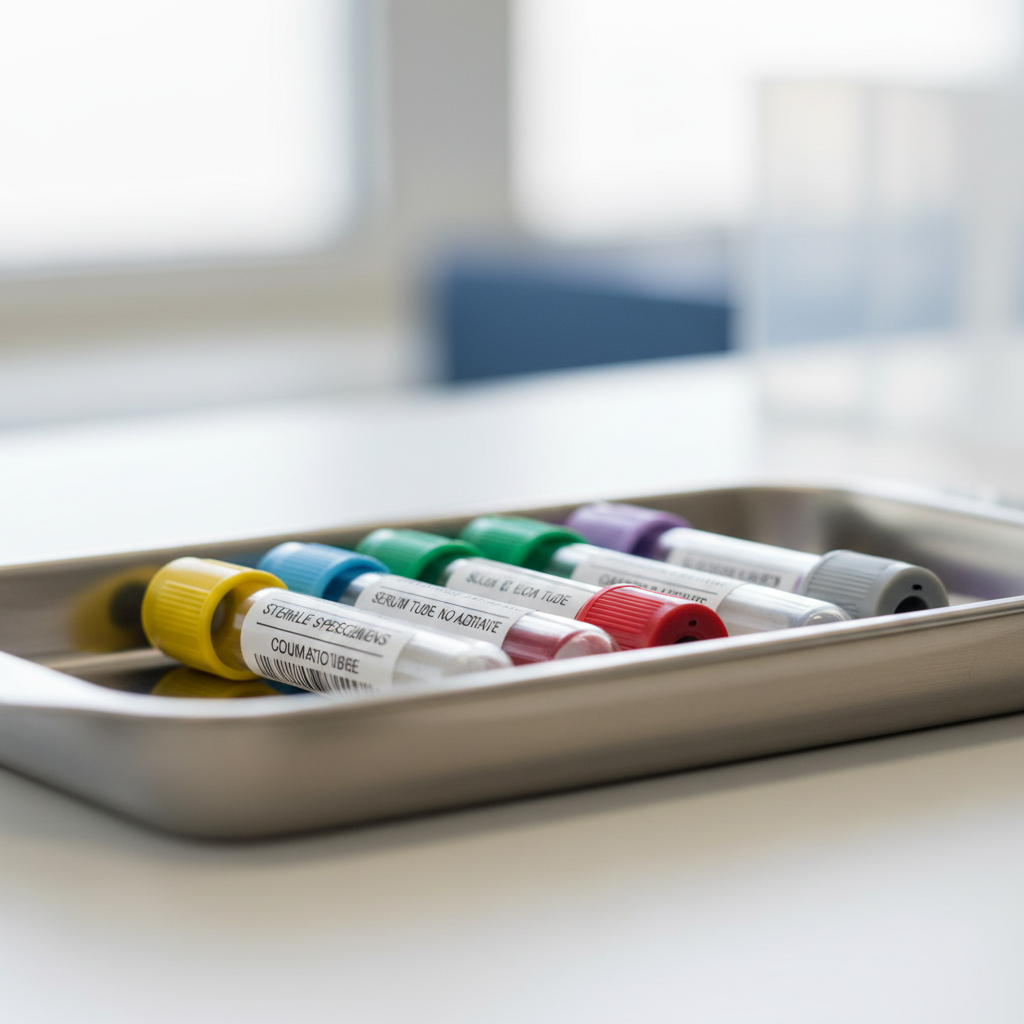
The order of draw in phlebotomy is one of the most-tested concepts on every certification exam (NHA CPT, ASCP PBT, CCMA Domain 3) — and one of the most clinically critical skills phlebotomists need to nail. Drawing tubes in the wrong order can contaminate specimens, alter lab results, and force redraws that delay diagnosis. The CLSI (Clinical and Laboratory Standards Institute) standard order of draw is: yellow → light blue → red/SST → green → lavender → gray. Whether you’re researching the order of draw phlebotomy for the first time or comparing programs, this guide pulls together what matters.
Most students learn the order through a memorization trick. The most reliable: “Stop Light, Red Light, Green Light, Go” matched to tube color sequences. This post covers the official CLSI order, what each tube contains and what it tests, why the order matters clinically, and the memorization tricks that actually work.
Want a faster path to your CPT?
Earn your NHA CPT in 4 weeks online with practice arm shipped, 30 supervised venipunctures, NHA exam included, and externship at a named partner clinic.
For students researching order of draw phlebotomy options, the practical reality is that the right choice depends on your timeline, budget, and target employer. Many candidates start their order of draw phlebotomy research with general questions and narrow down as they understand which credentials each setting accepts. Treat order of draw phlebotomy reviews as a comparison exercise, not a single decision.
The CLSI Order of Draw (Official Standard) — Order Of Draw Phlebotomy
| Order | Color | Additive | Lab tests |
|---|---|---|---|
| 1 | Yellow | SPS (Sodium Polyanethol Sulfonate) | Blood cultures (sterile, drawn first to avoid contamination) |
| 2 | Light Blue | Sodium citrate (3.2%) | Coagulation (PT/INR, PTT, fibrinogen, D-dimer) |
| 3 | Red / SST (gold-top) | None / Clot activator + gel | Serum chemistries, immunology, blood bank |
| 4 | Green | Heparin (lithium or sodium) | Plasma chemistries (chemistry profiles in stat cases) |
| 5 | Lavender | EDTA (K2 or K3) | Hematology (CBC, ESR, blood typing) |
| 6 | Gray | Sodium fluoride + potassium oxalate | Glucose, lactate, alcohol levels |
Why the Order Matters
If you draw tubes out of order, additives can carry over from one tube to the next on the needle, contaminating the next sample:
- Lavender (EDTA) before SST → potassium contamination → falsely high potassium results in chemistry
- Heparin (green) before light blue → heparin interferes with PT/INR clotting tests
- EDTA (lavender) before gray (glucose) → EDTA interferes with sodium fluoride preservation
- Drawing serum tubes (red) before light blue → tissue thromboplastin from the puncture site can contaminate coagulation samples
The CLSI order is calibrated to minimize cross-contamination across additives.
Memorization Tricks That Work
Stop Light, Red Light, Green Light
- Yellow = “School zone”
- Light Blue = “Stop light blue”
- Red = “Red light”
- Green = “Green light”
- Purple/Lavender = “Purple light”
- Gray = “Goodbye”
“Boys Love Ravishing Girls Like Grandmas”
- Boys = Blood culture (yellow)
- Love = Light blue (citrate)
- Ravishing = Red (no additive) or SST
- Girls = Green (heparin)
- Like = Lavender (EDTA)
- Grandmas = Gray (sodium fluoride)
Color sequence shortcut
Yellow → Blue → Red → Green → Purple → Gray (rainbow-ish)
Most working phlebotomists eventually rely on muscle memory rather than mnemonics, but the mnemonics get you through the exam and the first few months on the job.
Common Variations and Edge Cases
Royal Blue tubes (specialty)
For trace metals testing (zinc, copper, lead, etc.). Drawn after the gray top in routine sequence.
Pink tubes
EDTA-based; used for blood bank typing. Treat as lavender for order purposes.
Pediatric / Capillary draws
Different tube ratios; capillary heel-stick or finger-stick uses smaller microtainer tubes. Order conventions are similar but always confirm with your facility’s standard operating procedure.
Discarding the first tube
When drawing through a butterfly with a coagulation tube (light blue) first, the recommended practice is to draw a small “discard tube” first to clear air from the line, then draw the actual coagulation sample.
What the Exams Test
NHA CPT, ASCP PBT, and NHA CCMA all test:
- CLSI standard order of draw — memorize cold
- Tube color → additive → use case (all three)
- Common cross-contamination scenarios
- Clinical reasoning for why the order is what it is
Expect at least 3-5 order-of-draw questions across these exams.
Ready to stop studying alone? HealthCerts’ Certified Phlebotomy Technician (CPT) program is built around a 4 weeks online course with a guaranteed externship at a named partner clinic — so you walk out with both the credential and the clinical hours employers want.
The bottom line on order of draw phlebotomy: choose the path that matches your real-world constraints — schedule, financial aid eligibility, and target employer — rather than the cheapest or fastest option in isolation. order of draw phlebotomy outcomes vary meaningfully by program quality, so verify accreditation and externship support before enrolling.
Frequently Asked Questions
What is the order of draw in phlebotomy?
CLSI standard: yellow (blood cultures) → light blue (citrate, coagulation) → red/SST (clot activator, chemistries) → green (heparin) → lavender (EDTA, hematology) → gray (sodium fluoride, glucose).
Why does the order of draw matter?
Drawing tubes in the wrong order can cause additive carryover, contaminating subsequent specimens and altering lab results. EDTA before SST causes falsely high potassium; heparin before coag tubes interferes with PT/INR.
What’s drawn first — yellow or light blue?
Yellow (blood cultures) is drawn first when ordered to maintain sterility. If no blood cultures are ordered, light blue is the first tube drawn.
What color is heparin?
Green tube. Contains lithium or sodium heparin. Used for plasma chemistry tests, especially stat chemistries.
What’s the lavender tube for?
Lavender contains EDTA (K2 or K3). Used for hematology tests — CBC, ESR, and blood typing.
What does SST mean in phlebotomy?
SST = Serum Separator Tube. Has a clot activator and a gel that separates serum from cells when centrifuged. Color is gold or red-speckled. Used for serum chemistry tests.
What’s a discard tube?
When using a butterfly needle, the tubing has dead space. For coagulation testing (light blue tube), you draw a small “discard” tube first to clear the dead space air, then collect the actual coag sample.
What’s the easiest way to memorize the order of draw?
Mnemonics like “Boys Love Ravishing Girls Like Grandmas” (Blood culture, Light blue, Red, Green, Lavender, Gray) work for most students. After 50+ draws, muscle memory takes over.
Start Your CPT Journey with HealthCerts
Reading about order of draw phlebotomy is one thing — actually getting credentialed and into a clinical role is another. HealthCerts’ Certified Phlebotomy Technician (CPT) program is the fastest, most-supported path: Earn your NHA CPT in 4 weeks online with practice arm shipped, 30 supervised venipunctures, NHA exam included, and externship at a named partner clinic.
See CPT tuition, schedule, and what’s included →
Source: National Healthcareer Association (NHA) — CPT
For people researching order of draw phlebotomy, the practical decision points usually come down to three things: cost, time, and credential acceptance. Use the order of draw phlebotomy framing in the sections above to make each decision in the right order, and remember that order of draw phlebotomy outcomes scale with the quality of the program you pick.