Becoming a Certified Pharmacy Technician (CPhT) involves meeting eligibility requirements, completing training, passing an exam, and obtaining state licensure. Here’s a quick overview of the process:
- Eligibility: Must be at least 18 years old with a high school diploma or GED. You can qualify through formal training or 500+ hours of work experience.
- Training: Enroll in a PTCB-recognized program, which improves your chances of passing the exam.
- Exam: The PTCE is a 90-question test with a $129 fee. A passing score demonstrates your readiness for the role.
- Licensure: After passing the PTCE, apply for state licensure, which may involve background checks and additional fees.
- Career Outlook: Certified technicians earn a median salary of $43,460, with job growth projected at 6% through 2034.
This certification opens doors to roles in retail, hospital, and specialty pharmacies. The steps are clear, and preparation is key to success.
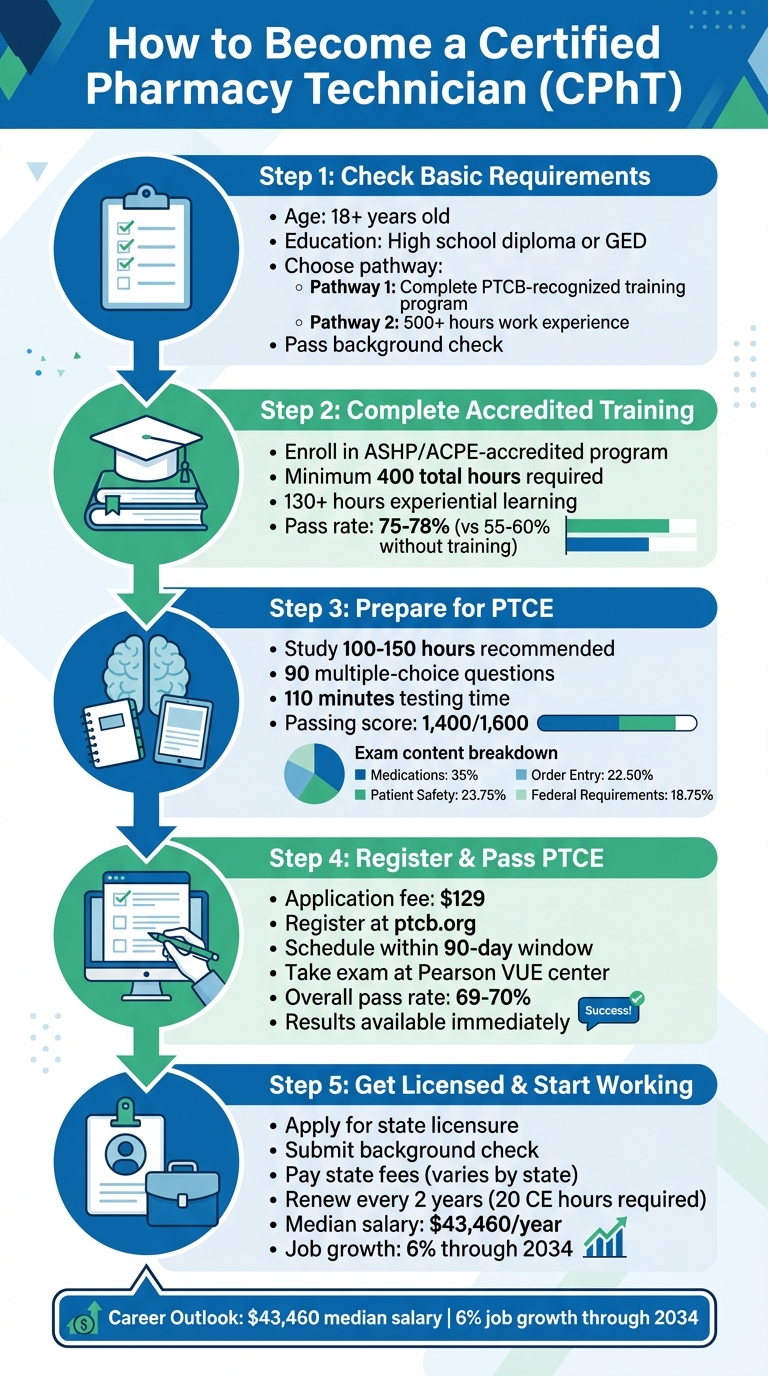
5 Steps to Become a Certified Pharmacy Technician (CPhT)
The Ultimate Step-By-Step Guide to Becoming a Pharmacy Technician in 2026. Everything You Need!
sbb-itb-7a67ffa
Step 1: Check If You Meet the Basic Requirements
Before diving in, make sure you meet the essential qualifications. The PTCB sets nationwide standards, but your state might have additional rules. Sorting this out early can save you time and hassle down the road.
Age and Education Requirements
To take the PTCE, you need to be at least 18 years old, though some states allow you to work at 17. A high school diploma or GED is the minimum educational requirement for both certification and state licensure. Additionally, you must reside in the United States or its territories.
There are two eligibility options for the PTCB:
- Pathway 1: Complete a PTCB-recognized education or training program. You can even apply within 60 days of your expected graduation.
- Pathway 2: Have 500 hours of pharmacy technician work experience if you haven’t attended a formal training program.
If you’re new to the field, Pathway 1 is a better fit. If you’ve already gained hands-on experience, Pathway 2 might be the way to go.
Once you’ve sorted out these basics, it’s time to review your legal background and ensure you meet the necessary requirements.
Background Checks and Legal Requirements
When applying, you’ll need to disclose any criminal history or actions taken against your State Board registration or licensure. The PTCB reviews each case individually, and while minor or older offenses might not automatically disqualify you, failing to disclose them could make you ineligible.
Most states also require a criminal background check, which typically involves submitting fingerprints and authorizing state and federal record reviews. Keep in mind that drug-related offenses are usually disqualifying since pharmacy technicians handle controlled substances like narcotics. Many training programs and employers also require drug screenings before allowing you to start work.
"Technicians should be sure to contact the State Board of Pharmacy where they are seeking employment, and before they relocate to a different state, to learn about the state’s complete and current pharmacy regulations." – PTCB
It’s a good idea to check your state’s Board of Pharmacy website early in the process. Requirements for registration, background checks, and the scope of practice can vary widely depending on where you live. While the standard PTCB application processes in about 24 hours, applications requiring a review for conduct issues can take 3–4 weeks once all documents are submitted.
Step 2: Complete an Accredited Training Program
After meeting the basic requirements, the next step is enrolling in a PTCB-recognized, ASHP/ACPE-accredited training program. These programs provide structured education that greatly improves your chances of passing the PTCE. First-time candidates from accredited programs have a 75-78% pass rate, compared to only 55-60% for those retaking the exam. This makes accredited training a critical part of preparing for the challenging PTCE exam.
Why Choose an Accredited Training Program?
Accredited programs ensure you receive standardized and thorough education tailored to the PTCE’s content. They cover essential topics like medication safety, federal regulations, and sterile and non-sterile compounding. These areas are directly aligned with the PTCE, where the Medications domain alone makes up 40% of the exam – and is often the most challenging section for candidates.
In some states, such as Washington, Florida, Nevada, and West Virginia, completing an ASHP/ACPE-accredited program (or an equivalent state-approved option) is required for licensure. Even in states without this mandate, hospitals and healthcare systems often favor candidates from accredited programs. Why? These programs include hands-on externships and simulation training, ensuring graduates are job-ready. ASHP/ACPE standards mandate a minimum of 400 total hours, with at least 130 hours of experiential learning. This blend of classroom and real-world training not only prepares you for the exam but also equips you with practical skills for the workplace.
What HealthCareer Certs Brings to the Table

HealthCareer Certs offers a self-paced, fully online training program licensed and approved by the New Hampshire Department of Education. The program is comprehensive, featuring 20 modules that cover the fundamentals of pharmacy technician work, along with an 8-module study guide specifically designed to prepare you for the PTCE.
Students gain essential skills like managing inventory, processing prescription requests, measuring medications accurately, maintaining patient records, and handling insurance claims. These skills align closely with PTCE topics, giving you a strong foundation for the exam and your future career.
The program also guarantees externship placement, giving you invaluable hands-on experience. To make this opportunity accessible, HealthCareer Certs offers an Externship Scholarship of up to $2,000 for eligible students. The curriculum is packed with interactive tools like 3D demos, quizzes, flashcards, and over 1,400 practice questions, all aimed at boosting your exam readiness.
| Feature | Details |
|---|---|
| Externship Placement | Guaranteed placement in a healthcare facility near you |
| Financial Aid | Up to $2,000 Externship Scholarship for qualified students |
| Program Approval | Licensed and approved by the New Hampshire Department of Education |
| Flexible Learning | Self-paced courses with interactive tools and detailed exam prep |
| Study Resources | Over 1,400 practice questions, 700 self-checks, 3D demos, quizzes, and flashcards |
Before enrolling in any program, confirm its inclusion in the PTCB’s Recognized Education/Training Program Directory to ensure it meets eligibility criteria for the exam. Additionally, check your state’s pharmacy board requirements, as some states specifically require ASHP/ACPE-accredited programs, while others accept any PTCB-recognized training.
Step 3: Prepare for the PTCE
Once you’ve wrapped up your training program, it’s time to shift your focus to preparing for the Pharmacy Technician Certification Exam (PTCE). This test evaluates your ability to perform safely and effectively as a pharmacy technician. A solid study plan makes all the difference – candidates who dedicate 100–150 hours to studying have pass rates of 78–85%, compared to the overall pass rate of 69–70%. Investing this time not only strengthens your knowledge but also boosts your confidence for exam day.
PTCE Format and Content Overview
The PTCE is a computer-based exam with 90 multiple-choice questions. Of these, 80 are scored, while 10 are unscored pilot questions designed to improve future exams. You’ll have 110 minutes of active testing time within a 2-hour appointment window. To pass, you’ll need a scaled score of 1,400, within a range of 1,000–1,600.
Starting January 6, 2026, the exam content has been updated to reflect new priorities, including the Drug Supply Chain Security Act (DSCSA). The exam now emphasizes Federal Requirements and Order Entry & Processing, while removing NTI lists and certain nonsterile compounding tasks.
Here’s a breakdown of the exam’s content domains:
| Knowledge Domain | Weight (%) | Key Content Areas |
|---|---|---|
| Medications | 35% | Generic/brand names, drug interactions, contraindications, dosage forms, routes of administration, and storage |
| Patient Safety & Quality Assurance | 23.75% | High-alert/LASA medications, error prevention (Tall Man lettering), pharmacist intervention issues, and event reporting |
| Order Entry & Processing | 22.50% | Calculations, SIG codes, medical terminology, NDC numbers, and inventory management |
| Federal Requirements | 18.75% | Controlled substance schedules, DEA requirements, REMS, FDA recalls, and DSCSA tracking/tracing |
Study Materials and Practice Resources
Start your preparation with official PTCB resources that closely simulate the exam experience. For example, the Pre-PTCE exam, a full-length simulation using retired questions, costs $29 (or $19 when bundled with your CPhT application). Candidates who pass this are three times more likely to succeed on the actual PTCE. Another great option is the PTCE Practice Bank, which offers over 300 questions and 400 flashcards for $65 (90-day access). On average, users score 10% higher on the exam after using this resource.
To sharpen your skills further:
- Practice pharmacy math daily. Solve 5–10 calculation problems each day for at least 4 weeks before the exam. Focus on dosages, concentrations, and IV flow rates, aiming to solve each problem in under 75 seconds.
- Use flashcards to memorize key information like the "Top 200" drugs, pharmacy conversions, medical abbreviations, and federal regulations. The Leitner Method can help you prioritize areas where you need improvement –.
- HealthCareer Certs students have access to over 1,400 practice questions, 700 self-checks, 3D demos, quizzes, and flashcards. These tools align closely with PTCE content and provide a strong preparation foundation.
Don’t overlook critical topics like high-alert medications, look-alike/sound-alike (LASA) drugs, and SIG codes, which are heavily tested in the Patient Safety and Order Entry domains. Keeping a "Drug Confusion Log" to track LASA drugs can help you avoid common errors that may appear on the exam.
Finally, simulate the real testing experience by taking 3–5 full-length timed practice exams (110–120 minutes) under test-like conditions. This will help you build stamina and identify weaknesses in your preparation. Remember, an on-screen calculator is provided during the test, so practice using a similar tool beforehand.
The PTCE application and exam fee is $129, and you’re allowed up to four attempts (with a six-month waiting period before a fourth attempt). With these strategies and resources, you’ll be ready to register and tackle the PTCE with confidence.
Step 4: Register for and Pass the PTCE
Once you’ve prepared, it’s time to register and schedule your PTCE. Start by creating a PTCB account at ptcb.org. After logging in, click the "Apply Now" button under the CPhT Certification section. You’ll need to choose your eligibility pathway: Pathway 1 (completed training program) or Pathway 2 (500+ hours of work experience). The application process also requires you to disclose any criminal or registration actions, provide your electronic signature, and request testing accommodations if necessary. The application and exam fee is $129, payable via credit or debit card. If your employer or school is covering the cost, enter the voucher information during payment.
Once your application is submitted, keep these scheduling details in mind: Most applications are approved within 24 hours. After approval, you’ll receive an Authorization to Schedule (ATS) email, which gives you a 90-day window to book your exam through Pearson VUE. The PTCE must be taken in person at a Pearson Professional Center; online testing isn’t an option. To secure your preferred date and location, it’s best to schedule your exam as soon as possible.
On test day, arrive at the Pearson VUE center 30 minutes early to allow time for check-in and security procedures. Be sure to bring a valid, government-issued photo ID that matches the name on your PTCB account exactly – any mismatch could result in being denied entry. Personal items like phones and study materials must be stored in lockers provided at the center. The testing environment is closely monitored, and you’ll be given scratch paper and access to a basic on-screen calculator for any calculations.
After completing the exam, you’ll see an unofficial pass/fail result immediately following a brief survey. If you pass, congratulations! You’ve just cleared a major hurdle. Official results, along with your score report, will be available in your PTCB account within two to three weeks. If you don’t pass, you’ll need to wait 60 days before attempting a retake. The retake fee is also $129. Keep in mind that the overall pass rate for the PTCE is around 69–70%, but candidates from accredited programs tend to have higher first-time pass rates of 75–78%.
Take a deep breath, stay focused, and tackle one question at a time. You’ve got this!
Step 5: Get Licensed and Begin Working
How to Obtain State Licensure
After passing the PTCE, the next step is securing your state licensure. You’ll find your official score report in your PTCB account within three weeks.
It’s important to understand the difference between certification and licensure. Your national CPhT certification from PTCB demonstrates your knowledge and skills, but state licensure is a legal requirement, enforced by your State Board of Pharmacy. Most states require both, as the national certification is often a prerequisite for obtaining the state license. However, five states (Colorado, Hawaii, New York, Pennsylvania, and Wisconsin) currently don’t regulate pharmacy technicians.
To apply, visit your State Board of Pharmacy’s website and complete the application. You’ll need to provide personal information, proof of your CPhT certification, details about your education, and pay the required fee (which varies by state). A criminal background check, including fingerprinting, is typically part of the process. Some states may have additional requirements. For instance, Louisiana mandates 600 hours of practical experience or the completion of an accredited program before applying for full certification.
Keep in mind the costs involved. You’ve already paid $129 for the PTCE, and state registration fees will add to your expenses. Once licensed, both your CPhT certification and state license require renewal every two years, which involves completing 20 hours of continuing education (including one hour focused on pharmacy law and one on patient safety).
Once your state licensure is in hand, you’re ready to officially start your career as a certified pharmacy technician.
Finding Your First CPhT Job
With your credentials in place, it’s time to hit the job market. Your CPhT certification gives you a competitive edge. According to the PTCB:
"Employers prefer, and many require, their pharmacy technicians to be PTCB CPhTs".
To stand out, claim your digital badge via Credly and showcase it on LinkedIn, your resume, and even your email signature. This makes it easy for recruiters and hiring managers to verify your qualifications.
When it comes to job opportunities, retail pharmacies like CVS, Walgreens, and independent drugstores are common starting points. These positions often involve regular business hours and plenty of customer interaction. If you’re looking for higher pay, consider hospital pharmacies, where you might work on more complex tasks like preparing IV solutions. However, these roles often require night, weekend, or holiday shifts. Other options include specialty pharmacies, which focus on medications for chronic conditions and tend to offer higher salaries, and mail-order facilities, which provide structured environments with less direct customer interaction. Jobs at long-term care facilities serving nursing homes and assisted living centers can also provide steady, reliable work.
To find openings, use major job boards like Indeed, LinkedIn, Glassdoor, and Monster, and set alerts for terms like "entry-level" or "CPhT". If you completed an externship during your training, reach out to that pharmacy – they often hire externs directly. Make sure your state license is active before applying, as employers will verify it. Be prepared for background checks and drug screenings, which are standard for roles involving controlled substances.
If you’re open to relocating, remember that state licenses are not transferable. Contact the Board of Pharmacy in your new state early to understand their requirements. For better pay at the entry level, aim for positions in hospital pharmacies, specialty pharmacies, or nuclear pharmacies, which typically offer higher wages compared to retail settings.
Conclusion
Becoming a Certified Pharmacy Technician is a structured process with clear steps. It starts with meeting basic eligibility requirements – being at least 18 years old and holding a high school diploma or GED. From there, you’ll complete accredited training, pass the PTCE, and secure state licensure. Each step builds on the last, paving the way for a career in healthcare.
"PTCB Certification is an important first step toward a rewarding career in healthcare".
Certification doesn’t just fulfill regulatory needs – it boosts your career prospects. Many employers prefer or require pharmacy technicians to hold PTCB certification. With a median annual salary of $43,460 and job growth expected at 6% through 2034, this field offers both stability and opportunities to grow. Experienced technicians in hospital or specialty roles can earn over $59,450 annually.
Maintaining your certification is equally important. Every two years, you’ll need to renew both your state licensure and national certification. This process includes 20 hours of continuing education, focusing on areas like pharmacy law and patient safety, which ensures you’re always up-to-date on best practices.
HealthCareer Certs makes the journey manageable with its 100% online, self-paced courses and guaranteed externship placements. You can prepare for the PTCE while balancing your studies with your current commitments. Take the first step toward a fulfilling healthcare career today.
FAQs
How long does it take to become a CPhT?
Becoming a Certified Pharmacy Technician (CPhT) usually takes around 4 to 6 months. This timeframe includes finishing an accredited training program and successfully passing the Pharmacy Technician Certification Exam (PTCE). Compared to many other healthcare careers, the process is fairly quick, enabling individuals to step into their roles in the field soon after completing these requirements.
What’s the difference between CPhT certification and state licensure?
CPhT certification is a national credential that confirms a pharmacy technician’s expertise by successfully completing the Pharmacy Technician Certification Exam (PTCE). While it’s not required, earning this certification can boost job opportunities and career prospects.
State licensure, however, is a mandatory requirement for working as a pharmacy technician in a specific state. Licenses are issued by state pharmacy boards and often include additional steps like state-specific exams or background checks.
What should I do if I fail the PTCE?
If you don’t pass the PTCE, it’s important to review your exam performance to identify areas where you struggled. For the second and third attempts, there’s no waiting period, allowing you to retake the exam right away. However, after a fourth unsuccessful attempt, you’ll need to wait six months before trying again. To boost your chances of passing next time, focus on strengthening your knowledge by studying the exam content, practicing with mock exams, using study guides, or even enrolling in prep courses. These steps can help you approach your next attempt with greater confidence.