Finding a budget-friendly online medical assistant program is key if you’re looking to enter the healthcare field without taking on excessive debt. With medical assistants earning a median annual salary of $44,200, the cost of training – often exceeding $18,000 – can be a barrier. Programs vary widely in price, duration, and certification options, so it’s critical to choose one that aligns with your budget, timeline, and career goals.
Here’s what you need to know:
- Certificate programs: Cost as low as $810 and can be completed in 2–4 months. They focus on preparing students for certifications like the CCMA (NHA) and often include externship placement.
- University programs: Cost between $15,000–$20,000+ and take 18–24 months. These may lead to multiple certifications or degrees, offering more flexibility for future education but at a higher price.
Key Considerations:
- Certificate programs are faster and cheaper but may lack federal financial aid options.
- University programs qualify for FAFSA and other aid but come with longer timelines and higher costs.
- Externship placement and certification exam prep are included in most programs, but details vary.
Quick Comparison:
| Program | Tuition Range | Completion Time | Financial Aid | Externship Support | Certifications Included |
|---|---|---|---|---|---|
| HealthCareer CERTS | $2,700–$4,500 | 4–12 weeks | Payment plans | Guaranteed | CCMA (NHA) |
| Clinical Skills Inst. | $810–$900 | 2–4 months | Payment plans | Guaranteed | CCMA (NHA) |
| Siena Heights Univ. | ~$15,000+ | 18–24 months | FAFSA eligible | Arranged by school | CMA (AAMA) or CCMA (NHA) |
| Roosevelt Univ. | ~$20,000+ | 18–24 months | FAFSA eligible | Arranged by school | CMA (AAMA) or CCMA (NHA) |
| Rowan Univ. | ~$15,000+ | 2 semesters | FAFSA eligible | Required practicum | Multiple NHA certifications |
If you need a fast, affordable path to certification, consider programs like HealthCareer CERTS or Clinical Skills Institute. For more advanced education with future degree potential, a university program may be worth the investment. Your choice depends on your career goals and financial situation.
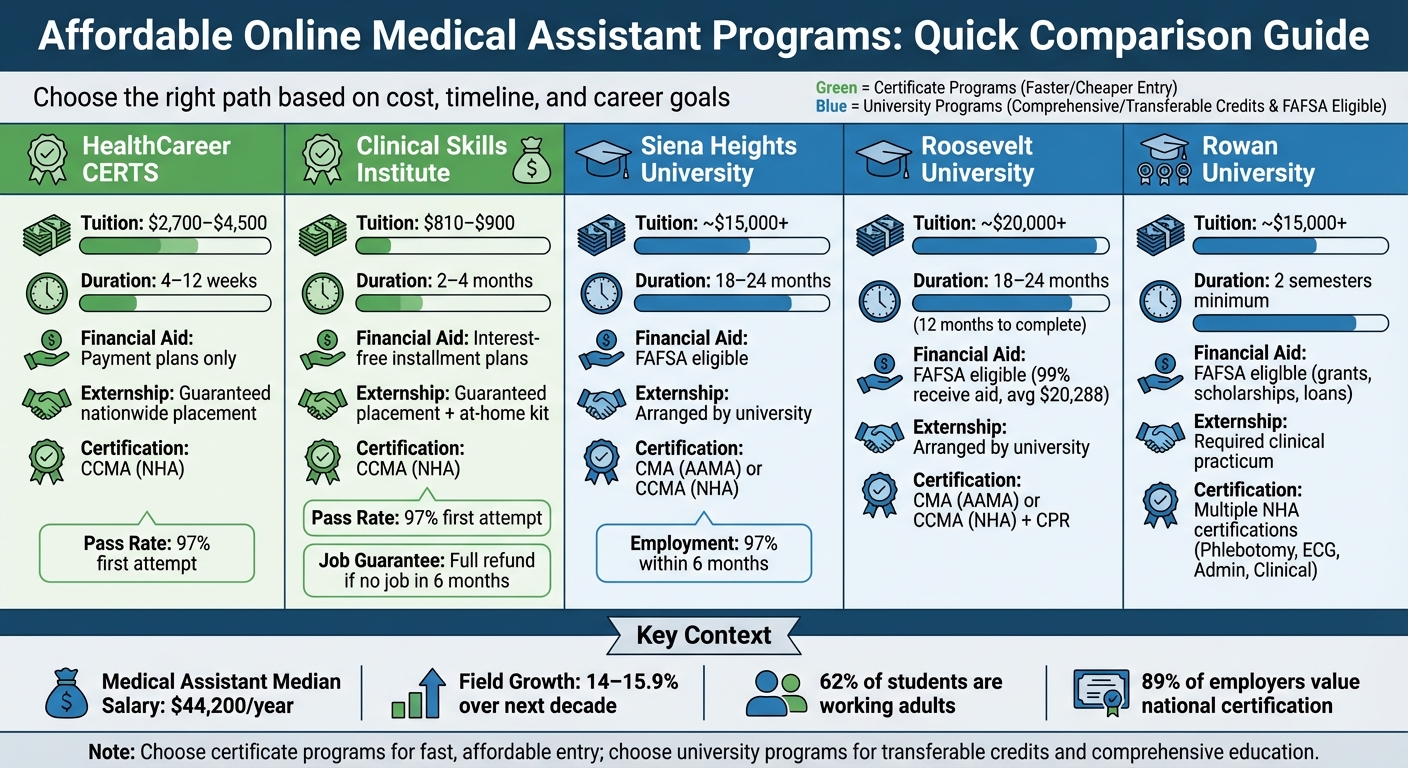
Online Medical Assistant Programs Cost and Duration Comparison
1. HealthCareer CERTS
Tuition Cost
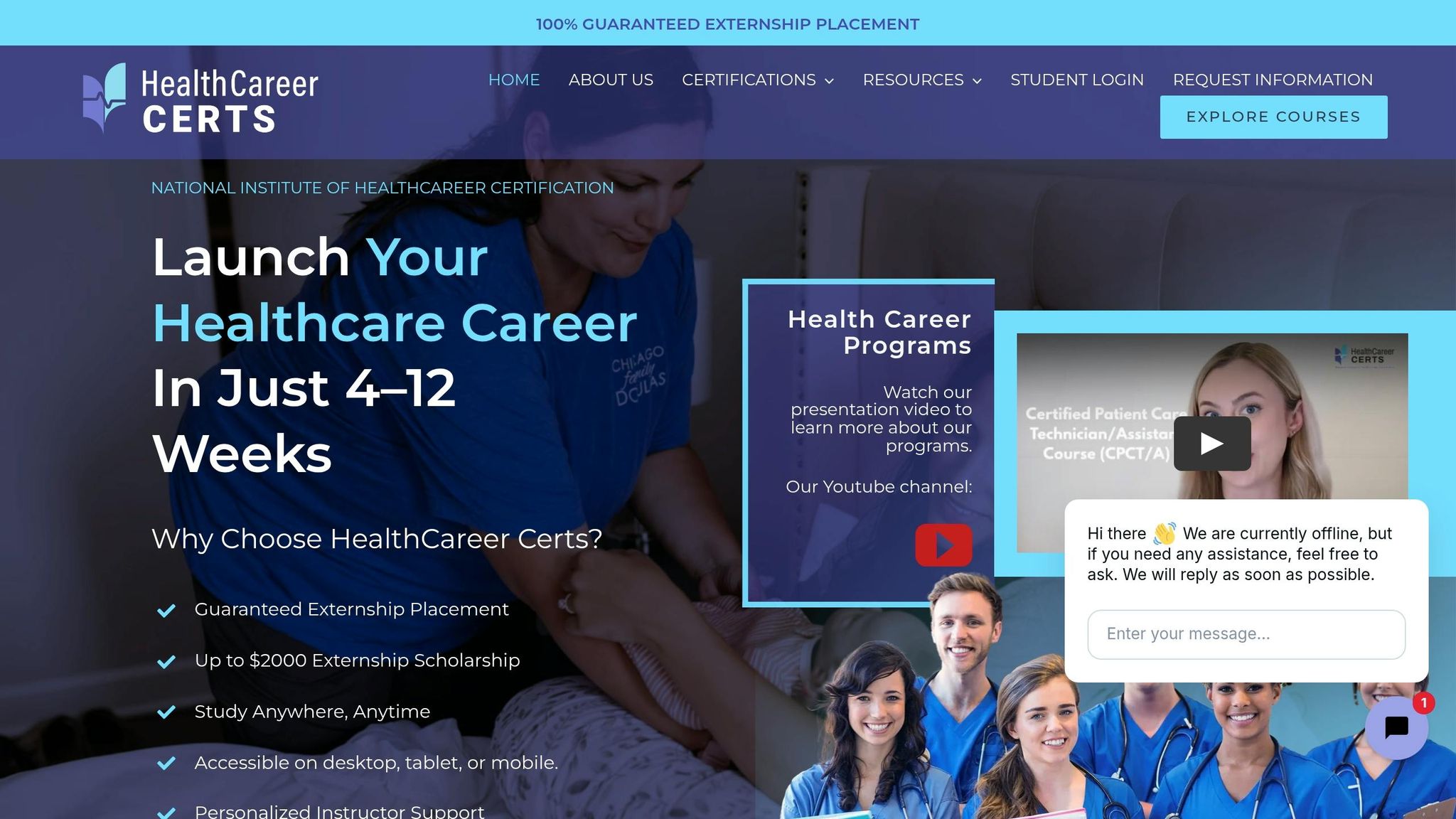
HealthCareer CERTS charges a flat tuition fee of $2,700, which includes everything you need – learning materials, the NHA CCMA certification exam registration, 12-month access to course content, study guides, practice tests, and additional resources. For those needing flexibility, interest-free installment plans are available. The program also offers up to $2,000 in scholarships to help cover the externship experience, with no extra fees for externship placement. This comprehensive approach ensures affordability without hidden costs.
Accreditation
HealthCareer CERTS is nationally accredited and licensed by the New Hampshire Department of Education. This accreditation allows students to qualify for the CCMA exam through the NHA or AMCA. Achieving CCMA certification earns students five ACE (American Council on Education) credits, which are accepted by over 2,000 colleges and universities nationwide. This credential is highly valued by employers, as many healthcare positions require or prefer national certification for medical assistants.
Program Format
The program is entirely online and self-paced, with 24/7 access to the learning platform. Students progress through 18 modules featuring 3D animated demonstrations, laboratory simulations, case study videos, and audio narration. While the program can be completed in as little as eight weeks, students have the flexibility to adapt the timeline to their personal schedules. With over 5,000 students rating the program 5/5 on Google, many commend its flexibility and support, which make it possible to balance certification with work and personal obligations. To complement online learning, the program also emphasizes practical experience through its externship support.
Externship Support
HealthCareer CERTS guarantees externship placement for all qualified students. The program’s placement team works with clinics and hospitals across the country to ensure students gain hands-on clinical experience near their home. This supervised externship is a key opportunity to apply classroom knowledge in real-world healthcare settings while building professional connections that can aid in future job searches.
Certification Pathways
Students are prepared to take the NHA CCMA exam, which can be completed at PSI centers or via online proctoring. The program also supports the AMCA certification pathway, with testing available at approved sites nationwide. The AMCA exam consists of 200 questions and takes 3 hours and 30 minutes to complete. To ensure success, students have access to instructor-led support through Zoom and email, as well as tutoring and career coaching. As one student, Olivia, shared:
I was able to get certified and pass the NHA exam on the first try in only 6 weeks, and I appreciated the ease of the entire process/course and the other support/resources I received.
sbb-itb-7a67ffa
2. Clinical Skills Institute
Tuition Cost
Clinical Skills Institute offers two payment options for its program: $810 upfront (with a $90 discount) or $900 through installment plans. The installment plans include a 3-month option at $300 per month or a 6-month option at $150 per month. This tuition covers the NHA CCMA exam fee, six practice exams, and a reference ebook. Students also gain 12 months of access to all course materials, providing flexibility to complete the program at their own pace.
The program includes a Career Support Guarantee, offering a full refund of tuition if graduates meet all program and placement requirements but are unable to secure a full-time position within six months of certification. Students may also request a refund within the first 7 days, but if the $125 ebook has been activated, its cost will be deducted from the refund.
Accreditation
Clinical Skills Institute is an approved training partner of the National Healthcareer Association (NHA), and its certifications are nationally accredited by the National Commission for Certifying Agencies (NCCA). This accreditation ensures that the program is recognized across all 50 U.S. states. Graduates can take the Certified Clinical Medical Assistant (CCMA) exam immediately after completing the program, which boasts a 97% first-attempt pass rate for the NHA CCMA exam.
Program Format
The program is entirely online and self-paced, with no set schedules or deadlines. While most students complete the coursework in 6 to 8 weeks, they have up to 12 months to finish. The curriculum includes simulation-based training, and students have the option to purchase an at-home clinical kit that includes a venipuncture trainer, stethoscope, and sphygmomanometer. One-on-one Zoom support is also available to assist with the learning process.
Externship Support
Clinical Skills Institute provides nationwide externship coordination at no additional cost after certification. These externships typically last 2 to 4 weeks (80 to 160 hours) and take place in settings such as urgent care facilities, family medicine practices, and pediatric offices. Students receive a customized list of clinics near their ZIP code and an Externship Toolkit, which includes recommendation letters, syllabi, and outreach scripts. The program follows an "externship-to-hire" approach, focusing on clinics with active hiring needs to enhance job placement opportunities. As Clinical Skills Institute explains:
CSI works directly with the clinic to sign an externship agreement, handle all legal, insurance, and documentation requirements, and schedule your official externship start date.
Certification Pathways
The program prepares students for the NHA CCMA exam, which is included in the tuition along with six practice exams to ensure readiness. Thanks to its alignment with NHA standards, graduates can test immediately upon completing the program. Entry-level salaries for graduates range from $40,000 to $46,000 annually, and the field is expected to grow by 15.9% over the next decade. Career support services, such as resume reviews, interview preparation, and access to a private job board, are also provided to help graduates successfully transition into the workforce. These features will be explored further in the upcoming program analysis.
3. Siena Heights University
Tuition Cost
Siena Heights University offers a Medical Assistant certificate program for $4,000, which can be completed in just 28 weeks. However, this program is available only until the end of the 2025–2026 academic year, as the university will close afterward. To help make the program more affordable, there are partnerships with Michigan Works! Southeast and tuition assistance options for Henry Ford Health employees. Plus, all students are eligible for financial aid [20,21,23].
Accreditation
The program holds institutional accreditation from the Higher Learning Commission (HLC), ensuring it meets rigorous academic and industry standards [22,23]. Siena Heights boasts a 12:1 student-to-faculty ratio and reports that 97% of graduates find employment within six months of completing the program [23,26]. The curriculum includes 552 hours of coursework covering essential topics like Medical Assistant Career Introduction, Healthcare Foundational Knowledge, Anatomy and Physiology, General Patient Care, Pharmacology Basics, and Infection Control [21,23].
However, students aiming for specific certifications should confirm whether the HLC accreditation aligns with their goals, as some certifications may require programmatic accreditation from organizations like CAAHEP or ABHES. The program’s robust academic framework is complemented by its flexible online format.
Program Format
This program is entirely online and self-paced, making it ideal for working professionals. Students can start whenever they are ready and progress at their own pace, all while receiving personalized support from a dedicated Student Success Advisor.
Externship Support
To meet clinical requirements, the program provides strong externship support. Each student is assigned a personal Student Success Advisor, who helps with coaching, scheduling clinical placements, and offering guidance throughout the program. As stated by the university:
Your personal Student Success Advisor is available for coaching and support throughout the program – as well as to help schedule your clinicals (if needed).
In addition, the university’s Career Services department offers a 7-step process to prepare students for the workforce. This includes resume building, interview practice through the "Suits for Saints" initiative, and access to the Handshake platform, which connects students with potential employers. Students are encouraged to work closely with their advisor to ensure their clinical placements align with their certificate plan.
Certification Pathways
Graduates of this program are well-prepared to take professional Certified Clinical Medical Assistant (CCMA) exams and secure entry-level roles in clinics, hospitals, or medical offices [20,23,24].
4. Roosevelt University
Tuition Cost
Roosevelt University offers a fully online Medical Assistant program designed for flexibility, allowing 12 months to complete coursework at your own pace. The program includes the CCMA exam registration fee at no additional cost. Financial aid is accessible to 99% of students, with an average award of $20,288. Plus, online students avoid certain campus fees, making this option more budget-friendly.
Accreditation
This program is institutionally accredited by the Higher Learning Commission (HLC). The curriculum covers essential areas such as medical terminology, law and ethics, HIPAA compliance, vital signs, lab testing, injections, and blood collection.
Program Format
The program is entirely online with open enrollment, allowing students to start anytime. Courses are delivered asynchronously through Blackboard, featuring short concept videos and readings. Students must meet weekly deadlines, and most dedicate 6–9 hours per week per three-credit class.
Externship Support
To complement online learning, students can engage in unpaid clinical practice for hands-on experience. The program provides a Clinical Experience Starter Kit and scheduling assistance from a Clinical Experience Coordinator to help secure training opportunities.
Certification Pathways
Graduates are prepared to sit for the CCMA certification exam and also earn CPR certification as part of the program. With medical assistant roles expected to grow by 14% over the next decade, this program equips students with the skills needed for entry-level positions in healthcare. It’s a solid foundation for those looking to enter the field or advance further. Next, we’ll evaluate the strengths and weaknesses of all the programs featured.
5. Rowan University
Tuition Cost
Rowan University keeps tuition straightforward by including certification exam vouchers in the cost, helping students avoid surprise fees. Financial aid options – such as grants, scholarships, federal loans, and work-study – are available through the Office of Financial Aid. Students can also save money through transfer-friendly policies, making the program more accessible.
Accreditation
The program is designed to prepare students for national certification through the National Healthcareer Association (NHA), meeting the requirements for the Certified Clinical Medical Assistant (CCMA) credential. As a public university, Rowan ensures its curriculum aligns with NHA standards, offering a clear path to certification.
Program Format
The coursework is divided into four modules: Phlebotomy, ECG, Administrative Medical Assisting, and Clinical Medical Assisting with Practicum. These can be completed in as little as two semesters. Students must finish the first three modules before starting the clinical practicum, which serves as the final step in the program.
Externship Support
The clinical practicum provides supervised, hands-on training in a real healthcare setting. Before beginning the externship, students are required to obtain BLS certification, pass a background check and drug test, and provide up-to-date immunization records. This training focuses on essential skills like aseptic techniques, measuring vital signs, assisting with exams, collecting specimens, and administering medications.
Certification Pathways
Graduates earn multiple certifications through the NHA, including Phlebotomy, ECG, and Administrative Medical Assisting, along with the comprehensive Clinical Medical Assistant credential. This multi-certification approach opens doors to various roles in healthcare support while keeping costs manageable. Rowan University’s program stands out for its affordability and flexibility, offering a well-rounded pathway into the medical field.
Top 5 Online Medical Assistant Programs – Can You Become a MA Online? Yes and No
Program Comparison: Strengths and Weaknesses
Choosing the right medical assistant program means finding a balance between affordability and career readiness. Programs vary widely in cost, duration, and focus, so it’s important to weigh your budget, timeline, and long-term goals. Certificate programs, like those offered by Clinical Skills Institute and HealthCareer CERTS, typically cost between $810 and $4,500. These programs focus on career-specific skills and can be completed quickly – usually within two to four months. On the other hand, university programs such as Siena Heights, Roosevelt, and Rowan offer Associate degrees that range from $15,000 to $46,000 and take 18 to 24 months. These programs include general education credits, which can later be applied toward degrees in nursing or health administration.
A key difference between these program types is financial aid. Certificate programs generally don’t qualify for federal aid but often offer interest-free installment plans. University programs, however, are FAFSA eligible, allowing students to use Pell Grants, federal loans, or GI Bill benefits. While this can ease upfront costs, it may also lead to long-term debt. This distinction is particularly important given that 62% of new medical assistant students are working adults and 34% are parents.
Additional costs, like exam fees and e-books, can also vary. Some programs, such as Clinical Skills Institute and HealthCareer CERTS, bundle these costs, while others list them separately, which can increase the total expense. Both of these certificate programs boast a 97% first-attempt pass rate on the NHA CCMA exam and even offer job guarantees. For instance, Clinical Skills Institute promises a full tuition refund if you don’t secure a job within six months, while HealthCareer CERTS provides similar guarantees within three months.
| Program | Tuition Range | Completion Time | Financial Aid | Externship Support | Certifications Included |
|---|---|---|---|---|---|
| HealthCareer CERTS | $3,300 – $4,500 | 4–12 weeks | Payment plans only | Guaranteed nationwide externship placement | CCMA (NHA) |
| Clinical Skills Institute | $810 – $900 | 2–4 months | Interest-free plans | Guaranteed externship placement + at-home kit | CCMA (NHA) |
| Siena Heights University | ~$15,000+ | 18–24 months | FAFSA eligible | Arranged by university | CMA (AAMA) or CCMA (NHA) |
| Roosevelt University | ~$20,000+ | 18–24 months | FAFSA eligible | Arranged by university | CMA (AAMA) or CCMA (NHA) |
| Rowan University | ~$15,000+ | 2 semesters minimum | FAFSA eligible | Required clinical practicum | Multiple NHA certifications |
When choosing a program, consider not only the cost but also the credentials it provides. Certificate programs primarily prepare students for the CCMA (NHA) credential, which is widely recognized by employers. However, if you’re aiming for the CMA (AAMA) – often considered the gold standard – you’ll need to complete a CAAHEP- or ABHES-accredited Associate degree program. University programs may also offer multiple NHA certifications, giving you the flexibility to pursue various healthcare support roles.
Conclusion
Choosing an affordable online medical assistant program means balancing your budget with your career goals and timeline. For those seeking the quickest and most cost-effective entry into the workforce, certificate programs stand out. With tuition starting as low as $810, a 97% first-attempt pass rate, and even guarantees like tuition refunds if employment isn’t secured within six months, these programs offer a compelling option.
Certificate programs typically allow students to complete their training in just two to four months, making them ideal for fast employment. On the other hand, associate degree programs, which take 18–24 months to finish, provide a broader education and transferable credits for future studies. However, these benefits come with higher tuition costs and the potential for increased debt.
Certification goals also play a major role in decision-making. Since roughly 89% of employers value national certification, choosing an accredited program becomes critical. Beyond accreditation, funding options are another key consideration. Certificate programs often lack access to federal aid but may offer interest-free payment plans. Degree programs, however, qualify for financial aid options like FAFSA, Pell Grants, and GI Bill benefits. For the 62% of new medical assistant students who are working adults, these financial options can be a game-changer.
Ultimately, your decision depends on your priorities. If immediate employment is your goal, certificate programs provide a quick path to earning. If you’re focused on long-term career growth or plan to continue your education later, an associate degree offers a solid foundation with transferable credits. Balancing these factors will help you make the best choice for your current needs and future ambitions.
FAQs
Do employers accept online medical assistant certificates?
Yes, employers do accept online medical assistant certificates, provided they come from nationally recognized and accredited programs. Credentials from reputable organizations like the National Healthcareer Association (NHA) are widely acknowledged and help showcase your qualifications to potential employers.
What extra costs should I budget for beyond tuition?
When budgeting for your education, it’s important to account for more than just tuition. You’ll likely encounter additional costs like certification exam fees, textbooks or course materials, clinical or externship fees, and even necessary supplies or equipment. These are usually separate expenses and aren’t covered in the tuition price.
How do I choose between CCMA and CMA certification?
When deciding between CCMA (Certified Clinical Medical Assistant) and CMA (Certified Medical Assistant) certifications, it’s important to weigh your career aspirations and the preferences of potential employers.
The CCMA, provided by the National Healthcareer Association (NHA), emphasizes clinical skills and often appeals to those who prefer online, self-paced learning options. On the other hand, the CMA, offered by the American Association of Medical Assistants (AAMA), is widely recognized and might be a better fit for individuals aiming for more traditional clinical roles.
Take the time to review factors like program flexibility, accreditation, and exam requirements to determine which certification aligns best with your goals.