Understanding the california cpt1 phlebotomy certification a lot easier once you know that California is one of the few states that actually regulates phlebotomists by law. In most states you can draw blood with a national certification alone. In California, you also need a state license — the Certified Phlebotomy Technician I (CPT1) — issued by the California Department of Public Health (CDPH). That extra step trips up a lot of newcomers, so this guide lays out exactly what you need and the order to do it in.
By the end, you’ll know who qualifies, the training and clinical reps required, which exam to take, and how to apply to the state without backtracking.
Want a faster path to your CPT?
Earn your NHA CPT in 4 weeks online with practice arm shipped, 30 supervised venipunctures, NHA exam included, and externship at a named partner clinic.
What Is the California CPT1 Certification?
The CPT1 is California’s entry-level phlebotomy license. It authorizes you to perform both venipuncture (drawing blood from a vein) and skin puncture (capillary, or fingerstick, draws).
It’s regulated by CDPH’s Laboratory Field Services division, not by a private certifying body alone. That’s the key difference: nationally certified phlebotomists still can’t legally work in California until they hold this state credential.
There are higher tiers — CPT2 (which adds arterial draws) and Limited Phlebotomy Technician (skin puncture only) — but CPT1 is the standard license most California phlebotomy jobs require.
california cpt1 phlebotomy certification You Licensed
Here’s the high-level picture before we break each piece down. Meeting the california cpt1 phlebotomy certification you eligible to apply to the state for your license.
| Requirement | What it involves |
|---|---|
| Education | High school diploma or GED |
| Classroom training | Approved didactic phlebotomy instruction |
| Practical training | Hands-on clinical training hours |
| Venipunctures | Minimum number of supervised venous draws |
| Skin punctures | Minimum number of supervised capillary draws |
| National exam | Pass an exam from a CDPH-approved certifying agency |
| State application | Submit to CDPH with documentation and fee |
Each row is a gate. Skip one and your CDPH application stalls, so it pays to track them as you go.
Step 1: Meet the Education Prerequisite
The baseline is a high school diploma or GED. You don’t need a college degree to become a phlebotomist in California.
This is the easiest requirement to satisfy, but keep your documentation handy — you’ll reference your education again at training enrollment and at the state-application stage.
Step 2: Complete CDPH-Approved Training
For applicants without prior phlebotomy experience, California requires completion of an approved training program that includes both classroom and practical components.
That training generally covers:
- Basic classroom instruction in anatomy, physiology, and safety.
- Practical, hands-on training in venous and capillary collection.
- Specimen handling, labeling, and infection control.
- Patient interaction and HIPAA basics.
Make sure any program you choose is recognized for California eligibility. The right program is built specifically to satisfy CDPH’s training expectations so your hours actually count.
Step 3: Log Your Supervised Draws
CDPH requires hands-on proof that you can perform draws, not just classroom knowledge. You must complete a minimum number of supervised venipunctures and skin punctures on live individuals.
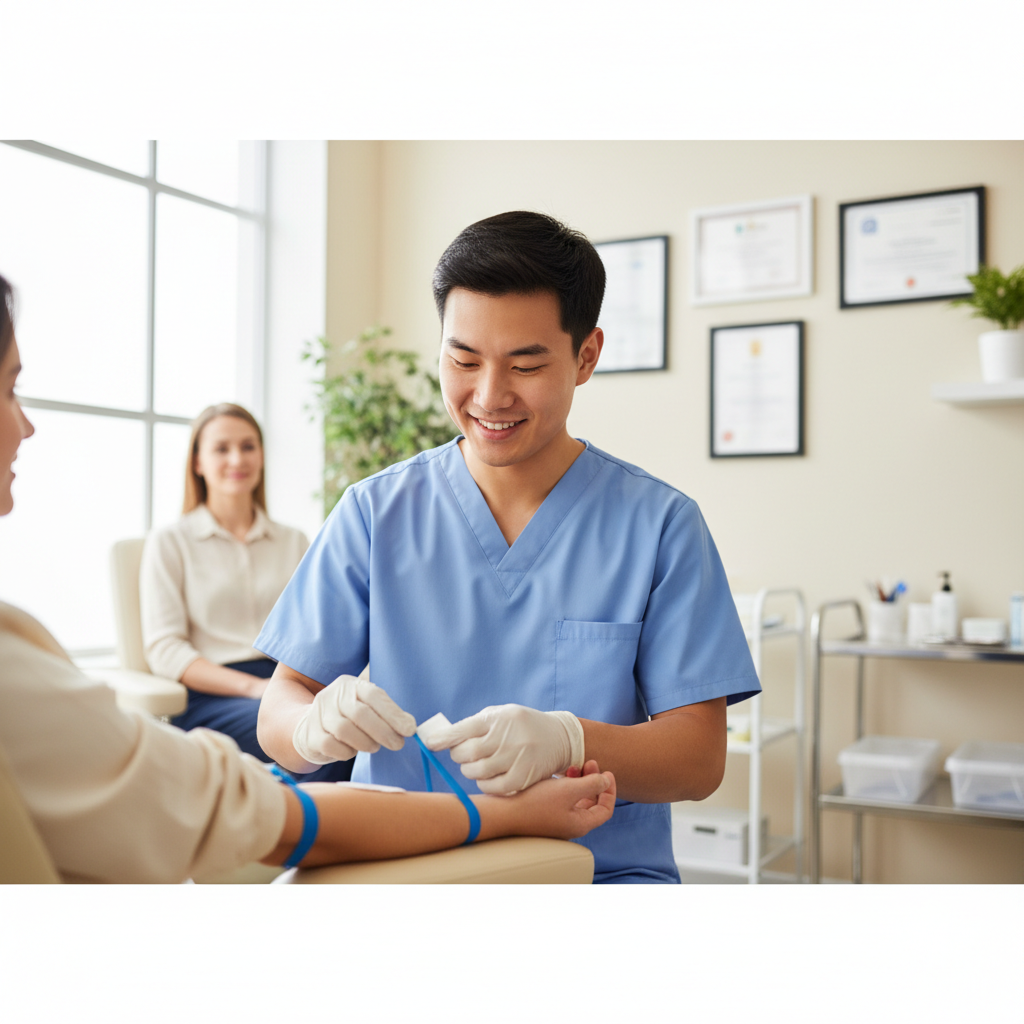
This is where a clinical externship becomes essential. You can’t get these reps from a screen — you need real patients, a real supervisor, and real specimens.
A program that only delivers lectures leaves you to find your own site to log these draws. That gap is exactly why a guaranteed clinical externship matters so much in California, where the supervised-draw requirement is non-negotiable.
Want the CA-eligible path without the placement headache? HealthCareerCerts pairs self-paced online phlebotomy coursework with a guaranteed clinical externship and national exam prep. Explore the phlebotomy program.
Step 4: Pass a National Certification Exam
Before California will license you, you must pass a phlebotomy certification exam from a CDPH-approved certifying organization. Several national agencies qualify, including the National Healthcareer Association (NHA), ASCP, NCCT, and others recognized by the state.
The exam tests the core competencies you trained on: safety, anatomy, collection technique, specimen handling, and patient care. Passing earns you the national certification that California requires as part of its licensing pathway.
This is the step where strong exam preparation pays off. A program aligned to the exam blueprint means you study what’s actually tested instead of guessing.
Step 5: Apply to CDPH for Your State License
With training, clinical draws, and a passing exam in hand, you submit your application to CDPH Laboratory Field Services. Your application package typically includes proof of education, proof of training, documentation of your supervised draws, your national certification, and the state fee.
Once CDPH approves your application, you receive your CPT1 license and can legally work as a phlebotomist in California. Keep copies of everything — you’ll renew the license periodically and need continuing education to stay current.
Always confirm the current forms, fees, and document requirements directly with CDPH before submitting, since state requirements can change.
How Long Does It Take and What Does It Cost?
Timelines vary by how fast you move through training and scheduling your exam. A self-paced online program lets motivated students move quickly, while clinical hours and the CDPH application add processing time.
Costs typically include three buckets: your training program, the national exam fee, and the CDPH application fee. Watch for programs that quote a low tuition but bill the externship or exam separately — ask for the total all-in cost in writing.
The most affordable path is rarely the cheapest sticker price; it’s the program that includes the clinical hours and exam prep so you don’t pay for missing pieces later.
Why an Online, Self-Paced Program Works for CPT1
California’s requirements are strict, but that doesn’t mean you have to sit in a classroom on someone else’s schedule. The didactic portion works well online and self-paced, letting you train around a current job.
The piece you can’t do online — supervised live draws — is exactly where a guaranteed externship closes the gap. HealthCareerCerts combines both: affordable online self-paced coursework, a guaranteed clinical externship for your required draws, and preparation for a recognized national certification exam. That’s a clean route through every box CDPH checks.
Ready to stop studying alone? HealthCerts’ Certified Phlebotomy Technician (CPT) program is built around a 4 weeks online course with a guaranteed externship at a named partner clinic — so you walk out with both the credential and the clinical hours employers want.
Frequently Asked Questions
What are the requirements to get a CPT1 in California?
You need a high school diploma or GED, completion of CDPH-approved classroom and practical training, a minimum number of supervised venipunctures and skin punctures, a passing score on a CDPH-approved national certification exam, and an approved application to CDPH Laboratory Field Services.
Do I need a license to draw blood in California?
Yes. California is one of the few states that legally requires phlebotomists to be state-certified. A national certification alone is not enough — you must hold a CDPH-issued credential like the CPT1 to work.
What’s the difference between CPT1 and CPT2?
CPT1 authorizes venipuncture and skin puncture, which covers most phlebotomy jobs. CPT2 adds authorization for arterial punctures and generally requires additional experience and documentation.
Can I complete California phlebotomy training online?
The classroom (didactic) portion can be completed online and self-paced. However, the supervised venipunctures and skin punctures must be performed in person, which is why a guaranteed clinical externship is so important for California applicants.
Which certification exam does California accept?
California accepts exams from CDPH-approved certifying organizations, including national agencies such as the NHA, ASCP, and NCCT. Always confirm an exam is on CDPH’s approved list before registering.
How much does it cost to get CPT1 certified?
Costs generally include your training program, the national exam fee, and the CDPH application fee. Ask any program for the total all-in cost in writing, and confirm whether the externship and exam are included rather than billed separately.
Do I need experience before training as a phlebotomist in California?
No. Applicants without prior experience qualify through the standard pathway: approved classroom and practical training, supervised draws, a passing national exam, and the CDPH application. A high school diploma or GED is the only educational prerequisite.
Source: California Department of Public Health — Laboratory Field Services
Start Your CPT Journey with HealthCerts
Reading about california cpt1 phlebotomy certification is one thing — actually getting credentialed and into a clinical role is another. HealthCerts’ Certified Phlebotomy Technician (CPT) program is the fastest, most-supported path: Earn your NHA CPT in 4 weeks online with practice arm shipped, 30 supervised venipunctures, NHA exam included, and externship at a named partner clinic.