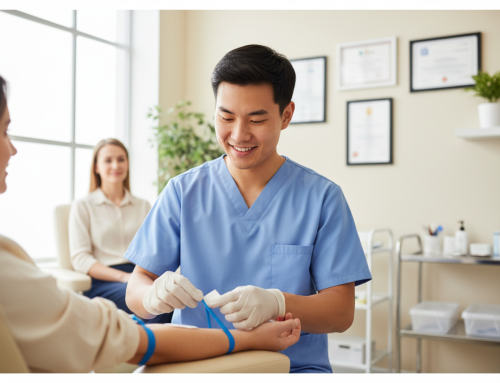
Few questions trip up future phlebotomists more than this one: can you do phlebotomy clinicals online to finish their training really be completed remotely, or is hands-on draw practice still required in person? It is a fair thing to ask. Phlebotomy is a physical skill — you cannot learn to find a vein, anchor it, and draw a clean tube from a video alone. But the way modern programs are structured, “online” and “hands-on” are no longer opposites.
This guide explains exactly what part of phlebotomy training can happen on your laptop, what has to happen with a needle in your hand, and how the better programs combine both so you still graduate clinic-ready. By the end you will know what to look for, what to avoid, and which questions to ask any school before you pay.
Want a faster path to your CPT?
Earn your NHA CPT in 4 weeks online with practice arm shipped, 30 supervised venipunctures, NHA exam included, and externship at a named partner clinic.
can you do phlebotomy clinicals online Really Be Done Remotely?
Here is the honest answer: the academic half of phlebotomy training is a great fit for online learning, but the clinical half is not. When people ask whether the phlebotomy clinicals online students need can be done remotely, they are usually mixing up two different things — coursework and clinical hours.
- Coursework covers anatomy and physiology, the circulatory system, order of draw, specimen handling, infection control, and patient communication. All of this can be learned online, on your own schedule.
- Clinical practice covers actual venipuncture and capillary sticks on real people, plus the supervised hours certification bodies require. This cannot be faked over video.
A legitimate program is upfront about this split. If a school promises you can earn a phlebotomy credential with zero in-person practice, treat that as a red flag — not a feature.
What You Can Learn Online
A surprising amount of phlebotomy is knowledge before it is technique. Online modules handle this part well, and self-paced delivery means you can rewind a tricky lecture or speed through material you already know.
The online portion of a strong program typically includes:
- Circulatory system anatomy and how blood is collected
- The correct order of draw and why tube additives matter
- Labeling, transport, and chain-of-custody rules
- Standard precautions, OSHA bloodborne pathogen rules, and PPE
- Patient identification, consent, and dealing with anxious patients
- Reading a requisition and avoiding common pre-analytical errors
Because this is self-paced and online, working students and parents can finish the didactic portion around a full-time job. That flexibility is the real advantage of online phlebotomy training — not skipping the needle work, but front-loading everything that does not require one.
What Cannot Be Done Online
The skills that get you hired are the ones you can only build with your hands. No online module replaces:
- Live venipuncture on a real arm, with a real pulse and a real patient who might flinch.
- Capillary (fingerstick) draws, which have their own technique.
- Vein selection by feel, anchoring, and angle of insertion.
- Handling a difficult draw — rolling veins, a missed stick, a patient who feels faint.
This is why certification bodies require a minimum number of successful, supervised draws before they will let you sit for an exam. The needle hours are the whole point.
How “Online” Programs Actually Handle Clinicals
The phrase “online phlebotomy program” almost always means a hybrid program. The classroom moves online; the clinical stays in person. There are three common models, and knowing the difference protects you from wasting money.
| Model | How clinicals work | Watch out for |
|---|---|---|
| Hybrid with included externship | School places you at a partner clinic or lab for supervised draws | The strongest option — placement is handled for you |
| Hybrid, find-your-own-site | You must locate and arrange your own clinical hours | You may struggle to find a site that will take you |
| “100% online,” no clinical | No supervised draws at all | Often will not qualify you for a recognized certification exam |
The single most important question to ask any online program is simple: Do you guarantee my clinical placement, or do I have to find it myself? A “find your own site” requirement is where most online students stall — clinics are not obligated to host you, and cold-calling labs as an unknown student is demoralizing.
What Employers and Certification Bodies Expect
Employers do not care whether you learned the order of draw on a laptop or in a lecture hall. They care about two things: that you can draw blood safely, and that you hold a recognized certification.
The most widely accepted phlebotomy credential is the Certified Phlebotomy Technician (CPT) offered through the National Healthcareer Association (NHA). To sit for that exam, you generally need to complete a training program and document a minimum number of supervised venipunctures and capillary sticks. That supervised-draw requirement is exactly why the clinical portion cannot be skipped — no hours, no exam eligibility, no job.
How HealthCareerCerts Solves the Clinicals Problem
The reason most students ask whether clinicals can be done online is fear: fear of paying for a program and then being left to find a clinic on their own. HealthCareerCerts removes that fear.
The Certified Phlebotomy Technician program pairs a self-paced online course with a guaranteed clinical externship. You learn the academic material on your own schedule, then complete your supervised draws at a real partner site that is arranged for you — not one you have to chase down. You finish with both the NHA-recognized credential and the hands-on hours employers require, at a price built for people changing careers, not a four-year tuition bill.
That combination — online flexibility plus guaranteed in-person draws — is the realistic version of what students mean when they search for “online phlebotomy clinicals.”
A Smart Checklist Before You Enroll
Before you pay any program, get clear answers to these:
- Is the clinical externship guaranteed and arranged, or do I find my own site?
- Does the program qualify me to sit for the NHA CPT exam (or another recognized credential)?
- How many supervised draws will I complete before I finish?
- Is the coursework truly self-paced, and how long do I have access?
- What is the all-in cost, including exam fees and supplies?
If a program answers those five clearly and the clinical is handled for you, you have found a real program — not a video course pretending to be one.
Ready to stop studying alone? HealthCerts’ Certified Phlebotomy Technician (CPT) program is built around a 4 weeks online course with a guaranteed externship at a named partner clinic — so you walk out with both the credential and the clinical hours employers want.
Frequently Asked Questions
Can you do phlebotomy clinicals fully online?
No. The coursework can be completed online, but supervised venipuncture and capillary draws must be performed in person. Any program claiming 100% online clinicals with no hands-on hours likely will not qualify you for a recognized certification exam.
What part of phlebotomy training can be done online?
The academic portion — anatomy, order of draw, specimen handling, infection control, and patient communication — is well suited to self-paced online learning. Only the live blood-draw practice requires an in-person clinical.
Do I need to find my own clinical site?
That depends on the program. Some hybrid programs make you locate your own site, which is the most common place students get stuck. Programs with a guaranteed externship arrange the placement for you.
How many supervised draws do I need for certification?
Certification bodies typically require a set minimum of successful venipunctures and capillary sticks before you can sit for the exam. A good program builds these supervised draws into the externship.
Is an online phlebotomy program respected by employers?
Yes, as long as it leads to a recognized credential like the NHA CPT and includes real clinical hours. Employers focus on your certification and your ability to draw blood safely, not where you watched the lectures.
How long does a hybrid phlebotomy program take?
Many self-paced online programs let you finish the coursework in a matter of weeks, with the clinical externship completed alongside or shortly after. Your exact timeline depends on your pace and externship schedule.
What certification should an online program prepare me for?
The NHA Certified Phlebotomy Technician (CPT) is the most widely recognized. Confirm any program you consider qualifies you to sit for it before enrolling.
Source: National Healthcareer Association
Start Your CPT Journey with HealthCerts
Reading about can you do phlebotomy clinicals online is one thing — actually getting credentialed and into a clinical role is another. HealthCerts’ Certified Phlebotomy Technician (CPT) program is the fastest, most-supported path: Earn your NHA CPT in 4 weeks online with practice arm shipped, 30 supervised venipunctures, NHA exam included, and externship at a named partner clinic.