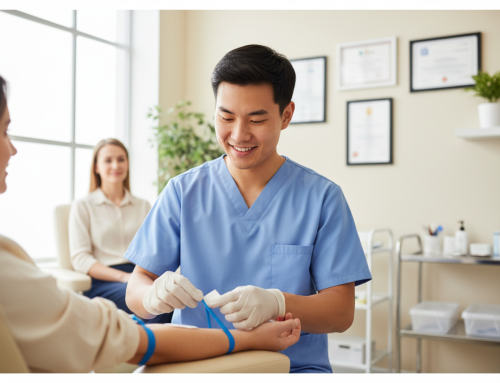
Most new trainees want to know what to expect during your phlebotomy externship rotations before they ever walk in the door — and that nervousness is completely normal. The externship is where classroom knowledge becomes a real skill, and where most students get their first taste of patient contact. The good news: it’s far less intimidating than the anticipation suggests. This guide walks you through what actually happens, day by day, so you arrive prepared and confident.
What a Phlebotomy Externship Is
Want a faster path to your CPT?
Earn your NHA CPT in 4 weeks online with practice arm shipped, 30 supervised venipunctures, NHA exam included, and externship at a named partner clinic.
An externship is supervised, hands-on training in a real clinical setting — a hospital lab, outpatient clinic, blood-donation center, or physician’s office. It’s where you complete the supervised blood draws that certification requires, working alongside experienced phlebotomists who guide and check your technique.
Think of it as the bridge between learning and your first job. You’ve studied anatomy, safety, and the order of draw; the externship is where you put a tourniquet on a real arm and draw real blood, with someone watching your back.
What to expect during your phlebotomy externship First Days
Your first days are mostly about observation and orientation, not solo sticks. Here’s the typical arc:
- Orientation. You’ll learn the site’s layout, safety protocols, where supplies live, and the documentation system.
- Shadowing. You’ll watch experienced phlebotomists perform draws, label specimens, and interact with patients.
- Assisting. You’ll prep trays, label tubes, and handle the non-needle parts of the workflow.
- Supervised draws. When your preceptor is confident, you’ll perform your first venipunctures with them right beside you.
Nobody expects perfection on day one. The whole point of supervision is that mistakes get caught and corrected before they matter.
A Typical Externship Day
Once you’re in the rhythm, a day usually looks like this:
- Arrive and prep. Stock your tray with tubes, needles, tourniquets, gauze, and labels.
- Morning draws. Many settings have a busy morning lab cart; you’ll work through patients with your preceptor.
- Specimen handling. Label at the bedside, confirm patient identity, and route samples to the lab correctly.
- Documentation. Chart each draw accurately in the system.
- Restock and reset. Keep your station clean and ready between patients.
The pace varies by setting — a hospital floor is busier than a small clinic — but the fundamentals stay the same.
Skills You’ll Practice and Sharpen
Your externship is where these skills move from theory to muscle memory:
| Skill | What you’ll get better at |
|---|---|
| Venipuncture | Finding veins, needle angle, smooth insertion, and draw |
| Skin punctures | Fingersticks and heel sticks for smaller samples |
| Patient identification | Verifying the right patient, every time |
| Order of draw | Filling tubes in the correct sequence to avoid contamination |
| Specimen labeling | Accurate, bedside labeling to prevent errors |
| Patient communication | Calming nervous patients and explaining the process |
| Safety and infection control | Sharps disposal, gloves, and standard precautions |
By the end, these stop feeling like a checklist and start feeling automatic — which is exactly what employers want to see.
How to Prepare and Make a Great Impression
Externships are also long job interviews. Many students get hired at their externship site, so treat every shift like an audition:
- Show up early and reliable. Punctuality signals you’ll be a dependable employee.
- Ask questions. Curiosity reads as engagement, not weakness.
- Take feedback well. Your preceptor’s corrections are gifts; thank them and apply them.
- Be kind to patients. A calm, warm manner is a skill employers prize as much as a clean stick.
- Stay tidy and professional. Clean station, professional appearance, no phone on the floor.
The students who get offers are rarely the flashiest — they’re the reliable, coachable, patient-friendly ones.
How the Right Program Sets Up Your Externship
The biggest stressor for many students isn’t the externship itself — it’s finding one. Cold-calling clinics hoping someone will host you can stall your certification for months.
That’s why a guaranteed clinical externship matters so much. When your program arranges the placement, you skip the anxiety and the delay and go straight to logging the supervised draws you need.
HealthCareerCerts is built around removing that obstacle. Its phlebotomy certification program pairs 100% online, self-paced coursework with a guaranteed externship and prepares you for a nationally recognized NHA certification — at affordable tuition with payment plans. You focus on getting good at the draw; the program handles getting you the seat.
Common Worries — and the Reality
A few fears come up again and again:
- “What if I miss a vein?” Everyone does at first. Your preceptor steps in, and you improve fast with reps.
- “What if a patient is upset?” You’ll learn calming techniques, and difficult patients are rarer than you’d think.
- “What if I faint at the sight of blood?” Most students acclimate quickly; tell your preceptor so they can ease you in.
The anticipation is almost always worse than the experience. A few shifts in, the externship feels normal.
What Your Preceptor Wants From You
Your preceptor — the experienced phlebotomist supervising you — has an outsized influence on both your learning and any future job offer. Understanding what they’re looking for helps you stand out:
- Coachability. They want to see that feedback sticks. Make the same correction once, not five times.
- Initiative without overstepping. Restock trays, prep rooms, and ask “what can I help with?” — but never perform a draw you haven’t been cleared for.
- Honesty about limits. If you’re unsure, say so. A student who flags uncertainty is far safer than one who guesses on a patient.
- Steady professionalism. Calm under pressure, kind with patients, and reliable shift after shift.
Preceptors talk to hiring managers. A strong impression here often becomes a recommendation later.
Turning Your Externship Into a Job Offer
Because so many graduates get hired where they train, it’s worth being intentional about it:
- Express genuine interest. Let your preceptor and the site know you’d love to work there.
- Learn the workflow deeply. The more you can do without hand-holding, the more valuable you are as a potential hire.
- Build relationships beyond your preceptor. Be friendly and helpful with the wider lab and clinical team — they have input too.
- Ask about openings before you finish. Timing matters; a role you flag interest in early may be held for you.
Even if your specific site isn’t hiring, the experience and reference you earn make every other application stronger.
Ready to stop studying alone? HealthCerts’ Certified Phlebotomy Technician (CPT) program is built around a 4 weeks online course with a guaranteed externship at a named partner clinic — so you walk out with both the credential and the clinical hours employers want.
Frequently Asked Questions
What should I expect during a phlebotomy externship?
What to expect during your phlebotomy externship rotations is a mix of orientation, shadowing experienced phlebotomists, assisting with prep, and then performing supervised blood draws yourself. It’s hands-on training in a real clinical setting, always with a preceptor guiding you.
How long is a phlebotomy externship?
It varies by program, but externships commonly run several weeks and include enough supervised draws to meet certification requirements. The exact hours depend on your program and your state’s rules.
Will I draw real blood during my externship?
Yes. The externship is specifically where you perform supervised venipunctures and skin punctures on real patients — that’s the whole point. You build the hands-on competence employers and certifying bodies require.
What should I bring to my first day?
Typically scrubs, closed-toe shoes, your ID, and any paperwork your program requires. Arrive early, well-rested, and ready to observe. Your site will orient you to supplies and protocols.
Is it normal to be nervous about my externship?
Completely. Nearly every student feels it. Remember you’re supervised the entire time, mistakes are expected and corrected, and confidence builds quickly once you’ve done a few draws.
Can my externship lead to a job?
Often, yes. Externships function as extended auditions, and many students receive job offers from their host site. Showing up reliably, taking feedback well, and treating patients kindly is the surest way to turn an externship into employment.
What if I can’t find an externship site?
Choose a program that guarantees one. Self-sourcing a clinical placement is the most common reason students stall, so a guaranteed externship removes the bottleneck and keeps your certification on track.
Source: National Healthcareer Association
Start Your CPT Journey with HealthCerts
Reading about expect during your phlebotomy externship is one thing — actually getting credentialed and into a clinical role is another. HealthCerts’ Certified Phlebotomy Technician (CPT) program is the fastest, most-supported path: Earn your NHA CPT in 4 weeks online with practice arm shipped, 30 supervised venipunctures, NHA exam included, and externship at a named partner clinic.