
A pharmacy technician’s job description spans dispensing, customer service, inventory management, and increasingly, clinical support work. CPhTs (Certified Pharmacy Technicians) work under licensed pharmacist supervision to fill prescriptions, count and label medications, manage inventory, process insurance claims, handle patient phone calls, and (in hospital settings) prepare sterile compounds and IV admixtures. The role is one of the most consistent in healthcare: median U.S. pharmacy tech pay is $40,300/year ($19.40/hour) with steady demand across retail, hospital, mail-order, and specialty pharmacy.
Whether you’re researching the pharmacy technician job description for the first time or comparing programs, this guide pulls together what matters.
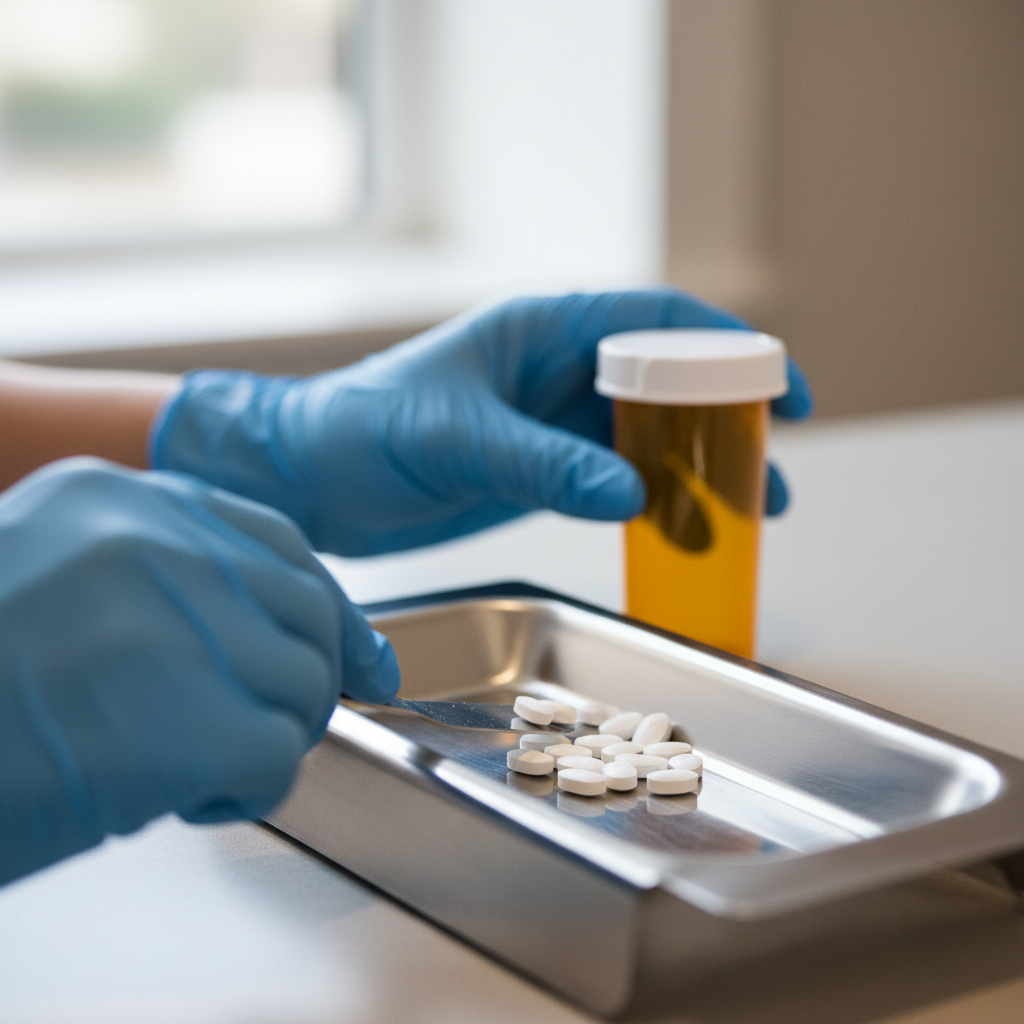
This post breaks down a complete pharmacy technician job description across the major settings, what CPhTs do day-to-day, and the skills employers prioritize.
Want a faster path to your CPhT?
Earn your CPhT in 12 weeks online with PTCB or NHA exam fee included and an externship at CVS, Walgreens, or hospital pharmacy.
For students researching pharmacy technician job description options, the practical reality is that the right choice depends on your timeline, budget, and target employer. Many candidates start their pharmacy technician job description research with general questions and narrow down as they understand which credentials each setting accepts. Treat pharmacy technician job description reviews as a comparison exercise, not a single decision.
Core Pharmacy Tech Duties — Pharmacy Technician Job Description
| Duty | Setting | Frequency |
|---|---|---|
| Receiving and processing prescriptions | All settings | Continuous |
| Counting, measuring, labeling medications | All settings | High frequency |
| Insurance claim processing + adjudication | Retail, mail-order | High frequency |
| Customer service (phone + counter) | Retail | Continuous |
| Inventory management + reordering | All settings | Daily |
| Compounding (non-sterile + sterile) | Compounding pharmacies, hospital | Daily |
| IV admixture preparation | Hospital | Daily |
| Sterile compounding (USP ) | Hospital, specialty | Daily |
| Hazardous drug handling (USP ) | Oncology, specialty | Daily |
| Patient profile review | All settings | Per prescription |
| Prior authorization processing | All settings | Daily |
| Cash register / point of sale | Retail | Continuous |
| Drug utilization review (DUR) | All settings | Per prescription |
Pharmacy Tech Job Description by Setting
Retail chain (CVS, Walgreens, Walmart, Kroger)
Core duties: filling prescriptions, customer service at the pickup counter, insurance claim resolution, phone calls, inventory restocking, immunization assists, register operations.
A typical retail CPhT shift involves 100-300 prescriptions filled, 50-150 customer interactions, and constant phone activity. Pace is faster, customer-service-heavy, and the most stressful of the major settings.
Hospital inpatient pharmacy
Core duties: filling unit-dose orders for inpatient floors, IV admixture preparation, sterile compounding under USP , automation system management (Pyxis, Omnicell), floor delivery, controlled substance reconciliation.
Hospital pharmacy is more technical and procedural. Less customer service. Often shift-differential opportunity.
Mail-order / specialty pharmacy
Core duties: high-volume prescription processing, prior authorization workflow, patient counseling triage to pharmacist, specialty drug fulfillment (oncology, HIV, fertility, rare disease).
Specialty pharmacy has significantly more prior authorization work because specialty drugs are expensive and require more insurance gatekeeping. Mail-order is high-volume but predictable.
Compounding pharmacy
Core duties: non-sterile compounding (creams, oral suspensions, capsules), sterile compounding (USP or ), specialty formulations, beyond-use dating, recipe documentation.
Most technical and skilled work in pharmacy tech roles. Often pays above retail.
Long-term care pharmacy
Core duties: filling weekly/monthly medication packets for nursing home residents, communication with facility staff, controlled substance management, packaging compliance.
Specialized scope, often M-F daytime, decent pay, less customer-service stress than retail.
What Pharmacy Techs DON’T Do
The scope is intentionally narrow on these:
- No clinical decision-making about drug therapy
- No patient counseling on medication therapy (that’s the pharmacist’s role)
- No final verification of prescriptions (pharmacist must check)
- No prescribing or recommending OTC beyond reading the label
- No interpretation of lab values or clinical assessments
A Typical Retail CPhT Day
A typical 8-hour retail shift:
| Time | Activity |
|---|---|
| 8:00 AM | Arrive, count controlled substance inventory, prep workstations |
| 8:30-12:00 PM | Morning rush — fill 50-100 prescriptions, customer service |
| 12:00-1:00 PM | Lunch coverage rotation |
| 1:00-5:00 PM | Afternoon — fill 50-150 prescriptions, prior auth processing, phone calls |
| 5:00-5:30 PM | End-of-day inventory, controlled substance reconciliation, prep next day |
Total prescription volume: 100-300/day depending on store traffic.
Skills That Differentiate Top Pharmacy Techs
- Speed accuracy on data entry — RxConnect and similar systems reward fast, accurate input
- Insurance fluency — knowing how to solve common adjudication errors saves the pharmacist time
- Customer service in stressful situations — angry customers, denied claims, drug interactions
- Top 200 drug recall — brand-generic-class without looking up
- Sterile compounding (hospital track) — USP certification opens hospital and specialty roles
- Bilingual capability — premium in many retail markets
Ready to stop studying alone? HealthCerts’ Certified Pharmacy Technician (CPhT) program is built around a 12 weeks online course with a guaranteed externship at a named partner clinic — so you walk out with both the credential and the clinical hours employers want.
Frequently Asked Questions
What is a pharmacy technician’s job description?
CPhTs work under pharmacist supervision to receive and process prescriptions, count and label medications, manage inventory, process insurance claims, handle customer phone calls, and (in hospital) prepare sterile compounds and IV admixtures.
What does a pharmacy technician do day-to-day?
A typical retail CPhT fills 100-300 prescriptions, handles 50-150 customer interactions, processes insurance claims, manages phone calls, and reconciles controlled substance inventory across an 8-hour shift.
What do hospital pharmacy techs do?
Hospital techs prepare unit-dose medications for inpatients, mix IV admixtures, handle sterile compounding (USP ), restock automated dispensing systems (Pyxis, Omnicell), and perform controlled substance reconciliation.
Can pharmacy techs counsel patients?
No — patient counseling on medication therapy is reserved for licensed pharmacists. Techs answer general questions but defer therapy questions to the pharmacist.
Do pharmacy techs administer medications?
Generally no — techs prepare and dispense but don’t typically administer. Some hospital techs assist with administration under pharmacist supervision in narrow settings.
How many prescriptions does a CPhT fill per day?
Retail: 100-300 per shift. Hospital: 50-200 unit-dose orders. Mail-order: highest volume, often 200-500/day. Compounding: lower volume, more time per prep.
What’s the hardest part of being a pharmacy tech?
Most CPhTs report: customer service stress (angry customers, denied claims), high-volume time pressure, insurance complexity, controlled substance reconciliation, and standing for full shifts.
Do pharmacy techs work nights or weekends?
Retail and hospital pharmacy techs typically work some weekends and evenings. 24-hour pharmacies and hospital inpatient need overnight coverage. Mail-order and specialty pharmacies more often have M-F daytime hours.
Start Your CPhT Journey with HealthCerts
Reading about pharmacy technician job description is one thing — actually getting credentialed and into a clinical role is another. HealthCerts’ Certified Pharmacy Technician (CPhT) program is the fastest, most-supported path: Earn your CPhT in 12 weeks online with PTCB or NHA exam fee included and an externship at CVS, Walgreens, or hospital pharmacy.
See CPhT tuition, schedule, and what’s included →
Source: Pharmacy Technician Certification Board (PTCB)
For people researching pharmacy technician job description, the practical decision points usually come down to three things: cost, time, and credential acceptance. Use the pharmacy technician job description framing in the sections above to make each decision in the right order, and remember that pharmacy technician job description outcomes scale with the quality of the program you pick.