CPCT vs CNA: Certification, Scope, and Pay Differences
CPCT (national NHA credential) vs CNA (state credential): scope differences, training paths, and how to compare pay.


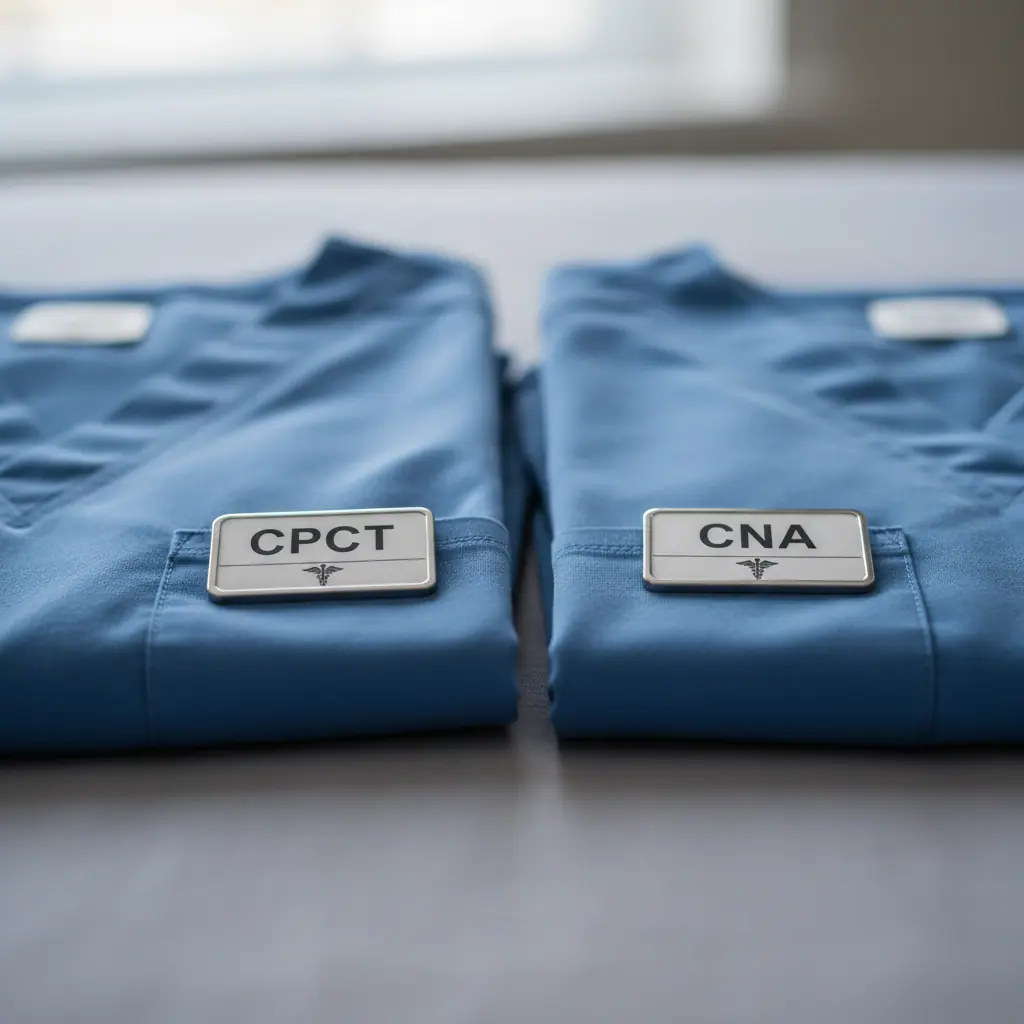
CPCT vs CNA is a more specific version of the broader PCT vs CNA question — and it matters because a CPCT is the formal NHA certification (Certified Patient Care Technician/Assistant) that an aspiring patient care technician earns, while CNA (Certified Nursing Assistant) is a state-issued credential. The two roles overlap significantly but have meaningfully different scope, training paths, certification bodies, and pay.
The short version: a CPCT has broader clinical scope (phlebotomy, EKG, glucose, specimen collection) and works primarily in hospitals; a CNA is more focused on activities of daily living (ADL) and is concentrated in long-term care. CPCTs often earn more than CNAs in hospital and dialysis settings and have national credential portability that CNAs don’t.
Want a faster path to your CPCT?
Earn your NHA CPCT in 8 weeks online — patient care, EKG, phlebotomy, and EHR. NHA exam fee, externship, and 6 practice tests included. Military spouses: SpouseWorks Scholarship (formerly MyCAA) funding may apply; confirm eligibility first.
CPCT vs CNA: Side-by-Side
| CPCT | CNA | |
|---|---|---|
| Full title | Certified Patient Care Technician/Assistant | Certified Nursing Assistant |
| Issued by | NHA (National Healthcareer Association) | State (each state runs its own registry) |
| Recognition | National — same credential anywhere in U.S. | State-by-state; moving may require recertification |
| Training length | 8 weeks online + clinical externship typical | 4-12 weeks (federal minimum 75 hours) |
| Phlebotomy? | Yes | No |
| EKG? | Yes | No |
| Glucose monitoring? | Yes | Sometimes (varies by state) |
| Specimen collection? | Yes | Limited |
| Vital signs? | Yes | Yes |
| Patient ADL support? | Yes | Yes (primary focus) |
| Typical setting | Hospital, dialysis | Long-term care, hospital, home health |
| Median pay | Not reported separately by BLS $42,260/year | (nursing assistants, BLS May 2025) |
| Pay range | Not reported separately by BLS | $33,940-$51,980 (10th to 90th percentile) |
What Each Credential Authorizes
CPCT scope of practice
A CPCT is authorized to perform:
- All CNA scope (ADL, vitals, mobility, basic monitoring), AND
- Venipuncture / phlebotomy
- 12-lead EKG
- Bedside glucose monitoring
- Specimen collection (urine, stool, sputum)
- Wound care assistance
The CPCT scope reflects the role’s hospital origins — most U.S. hospitals created the patient care technician role specifically because they needed clinical staff between CNA and LPN for procedures CNAs aren’t trained for.
CNA scope of practice
CNAs are authorized to perform:
- Activities of daily living (bathing, dressing, toileting, feeding)
- Mobility support (transfers, repositioning, ambulation)
- Basic vital signs (BP, pulse, temp, respiratory rate)
- Patient safety monitoring
- Basic communication and documentation
- Skin care and pressure ulcer prevention
CNAs do NOT perform phlebotomy, EKG, or specimen collection in most states.
Training Path Comparison
Becoming a CPCT (NHA pathway)
- Complete an accredited CPCT program — typically 8 weeks online + clinical externship (80-160 hours)
- Pass the NHA CPCT/A exam — 100 questions, 2 hours, $169 (NHA store) cost, 390 passing scaled score
- National credential — state and employer requirements vary.
For our CPCT program, the path is 8 weeks online coursework + clinical externship, with the NHA exam fee included.
Becoming a CNA
- Complete a state-approved CNA training program — typically 4-12 weeks at a community college, healthcare facility, or American Red Cross site
- Complete state-required clinical hours (federal minimum 16 hours, most states require 40-100)
- Pass state CNA exam — written + skills demonstration components
- Get listed on the state nurse-aide registry
The state CNA path is typically faster and cheaper but doesn’t transfer cleanly across state lines.
Pay Comparison
BLS does not track patient care technicians as a separate occupation; nursing assistants (31-1131), a comparison occupation only, had a national median of $42,260 per year ($20.32/hour) in May 2025. Patient care technician pay varies by employer and setting; compare local job postings for both roles.
Where Each Role Works Most
CPCT settings
- Hospital med-surg, telemetry, step-down floors (largest)
- Dialysis clinics (specialized CHT or CCHT credential)
- Hospital ICU, ER (typically requires 1-2 years floor experience first)
- Outpatient clinics
CNA settings
- Skilled nursing facilities (SNFs) and nursing homes (largest)
- Hospital med-surg floors
- Home health
- Hospice care
- Assisted living
Which Should You Choose?
Choose CPCT if:
- You want to work primarily in hospitals or dialysis
- You want a credential that transfers nationally
- You want broader clinical scope and procedural skills
- You’re using the role as a stepping stone to nursing or specialty roles
- You want to qualify for more roles
Choose CNA if:
- You want to start working in 4-12 weeks (faster than CPCT)
- You’re targeting long-term care, home health, or hospice
- Your local labor market has more CNA openings than CPCT
- You’re working toward LPN or RN and want the lowest-friction credential to start
Or do both
Many healthcare workers earn CNA first (faster to start working) then add CPCT certification within 1-2 years to expand scope and pay. Most accredited CPCT programs accept CNA training as partial credit toward CPCT eligibility.
Ready to stop studying alone? HealthCerts’ Certified Patient Care Technician (CPCT) program is built around an 8-week online course with externship placement — so you walk out with both the credential and the clinical hours employers want.
The bottom line on cpct vs cna: choose the path that matches your real-world constraints — schedule, financial aid eligibility, and target employer — rather than the cheapest or fastest option in isolation. cpct vs cna outcomes vary meaningfully by program quality, so verify accreditation and externship support before enrolling.
Frequently Asked Questions
What’s the difference between CPCT and CNA?
CPCT (Certified Patient Care Technician/Assistant) is a national credential from NHA with broader clinical scope (phlebotomy, EKG, specimen collection). CNA (Certified Nursing Assistant) is a state-issued credential focused on ADL and basic patient care.
Do CPCTs make more than CNAs?
It depends on the employer and setting; CPCTs often earn more in hospital and dialysis roles.
Is CPCT the same as CNA?
No. CPCT is a national NHA credential with broader scope including phlebotomy and EKG. CNA is a state credential focused on ADL.
Can a CNA become a CPCT?
Yes — CNAs typically need additional training in phlebotomy, EKG, and clinical procedures (or a full CPCT program) to qualify for the NHA CPCT/A exam.
Which is faster — CPCT or CNA?
CNA is typically faster (4-12 weeks). CPCT programs are 8 weeks coursework + 2-4 weeks externship.
Does a CPCT certification work in any state?
Yes — NHA CPCT/A is a national credential; state and employer requirements can differ when you move, so confirm them before you relocate.
Does CPCT require state licensure?
Most states do not require state licensure for CPCT-certified PCTs. California and Washington require state licensure for PCTs performing phlebotomy.
Can I be a hospital tech with just a CNA?
Some hospitals hire CNAs into Patient Care Tech-titled roles, but most prefer CPCT certification. CNAs in hospital roles often earn similar pay to PCTs but have fewer promotion paths.
Start Your CPCT Journey with HealthCerts
Reading about it is one thing — actually getting credentialed and into a clinical role is another. HealthCerts’ Certified Patient Care Technician (CPCT) program is the fastest, most-supported path: Earn your NHA CPCT in 8 weeks online — patient care, EKG, phlebotomy, and EHR. NHA exam fee, externship, and 6 practice tests included. Military spouses: SpouseWorks Scholarship (formerly MyCAA) funding may apply; confirm eligibility first.
See CPCT tuition, schedule, and what’s included →
Source: U.S. Bureau of Labor Statistics, Occupational Employment and Wage Statistics, May 2025 (31-1131 Nursing Assistants, nearest BLS occupation); NHA 2025 Industry Outlook for the employer survey figure.
Shahnaz Ghassemi Ph.D., is a co-founder of HealthCareerCerts and a dedicated educator, scientist, and workforce development leader. She holds a Ph.D. in Chemistry and brings extensive experience as both an educator and a research scientist in industry. As a co-leader of HealthCareerCerts, Shahnaz is deeply committed to making healthcare education accessible through affordable, flexible, and high-quality learning pathways. She works closely with academic institutions, healthcare partners, and workforce organizations to deliver certification programs that are practical, inclusive, and directly aligned with real-world healthcare needs. Since co-founding the organization, she has played a key role in building strategic partnerships that expand impact and opportunity, helping learners across the country gain essential skills, confidence, and meaningful careers in healthcare. Seeing hundreds of students thrive within the supportive learning community she helps lead continues to inspire and drive her mission forward.