What is a Phlebotomy Technician? Duties, Career Path, and Pay
Phlebotomy technicians collect blood specimens for testing in hospitals, labs, and clinics. Here’s what the role involves, how to become one, and current pay.

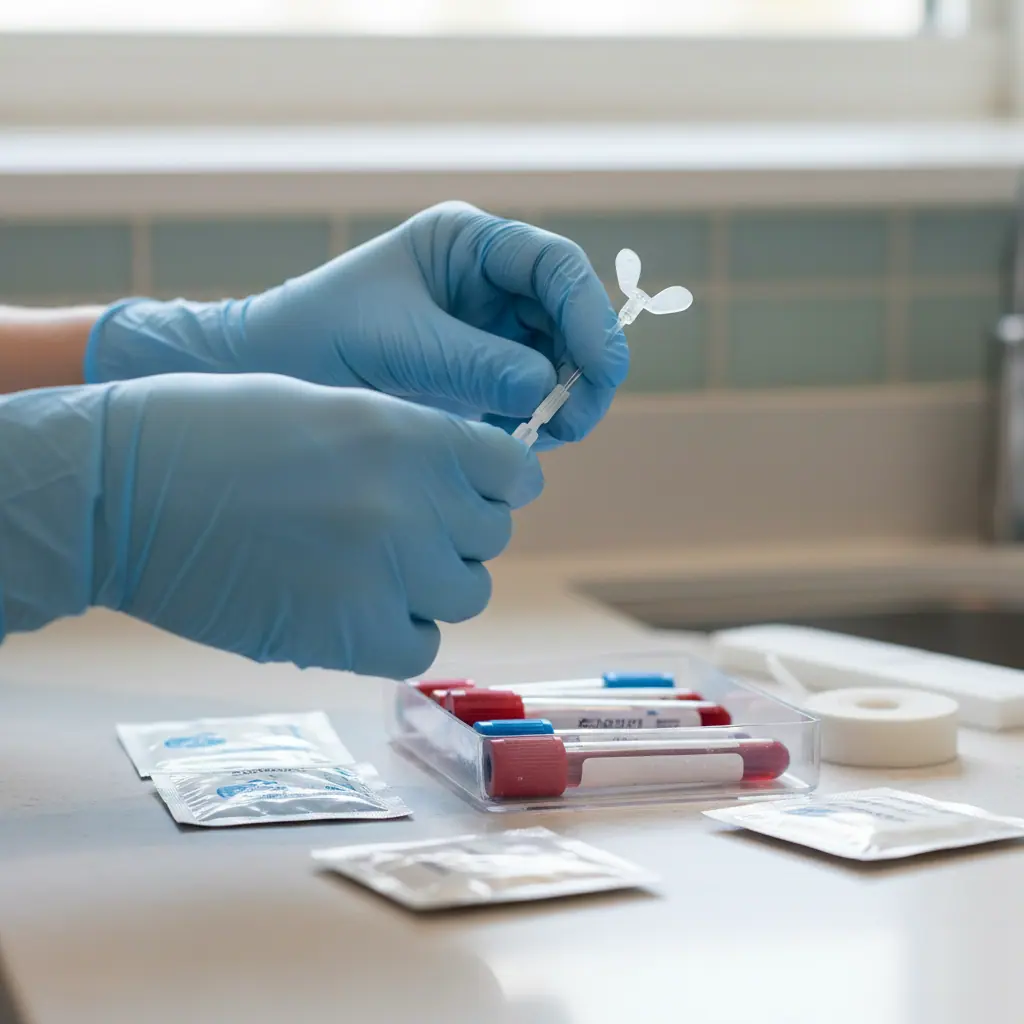
A phlebotomy technician is a trained healthcare professional who collects blood specimens from patients for laboratory testing, blood transfusions, donations, or research. The role is foundational to modern medicine — almost every diagnosis, treatment monitoring decision, and screening test depends on accurately drawn and properly handled blood samples.
Phlebotomy techs work in hospitals, reference labs, mobile draw services, donor centers, and outpatient clinics. BLS reported a national median of $45,230/year ($21.75/hour) for phlebotomists in May 2025, with the role being one of the fastest entries to a paid healthcare career — most certified phlebotomists are working within 4-12 weeks of starting their training program.
Want a faster path to your CPT?
Earn your NHA CPT in 4 weeks online with practice arm shipped, 30 supervised venipunctures, NHA exam included, and externship.
This post covers what phlebotomy techs actually do, the duties and skills required, where they work, how the role compares to related healthcare jobs, and the typical career path.
What Phlebotomy Technicians Do — What Is Phlebotomy Technician
The core duties of a phlebotomy technician:
| Duty | Frequency |
|---|---|
| Venipuncture (drawing blood from a vein) | The primary role — typically 30-100+ draws per shift |
| Capillary puncture (finger-stick or heel-stick) | For pediatric draws, point-of-care glucose, certain tests |
| Patient identification | Two-identifier verification before every draw |
| Specimen labeling | At the bedside, in the patient’s presence, before leaving |
| Specimen handling | Correct tube, correct order of draw, correct transport temperature |
| Patient communication | Explaining the draw, calming nervous patients, answering questions |
| Documentation | Recording the draw in EHR, time, tubes drawn, location |
| Specimen processing | Centrifuging, aliquoting, sending to the lab |
| Sterile technique | Maintaining infection control, OSHA compliance |
| Special collections | Blood cultures, glucose tolerance tests, therapeutic drug monitoring |
Phlebotomy techs do NOT diagnose, prescribe medications, or perform clinical assessments. The scope is intentionally narrow but technically demanding — accuracy and speed are the primary skills.
Where Phlebotomy Techs Work
The five most common employers:
Hospital inpatient (largest employer category)
Hospital phlebotomists handle:
- Morning lab cart (3 AM-7 AM “early-bird” rounds collecting routine inpatient labs)
- Stat draws throughout the day for ED, ICU, and floor patients
- Difficult-vein patients referred from nurses
- Blood culture draws
Reference labs (Quest, LabCorp, etc.)
Reference lab patient service centers (PSCs) are storefront draw locations for outpatient samples. Phlebotomists collect samples ordered by external physicians, label and ship to central processing labs.
Mobile / home phlebotomy
Mobile phlebotomists travel to patients’ homes, assisted-living facilities, or workplace events. Pay is typically higher because of mileage, time-on-task variability, and customer-service skills required.
Plasma / blood donor centers
CSL Plasma, Grifols, BioLife, Octapharma operate hundreds of donor centers nationally. Phlebotomy work is more limited in scope (focused on plasma donor collection) but the role is widely available and easy to enter.
Outpatient clinics + physician offices
Smaller patient volumes, often hybrid CPT/MA roles. Lower pay, more work-life balance.
Skills Required to Be a Phlebotomy Tech
Beyond technique, the skills that make phlebotomists successful:
- Vein identification — finding accessible veins quickly across body types, dehydration states, and anatomic variation
- Patient communication — calming nervous patients, explaining the draw, building rapport quickly
- Time management — completing 30-100+ draws per shift while documenting accurately
- Attention to detail — correct tube, correct label, correct order, correct timing
- Hand-eye coordination — needle placement requires fine motor control
- Stress tolerance — failed draws, fainting patients, difficult vein presentations all happen daily
- Memory — order of draw, tube additives, special-collection protocols are extensive
How to Become a Phlebotomy Tech
The typical path:
- Complete an accredited phlebotomy training program — 4-12 weeks total. Online + clinical externship is the fastest format.
- Complete supervised clinical hours — 40+ successful venipunctures and a defined number of capillary draws.
- Pass a national certification exam — NHA CPT, ASCP PBT, NPA CPT, or AMT RPT.
- Get state licensure if required — California, Louisiana, Nevada, Washington require additional state-level licensure.
- Apply for jobs — most newly-certified phlebotomists are hired within 4-8 weeks.
For our 4-week CPT program, the path is: practice arm shipped to your home for at-home technique drills, online coursework you complete on your schedule, then 2-3 weeks for the externship.
For a deeper how-to, see our how to get phlebotomy certification guide.
Phlebotomy Tech vs Related Roles
| Role | Primary scope | Median pay |
|---|---|---|
| Phlebotomy Tech (CPT) | Blood specimen collection only | $45,230 |
| Patient Care Tech (CPCT) | Phlebotomy + EKG + ADL + glucose | Not reported separately by BLS |
| Medical Assistant (CCMA) | Phlebotomy + EKG + clinical + admin | $45,690 (BLS, May 2025) |
| Medical Lab Tech (MLT) | Phlebotomy + sample analysis | See BLS (clinical laboratory technologists and technicians) |
| CNA | ADL focus, no phlebotomy | $42,260 (BLS nursing assistants, May 2025) |
A phlebotomy tech has narrower scope than a PCT or MA but is faster to train (4-12 weeks vs. 8-12 weeks for the broader credentials). Phlebotomy is often used as a starting credential, with techs adding CPCT, CCMA, or MLT credentials over time.
Career Path After Phlebotomy
Common 2-5 year trajectories:
- CPT → Senior phlebotomist / Lead: $48-55k, requires 5+ years experience
- CPT → Medical Lab Tech (MLT): 2-year program, $52-60k
- CPT → Patient Care Tech (CPCT): adds clinical scope, $42-50k
- CPT → Medical Assistant (CCMA): adds clinical + admin, $42-50k
- CPT → RN: 2-year associate’s program, $75-85k median entry
- CPT → Mobile / 1099 phlebotomy: 25%+ pay bump if you have benefits coverage from another source
Phlebotomy Tech Salary Snapshot
National median: $45,230/year ($21.75/hour), BLS May 2025. The 10th percentile is $35,780 and the 90th is $58,780; by state, California's median is $56,040 and Mississippi's is $36,290. See our full phlebotomy technician salary breakdown.
Ready to stop studying alone? HealthCerts’ Certified Phlebotomy Technician (CPT) program is built around a 4-week online course with externship placement — so you walk out with both the credential and the clinical hours employers want.
The bottom line on what is phlebotomy technician: choose the path that matches your real-world constraints — schedule, financial aid eligibility, and target employer — rather than the cheapest or fastest option in isolation. what is phlebotomy technician outcomes vary meaningfully by program quality, so verify accreditation and externship support before enrolling.
Frequently Asked Questions
What is a phlebotomy technician?
A phlebotomy technician is a trained healthcare professional who collects blood specimens from patients for laboratory testing, blood transfusions, donations, or research. They work in hospitals, reference labs, mobile draw services, donor centers, and outpatient clinics.
What does a phlebotomy technician do?
Phlebotomists perform venipuncture (blood draws from veins), capillary puncture (finger-stick or heel-stick), specimen labeling and handling, patient identification and communication, and documentation. The role is narrow in scope but technically demanding.
How long does it take to become a phlebotomy technician?
4-12 weeks for accredited training programs. Online + clinical externship is fastest at 4-8 weeks; community college is 1 semester (15-16 weeks).
Do phlebotomists need a license?
National certification (NHA CPT, ASCP PBT, etc.) is required by most employers. Four states (California, Louisiana, Nevada, Washington) require additional state-specific licensure on top of national certification.
How much does a phlebotomy tech make?
BLS reported a national median of $45,230/year ($21.75/hour) for phlebotomists in May 2025. Range is $35,780 at the 10th percentile to $58,780 at the 90th, with state, setting, and certifications driving most variation.
Where do phlebotomy techs work?
Hospitals, reference labs (Quest, LabCorp), mobile/home phlebotomy services, plasma/blood donor centers (CSL, Grifols), outpatient clinics, and physician offices.
Is phlebotomy a good career?
For career-changers and adults wanting a fast entry to healthcare, yes — short training (4-12 weeks), affordable certification ($1,500-$2,500), strong demand nationally, and clear progression to MLT, RN, or PCT/MA roles.
What’s the difference between a phlebotomist and a phlebotomy technician?
The terms are often used interchangeably in job postings. “Phlebotomist” is the more general term; “phlebotomy technician” emphasizes the certification. Some states (notably California with CPT-1 designation) use specific titles tied to licensure.
Start Your CPT Journey with HealthCerts
Reading about it is one thing — actually getting credentialed and into a clinical role is another. HealthCerts’ Certified Phlebotomy Technician (CPT) program is the fastest, most-supported path: Earn your NHA CPT in 4 weeks online with practice arm shipped, 30 supervised venipunctures, NHA exam included, and externship.
Shahnaz Ghassemi Ph.D., is a co-founder of HealthCareerCerts and a dedicated educator, scientist, and workforce development leader. She holds a Ph.D. in Chemistry and brings extensive experience as both an educator and a research scientist in industry. As a co-leader of HealthCareerCerts, Shahnaz is deeply committed to making healthcare education accessible through affordable, flexible, and high-quality learning pathways. She works closely with academic institutions, healthcare partners, and workforce organizations to deliver certification programs that are practical, inclusive, and directly aligned with real-world healthcare needs. Since co-founding the organization, she has played a key role in building strategic partnerships that expand impact and opportunity, helping learners across the country gain essential skills, confidence, and meaningful careers in healthcare. Seeing hundreds of students thrive within the supportive learning community she helps lead continues to inspire and drive her mission forward.