
CCMA vs CMA is the most common comparison medical assistant students run into, and the answer matters because the certification you earn determines which employers will hire you and which states have stricter restrictions. The short version: CCMA (Certified Clinical Medical Assistant) is from the National Healthcareer Association (NHA); CMA (Certified Medical Assistant) is from the American Association of Medical Assistants (AAMA). Both are nationally recognized. The most important practical difference is that CMA requires graduation from a CAAHEP- or ABHES-accredited program, while CCMA accepts a wider range of accredited programs plus an experience pathway.
Add RMA (Registered Medical Assistant from American Medical Technologists) to the comparison and you’ve covered the three credentials that account for ~95% of certified MAs in the U.S. This post breaks down the differences across eligibility, exam, recognition, pay, and how to choose the right credential for your situation.
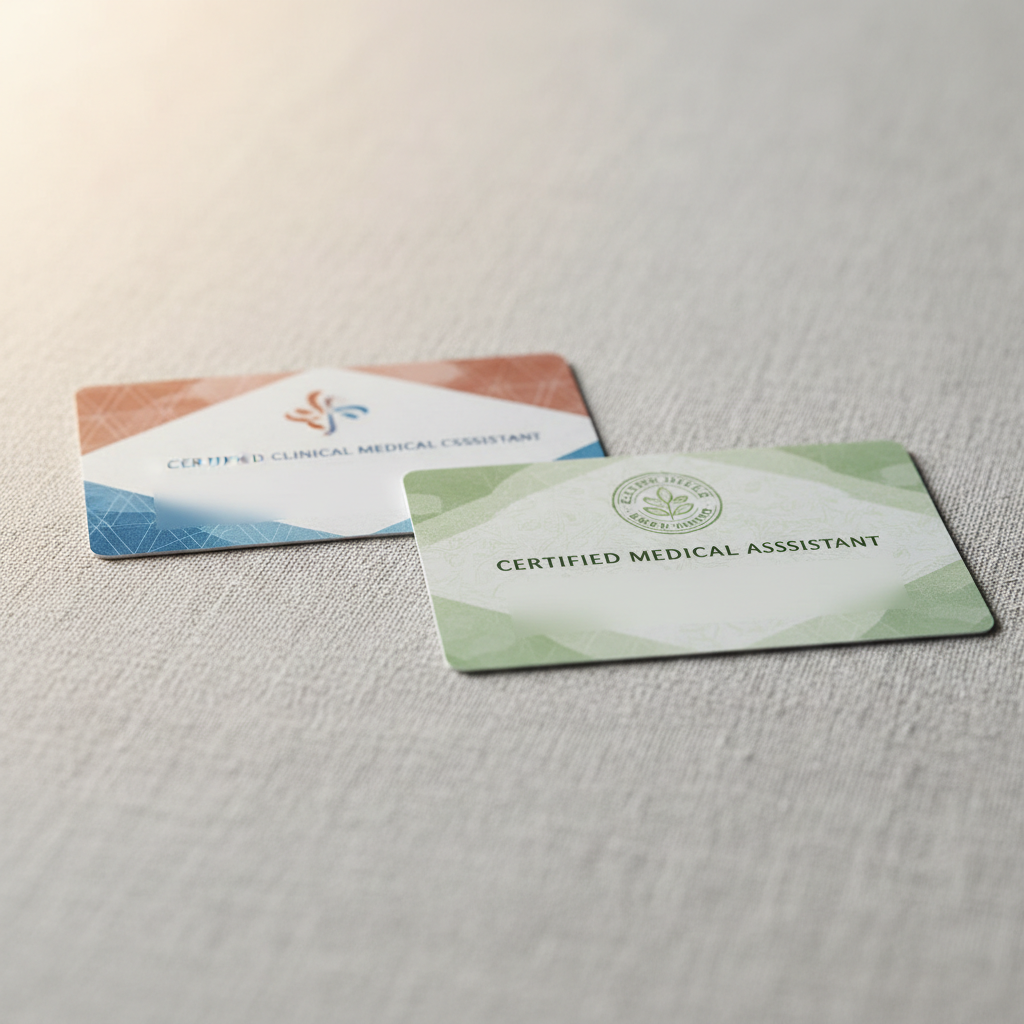
Want a faster path to your CCMA?
Earn your NHA CCMA in 8 weeks online with NHA exam fee, externship at a named partner clinic, and a venipuncture practice kit included. 5 ACE college credits.
For students researching ccma vs cma options, the practical reality is that the right choice depends on your timeline, budget, and target employer. Many candidates start their ccma vs cma research with general questions and narrow down as they understand which credentials each setting accepts. Treat ccma vs cma reviews as a comparison exercise, not a single decision.
CCMA vs CMA vs RMA: At a Glance
| CCMA | CMA | RMA | |
|---|---|---|---|
| Issued by | NHA (National Healthcareer Association) | AAMA (American Association of Medical Assistants) | AMT (American Medical Technologists) |
| Eligibility | Accredited program OR 1 year experience | CAAHEP- or ABHES-accredited program required | Accredited program OR 5 years experience |
| Exam length | 180 questions, 3 hr 10 min | 200 questions, 3 hours | 200-210 questions, 3 hours |
| Passing score | 390 scaled | 405 scaled | 70%+ |
| Cost | $155 | $125 (member) / $250 | $135 |
| Pass rate (first attempt) | ~74% | ~62% | ~70% |
| Recertification | Every 2 yrs (10 CE) | Every 5 yrs (60 CE) or re-exam | Every 3 yrs (30 CE) |
| Geographic recognition | Nationwide | Nationwide; required in some states for “CMA” title | Nationwide; common in southern + midwestern markets |
Eligibility — Where CCMA and CMA Diverge
The biggest practical difference between CCMA and CMA is eligibility:
CCMA eligibility (NHA)
You can sit for the CCMA exam if you have:
- Completed an accredited medical assistant program in the past 5 years (institutional, online, or hybrid), OR
- 1+ year (1,200 hours) of medical assistant work experience in the past 3 years, OR
- Completed eligible military medical training in the past 5 years
CMA eligibility (AAMA)
You must have graduated from a program accredited by:
- CAAHEP (Commission on Accreditation of Allied Health Education Programs), OR
- ABHES (Accrediting Bureau of Health Education Schools)
The CMA does NOT accept an experience pathway. If your training program is not CAAHEP- or ABHES-accredited, you cannot sit for the CMA exam.
What this means in practice
Many shorter, online-first medical assistant programs are not CAAHEP- or ABHES-accredited (those accreditations typically require longer in-person components). If you complete one of those programs, you are eligible for CCMA but not CMA. Both credentials are widely accepted by employers, so this rarely creates a real barrier — but it’s the central practical difference.
For our CCMA program, we built the curriculum around the NHA CCMA exam pathway: 8 weeks online + clinical externship at a partner clinic, with the exam fee included.
Pay Differential
Pay for CCMA, CMA, and RMA is similar nationally — most employers don’t differentiate between them. National median for all certified medical assistants is about $42,000/year ($20.20/hour) in 2026, with state and setting driving more variation than which specific credential you hold. See our full CCMA salary breakdown.
What’s Tested on Each Exam
NHA CCMA exam content
- Clinical Patient Care: 56%
- Foundational Knowledge: 10%
- Anatomy/Physiology: 8%
- Patient Care Coordination: 8%
- Administrative Assisting: 8%
- Communication: 5%
- Medical Laws/Ethics: 4%
AAMA CMA exam content
- General: 33% (anatomy/physiology, professionalism, communication, ethics, legal)
- Administrative: 33% (data entry, billing, scheduling)
- Clinical: 34% (patient care, phlebotomy, laboratory, medication, ECG, infection control)
AMT RMA exam content
Similar to CMA but slightly more weight on administrative content.
The CCMA emphasizes clinical content (56% Domain 3); the CMA balances clinical and administrative more evenly. If you want to focus on clinical work in a hospital outpatient or specialty practice, CCMA may align better. If you’ll work in a generalist primary-care setting with significant admin scope, either fits well.
Pass Rate Comparison
| Credential | First-attempt pass rate |
|---|---|
| NHA CCMA | ~74% |
| AAMA CMA | ~62% |
| AMT RMA | ~70% |
The CMA’s lower pass rate isn’t because the exam is unfair — it’s because the CMA candidate pool tends to include candidates from longer accredited programs (which include more theoretical depth), and the CMA exam tests administrative content more heavily than candidates expect.
Which Credential Should You Get?
Choose CCMA if:
- Your training program is accredited but not specifically CAAHEP- or ABHES-accredited
- You’re using the experience pathway (1,200+ hours of MA work)
- You want a faster recertification cycle (every 2 years vs every 5)
- You completed a shorter online program with clinical externship
- You’re targeting hospital outpatient, specialty practice, or clinic networks where CCMA is widely accepted
Choose CMA if:
- Your training program is CAAHEP- or ABHES-accredited
- You’re in a state that requires the “CMA (AAMA)” credential specifically (only a few)
- You’re targeting academic medical centers or university clinic systems where CMA is preferred
- You want the longest recertification cycle (5 years)
Choose RMA if:
- You’re in a region (south, midwest) where AMT RMA is more common
- You’re using the experience pathway (5 years required) and don’t want to retake training
Ready to stop studying alone? HealthCerts’ Certified Clinical Medical Assistant (CCMA) program is built around a 8 weeks online course with a guaranteed externship at a named partner clinic — so you walk out with both the credential and the clinical hours employers want.
The bottom line on ccma vs cma: choose the path that matches your real-world constraints — schedule, financial aid eligibility, and target employer — rather than the cheapest or fastest option in isolation. ccma vs cma outcomes vary meaningfully by program quality, so verify accreditation and externship support before enrolling.
Frequently Asked Questions
What’s the difference between CCMA and CMA?
CCMA is from NHA; CMA is from AAMA. Both certify medical assistants and are widely recognized. The biggest practical difference is eligibility: CMA requires graduation from a CAAHEP- or ABHES-accredited program; CCMA accepts a broader range of accredited paths plus an experience pathway.
Is CCMA harder than CMA?
The pass rates are higher for CCMA (~74%) than CMA (~62%), but the CCMA emphasizes clinical content while the CMA balances clinical and administrative. Most candidates find one easier than the other based on their training program’s emphasis.
Do CCMAs and CMAs make the same?
Yes — pay is similar nationally. State, setting, and stacked certifications drive more pay variation than which credential you hold.
Which is better — CCMA or CMA?
Neither is universally better. CCMA has more flexible eligibility paths; CMA is preferred at some academic medical centers. Most employers accept both interchangeably. Choose based on your training program’s accreditation and your target labor market.
Can I take both the CCMA and CMA exams?
Yes — many medical assistants hold both credentials. Some employers value the dual certification, though most consider either sufficient.
Which exam is easier — CCMA or CMA?
CCMA pass rate (~74%) is higher than CMA (~62%), suggesting CCMA is slightly easier on average. The CCMA emphasizes clinical content; the CMA tests administrative content more heavily.
Do hospitals prefer CCMA or CMA?
Hospital systems vary. HCA, Tenet, Ascension, and most major health systems accept both. Academic medical centers (UCLA, Stanford, etc.) sometimes specifically request CMA. Outpatient clinic networks usually accept either.
Is RMA the same as CCMA?
No — RMA is from AMT, CCMA is from NHA. Both are widely recognized national credentials with similar pay and acceptance. RMA requires either an accredited program OR 5 years of experience.
Start Your CCMA Journey with HealthCerts
Reading about ccma vs cma is one thing — actually getting credentialed and into a clinical role is another. HealthCerts’ Certified Clinical Medical Assistant (CCMA) program is the fastest, most-supported path: Earn your NHA CCMA in 8 weeks online with NHA exam fee, externship at a named partner clinic, and a venipuncture practice kit included. 5 ACE college credits.
See CCMA tuition, schedule, and what’s included →
Source: National Healthcareer Association (NHA)
For people researching ccma vs cma, the practical decision points usually come down to three things: cost, time, and credential acceptance. Use the ccma vs cma framing in the sections above to make each decision in the right order, and remember that ccma vs cma outcomes scale with the quality of the program you pick.