
PCT vs CNA is one of the most-asked questions among new healthcare students — and a real source of confusion because the roles look similar from the outside but have meaningfully different scope, training, and pay. The short version: a CNA is a state-licensed nursing assistant focused on activities of daily living and basic vital signs. A PCT is a nationally-certified patient care technician trained to do everything a CNA does plus phlebotomy, EKG, glucose monitoring, and broader procedural assist.
PCTs typically earn $1-$3 more per hour, work primarily in hospitals, and have a clearer ladder to nursing school or specialty roles.
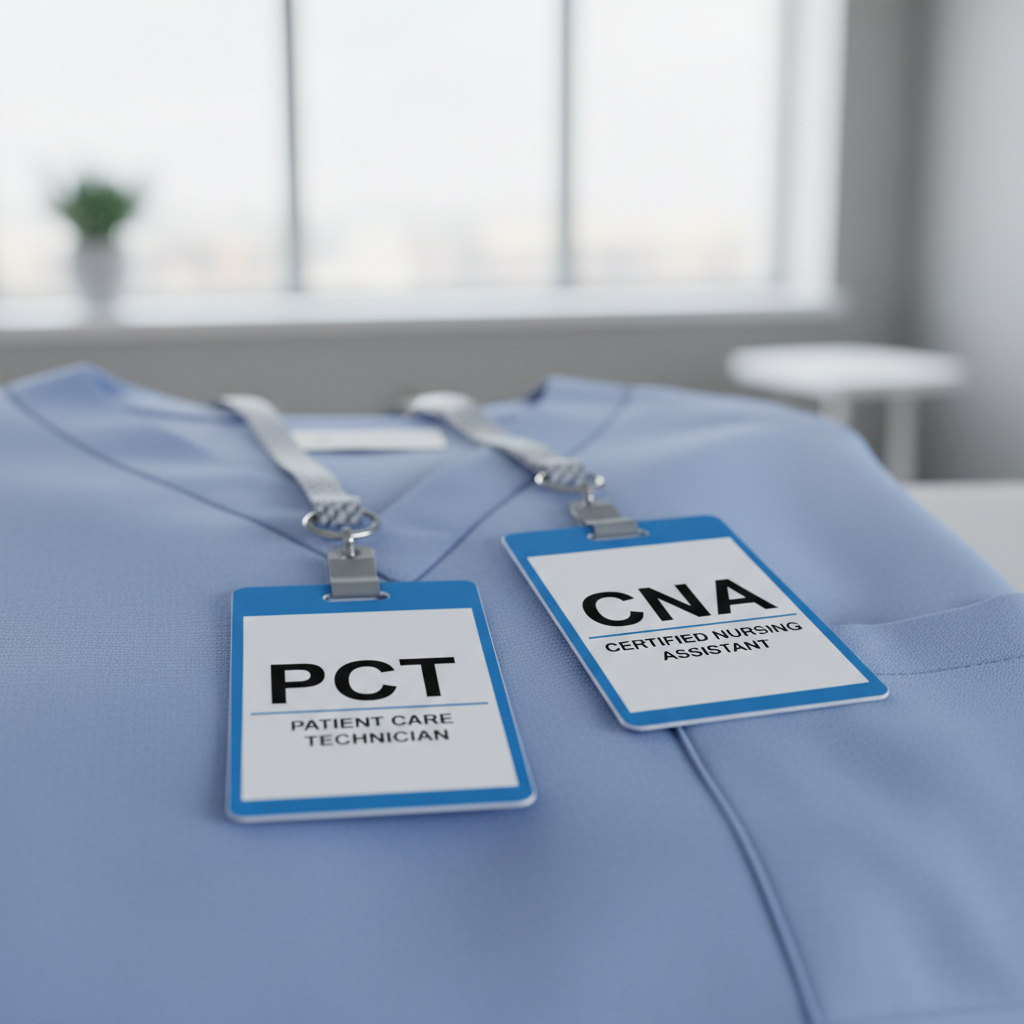
Whether you’re researching the patient care technician vs cna for the first time or comparing programs, this guide pulls together what matters.
This post breaks down the differences across training, certification, scope of practice, settings, pay, and career paths — then helps you decide which path fits if you’re choosing your first healthcare credential.
Want a faster path to your CPCT?
Earn your NHA CPCT in 8 weeks online — patient care, EKG, phlebotomy, and EHR. NHA exam fee, externship, and 6 practice tests included. MyCAA-eligible for military spouses.
For students researching patient care technician vs cna options, the practical reality is that the right choice depends on your timeline, budget, and target employer. Many candidates start their patient care technician vs cna research with general questions and narrow down as they understand which credentials each setting accepts. Treat patient care technician vs cna reviews as a comparison exercise, not a single decision.
PCT vs CNA: At a Glance — Patient Care Technician Vs Cna
| PCT | CNA | |
|---|---|---|
| Title | Patient Care Technician | Certified Nursing Assistant |
| Certification | National (NHA CPCT/A most common) | State-issued (each state has its own registry) |
| Training length | 8 weeks online + clinical externship | 4-12 weeks state-approved program |
| Training hours required | 75-150 hours typical | State minimum: 75 hours federal, many require 100-180 |
| Phlebotomy? | Yes | No |
| EKG? | Yes | No |
| Glucose monitoring? | Yes | No (CNAs in some states; varies) |
| Specimen collection? | Yes | Limited |
| Patient ADL support? | Yes | Yes (primary focus) |
| Vital signs? | Yes | Yes |
| Typical setting | Hospital, dialysis | Long-term care, hospital, home health |
| Median pay | $40,500/year | $35,800/year |
| Pay range | $32,000-$59,000 | $28,000-$48,000 |
| National recognition | Same credential works anywhere | State-by-state — moving may require recertification |
Scope of Practice — The Real Difference
Both PCTs and CNAs work under RN supervision and don’t administer medications (except specific protocols). But the procedures each is trained to perform diverge meaningfully:
What CNAs do (and do well)
- Bathing, dressing, toileting, and feeding patients
- Mobility support — repositioning, transfers, ambulation
- Basic vital signs (BP, pulse, temp, respiratory rate)
- Patient safety monitoring
- Communication with the supervising RN
- Documentation in the EHR
- Skin care and pressure ulcer prevention
What PCTs do (CNA scope plus more)
- Everything CNAs do, AND:
- Phlebotomy / venipuncture
- 12-lead EKG placement
- Bedside glucose monitoring (fingerstick)
- Specimen collection (urine, stool, sputum)
- Wound care assist
- Setting up rooms and equipment for procedures
- Transport to imaging or procedures
The PCT scope reflects the role’s hospital origins — most U.S. hospital systems created the PCT title in the late 1990s and 2000s specifically because they needed a more clinically-trained level between CNA and LPN.
Where They Work
CNA settings (most common)
- Skilled nursing facilities (SNFs) and nursing homes — the largest CNA employer category nationally. Lower pay, higher patient-to-CNA ratios, more ADL-focused work.
- Hospital med-surg floors — typically alongside or instead of PCTs, depending on system staffing model.
- Home health and assisted living — growing sector with flexible schedules.
- Hospice care — emotionally intense but meaningful work.
PCT settings (most common)
- Hospital inpatient floors (med-surg, telemetry) — the largest PCT employer category.
- Dialysis clinics — specialized PCT role (often called CHT or CCHT) with dialysis-machine training.
- Hospital ICU and ER — usually requires 1-2 years of floor PCT experience first.
- Outpatient clinics — sometimes PCT-MA hybrid roles.
Pay Comparison
National median:
- PCT: $40,500/year ($19.50/hour)
- CNA: $35,800/year ($17.20/hour)
Difference: about $4,700/year more for PCTs nationally. The gap widens in hospital settings (PCTs often earn 15-20% more than CNAs in the same hospital) and narrows in long-term care (where CNAs and PCTs sometimes earn similar pay because the role distinction blurs).
By state, the highest-paying for both:
| State | PCT median annual | CNA median annual |
|---|---|---|
| California | $50,900 | $43,800 |
| Massachusetts | $48,900 | $42,400 |
| New York | $47,800 | $41,600 |
| Hawaii | $46,800 | $40,500 |
| Alaska | $49,900 | $45,000 |
Training Path
Becoming a CNA
- Find a state-approved CNA training program — usually 4-12 weeks at a community college, healthcare facility, or American Red Cross site.
- Complete state-required clinical hours (varies; federal minimum 16 hours, most states require 40-100).
- Pass the state CNA exam — written + skills demonstration components. State-specific.
- Get listed on the state nurse-aide registry. CNA licensure does not transfer automatically across states; moving usually requires re-listing or sometimes retraining.
Becoming a PCT
- Complete an accredited PCT training program — typically 8 weeks online with clinical externship (80-160 hours).
- Pass the NHA CPCT/A exam — 100 questions, 2 hours, scaled scoring 200-500 with 390 passing. Cost: $155.
- National certification — works anywhere in the U.S. without retraining.
For a deeper salary breakdown, see our patient care technician salary guide.
Career Path Differences
CNA → next steps
CNAs commonly move toward:
- PCT (with additional certification in phlebotomy and EKG)
- LPN/LVN — 12-15 month nursing program
- RN (associate’s) — 2-year program
- Medical assistant — with additional training and certification
PCT → next steps
PCTs commonly move toward:
- Specialty PCT (dialysis CHT, ICU PCT) — 10-15% pay bump
- CCMA — adds outpatient + admin scope
- LPN/LVN — same path as CNA, often faster because clinical exposure is broader
- RN — popular path; many hospital systems offer tuition support for PCT-to-RN transitions
- Surgical Tech (CST), Respiratory Therapist — both common 1-2 year programs
Which Should You Choose?
Choose CNA if:
- You want to start working in 4-12 weeks
- You’re targeting long-term care, home health, or hospice
- Your local labor market has more CNA openings than PCT (true in some rural states)
- You’re working toward LPN or RN and want the lowest-friction starting credential
Choose PCT if:
- You want to work primarily in hospitals or dialysis
- You want broader clinical scope and procedural skills (phlebotomy, EKG)
- You want a credential that transfers nationally
- You’re using the role as a stepping stone to nursing school or specialty tech roles
- You want the higher starting pay
Ready to stop studying alone? HealthCerts’ Certified Patient Care Technician (CPCT) program is built around a 8 weeks online course with a guaranteed externship at a named partner clinic — so you walk out with both the credential and the clinical hours employers want.
The bottom line on patient care technician vs cna: choose the path that matches your real-world constraints — schedule, financial aid eligibility, and target employer — rather than the cheapest or fastest option in isolation. patient care technician vs cna outcomes vary meaningfully by program quality, so verify accreditation and externship support before enrolling.
Frequently Asked Questions
What’s the difference between a PCT and a CNA?
A PCT (Patient Care Technician) has broader clinical scope than a CNA (Certified Nursing Assistant) — including phlebotomy, EKG, and specimen collection. PCTs primarily work in hospitals; CNAs are concentrated in long-term care.
Do PCTs make more than CNAs?
Yes — PCTs earn about $4,700/year more nationally ($40,500 vs $35,800 median). The gap is widest in hospital settings.
Is PCT a better career than CNA?
For healthcare workers building toward hospital roles, dialysis, or nursing school, PCT is generally the better starting credential because of broader clinical scope, national transferability, and higher pay. CNA is a solid choice for long-term care or home health pathways.
Can a CNA become a PCT?
Yes — CNAs typically need additional training in phlebotomy, EKG, and clinical procedures (or a full PCT program) to qualify for the NHA CPCT/A exam. Many CNAs add PCT certification within their first 1-2 years to expand scope and pay.
Is the PCT exam harder than the CNA exam?
The NHA CPCT/A is broader — 100 questions across patient care, EKG, phlebotomy, and safety. State CNA exams are typically 60-70 questions plus a hands-on skills demonstration. Both pass rates run 70-80% with proper preparation.
Which is faster to become — PCT or CNA?
CNA is typically faster (4-12 weeks). PCT programs are usually 8 weeks for coursework plus 4-6 weeks of clinical externship. If you need to start working as fast as possible, CNA wins; if you want broader scope, PCT is a slightly longer path.
Can a PCT work as a CNA?
Most state nurse-aide registries don’t automatically list PCTs — even though the PCT scope exceeds CNA scope, you usually need to register separately as a CNA. Many hospitals hire PCTs into CNA-titled roles where the work overlaps; check your state requirements.
Which is easier — being a PCT or a CNA?
CNA work is more physically demanding (more lifting, transfers, ADL support); PCT work has more procedural complexity (venipuncture, EKG, glucose monitoring, specimen handling). Most CNAs and PCTs report the workload is comparable on different axes.
Start Your CPCT Journey with HealthCerts
Reading about patient care technician vs cna is one thing — actually getting credentialed and into a clinical role is another. HealthCerts’ Certified Patient Care Technician (CPCT) program is the fastest, most-supported path: Earn your NHA CPCT in 8 weeks online — patient care, EKG, phlebotomy, and EHR. NHA exam fee, externship, and 6 practice tests included. MyCAA-eligible for military spouses.
See CPCT tuition, schedule, and what’s included →
Source: National Healthcareer Association (NHA) — CPCT/A
For people researching patient care technician vs cna, the practical decision points usually come down to three things: cost, time, and credential acceptance. Use the patient care technician vs cna framing in the sections above to make each decision in the right order, and remember that patient care technician vs cna outcomes scale with the quality of the program you pick.