To become a certified medical assistant in New York, follow these steps:
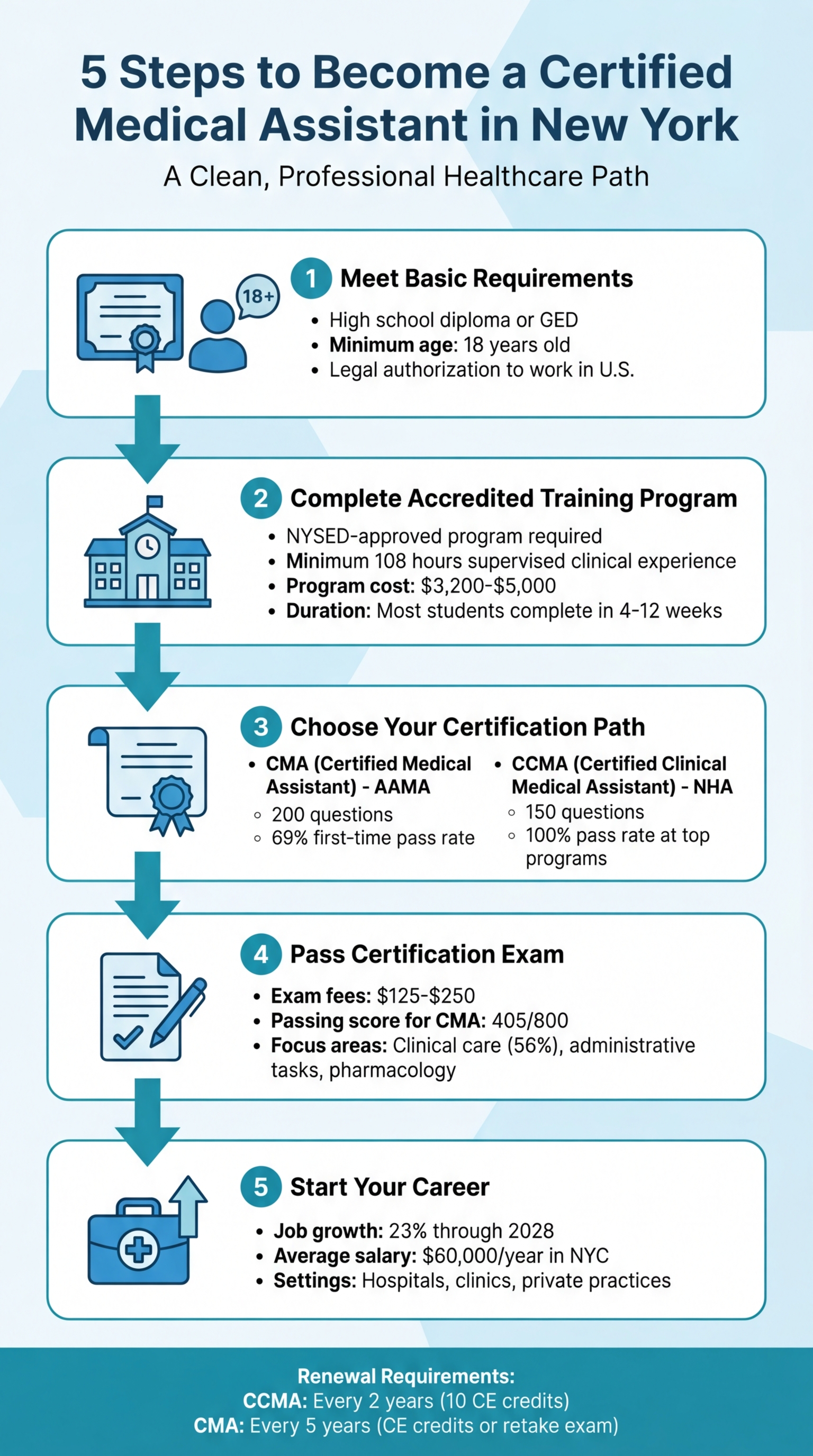
- Meet Basic Requirements: You need a high school diploma or GED, be at least 18 years old, and have legal authorization to work in the U.S.
- Complete an Accredited Program: Enroll in a program approved by the New York State Education Department (NYSED). This includes classroom instruction and at least 108 hours of supervised clinical experience.
- Choose Your Certification: The most recognized certifications in New York are:
- CMA (Certified Medical Assistant) from the AAMA.
- CCMA (Certified Clinical Medical Assistant) from the NHA.
- Pass the Certification Exam: Prepare thoroughly for exams like the CMA (200 questions, 69% first-time pass rate) or CCMA (150 questions). Programs like those at LaGuardia Community College boast high pass rates.
- Start Your Career: Certification opens doors to jobs in hospitals, clinics, and private practices. Medical assistant roles in New York are projected to grow by 23% through 2028.
Key Details:
- Programs range from $3,200 to $5,000, depending on the institution.
- Certifications must be renewed every 2–5 years, requiring continuing education credits.
With certification, you’ll gain the skills and credentials to thrive in New York’s growing healthcare sector.
5 Steps to Become a Certified Medical Assistant in New York
Become a Certified Medical Assistant in 2 Months
sbb-itb-7a67ffa
New York Medical Assistant Certification Requirements
In New York, medical assistants are considered unlicensed professionals who handle both administrative and clinical tasks under the supervision of licensed practitioners. While you don’t need a state license to work, completing an accredited training program is a must. The New York State Education Department (NYSED) outlines specific standards for these programs, making it essential to understand these requirements if you’re aiming for certification.
Basic Eligibility Requirements
To qualify, you need to meet a few key criteria: a high school diploma or GED, a minimum age of 18, and legal authorization to work in the United States. Additionally, you must complete a formal medical assistant program that includes both classroom instruction and practical clinical training.
The coursework typically covers areas like administrative procedures, diagnostic methods, pharmacology, infection control, medical terminology, and first aid/CPR. However, certain tasks – like triage, administering injections, suturing, or performing independent x-ray positioning – are restricted under New York law.
Once you meet these eligibility requirements, the next step is ensuring your training program is approved by NYSED.
Accredited Training Program Requirements
An NYSED-approved program must provide at least 108 hours of supervised clinical experience in a healthcare setting. This hands-on training is critical for developing practical skills and can only start after you’ve completed the required classroom instruction and demonstrated competency under supervision.
Your chosen program should comply with National Consortium for Health Science Education (NCHSE) standards and have established agreements with healthcare facilities to facilitate clinical training. It’s also important to select a program that offers pathways to recognized certifications, such as the Certified Medical Assistant (CMA) from the American Association of Medical Assistants (AAMA) or the Certified Clinical Medical Assistant (CCMA) from the National Healthcareer Association (NHA). If you’re aiming for the CMA credential, look for programs accredited by the Commission on Accreditation of Allied Health Education Programs (CAAHEP) or the Accrediting Bureau of Health Education Schools (ABHES), as graduation from these programs is often required to sit for the exam.
Medical Assistant Certifications Accepted in New York
In New York, the NYSED recognizes two main certifications: the Certified Medical Assistant (CMA) from the American Association of Medical Assistants (AAMA) and the Certified Clinical Medical Assistant (CCMA) from the National Healthcareer Association (NHA). These credentials are highly regarded across the state and can significantly enhance job opportunities in a field expected to grow by 23% through 2028. Here’s a closer look at each certification option.
Certified Clinical Medical Assistant (CCMA)
The CCMA certification is geared toward individuals aiming to focus on clinical care in New York’s fast-paced healthcare settings. This certification emphasizes clinical skills such as phlebotomy and EKG interpretation. Programs for CCMA certification are available at institutions like CCNY and LaGuardia Community College. LaGuardia, notably, boasts a 100% pass rate on the national NHA exams over the last four years.
At CCNY, the total cost for the CCMA program is $3,224, which includes $3,199 for tuition and a $25 registration fee. This does not cover textbooks or exam fees. Students are also required to demonstrate specific clinical proficiencies, such as completing a minimum of 20 venipunctures and 20 EKG monitorings, to qualify for the certification exam. Many programs offer hybrid or online training options, making them a flexible choice for working adults.
Certified Medical Assistant (CMA)
The CMA (AAMA) credential is recognized nationwide and requires candidates to graduate from a program accredited by either CAAHEP or ABHES to be eligible for the exam. As of January 5, 2026, there were 68,495 active CMAs across the country.
"Earning your Certified Medical Assistant (AAMA)® credential can be the key to unlocking new opportunities, higher earning potential, and greater job security." – American Association of Medical Assistants
The CMA exam includes 200 multiple-choice questions divided into four 40-minute segments. To pass, candidates must score at least 405 on a scale ranging from 200 to 800. This certification covers a mix of general, clinical, and administrative skills, preparing candidates for diverse roles in New York’s healthcare industry.
Additional Certifications (RMA, NCMA, CMAC)
Beyond the CMA and CCMA, other certifications like the Registered Medical Assistant (RMA), National Certified Medical Assistant (NCMA), and Certified Medical Administrative Assistant (CMAC) are also recognized in many healthcare settings across New York. These certifications cater to specific career paths, such as administrative roles, and align with the evolving needs of employers. When choosing a certification, it’s essential to ensure it matches your career goals and meets employer expectations.
How to Get Certified as a Medical Assistant in New York
To earn your medical assistant certification in New York, you’ll need to complete an accredited training program, pass a national certification exam, and apply for your credential. These programs typically require around 320 hours of combined classroom and clinical training.
Complete an Accredited Training Program
Your first step is enrolling in a program approved by the New York State Education Department (NYSED). These programs ensure you meet the eligibility requirements and cover essential subjects like anatomy, physiology, medical terminology, administrative practices, laboratory procedures, pharmacology, and infection control. A clinical component is also mandatory, but it only begins after you’ve received prior instruction and shown competency under supervision.
Additionally, obtaining an American Heart Association (AHA) Basic Life Support (BLS) for Healthcare Providers and AED certification is required. Costs for these programs can vary. For instance, LaGuardia Community College offers courses such as Medical Terminology for $405 and Phlebotomy for $1,578. Once your training is complete, you’ll need to focus on preparing for the certification exam, emphasizing both clinical and administrative skills.
Prepare for and Pass the Certification Exam
After completing your training, you’ll be eligible to sit for a national certification exam. In New York, the most common options are the NHA Certified Clinical Medical Assistant (CCMA) exam and the AAMA Certified Medical Assistant (CMA) exam. For example, the CMA exam includes 200 multiple-choice questions split into four 40-minute segments, and a passing score is 405 on a scale of 200 to 800. Between July 2024 and April 2025, the first-time pass rate for the CMA exam was 69%. Notably, LaGuardia Community College’s CCMA program has achieved a 100% pass rate on national certification exams for four consecutive years.
To succeed, focus on mastering both clinical and administrative competencies. It’s also critical to understand the scope of practice for medical assistants in New York. For instance, you cannot perform tasks like triage, administer injections or vaccinations, place sutures, or independently position patients for x-rays. Knowing these legal limits is essential for both exam preparation and professional practice.
Apply for Certification and Start Your Job Search
Once you pass your certification exam, you’ll receive your credential from either the NHA or AAMA. As of January 5, 2026, there were 68,495 active CMAs across the U.S.. With medical assistant jobs in New York expected to grow by 23% through 2028, certification can lead to opportunities in hospitals, clinics, private practices, and specialty care facilities.
Many training programs also offer career support services, such as resume workshops, interview coaching, and externship placements that often lead to employment. Highlighting your clinical skills – like phlebotomy and EKG proficiency – on your resume can make you stand out to potential employers.
HealthCareer Certs CCMA Program for New York Residents
Program Features and Benefits
HealthCareer Certs offers a fully online, self-paced CCMA program tailored for New York residents. With 12 months of access to complete your coursework, you can move at your own pace, with most students finishing in just 4 to 12 weeks. The program includes over 1,400 practice questions, 3D demonstrations, and interactive simulations to help you prepare for clinical scenarios. You’ll also have access to one-on-one Zoom sessions with instructors, email support, and career coaching to guide you along the way.
A standout feature of the program is the guaranteed externship at a local facility, ensuring you gain the hands-on experience required for certification. After passing the NHA CCMA exam, you’ll also earn 5 ACE credits, which can be transferred to more than 2,000 colleges and universities. These features aim to make your certification process smooth and efficient, right here in New York.
Exam Preparation and Job Placement Support
The program includes a voucher for the NHA CCMA exam, which features 150 multiple-choice questions and a 3-hour time limit. Exam preparation covers all seven topic areas, with a strong emphasis on clinical patient care, which accounts for 56% of the exam. Thanks to this thorough preparation, students often achieve high first-time pass rates.
As Juliana J. shared:
"I passed my certification exam on the first try because of them! All of the instructors were so helpful and amazing, everything is self-paced online".
Olivia, another student, added:
"I was able to get certified and pass the NHA exam on the first try in only 6 weeks, and I appreciated the ease of the entire process/course".
The program boasts a 5.0/5 rating on Google, with over 5,000 glowing reviews as of early 2026. Beyond helping you ace the exam, HealthCareer Certs also offers cost-effective options to simplify your journey to certification.
Flexible and Affordable Options
To support students during their clinical training, HealthCareer Certs provides an externship scholarship of up to $2,000. The self-paced format is ideal for those juggling work, family, or other commitments, making it a practical choice for busy New Yorkers. Plus, the program offers a guaranteed tuition refund if you don’t secure a healthcare job after earning your certification.
Brianna M. summed up her experience:
"HealthCareer Certs was overall 10 out of 10, instructors were so kind and willing to answer any questions throughout the course at any given time".
With comprehensive job placement support, graduates are well-positioned to land roles in New York’s growing healthcare industry. These flexible and affordable options, combined with top-notch training and externship opportunities, make the program a solid choice for aspiring healthcare professionals.
Medical Assistant Training Programs and Externships in New York
Accredited Programs in New York
New York offers several accredited medical assistant training programs that combine classroom instruction with hands-on clinical practice. For instance, the City College of New York (CCNY) provides a hybrid Certified Clinical Medical Assistant (CCMA) program with tuition set at $3,224. This program includes a 160-hour clinical segment, during which students complete at least 20 venipunctures and 20 EKG monitorings. LaGuardia Community College offers modular courses such as EKG Technician ($1,280), Phlebotomy ($1,578), and CCMA Procedures ($654). Impressively, the college has maintained a 100% pass rate on national certification exams over the past four years. Similarly, Lehman College features a program with a 120-hour externship and eligibility for Workforce1 ITG Vouchers, which help fund training for high-demand jobs in New York City. All these programs meet the New York State Education Department’s (NYSED) clinical experience standards.
These programs not only prepare students for national certification exams but also cover essential subjects like medical terminology, anatomy, physiology, phlebotomy, and EKG technician training. A standout feature of these programs is the structured externship, which connects theoretical knowledge with real-world application.
How Externships Support Certification
Externships provide the practical experience that classroom learning alone cannot replicate. During these rotations, students undertake critical tasks such as recording vital signs, collecting lab specimens, performing EKGs, and assisting patients during examinations. This supervised hands-on training is essential, as it allows students to demonstrate their skills in a clinical environment before officially entering the workforce. For example, LaGuardia Community College mandates a minimum of 35 live blood draws for phlebotomy certification eligibility.
Schools establish formal partnerships with healthcare facilities to facilitate externship placements. Before starting, students must provide proof of immunizations, undergo drug screenings, and complete background checks. These externships not only fulfill certification requirements but also enhance employability by equipping students with real-world experience. Upon completing a supervised externship, students qualify for national credentialing exams, which are often a prerequisite for employment.
With medical assistant jobs expected to grow by 23% between 2024 and 2028 and an average hourly wage of $23 in New York City (around $60,000 annually), externships act as a crucial stepping stone to a thriving career in healthcare.
Preparing for and Maintaining Your Certification in New York
Exam Preparation Strategies
To prepare for your certification exam, focus on the core subject areas recommended by the New York State Education Department. These align with the National Consortium for Health Science Education (NCHSE) Health Science Standards. Key topics to study include:
- Administrative practices
- Laboratory and diagnostic procedures
- Pharmacology principles
- Infection control
- Medical terminology
- Patient communication
Additionally, familiarize yourself with Section 6530 of the Education Law, which highlights tasks unlicensed medical assistants are prohibited from performing. These include administering vaccines, patient triage, drawing up medications in syringes, placing sutures, and independently positioning patients for x-rays. Knowing these restrictions can help you tackle scenario-based questions on the exam.
Certification exams typically consist of 150–210 multiple-choice questions. For example, the CCMA exam includes 150 scored questions and costs $155, while the CMA exam features 200 questions, with fees ranging from $125 to $250. Be sure to meet all eligibility requirements before scheduling your test. Once you pass, staying informed about renewal processes is key to maintaining your credentials.
Certification Renewal Requirements in New York
After earning your certification, maintaining it is critical for career growth. Since medical assistants in New York are considered unlicensed personnel, the state does not issue licenses or require state-managed renewals. Instead, the renewal process is governed by the national certifying body.
- CCMA Certification: Renew every two years by earning at least 10 continuing education credits and paying a recertification fee.
- CMA Certification: Renew every five years, either by retaking the exam or completing continuing education credits.
Many employers in New York also require medical assistants to hold a current Basic Life Support (BLS) for Healthcare Providers certification through the American Heart Association. These courses generally cost around $160. To stay on top of renewal deadlines and manage continuing education requirements, use the renewal portal provided by your certifying organization.
Conclusion
To earn your certification, you’ll need to complete an accredited program that includes 108 hours of supervised clinical experience and successfully pass a national exam, such as the CMA or CCMA.
It’s important to note that medical assistants in New York work under licensed supervision. Be sure to understand Section 6530 of the Education Law, which outlines restrictions on certain clinical tasks. For example, medical assistants in New York are not permitted to administer vaccines, perform patient triage, or prepare medications in syringes. Staying informed about these regulations ensures you practice safely and within the law.
Once you’re familiar with the legal requirements, the next step is selecting the right training program. Look for a program that aligns with New York’s clinical standards and prepares you for certification. Earning certification can open doors to opportunities in New York’s growing healthcare sector, which boasts a 9% annual increase in job postings and a projected 23% employment growth.
FAQs
Which certification is better in New York: CMA or CCMA?
Both the CMA (Certified Medical Assistant) and CCMA (Certified Clinical Medical Assistant) are valid certifications in New York, but they serve different purposes depending on your career aspirations.
The CMA is nationally recognized and opens doors to a variety of roles across diverse healthcare environments. On the other hand, the CCMA emphasizes clinical and administrative skills, making it ideal for hands-on roles in clinical settings.
If you’re looking for broader recognition and potentially higher earning potential, the CMA might be the better choice. However, if your focus is on practical clinical training, the CCMA could align more closely with your goals.
Can I get certified online in New York?
Yes, it’s possible to earn a medical assistant certification online in New York. Several programs provide remote learning options and virtual exams, allowing you to complete the certification process from the comfort of your home. Schools such as Lehman College, LaGuardia Community College, and Southern Westchester BOCES offer online or hybrid programs designed to help you meet state requirements and prepare for employment, making it easier to advance your career.
How long does it take to become a certified medical assistant in New York?
To become a certified medical assistant in New York, you’ll generally need to complete around 108 hours of clinical experience as part of an approved training program. The total length of these programs can vary based on the specific course or certification path you decide to pursue.