To work as a medical assistant in Connecticut, certification is mandatory. The Connecticut Department of Public Health requires professionals to hold valid credentials from recognized organizations like AAMA, NHA, AMT, or NCCT. Certification ensures you have the skills to perform clinical and administrative tasks, including managing patient records, taking vital signs, and administering vaccines under supervision.
Key Steps to Certification:
- Education: A high school diploma or GED is required. Training programs range from 128-hour courses to 12-month collegiate programs.
- Certification Options: Choose from CMA (AAMA), RMA (AMT), or CCMA (NHA). Each has specific eligibility criteria, including accredited training or relevant work experience.
- Training Providers: Online programs like HealthCareer Certs offer flexible, self-paced learning, while in-person options are available at institutions like CT State.
Certification Benefits:
- Job Growth: Medical assistant roles in Connecticut are projected to grow by 12% through 2034.
- Higher Earnings: Certified professionals earn 10% more on average, with base salaries around $46,314 annually.
- Career Advancement: Certification opens doors to specialized roles and higher-paying opportunities in healthcare.
For those starting their journey, online programs like HealthCareer Certs provide a convenient path to certification with externship placements and exam preparation included.
Connecticut Requirements for Medical Assistants
Education Requirements
To enroll in medical assistant training programs in Connecticut, candidates need a high school diploma or GED. Additionally, most certifying organizations, including the National Healthcareer Association (NHA), require candidates to be at least 18 years old.
There are multiple training options available in the state. For instance, you can complete a 128-hour non-credit training course or choose collegiate certificate programs, which can often be completed in as little as 12 months. As an example, CT State offers an Administrative Medical Assistant program for $2,725, not including exam fees or textbooks. Goodwin University’s certificate program boasts a 100% exam passage rate for its 2024 graduates and an impressive cumulative rate of 94.23% from 2019 to 2024.
If you’re pursuing credentials like CMA or RMA, you’ll need to attend programs accredited by CAAHEP or ABHES.
Once educational requirements are fulfilled, candidates must meet certification criteria to qualify for professional registration.
Certification Eligibility
The Connecticut Department of Public Health recognizes certifications from four national organizations: the American Association of Medical Assistants (AAMA), National Healthcareer Association (NHA), National Center for Competency Testing (NCCT), and American Medical Technologists (AMT). Because of this, it’s essential to choose a training program that prepares you for the certification exam offered by one of these organizations to secure a spot on the state’s official registry.
Each certification has unique eligibility requirements. For example, the CMA (AAMA) requires graduation from a CAAHEP- or ABHES-accredited program. The RMA (AMT) pathway allows candidates who graduate from an accredited medical assistant program or complete relevant military training. For the CCMA (NHA), candidates need a high school diploma or GED along with either a completed training program or one year of work experience. Moreover, students enrolled at CT State Community College must maintain a grade of "C" or higher in all MED courses to continue in their program.
sbb-itb-7a67ffa
Medical Assistant Certifications: CCMA, CMA, and RMA
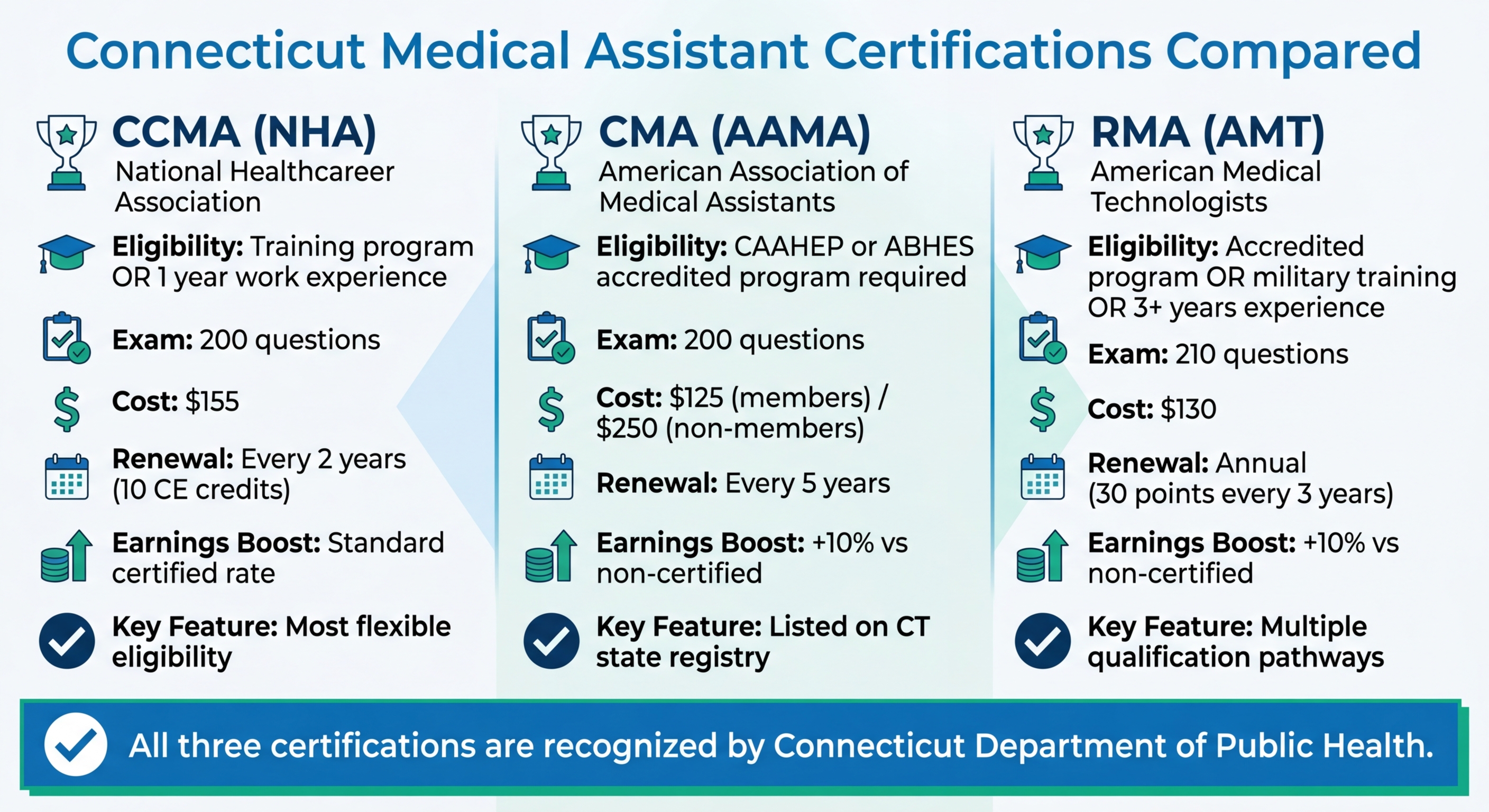
Connecticut Medical Assistant Certifications: CCMA vs CMA vs RMA Comparison
If you’re pursuing a career as a medical assistant in Connecticut, there are three main certifications to consider. Each offers unique benefits and requirements, so understanding their differences can help you make the right choice.
Certified Clinical Medical Assistant (CCMA)
The Certified Clinical Medical Assistant (CCMA) credential, offered by the National Healthcareer Association (NHA), is officially recognized by the Connecticut Department of Public Health. It has relatively straightforward eligibility criteria: you can qualify either by completing a clinical medical assistant training program or by having at least one year of relevant work experience.
The CCMA exam focuses on clinical skills like phlebotomy, EKG, infection control, and patient care. It includes 200 questions, costs $155, and must be renewed every two years by completing 10 continuing education credits. For those preparing for this certification, HealthCareer Certs provides online training tailored to cover all exam topics and clinical skills required by employers in Connecticut.
Certified Medical Assistant (CMA) and Registered Medical Assistant (RMA)
The Certified Medical Assistant (CMA) and Registered Medical Assistant (RMA) certifications differ from the CCMA by requiring more extensive educational backgrounds.
To earn the CMA credential, administered by the American Association of Medical Assistants (AAMA), candidates must graduate from a program accredited by either CAAHEP or ABHES. Unlike the CCMA, work experience alone isn’t enough to qualify. The CMA exam includes 200 questions, costs $125 for AAMA members (or $250 for non-members), and requires recertification every five years. Additionally, CMA holders in Connecticut are listed on the state’s official registry.
The RMA, offered by American Medical Technologists (AMT), provides more flexible eligibility options. Candidates can qualify by graduating from an accredited program, completing military training, or having three or more years of full-time work experience. The RMA exam consists of 210 questions, costs $130, and requires annual renewal with 30 points every three years.
Both CMA and RMA certifications are associated with a 10% increase in earnings for medical assistants compared to their non-certified counterparts. Furthermore, certified medical assistants in Connecticut who receive specialized training are authorized under state statute CGS 19a-6s to administer vaccines under physician supervision.
These certifications not only meet state requirements but also enhance career opportunities and earning potential in the medical field.
How to Get CCMA Certification with HealthCareer Certs
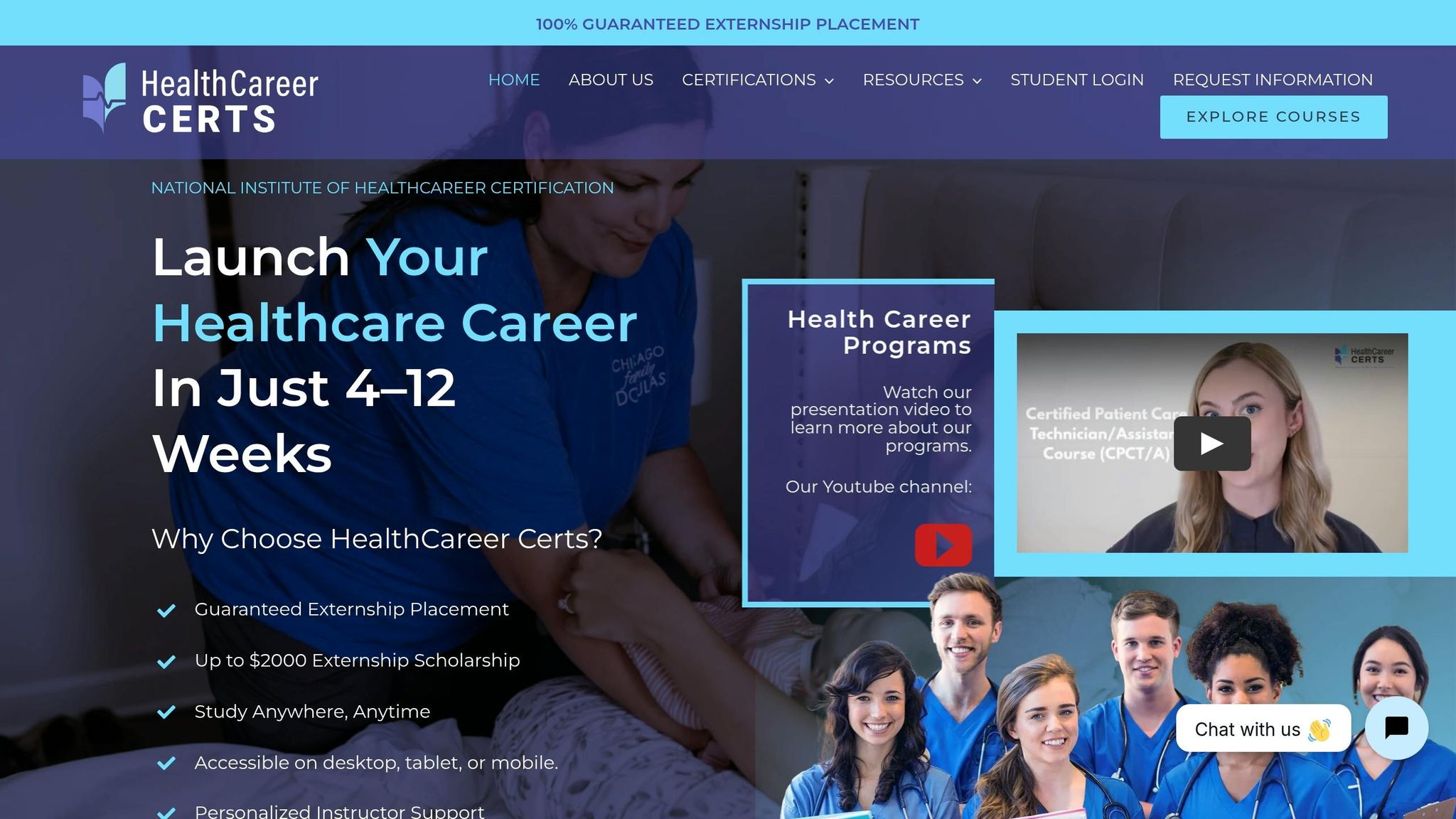
Earning your CCMA certification through HealthCareer Certs is an online process tailored for Connecticut residents who need flexible study options. The journey is divided into three main steps: enrollment, completing the training, and preparing for the certification exam.
Enrolling in the Online Program
To start, head to the HealthCareer Certs website and check out the free course preview. This gives you a feel for the platform before committing. Once you’re ready, choose a payment plan and enroll. You’ll need to provide some documents, including your high school diploma or GED, proof of identity, and any required health records (like immunizations or TB test results) for the practical components.
After registering, you’ll gain access to the online student portal within 24–48 hours. The platform is mobile- and tablet-friendly, making it easy to study whenever it suits your schedule. HealthCareer Certs is trusted by thousands of students and is approved by the New Hampshire Department of Education, ensuring a reliable and recognized program.
Once enrolled, you can dive into the structured, self-paced training that covers all the key areas of the CCMA curriculum.
Completing Your Training
The training program includes 18 modules and 132 lessons, covering both clinical and administrative skills essential for the CCMA exam. You’ll engage with interactive tools like 3D demos, lab simulations, games, and flashcards to simplify complex topics such as phlebotomy and EKG placement.
The self-paced design means you can move at your own speed – whether that’s completing the course in 4 to 6 weeks with full-time focus or stretching it out to 12 months if you have other commitments. As one student, Juliana J., shared:
I passed my exam on the first try because of the self-paced online program.
Support is always available through one-on-one Zoom sessions with instructors, email assistance, and virtual discussion boards where you can connect with other students.
Once you’ve completed the modules, the next step is preparing for the certification exam.
Preparing for the Certification Exam
HealthCareer Certs provides everything you need to confidently tackle the 150-question NHA CCMA exam. Your tuition includes a certification exam voucher, access to over 1,400 practice questions, 700 self-checks, and six full-length practice tests. These materials align with the exam’s structure, which emphasizes clinical patient care (56%) and foundational knowledge (10%).
The program also includes an externship placement at a Connecticut healthcare facility, where you’ll complete 160 hours of hands-on clinical experience. Plus, you might qualify for an externship scholarship of up to $2,000 to help with training costs. Once you’ve completed the coursework and feel ready, you can schedule your CCMA exam at a PSI testing center or take it online with live remote proctoring.
Passing the CCMA exam not only certifies you but also earns you 5 college credits through the American Council on Education – credits recognized by over 2,000 institutions. And with a 100% tuition refund guarantee if you don’t secure a healthcare job after certification, the program offers peace of mind. There’s even a 24-hour cancellation policy for added flexibility.
Training Options in Connecticut: Online vs. In-Person
Connecticut residents looking to become medical assistants have two primary training options: online programs that offer flexibility and self-paced learning or in-person programs held at local campuses with scheduled classes. Deciding between these formats depends on your personal schedule, learning preferences, and career goals. Here’s a closer look at the advantages of each option to help you choose the best fit.
Benefits of Online Training with HealthCareer Certs
HealthCareer Certs’ online training is perfect for those juggling work, family, or other responsibilities. With 24/7 access via your phone, tablet, or computer, you can learn at your own pace, completing the program in as little as 4 weeks or up to 12 weeks, depending on your schedule.
The curriculum covers both clinical and administrative skills needed for the CCMA certification, equipping you for a variety of medical assistant roles. Instead of traditional lectures, the program uses interactive tools like 3D demos and lab simulations to make learning engaging and practical. Plus, you’ll gain real-world experience through a guaranteed externship at a Connecticut healthcare facility. Personalized one-on-one Zoom sessions eliminate the hassle of commuting while still providing direct support. Both online and in-person options prepare you thoroughly for the CCMA certification exam.
In-Person Training Options in Connecticut
For those who prefer structured, face-to-face learning, in-person training programs at Connecticut institutions like CT State might be a better choice. CT State offers Administrative Medical Assistant programs at campuses including Capital, Housatonic, Naugatuck Valley, and Tunxis, aligning with traditional academic schedules (Fall, Spring, and Summer terms).
In-person programs can be especially appealing if you qualify for funding opportunities like WIOA, SNAP, or CareerConneCT, which are often available for state college workforce programs. However, it’s important to note that CT State’s programs focus primarily on administrative skills, such as medical coding and billing. In contrast, online CCMA training provides a more comprehensive approach by covering both clinical and administrative competencies.
Also, keep in mind that Connecticut law limits certain tasks medical assistants can perform. For example, they are not permitted to conduct radiography or administer most medications, though they can give vaccines under direct supervision.
Preparing for the Certification Exam
Study Strategies and Resources
Getting ready for the CCMA exam from the National Healthcareer Association (NHA) means tackling both administrative and clinical skills. To succeed, your study plan should cover all the major content areas in an organized way.
Break your study time into three key areas: administrative, clinical, and general competencies. HealthCareer Certs offers 1,400+ practice questions and 700 self-checks – great tools to identify weak spots and improve them. These resources can help you feel more confident as you prepare.
If you’re in Connecticut, make sure to focus on the state’s specific regulations. For example, Connecticut’s scope-of-practice rules allow medical assistants to focus on tasks like data collection and health maintenance education, so these should be emphasized in your preparation.
Create a study schedule that fits your routine, but make sure it balances all topics. Practice under timed conditions to get used to the exam format and build your endurance. Don’t forget to review administrative modules on Electronic Medical Records (EMR), medical insurance, and billing – these are critical areas for the exam.
With a solid study plan, you’ll be ready to tackle exam day with confidence.
What to Expect on Exam Day
The CCMA exam is computer-based and features multiple-choice questions across the topics you’ve studied. Take your time with each question and flag any you’re unsure about so you can return to them later. Once the exam is finished, you’ll receive your results – a big step forward in becoming a certified medical assistant in Connecticut.
Career Outlook for Medical Assistants in Connecticut
Job Demand in Connecticut
The job market for certified medical assistants in Connecticut is thriving. Employment in this field is expected to grow by 12% between 2024 and 2034, a rate much faster than the average for most occupations. This growth is fueled by an aging baby boomer population that requires more medical care and an increase in lifestyle-related health conditions like obesity and diabetes.
Currently, there are over 1,100 active job postings for medical assistants in the state. Most medical assistants – between 57% and 62% – work in physician offices, while hospitals employ 17%, and outpatient centers account for 10% of jobs.
Salaries in Connecticut are competitive, with an average base pay of about $46,314 per year, which is higher than the national median of $44,200. However, pay can vary by location and employer. For example, Oak Street Health recently advertised a Certified Medical Assistant position with a salary of $59,613, and Signify Health listed a Medical Assistant/Phlebotomist role at $58,240. Outpatient care centers tend to offer the highest median wages at approximately $47,560, compared to $45,930 in hospitals and $43,880 in physician offices.
In addition to strong job growth, medical assistants in Connecticut benefit from opportunities to advance their careers.
Career Advancement Opportunities
Connecticut offers plenty of room for career growth in this field. With the right skills and certifications, medical assistants can branch out into specialized clinical roles – such as specimen collection or patient care – or focus on administrative areas like medical coding, billing, or managing electronic health records (EHR).
The Connecticut Department of Public Health supports career development by maintaining a public registry of certified medical assistants. This registry includes individuals certified by organizations like AAMA, NHA, NCCT, and AMT, giving employers a reliable way to find qualified professionals.
To maintain certification, ongoing professional development is essential. For instance, NHA certification must be renewed every two years, often through online continuing education. These courses help medical assistants stay up-to-date on important topics like HIPAA regulations, medical terminology, and new healthcare technologies. This commitment to learning not only keeps skills sharp but also opens doors to advanced roles, such as medical billing specialists, clinic managers, or even further clinical training to become nurses or physician assistants.
Conclusion
To earn certification in Connecticut, you’ll need to complete an approved training program and meet the standard eligibility requirements. The Connecticut Department of Public Health recognizes certifications from organizations like AAMA, AMT, NHA, and NCCT.
HealthCareer Certs makes the process easier with its fully online, self-paced CCMA program. This program offers one-on-one instructor support, interactive learning tools, thorough exam preparation, and guaranteed externship placement – all of which you can complete within 4 to 12 weeks.
Remember to renew your credential every two years by completing online continuing education. This ensures you stay qualified for specialized roles, such as vaccine administration under physician supervision, as authorized by CGS 19a-6s.
HealthCareer Certs is dedicated to equipping you with the training, resources, and confidence needed to start and grow your career in healthcare.
FAQs
Which certification should I choose for Connecticut: CCMA, CMA, or RMA?
Choosing between CCMA, CMA, or RMA in Connecticut comes down to your career goals and what employers in your area value most. The CMA is often the go-to choice because it meets national standards and is widely recognized. However, the RMA and CCMA are strong alternatives, especially if they align better with your training or the specific roles you’re targeting. It’s important to research which certification is most respected locally and how it fits into your long-term plans.
How do I get on Connecticut’s medical assistant registry after I pass the exam?
After successfully passing the medical assistant exam in Connecticut, you can be listed on the state’s registry by obtaining certification from recognized organizations such as the American Association of Medical Assistants (AAMA) or the National Healthcareer Association (NHA). It’s important to keep your certification up to date and properly documented with these organizations, as the Connecticut Department of Public Health relies on this information to manage the official registry of certified professionals.
What clinical tasks can a certified medical assistant legally do in Connecticut?
Certified medical assistants in Connecticut are allowed to carry out certain clinical tasks, but only when these are delegated by licensed nurses. These tasks must fit within the boundaries of the state’s nursing practice scope and delegation rules. While Connecticut’s regulations don’t provide a detailed list of allowable tasks, any duties assigned must strictly adhere to the state’s legal standards for medical assistants.