Becoming a certified medical assistant in Michigan isn’t required by law, but it can greatly improve your job prospects and earning potential. Employers across the state prefer hiring certified professionals to meet federal regulations and ensure quality patient care. Certification also allows you to work nationwide and opens doors to advanced healthcare roles like nursing or respiratory therapy.
Key Points:
- Certification Benefits: Higher starting salaries, faster job placements, and eligibility for roles in all 50 states.
- Job Market: Medical assistant jobs in Michigan are projected to grow by 16% by 2031.
- Education Paths: Choose between shorter certificate programs (9–12 months) or a 2-year Associate in Applied Science (AAS) degree.
- Certification Options: CMA (AAMA), RMA (AMT), and CCMA (NHA) are the most recognized credentials.
- Exam Costs: CMA: $125–$250, RMA: ~$130, CCMA: ~$155.
- Continuing Education: Renewal cycles require ongoing CEUs (e.g., 60 CEUs every 5 years for CMA).
Certification not only enhances your skills in clinical and administrative tasks but also aligns with Michigan’s growing demand for healthcare professionals.
Education Requirements and Program Selection
Basic Education Requirements
To start a medical assistant program in Michigan, you’ll need a high school diploma or GED and to complete specific prerequisite courses. These typically include Medical Terminology, Introduction to Human Disease, and Basic Algebra. Programs also require maintaining a minimum 2.5 GPA and earning at least a "C" grade in all courses. Keep in mind, each course can only be repeated once.
Before beginning clinical training, you’ll also need to complete health and safety clearances, which include a criminal background check (with fingerprinting) and a drug screening. Mid Michigan College outlines these requirements clearly:
"Students who receive an Entrance Letter are required to complete a background check, which includes fingerprinting, a clear random drug screen and be clear of certain misdemeanor and felony crimes".
If you have a history of certain misdemeanors or felonies, it could prevent you from entering the program due to clinical site restrictions. Additionally, science courses like Human Disease or Anatomy often need to have been completed within the last five years. If not, you’ll have to retake them. Meeting these academic and clearance requirements is critical for moving forward in your training and working toward certification.
Program Types in Michigan
Michigan offers two main types of medical assistant training programs: certificate programs and Associate in Applied Science (AAS) degrees.
- Certificate Programs: These are shorter, lasting about 9–12 months, and focus entirely on medical assisting skills. They’re perfect if you’re looking to enter the workforce quickly. For example, Grand Rapids Community College offers a 22-week certificate program costing $8,744. This covers everything from textbooks and uniforms to the RMA certification exam fee. Mid Michigan College has a 10-month program accredited by CAAHEP, with the CMA exam fee included in tuition.
- Associate in Applied Science Degrees: These take about two years (64 credits over six semesters) and include general education courses. They’re a great option if you’re considering further education, like transferring into nursing or pursuing other advanced healthcare roles.
Both pathways include a mandatory externship – 160 hours split between administrative and clinical training. Programs in Michigan are available in various formats, including in-person, online, and hybrid options. Regardless of the format, it’s crucial to choose a program accredited by CAAHEP or ABHES, as this is required for national certification exams like the CMA (AAMA).
Some programs also offer apprenticeships or scholarships to help with costs. For instance, Oakland Community College partners with Henry Ford Health to provide free tuition and guaranteed full-time employment for qualified students. Similarly, the Corewell Health Care Professionals Education Scholarship awards up to $2,000 to eligible candidates. These opportunities can make training more affordable while setting you up for success.
Admission Requirements
The admissions process typically involves two steps: applying to the college first and then to the medical assistant program after completing prerequisites. Some schools, like Oakland Community College and Grand Rapids Community College, require attendance at mandatory information sessions.
Many programs are competitive and have limited spots. For example, Mid Michigan College accepts only 30 students each fall semester. Applications are generally open between December and May 1, with entrance letters issued in the spring for a fall start.
Once accepted, you’ll need to complete all screenings and meet performance benchmarks before registration. Candidates must score 100% on clinical competencies (with up to two attempts) and at least 75% on administrative tasks. These rigorous standards ensure you’re fully prepared for certification and capable of excelling in the field.
sbb-itb-7a67ffa
Why Get Certified as a Registered Medical Assistant
Certification Options for Michigan Medical Assistants
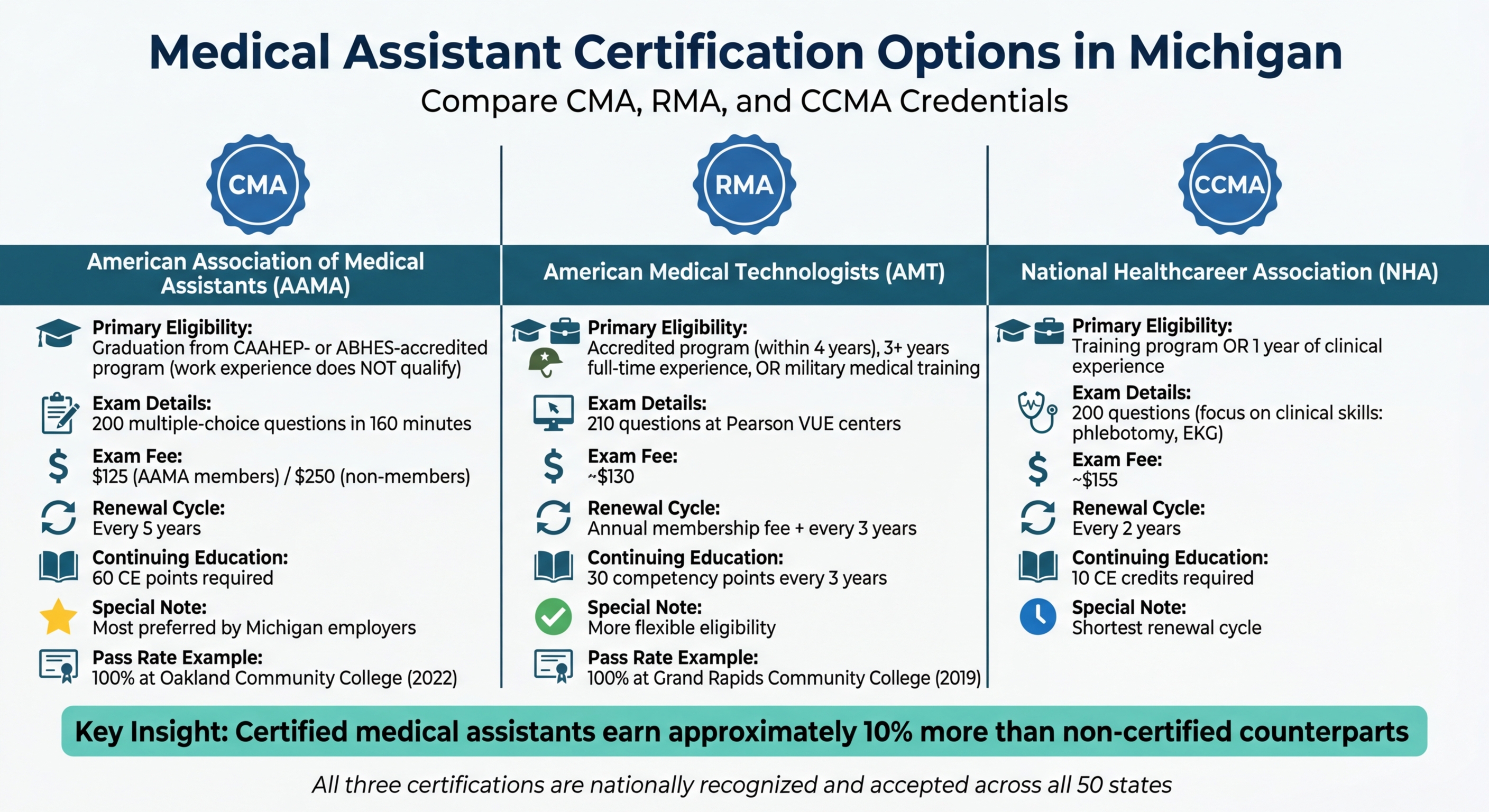
Michigan Medical Assistant Certification Comparison: CMA vs RMA vs CCMA
After completing your training program in Michigan, the next step is deciding which national certification to pursue. While certification isn’t required by law in Michigan, most employers either prefer or require it. The three most prominent credentials are the CMA (AAMA), RMA (AMT), and CCMA (NHA), each with its own eligibility criteria and advantages. Here’s a closer look at your options.
Certified Medical Assistant (CMA)
In Michigan’s healthcare field, the Certified Medical Assistant (CMA) credential, offered by the American Association of Medical Assistants (AAMA), is often the top choice for employers. Unlike other certifications, the CMA requires completion of a program accredited by either CAAHEP or ABHES – work experience alone won’t qualify you.
The CMA exam consists of 200 multiple-choice questions, covering both clinical and administrative skills, and must be completed within 160 minutes. The exam fee is $125 for AAMA members and $250 for non-members. Many Michigan programs, like Oakland Community College, are CAAHEP-accredited and prepare students specifically for this exam. Impressively, Oakland Community College’s 2022 graduates achieved a 100% pass rate on the CMA exam.
You can apply for the CMA exam as a student nearing the end of your coursework, a recent graduate (within 12 months), or even as a non-recent graduate, as long as you provide transcripts. Certification renewal happens every five years and requires earning 60 continuing education points.
If your background doesn’t align with the CMA’s strict requirements, the RMA might be a better fit.
Registered Medical Assistant (RMA)
The Registered Medical Assistant (RMA), offered by American Medical Technologists (AMT), provides a more flexible pathway for those with diverse training or experience. Eligibility includes graduating from an accredited program within the past four years, completing military medical training, or having at least three years of full-time medical assisting experience.
The RMA exam, which includes 210 questions, is administered at Pearson VUE testing centers across Michigan. The exam costs around $130, and some programs, like Grand Rapids Community College, even include this fee in their tuition. Grand Rapids Community College also reported a 100% pass rate for its 2019 RMA exam takers.
To maintain the RMA credential, you’ll need to pay an annual membership fee and earn 30 continuing competency points every three years. This certification is widely accepted by employers in Michigan and beyond. Additionally, certified medical assistants typically earn about 10% more than their non-certified counterparts.
Certified Clinical Medical Assistant (CCMA)
The Certified Clinical Medical Assistant (CCMA), offered by the National Healthcareer Association (NHA), is another well-recognized option in Michigan. You can qualify for this certification by completing a formal training program or by documenting at least one year of hands-on clinical experience as a medical assistant.
The CCMA exam focuses on clinical skills such as phlebotomy and EKG and includes 200 questions. The exam fee is approximately $155. Certification renewal is required every two years and involves earning 10 continuing education credits.
| Certification | Organization | Primary Eligibility | Exam Fee | Renewal Cycle |
|---|---|---|---|---|
| CMA | AAMA | Graduation from a CAAHEP-/ABHES-accredited program | $125–$250 | Every 5 years (60 CE points) |
| RMA | AMT | Accredited program, 3+ years of experience, or military training | ~$130 | Annual fee + 30 points every 3 years |
| CCMA | NHA | Training program or 1 year of clinical experience | ~$155 | Every 2 years (10 CE credits) |
When deciding which certification to pursue, it’s a good idea to review job postings from leading Michigan healthcare systems to see which credentials are most commonly required or preferred. If you’re a recent graduate of an accredited program, the CMA is often the top choice. However, if you have significant on-the-job experience, the RMA or CCMA can help validate your skills with a nationally recognized credential.
How to Prepare for Certification Exams
Once you’ve picked your certification path, the next step is crafting a study plan that positions you for success. A well-structured approach can significantly boost both your confidence and your chances of passing.
Exam Format and Structure
Knowing the exam format can help ease test-day nerves. For instance, the CMA exam consists of 200 multiple-choice questions, though only 180 are scored – the other 20 are unscored pretest questions. You’ll have 160 minutes to complete it, broken into four 40-minute segments, giving you roughly 48 seconds per question. The exam covers three domains: Clinical (59%), General (21%), and Administrative (20%).
The RMA exam includes 210 questions with a 120-minute time limit, while the CCMA exam features 200 questions with a 180-minute window. All three exams are computer-based and administered at designated testing centers across Michigan: CMA exams are handled by Prometric, RMA by Pearson VUE, and CCMA by PSI.
"The Clinical domain accounts for 59% of the CMA exam, making it by far the most important area to study." – OpenExamPrep
Understanding these details is key to building an effective study plan.
Study Methods and Resources
Start your preparation 4–6 weeks before the exam, aiming for about 75 minutes of study time daily (totaling 55–65 hours). Focus heavily on clinical procedures since they carry the most weight on the exam. Topics to prioritize include vital signs, patient positioning, injection techniques (intradermal at 10–15°, subcutaneous at 45°, intramuscular at 90°), specimen collection, 12-lead ECG placement, and pharmacology calculations.
Invest in official practice materials from your certifying body. For example, the AAMA offers full-length practice exams for about $30, which closely mimic the actual test format. In the final week, take timed practice exams under real testing conditions to build stamina. For context, between July 2019 and July 2020, the CMA exam had a 67% pass rate.
When tackling practice questions, keep this strategy in mind: prioritize patient safety, avoid answers with absolute terms like "always" or "never", and review all options before choosing the best one.
Once your study plan is in place, the next step is registering for your exam.
Registration and Scheduling
Start by verifying your eligibility on the certifying body’s website. CMA candidates need transcripts from a CAAHEP- or ABHES-accredited program, while RMA and CCMA candidates can submit proof of work experience. Submit your documentation along with the exam fee: $125–$250 for the CMA (depending on AAMA membership), about $130 for the RMA, or approximately $155 for the CCMA.
After approval, you’ll receive authorization to schedule your exam within a 90-day window. Visit the testing vendor’s website (Prometric, Pearson VUE, or PSI) to select a Michigan testing center and book your date. Most candidates schedule their exam 1–3 months after program graduation, while the material is still fresh. If you don’t pass on your first try, you can reapply, but you’ll need to pay the full exam fee again.
What Medical Assistants Can Do in Michigan
Michigan law outlines specific roles for certified medical assistants, ensuring that professionals in this field operate safely and effectively. Certification allows you to handle both clinical and administrative tasks with confidence.
Clinical and Administrative Responsibilities
Medical assistants in Michigan play a vital role in keeping healthcare facilities like physician offices, outpatient clinics, labs, and hospitals running smoothly. On the clinical side, you’ll handle tasks such as taking medical histories, preparing patients for exams, and recording vital signs like blood pressure and temperature. You might also perform procedures like drawing blood (phlebotomy), giving injections, conducting EKG tests, and running CLIA-waived lab tests.
On the administrative front, your duties may include scheduling appointments, managing phone calls, maintaining medical records, and handling insurance-related tasks like coding and billing. Proficiency in electronic health record (EHR) systems is especially important, as organizational skills are key to managing these responsibilities effectively.
"Medical assistants are in high demand and work in physician offices, outpatient clinics, laboratories and hospitals." – Oakland Community College
Although medical assistants handle a variety of tasks, certain responsibilities are beyond their legal scope.
What Medical Assistants Cannot Do
There are clear boundaries to what medical assistants in Michigan are allowed to handle. You are not permitted to diagnose patients, prescribe medications, or perform surgical procedures. Additionally, interpreting test results or making independent clinical decisions about patient care is outside your scope. Adhering to these restrictions is essential for both patient safety and legal compliance.
Supervision Requirements
To ensure patient safety, all clinical tasks must be performed under supervision. Michigan law requires that medical assistants work alongside or under the guidance of doctors, nurses, or other licensed healthcare professionals. Programs like those at Oakland Community College include courses in Medical Law and Ethics (MDA 1350) to help you understand these rules and their importance. This structure allows medical assistants to contribute effectively while maintaining a safe and compliant environment for patients.
Maintaining Your Certification
Earning your medical assistant certification is just the beginning – keeping it active is a crucial part of your career in Michigan’s healthcare field. To stay certified and maintain your professional standing, you’ll need to meet specific renewal requirements that depend on your certification type.
Renewal Requirements by Certification Type
If you’re a Certified Medical Assistant (CMA), your certification needs to be renewed every five years (60 months). During this period, you’ll have to complete 60 continuing education units (CEUs). These CEUs are divided into specific categories: 10 administrative units, 10 clinical units, and 10 general units, with the remaining 30 units being flexible across any of these categories. Importantly, at least 30 of these CEUs must be approved by the American Association of Medical Assistants (AAMA), though you can count up to 30 non-AAMA CEUs toward the total.
For Registered Medical Assistants (RMA), the renewal cycle is shorter – every three years – and requires 30 CEUs. This more frequent schedule means you’ll need to consistently engage with educational opportunities to stay up to date in your field.
Timing matters: If your CMA credential expires for more than three months, you’ll lose the option to recertify through CEUs alone. In that case, you’ll have to retake and pass the CMA Certification Exam to regain your credential. However, you can renew early and maintain your certification for five years beyond your original deadline, so planning ahead is a smart move.
Once you’ve got a handle on the CEU requirements, the next step is finding the right options to earn those credits.
Where to Get Continuing Education Credits
Michigan offers a variety of ways to complete your CEUs. For CMAs, it’s essential to ensure that courses are AAMA-approved, as these make up at least half of your required credits. If you’re submitting non-AAMA credits, make sure your documentation includes your name, the date of completion, at least one contact hour (a 50-minute instructional session), and the name of the sponsor.
Thanks to online platforms, earning CEUs has become more convenient for busy medical assistants working in Michigan’s clinics, hospitals, and physician offices. Look for courses in areas like Medical Health, Pharmacology, Clinical Methods, Documentation, and Ethics – topics that directly tie into your daily responsibilities. Many providers offer flexible learning options, such as self-paced courses or live webinars, so you can fit continuing education into your schedule.
Specific to Michigan: While medical assistants in Michigan don’t require state licensure, healthcare professionals in the state often complete mandatory Human Trafficking training and annual Implicit Bias training (one hour per license year). Check with your employer to confirm these additional requirements.
Once you’ve earned your CEUs, it’s time to review the deadlines and fees for recertification.
Renewal Deadlines and Costs
Keep track of your certification’s expiration date using your certifying organization’s account system. For many CMAs, common recertification deadlines include May 31, 2026, and June 30, 2026. Regularly check your transcript to monitor your progress and ensure you’ve met all category requirements.
CMA (AAMA) fees: The recertification fee is $80 for AAMA members and $160 for nonmembers. If your credential has expired, there’s an additional $50 reactivation fee. For those opting to recertify by exam, the costs are $125 for members and $250 for nonmembers. Submitting non-AAMA CEUs for review? Standard processing takes up to 30 days, but you can pay a $30 fee to expedite it to 5–7 business days.
RMA (AMT) fees: While exact costs may vary, you’ll need to budget for renewal fees every three years, as well as the cost of continuing education courses to meet the 30-CEU requirement.
Meeting these requirements not only keeps your certification active but also helps you stay competitive in Michigan’s expanding healthcare sector.
Conclusion
Becoming a certified medical assistant in Michigan is a clear and achievable path that leads to a fulfilling career in healthcare. Start by completing an accredited training program – whether in-person, online, or hybrid – and then pursue one of the nationally recognized certifications like the CMA (AAMA), RMA (AMT), or CCMA (NHA). After earning your certification, staying current through continuing education and timely renewals ensures your skills remain sharp and your credentials valid.
Certification offers more than just meeting employer expectations. Michigan’s healthcare industry actively seeks certified medical assistants for positions in physician offices, outpatient clinics, hospitals, and labs. These credentials highlight your clinical abilities – like phlebotomy, taking vital signs, and administering injections – alongside administrative skills such as billing, coding, and insurance processing. Together, these competencies enhance patient care and strengthen your job stability. Additionally, the recognition of these certifications extends beyond Michigan, offering nationwide credibility.
"Medical Assisting is a rewarding career if you want to help others. It also can be a great stepping stone to careers in: Nursing, Dental Hygiene, Respiratory Therapy, Surgical Technology." – Oakland Community College
Michigan’s training programs have a strong track record of preparing students for certification success, showcasing the high-quality education available in the state. National certifications like the RMA also provide flexibility, as they are accepted across all 50 states, giving you the freedom to relocate if needed. Whether you’re starting your career or moving toward advanced roles in nursing or respiratory therapy, Michigan’s certification process sets you up for success in the state’s expanding healthcare field.
FAQs
Which certification should I choose in Michigan?
In Michigan, certifications such as the Certified Medical Assistant (CMA) and Registered Medical Assistant (RMA) are highly regarded by employers in the healthcare field. Earning these credentials involves completing an accredited program and passing a certification exam. Institutions like Oakland Community College and Grand Rapids Community College offer programs designed to help students achieve these certifications, opening doors to greater career opportunities in Michigan’s healthcare sector.
Can I get certified without an accredited program?
To take a national medical assistant certification exam in Michigan, you’ll usually need to complete an accredited program. These programs are available at various places, including community colleges and training centers throughout the state. It’s important to check that the program is accredited before enrolling to make sure you meet the requirements for the certification exams.
How do I find a Michigan-approved externship?
If you’re looking for a Michigan-approved externship, your medical assisting program is a great place to start. Many programs collaborate with local healthcare facilities that fulfill state requirements. For additional help, connect with your program coordinator or career center – they can often guide you toward approved externship sites. Some colleges in Michigan also share details about externship opportunities and partnerships with healthcare providers, making it easier to kick off your search.