If you’re a college student interested in healthcare, earning a Certified Clinical Medical Assistant (CCMA) certification can set you apart. Offered by the National Healthcareer Association (NHA), this certification equips you with clinical skills like drawing blood, administering injections, and assisting in minor procedures. It’s a great way to gain patient care experience, especially if you’re pursuing medical school, nursing, or physician assistant programs.
Why consider it?
- Flexible online programs fit into your schedule, often completed in 6–8 weeks.
- Externship placements provide hands-on experience near your campus or home.
- Certified medical assistants earn an average salary of $45,061 (2023 data).
- 85% of healthcare employers prefer certified candidates.
Key benefits:
- Earn 5 ACE credits transferable to over 2,000 colleges.
- Certification boosts job prospects and helps secure part-time healthcare roles.
- The CCMA exam has an 81.38% pass rate, with remote proctoring options available.
Completing your CCMA certification while in college is a smart way to gain clinical skills, earn transferable credits, and enhance your resume – all before graduation.
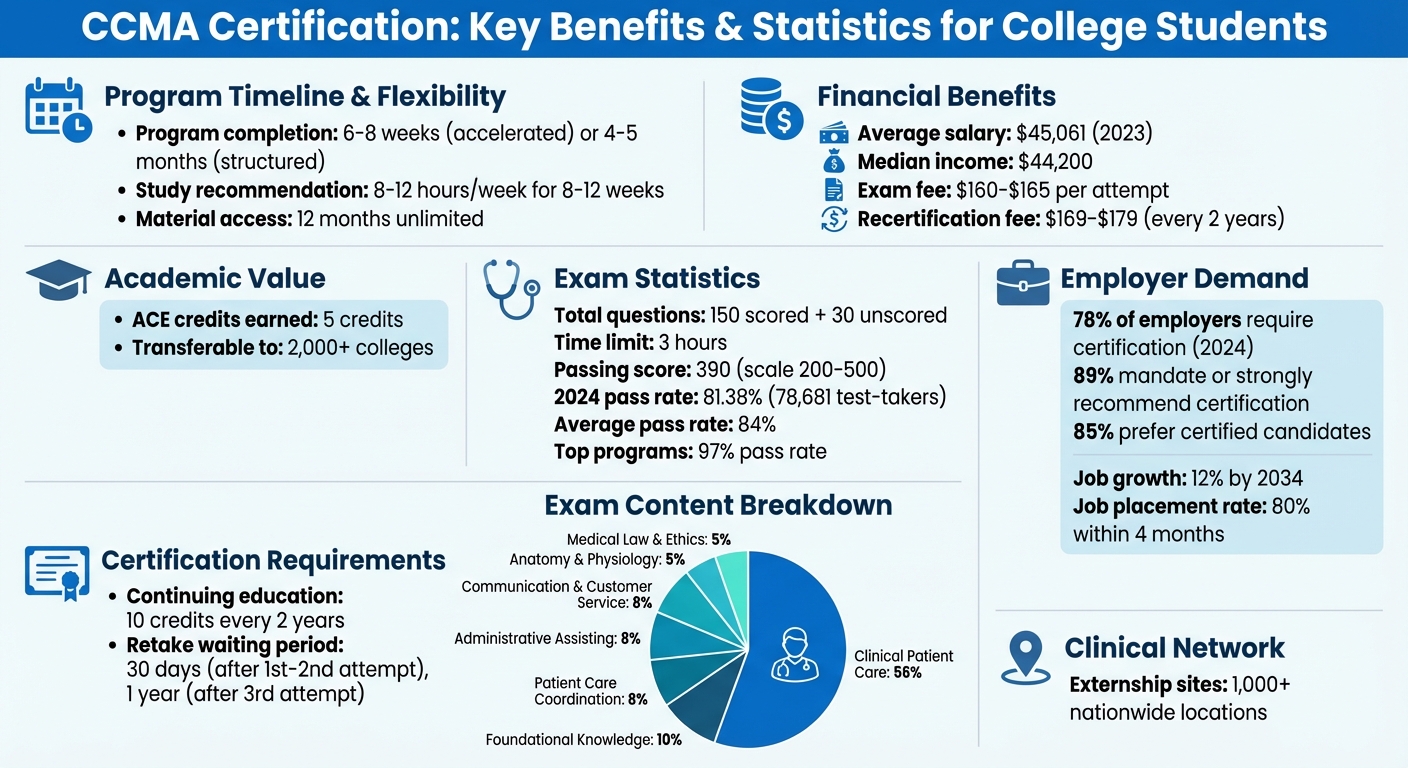
CCMA Certification Benefits and Statistics for College Students
What is CCMA Certification and Why Should Students Get It?
CCMA Certification Explained
The Certified Clinical Medical Assistant (CCMA) credential, issued by the National Healthcareer Association (NHA), is a nationally recognized certification that confirms your ability to handle both clinical and administrative responsibilities in healthcare settings like hospitals, outpatient clinics, and private practices.
The training equips you with vital clinical skills, including phlebotomy, administering injections, conducting EKG/ECG tests, taking vital signs, and processing specimens – all aligned with OSHA and HIPAA standards.
The NHA has awarded over 1 million certifications, highlighting the CCMA’s broad acceptance in the healthcare field. The exam itself consists of 150 scored multiple-choice questions and 30 unscored pretest questions, all to be completed within three hours. With an average pass rate of 84% – and top programs achieving up to 97% with adequate preparation – it’s an attainable goal for students balancing busy schedules.
These certified skills not only fulfill the needs of healthcare employers but also give students a competitive edge academically and professionally.
Why College Students Should Pursue CCMA Certification
The CCMA certification offers clear benefits, especially for college students pursuing pre-med, pre-PA, or pre-nursing tracks. It provides a fast and credible way to gain hands-on experience, which is essential for strengthening applications to graduate programs. By earning this certification while still in school, you can begin accumulating clinical experience early, setting yourself apart from peers.
Certified candidates are in high demand. According to the 2024 Industrial Outlook Survey, more than 78% of employers require certification for medical assistant roles, and 89% either mandate or strongly recommend it during hiring [[8]](https://southbend.iu.edu/professional-development/certified-clinical-medical-assistant .html). Testimonials from students echo these advantages. Darius Ross, a pre-med student, shared:
With this certification, you can land a healthcare job practically in any specialty you want. Best investment I’ve made for my future! I landed a MA job in an Internal Medicine Clinic and am finally gaining clinical experience before med school!
The financial benefits are also compelling. As of late 2023, certified medical assistants earned an average annual salary of $45,061, with a median income of about $44,200 [[8]](https://southbend.iu.edu/professional-development/certified-clinical-medical-assistant .html). Because CCMAs handle both clinical and administrative tasks, they are valued for their versatility and can work in various healthcare environments. This flexibility allows you to explore different specialties before deciding on a long-term career path [[8]](https://southbend.iu.edu/professional-development/certified-clinical-medical-assistant .html).
sbb-itb-7a67ffa
Eligibility Requirements and How to Enroll in an Online CCMA Program
Who Qualifies for CCMA Certification
To qualify for CCMA certification, you need to have a high school diploma, GED, or an equivalent credential. The National Healthcareer Association (NHA) provides two main eligibility pathways. Most students opt for the training pathway, which requires completing a medical assistant program within the last five years.
Alternatively, there’s the work experience pathway. This option is for those who have worked as a medical assistant under supervision for at least one year within the past three years, or for two years within the past five years. For individuals without prior healthcare experience, enrolling in an accredited training program is usually the best choice.
To confirm your eligibility, you can create a free NHA account. After answering a few simple questions, the platform will guide you through uploading the required documents. Keep in mind that some states may have additional requirements, so it’s important to check for any state-specific rules.
Documents and Requirements for Program Enrollment
Once you’ve determined your eligibility, you’ll need to gather and submit specific documents to enroll in a CCMA training program. Start by having a copy of your high school diploma or GED ready, as most programs will ask for this during the application process.
Since CCMA training includes clinical labs and externships, you’ll also need to meet health and safety requirements. These typically involve:
- Providing vaccination and immunization records.
- Completing drug testing.
- Passing a criminal background check.
Additionally, many programs require you to have Basic Life Support (BLS) CPR certification, which can be obtained through the American Heart Association or the American Red Cross, before beginning any hands-on clinical training.
Other potential requirements include:
- A math assessment or competency test.
- Proof of medical and liability insurance for clinical components.
- Documentation showing you are physically and emotionally prepared for the demands of the role.
Some college-based programs may also request official transcripts or ACT/SAT scores to ensure you’re academically ready for the coursework.
It’s a good idea to prepare these documents as early as possible. Delays in meeting clinical site requirements could push back your start date or externship, so being proactive can help you avoid unnecessary setbacks.
How to Select an Online CCMA Program
Program Features That Matter Most
When choosing an online CCMA program, look for one that fits into your college schedule. If you’re balancing school and work, self-paced programs with 24/7 access to materials can be a game-changer. They let you work toward your healthcare career without disrupting your academic progress.
Interactive tools can make studying more effective. Features like 3D anatomical demonstrations, digital flashcards, and practice quizzes help bring clinical concepts to life. Many leading programs offer over 1,400 practice questions and 700 self-checks to get you exam-ready. Some even ship clinical kits directly to you so you can build hands-on skills at home.
Program lengths vary depending on your availability. Accelerated courses can be finished in 6–8 weeks if you can dedicate extra time, while more structured options typically take 4–5 months with scheduled live sessions. Some programs boast national certification exam pass rates as high as 97%.
These flexible options ensure your certification journey fits smoothly with your other commitments.
Evaluating Program Format and Student Support
The way a program handles externships is just as important as its course content. Some programs offer guaranteed externship placements through large clinical networks, while others provide only a booking platform, leaving you to arrange interviews with local clinics. For busy students, guaranteed placements can save a lot of stress.
Make sure externship schedules align with your availability. Programs that require a Monday-to-Friday, 9-to-5 commitment might clash with your classes. Those offering evening or weekend options are often a better fit. Also, having access to one-on-one instructor support via Zoom or email can be a huge help when tackling tough topics. Before signing up, see how quickly the program responds to questions – that can give you a sense of the support you’ll receive.
Some programs go the extra mile by offering resume workshops, mock interviews, and job-search coaching tailored to healthcare roles. These extras can make a big difference, with certain programs reporting an 80% job placement rate within four months of graduation.
Managing CCMA Certification Alongside College Coursework
Time Management Strategies for Students
Treat your CCMA certification prep like a formal college course. Set aside regular study sessions each week and stick to them, just as you would for a core class. Consistent, daily study is far more effective than cramming, helping you retain material and stay on top of the workload.
Plan for an eight-week review schedule leading up to your exam. Divide the material into sections: spend one week on each of the seven core topics, and allocate two weeks specifically for Clinical Patient Care, as it accounts for 56% of the exam. This structured approach helps you stay organized while managing midterms and other responsibilities.
Take advantage of mobile study tools to fit learning into your daily routine. A biology graduate shared, "I was able to get certified while taking some time to travel, thanks to the course being online. I studied anywhere and everywhere". Whether it’s using digital flashcards during your commute or tackling practice questions between classes, these small efforts can add up.
Many programs offer 12 months of unlimited access to materials, giving you the flexibility to shift your study timeline if you face a heavy semester. This ensures you won’t lose access to critical resources.
Scheduling Externships Around Your Academic Calendar
Once you’ve established solid study habits, planning your externship is the next critical step. Since online coursework can typically be completed in 6 to 8 weeks, aim to finish the theory portion during the semester and schedule your clinical hours during breaks. This approach minimizes conflicts with major academic deadlines.
Reach out to the externship placement department as soon as you enroll. Many programs have placement teams that can match you with clinics based on your location and schedule. This early coordination ensures your clinical experience aligns smoothly with your academic calendar.
Programs with nationwide clinical networks, often including over 1,000 sites, make it easier to find a placement near your college or home. Choosing a program that guarantees placement can save you time and effort, letting you focus on excelling in both your coursework and certification journey.
How to Prepare for and Pass the CCMA Certification Exam
What the CCMA Exam Covers
The CCMA exam tests your knowledge in seven key areas, with Clinical Patient Care making up a hefty 56% of the scored questions. This section emphasizes practical skills like taking vital signs, conducting EKGs, and assisting with patient procedures. The remaining topics include:
- Foundational Knowledge and Basic Science (10%)
- Patient Care Coordination and Education (8%)
- Administrative Assisting (8%)
- Communication and Customer Service (8%)
- Anatomy and Physiology (5%)
- Medical Law and Ethics (5%).
The exam consists of 150 scored questions and 30 unscored ones, all of which must be completed within 3 hours. To pass, you’ll need a score of 390 on a scale of 200 to 500. In 2024, the overall pass rate was 81.38%, based on 78,681 test-takers.
Study Strategies for Exam Success
Knowing what the exam covers is just the first step – effective preparation is key. Instead of passively reading, engage in active learning techniques. Use flashcards, work through practice questions, and explain concepts aloud to solidify your understanding. Plan to study 8–12 hours per week for 8–12 weeks before test day. Since Clinical Patient Care dominates the exam, spend at least two weeks focusing solely on this section.
In the final two weeks, take full-length practice exams under timed conditions. This will help you build endurance and pinpoint areas that need attention. Aim to score at least 80% on practice tests before scheduling your official exam. For any incorrect answers, jot down the question, the correct response, and a brief explanation to boost retention by up to 300%.
The National Healthcareer Association (NHA) offers study resources, including a study guide ($69), practice tests ($49), or a bundle of both for $94. These materials can provide structured guidance as you prepare.
Exam Day Procedures and What Comes Next
When exam day arrives, you’ll need to register through the NHA website and choose between a PSI testing center or an online proctored session. The exam fee is $160 to $165 per attempt. Bring a valid government-issued photo ID, a secondary ID, and your exam admission ticket. If you’re testing in person, arrive 30 minutes early for check-in.
During the exam, manage your time wisely by spending no more than 60 seconds per question. Use the flag feature to mark tricky questions and revisit them later. Pay close attention to words like "first", "most important", or "immediately", and eliminate obviously wrong answers to narrow your choices.
For computer-based exams, results are available within two days, while written exam results may take up to two weeks. If you don’t pass, you’ll need to wait 30 days before retaking the test. After three failed attempts, a one-year waiting period applies.
Once certified, you must complete 10 continuing education credits every two years to maintain your credential, along with a recertification fee of $169 to $179.
CCMA Certification – Everything You Need To Know
Conclusion
Earning your CCMA certification online while still in college gives you a head start in the healthcare field. With guaranteed externships, you’ll gain hands-on patient care experience while building clinical skills that are essential for success. Plus, the program offers 5 ACE credits that can transfer to over 2,000 colleges. In as little as 8 weeks, you can complete the training and fit it seamlessly into your academic schedule.
The online format offers flexibility, allowing you to study during breaks, adjust your pace during busy times like finals, and complete your externship when it works best for you. Many students praise the convenience and career benefits of these programs, making them a popular choice for those balancing school and future career goals.
HealthCareer Certs provides self-paced training with personalized instructor support, interactive 3D demos, and up to $2,000 in externship scholarships to make the process more accessible. There are no waitlists or rigid schedules, so you can start right away.
With medical assistant roles expected to grow by 12% by 2034, earning your CCMA certification now positions you for success in a rapidly expanding field. Thousands of students have used this credential as a stepping stone to fulfilling healthcare careers. Whether you’re aiming for graduate programs or professional roles, this certification provides the clinical expertise and credentials to help you stand out. Begin your certification journey today and take the next step toward achieving your healthcare goals.
FAQs
Will CCMA hours count for clinical experience on med, PA, or nursing applications?
Yes, hours worked as a Certified Clinical Medical Assistant (CCMA) can count as clinical experience for medical, physician assistant (PA), or nursing school applications. Many online CCMA programs provide training in clinical skills alongside hands-on experience. Some even include externships or clinical hours, which can enhance your application by showcasing your practical involvement in healthcare settings.
How do I fit an externship around my college class schedule?
To make room for an externship in your college schedule, planning is everything. Start by submitting any necessary documents – like immunization records or background checks – as early as possible. Don’t forget to sort out your transportation ahead of time to avoid last-minute stress.
Once that’s handled, connect with your externship supervisor to work out a schedule that fits around your classes. Be upfront about your availability and explore options like part-time or flexible shifts if needed. Ideally, begin organizing everything at least two weeks before your externship starts to ensure your commitments don’t clash.
And remember: punctuality and professionalism aren’t just appreciated – they’re expected. These small habits can leave a lasting impression during your externship.
What should I do if my state has extra requirements for medical assistants?
If your state imposes specific requirements for medical assistants, your first step should be reviewing the regulations set by your state’s health department or licensing board. These requirements might include completing additional coursework, obtaining state-specific licenses, undergoing background checks, or logging extra clinical hours. Make sure the training program you choose aligns with these regulations. If you’re unsure about any details, reach out to your state’s licensing authority or your certification provider for guidance.