Earning your CCMA certification as a college student can boost your career in healthcare by making you more competitive in the job market. Employers prefer certified candidates, with 85% more likely to interview those with nationally recognized credentials. Certification also qualifies you for tasks like entering medical orders into CPOE systems and helps build clinical experience for advanced healthcare roles.
Here’s a quick breakdown of how to achieve your CCMA certification:
- Eligibility: You need to be 18+, have a high school diploma or GED, and complete a medical assistant program or have recent supervised work experience.
- Program Options: Choose from online, hybrid, or in-person programs based on your schedule. Online options offer flexibility, while hybrid and in-person programs include hands-on training.
- Skills Covered: Training includes clinical skills like phlebotomy, EKGs, and medication administration, as well as administrative tasks like managing EHRs and patient scheduling.
- Exam Prep: Study for 8–12 weeks using official guides, practice tests, and active recall techniques. The exam costs $165, and a passing score is 390 out of 500.
- Externship: Complete 40–100 clinical hours, ideally during academic breaks, to gain hands-on experience.
Certification can be completed in as little as 8 weeks and provides access to better job opportunities, with medical assistant roles projected to grow by 12% through 2034. Start today by choosing a program that fits your schedule and career goals.
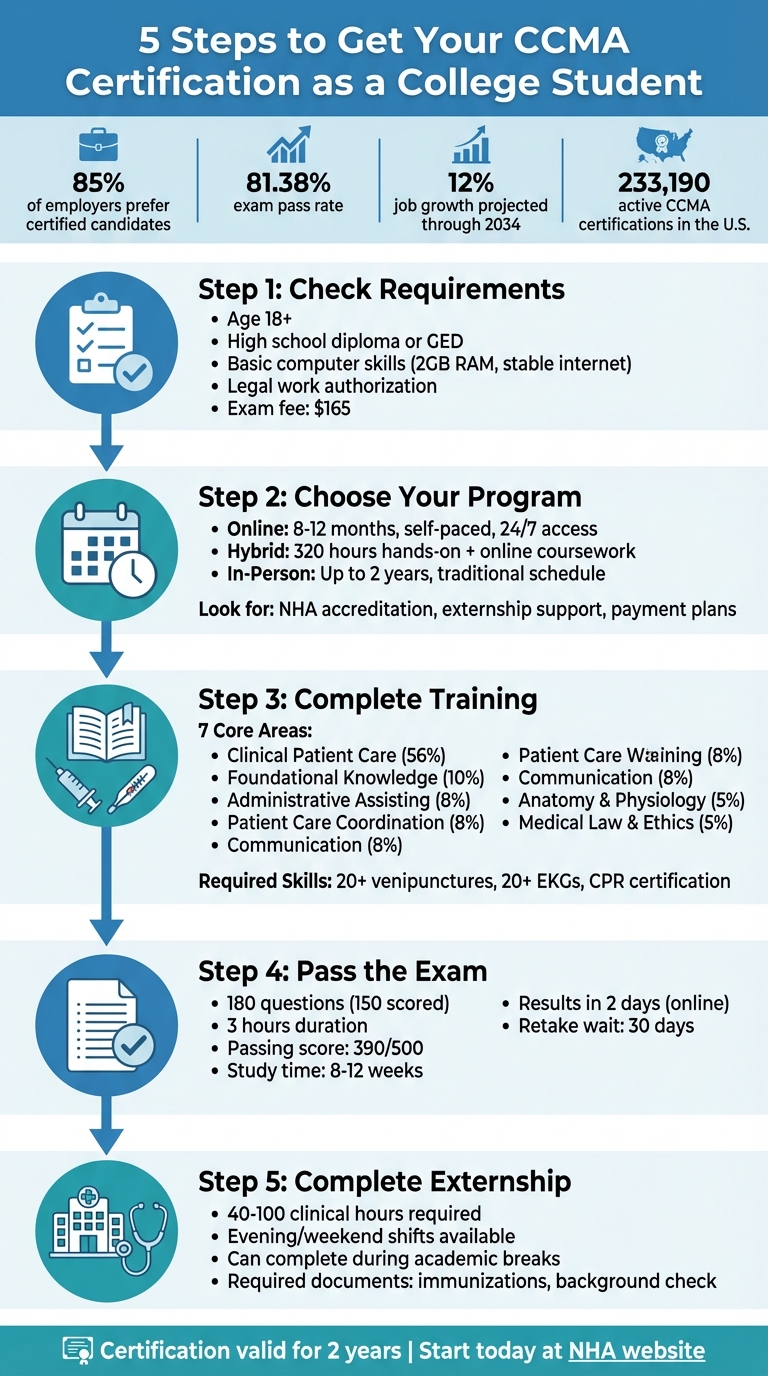
5 Steps to Get CCMA Certification as a College Student
How to Become a Medical Assistant in College
sbb-itb-7a67ffa
Step 1: Check If You Meet the Requirements
Before enrolling in a CCMA training program, make sure you meet the basic eligibility criteria. Most programs require you to be at least 18 years old, possess a high school diploma or GED, and have legal authorization to work in the United States. Additionally, basic computer skills are essential, especially for managing online courses and working with Electronic Health Records (EHR) systems .
Basic Requirements for CCMA Programs
To enroll in a CCMA program, you’ll need a high school diploma or equivalent. Many programs may ask for your official transcripts during the application process. If the program is offered online or in a hybrid format, ensure you have access to a reliable computer with at least 2 GB of RAM and a stable internet connection .
If you plan to take the NHA CCMA exam after completing your training, you must meet specific conditions. These include completing an accredited medical assistant program within the last five years . Alternatively, if you’ve accumulated one year of supervised work experience in the field within the past three years, you may qualify without additional training . The exam fee is $165, with retakes costing $160.
Once you’ve confirmed these requirements, it’s time to evaluate whether you possess the physical and technical skills needed for the role.
Physical and Technical Skills You’ll Need
Being a clinical medical assistant requires both physical endurance and technical expertise. You’ll need the stamina to stand for long periods and assist patients with mobility. Additionally, you’ll perform precise procedures like venipuncture (drawing blood) and administering injections . Most programs require you to complete at least 20 successful venipunctures and 20 EKG monitorings during training.
On the technical side, you’ll develop skills for both clinical and administrative tasks. Clinical training includes taking vital signs, performing EKGs, providing wound care, and administering medications . On the administrative side, you’ll learn how to update Electronic Health Records, manage billing, schedule appointments, and handle patient intake . Many programs also require you to obtain Basic Life Support (BLS) CPR certification through the American Heart Association.
Finally, you’ll need to follow strict health and safety protocols, especially during in-person clinical training sessions .
Step 2: Pick a CCMA Program That Works with Your College Schedule
Once you’ve confirmed your eligibility, the next step is finding a CCMA program that fits seamlessly into your college routine. The key is to choose a format that aligns with both your learning preferences and your schedule. Let’s explore the options and what to consider when making your decision.
Online, Hybrid, and In-Person Program Options
Online programs are the most flexible option, giving you 24/7 access to course materials on your phone, tablet, or laptop. These programs are typically self-paced and can be completed in 8 to 12 months. For example, HealthCareer Certs offers a fully online CCMA program featuring self-paced modules, one-on-one Zoom sessions with instructors, and interactive tools like 3D demos and flashcards. This setup is ideal for college students juggling academic and certification training.
Hybrid programs combine online coursework with in-person clinical training. These programs usually include around 320 hours of hands-on skills practice, such as venipuncture and EKG monitoring. However, the fixed schedule for lab sessions can be tricky to coordinate with your college classes.
In-person programs, often offered by community colleges or universities, follow a traditional academic calendar and can take up to two years to complete. While these programs provide face-to-face learning, they tend to be the least flexible for students already managing a full college course load.
What to Look for When Choosing a Program
After deciding on a format, make sure the program checks off a few essential boxes. First, confirm that it includes all necessary fees. For instance, the NHA CCMA exam costs $165, and some programs include this fee in their tuition, saving you from unexpected expenses.
If cost is a concern, look for programs offering interest-free monthly payment plans. These plans can help you spread out the cost over time, making it easier to budget.
Another important factor is externship placement support. Programs with strong clinical partnerships can help you secure a placement near your college campus without added stress. HealthCareer Certs, for example, guarantees externship placements, ensuring you won’t need to find a site on your own.
Accreditation is crucial too. Make sure the program is accredited by the National Healthcareer Association (NHA) or a similar recognized body. This ensures your certification will be valid nationwide.
Finally, consider programs with flexible enrollment options. Some allow you to start anytime, while others offer multiple start dates throughout the year. If you prefer hands-on learning, look for online programs that send medical practice kits to your home. These kits let you develop skills like venipuncture and injections without needing to commute to a lab.
Step 3: Learn What the CCMA Program Covers
Once you’ve chosen a program that fits your schedule, the next step is to dive into the curriculum. Understanding what the program covers will help you focus your study efforts and manage your time effectively. CCMA programs are designed to prepare you with both the theoretical knowledge and hands-on skills needed to excel in the field. Here’s a breakdown of what to expect.
Main Topics in CCMA Training
The CCMA curriculum is divided into seven core areas, each weighted differently for the certification exam:
- Clinical Patient Care (56%): This is the largest section, focusing on tasks like taking vital signs, patient intake, and assisting with physical exams.
- Foundational Knowledge and Basic Science (10%): Covers healthcare systems, medical terminology, pharmacology, nutrition, and psychology.
- Anatomy and Physiology (5%): Focuses on body structures, organ systems, pathophysiology, and microbiology.
- Administrative Assisting (8%): Includes patient scheduling, electronic health record documentation, and medical coding with ICD-10 and CPT.
- Patient Care Coordination and Education (8%): Prepares you to guide patients through transitions in care and provide clear instructions.
- Communication and Customer Service (8%): Emphasizes professional interactions and sensitivity to diverse backgrounds.
- Medical Law and Ethics (5%): Focuses on HIPAA, OSHA regulations, scope of practice, and informed consent.
Passing the CCMA exam requires a scaled score of 390 out of 500, with a passing rate of 81.38% as of 2024. These topics lay the groundwork for the practical skills you’ll need on the job, which are covered in detail during training.
Hands-On Skills You Must Master
Practical skills are just as important as theoretical knowledge. CCMA programs emphasize hands-on training to ensure you’re job-ready. Here’s what you’ll learn:
- Phlebotomy: Master venipuncture techniques, the correct order of draw, and specimen handling. Some programs require completing 35 live blood draws to demonstrate competency.
- EKG and Cardiovascular Testing: Learn accurate lead placement and how to monitor heart rhythms effectively.
- Medication Administration: Practice dosage calculations and various injection methods, including intramuscular, subcutaneous, and intradermal techniques.
- Infection Control: Develop aseptic techniques and proper use of personal protective equipment (PPE).
- Laboratory Procedures: Gain skills in point-of-care testing, quality control, and handling lab equipment.
- Emergency Response: Train in CPR, AED usage, and choking rescue techniques.
Some online programs, like HealthCareer Certs, even provide clinical kits so you can practice skills like venipuncture, injections, and wound care from home. This combination of theory and practice ensures you’re fully prepared for both the exam and real-world scenarios.
Step 4: Prepare for and Pass the Certification Exam
Once you’ve built a solid foundation of both theoretical knowledge and hands-on skills, it’s time to focus on passing the certification exam. With a 2024 pass rate of 81.38%, preparation is key to succeeding on your first attempt.
How to Register for the Certification Exam
To register, first ensure you meet the eligibility requirements. You must have completed an accredited CCMA training program within the last five years. Alternatively, high school students in a health science program who are set to graduate within 12 months may also qualify. A high school diploma or GED is a mandatory requirement.
Head to the NHA website to complete your application and pay the exam fee, which ranges from $155 to $165. Choose your preferred testing method: on campus, at a PSI center, or through live remote proctoring. The exam itself consists of 180 questions (150 scored and 30 unscored) and lasts three hours. To pass, you’ll need a scaled score of 390 out of 500. If you take the test online, results are typically available in your NHA account within two days.
If you don’t pass, you’ll need to wait 30 days to retake the exam. After three failed attempts, there’s a mandatory one-year waiting period before you can try again.
Study Materials and Practice Resources
A strong study plan is essential for success. Start by downloading the free NHA CCMA Test Plan, which outlines the exam’s content. Keep in mind that Clinical Patient Care makes up 56% of the exam, so prioritize this area. Plan to study for 1–3 months before your test date.
The NHA provides official study resources, such as a $69 study guide and $49 practice tests. You can also purchase both as a bundle for $94. These materials are designed to reflect the actual exam format and can help you pinpoint areas where you need improvement. If you’re looking for free options, Open Exam Prep offers practice questions and an 8-week study timeline, perfect for those juggling work or school commitments. Additionally, Exam Edge provides 20 practice test versions with 100 questions each, available in both timed and untimed formats.
Spend 65–70% of your study time on the highest-weighted sections, like Clinical Patient Care and Phlebotomy/EKG. Use active recall techniques: take practice tests, review the questions you miss, and write a one-sentence explanation for each error. This method can improve memory retention by up to 300%. Simulate real exam conditions by practicing with timed tests to get comfortable with the one-minute-per-question pace.
"Practice testing requires free recall of facts in the same way you’ll need to think on the actual exam day. By making an effort to pull information from your memory, your brain learns to retrieve details more quickly." – Exam Edge
Before scheduling your exam, aim to consistently score at least 80% on practice tests. And don’t underestimate the power of rest – get 7–8 hours of sleep the night before your test to ensure you’re at your best.
Step 5: Manage Certification Training with College Classes
Treat your CCMA training like a regular three-credit college course to keep everything manageable and avoid overloading yourself.
Time Management Strategies for Students
Short, daily study sessions – about 60 minutes each – are far more effective than cramming for hours on end. This is especially true if you’re juggling college classes, part-time work, or other responsibilities.
Plan your week by assigning specific CCMA topics to specific days. For instance:
- Mondays: Focus on medical terminology and anatomy with tools like flashcards and diagrams for 1.5 hours.
- Tuesdays: Dive into clinical skills like vitals and EKGs using video tutorials for 2 hours.
This kind of structured weekly schedule eliminates the guesswork, so you’ll always know what to tackle next.
When your schedule gets tight, the Pomodoro Technique can help. Work in 25-minute bursts with 5-minute breaks to stay sharp and avoid burnout. It’s a great way to squeeze in study sessions between classes or during downtime on campus.
Take advantage of micro-learning opportunities, too. For example:
- Review flashcards during your commute.
- Listen to audio lessons between classes.
- Quiz yourself in short gaps between lectures.
Start prepping 8–12 weeks before your exam, aiming for 8–12 hours of focused study each week. If you’re balancing a job or externship, use shorter study blocks during weekdays and reserve longer sessions for weekends. To keep yourself refreshed, plan at least one "light" day per week for easy review or complete rest.
Beyond planning your study time, explore the resources your college offers to help you succeed.
Using College Resources to Help You Succeed
Your college campus is full of tools to support your CCMA prep – you just need to tap into them. Study groups or study partners can be game changers. They let you exchange knowledge, quiz each other on tough topics, and keep each other motivated.
Don’t overlook instructor office hours. These are perfect for getting quick answers and one-on-one guidance without waiting until exam week.
Another smart move? Connect with peers who’ve already passed the CCMA exam. They can share tips about what to focus on and what they wish they had done differently. Their advice can save you from common mistakes and help you prioritize.
If you’re in a healthcare-related program, talk to your academic advisor. They might explain how earning a CCMA certification could count as college credit if you decide to pursue further medical studies.
And while you’re managing study sessions, don’t forget to plan for your clinical externship.
Completing Your Externship While in College
Finding a flexible externship schedule is key to balancing certification training with your academic workload. Externships usually require 40 to 100 total hours, which can feel overwhelming during a busy semester. Luckily, many clinics offer evening or weekend shifts, so you can fit your externship around your classes.
You can also spread your hours out – say, 15 hours a week over two months. This way, you’ll gain valuable hands-on experience without overloading your schedule.
Plan around academic breaks. Completing your 90–100 externship hours during summer or winter breaks lets you focus entirely on clinical training without worrying about exams. Start coordinating your externship midway through your CCMA training program to ensure everything is lined up when you’re ready.
"The program was designed with flexibility in mind, which allowed me to balance my busy school schedule while still preparing thoroughly for the exam." – Samiyra A., Certified Medical Assistant
Before starting, make sure you have all required paperwork ready – like immunization records (TB, Flu, COVID) and background checks – to avoid delays. If your semester becomes too hectic, some programs let you take a "Leave of Absence" for 30–180 days without losing your progress.
Conclusion
Earning your CCMA certification as a college student is entirely possible when approached step by step. Start by confirming your eligibility and choosing a training program that aligns with your schedule. Many online programs offer accelerated options, making it easier for busy students to complete training efficiently. Once your training is done, head to the National Healthcareer Association website to register for the exam.
Taking these steps allows you to fit certification into your college routine without overwhelming your schedule. And the effort pays off. As of December 31, 2024, there are 233,190 active CCMA certifications in the U.S., and the demand for medical assistants is projected to grow by 12% through 2034. Plus, 85% of allied health employers prefer candidates with nationally recognized certifications.
"Certification may not always be required to start a career as a Medical Assistant, but it can mean the difference between good work opportunities and great work opportunities." – Alyssa Jordan, Provo College
The CCMA exam has a pass rate of 81.38%, and with a focused study plan over 8 to 12 weeks, you’ll be set up for success. Once certified, your credential is valid for two years, requiring only minimal continuing education and a recertification fee to maintain.
So, why wait? Create your NHA account today and map out your study schedule. The sooner you start, the sooner you’ll qualify for clinical roles requiring certification – like entering medication, lab, and radiology orders into computerized provider order entry (CPOE) systems, a task exclusively for credentialed medical assistants.
FAQs
Can I get CCMA certified before I turn 18?
Yes, it’s possible to earn your CCMA certification before turning 18, as long as you meet the basic requirements. These typically include having a high school diploma or GED and completing a medical assistant training program. While certain programs might have age restrictions, most prioritize your training and clinical experience. Be sure to check with your certifying organization or training provider to see if any specific age-related rules apply.
Will my CCMA certification expire while I’m still in college?
The CCMA certification remains valid for two years. To ensure it stays active while you’re in college, make sure to renew it before the expiration date. Keeping up with renewal requirements is key to maintaining your certification without any interruptions.
How do I find an externship near my campus?
Finding an externship near your campus for CCMA certification can feel like a big task, but there are several steps you can take to make it easier. First, check if your training program already includes a supervised externship as part of its curriculum – this is often the simplest route.
Next, take advantage of externship checklists provided by certifying organizations. These can help you gather the necessary documentation and ensure you’re prepared to apply. It’s a good idea to start the process early to secure your spot.
You should also reach out to your college’s career services or health sciences department. These departments often have connections with local clinics or hospitals and can guide you toward healthcare partnerships that are close to campus. Many colleges already have established relationships with healthcare facilities, making it easier for students to find placements nearby.