
Preparing for the 2026 CCMA exam? Here’s what you need to know:
- The Exam: 180 questions (150 scored, 30 unscored), 3-hour time limit, passing score is 390/500 (78% correct).
- Key Focus Areas: Clinical Patient Care (56% of the test), Phlebotomy (16%), EKG (16%). Prioritize practical skills like vital signs, the phlebotomy order of draw, and EKG placement.
- Changes in 2026: The updated "CCMA 3.0" exam emphasizes clinical scenarios and tasks over memorization.
- Eligibility: High school diploma/GED plus medical assistant training or recent supervised work experience.
- Cost: $165 for the exam, $160 for retakes.
- Job Outlook: Medical assistant roles are growing by 12.5% through 2034, with a median annual salary of $44,200.
To prepare effectively, focus on practice exams, active recall methods, and a structured study plan. Certification can lead to better job opportunities and higher pay. Ready to take the next step? Start studying today!
CCMA Practice Test 2026 NHA (NEW) Updated Medical Assistant 50 Questions and Answers
sbb-itb-7a67ffa
CCMA Exam Format and Content
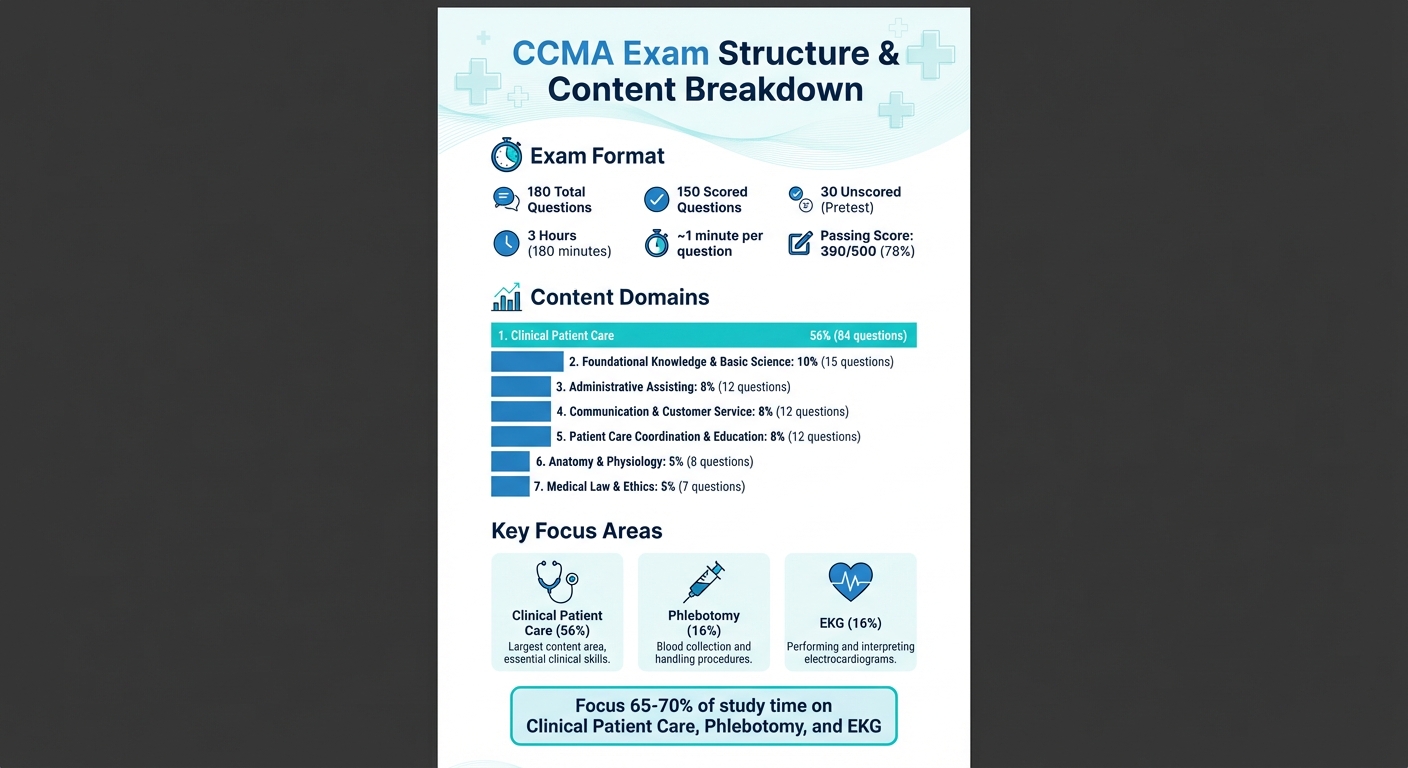
CCMA Exam Structure and Content Distribution 2026
Exam Structure and Time Limit
The CCMA exam is a computer-based test with 180 multiple-choice questions to be answered in 3 hours (180 minutes). This gives you roughly one minute per question, so managing your time is crucial. Out of the 180 questions, 150 are scored and will determine your final result, while 30 are unscored "pretest" items used to evaluate potential future questions. Since you won’t know which questions are unscored, treat every question as if it counts.
You can take the exam at authorized PSI testing centers, NHA-affiliated schools, or even at home through Live Remote Proctoring (LRP) if you have a compatible computer and webcam. Planning to test remotely? Make sure to run a system compatibility check at least 24 hours before your exam to avoid last-minute technical problems.
Now that you know the exam’s format, let’s dive into how the content is organized so you can prioritize your studies effectively.
Content Domains and Topic Breakdown
The exam is divided into seven content domains, with Clinical Patient Care taking up the largest share at 56% of the scored questions (84 out of 150). This section covers essential topics like vital signs, infection control, specimen collection, pharmacology, and clinical procedures. Naturally, this should be the main focus of your preparation.
The remaining domains are smaller but still important:
- Foundational Knowledge & Basic Science: 10% (15 questions), focusing on medical terminology, measurement conversions, and general concepts.
- Administrative Assisting: 8% (12 questions), covering scheduling, insurance verification, and medical records.
- Communication & Customer Service: 8% (12 questions), emphasizing patient interaction and professionalism.
- Patient Care Coordination & Education: 8% (12 questions), testing your ability to educate patients and manage referrals.
- Anatomy & Physiology: 5% (8 questions), focusing on body systems and their functions.
- Medical Law & Ethics: 5% (7 questions), addressing topics like HIPAA, informed consent, and scope of practice.
Since Clinical Patient Care makes up more than half the exam, dedicate most of your study time to mastering clinical skills, safety protocols, and practical procedures.
Question Types on the Exam
The CCMA exam uses multiple-choice questions exclusively, but they come in different formats designed to test both your knowledge and practical reasoning. Here’s a breakdown:
- Standard multiple-choice questions: Focus on definitions, procedures, and regulations.
- Scenario-based questions: Present real-life situations where you’ll need to choose the safest and most compliant action.
- Procedure sequencing questions: Test your ability to determine the correct order of steps for tasks like patient intake, phlebotomy, or EKG placement.
"The exam often rewards the safest immediate action over the most complete action. When two answer choices seem right, choose the option that prioritizes immediate safety and compliance." – Open Exam Prep
You’ll also see multi-step reasoning questions that require analyzing data, such as abnormal vital signs or EKG results, to decide the proper clinical response. The exam emphasizes practical application, so it’s not just about knowing what to do, but also when and why to do it. Always stay within the medical assistant’s scope of practice – avoid answers that involve diagnosing, prescribing, or making independent treatment decisions.
Study Strategies for the CCMA Exam
To ace the updated CCMA 3.0 exam and earn your certification in 2026, having a solid study plan is essential. Here’s how to prepare effectively.
Building a 6-Week Study Plan
Start your preparation with a diagnostic test during Week 1. This helps pinpoint your weaker areas and allows you to create a customized study tracker. Follow a structured "Learn-Apply-Analyze-Retain" cycle:
- 30 minutes learning new material
- 40 minutes practicing questions
- 20 minutes analyzing mistakes
- 10 minutes rapid recall of key facts
Focus 65–70% of your study time on Clinical Patient Care, Phlebotomy, and EKG, as they dominate the exam. Dedicate Week 2 to mastering Clinical Patient Care essentials, like vital signs, sterile techniques, and administering injections. Shift to Phlebotomy and EKG in Week 3, concentrating on sequencing, specimen handling, and error prevention. Week 4 should cover Administrative and Communication topics, while Week 5 tackles Compliance, Safety, Law, and Ethics. Use Week 6 for a comprehensive review and complete two full-length timed simulations.
Don’t schedule your official exam until your practice test scores consistently hit 80% or higher. This ensures you’re ready for the real challenge.
Incorporate timed practice exams regularly throughout your plan to sharpen test-taking skills and build confidence.
Using Practice Exams and Study Tools
Practice exams are your best resource for identifying weaknesses and improving endurance for the 3-hour test. Take them under timed conditions – research from the Journal of Medical Education shows that candidates who practice under timed constraints perform 23% better on certification exams.
Analyze every error after a practice test. Use a "Green/Yellow/Red" system to track your confidence in different areas, and turn "Red" (weak) sections into focused study sessions for the next week.
For high-memorization topics, like medical prefixes and suffixes, injection angles (e.g., 10–15 degrees for intradermal), normal vital sign ranges, and the phlebotomy order of draw, flashcards are incredibly effective. Digital tools that allow you to tag and revisit difficult questions can accelerate your progress from "unknown" to "mastered."
Pair these tools with active recall techniques to reinforce your learning.
Memory Retention Techniques
One of the most effective ways to retain information is rewriting missed questions. For every incorrect answer, write down the question, the correct answer, and a brief explanation of why it’s correct. This method strengthens recall and helps you understand question patterns. Keep a "repeat mistakes" sheet and review it daily, focusing on why the right answers are correct and why the wrong ones aren’t.
"Rewriting missed questions… boosts recall by 300% and trains your brain on the question patterns." – Clinical Skills Institute
Gradually increase your study sessions from 60 minutes to 2 hours to build the stamina needed for the 3-hour exam. Avoid cramming in the final 24 hours. Instead, stick to light review of safety protocols and legal/ethical concepts, and aim for 7–8 hours of sleep to ensure you’re mentally sharp on test day.
CCMA Exam Prep Resources
Having the right tools and materials can make all the difference when preparing for your CCMA exam. HealthCareer Certs offers a range of resources designed to fit seamlessly into your study plan.
HealthCareer Certs CCMA Certification Program
The Certified Clinical Medical Assistant (CCMA) course costs $2,700 and offers extensive preparation for the exam. With access to over 1,400 practice questions and 700 self-checks that mirror the NHA exam format, you’ll be well-equipped to tackle the test. The program is self-paced, giving you 12 months of unlimited access to its resources.
Students can also benefit from one-on-one Zoom sessions with instructors, where challenging topics like the phlebotomy order of draw or EKG interpretation are broken down in detail. As one student, Brianna M., shared:
"HealthCareer Certs was overall 10 out of 10, instructors were so kind and willing to answer any questions throughout the course." – Brianna M.
The program includes a venipuncture and injection practice kit sent directly to your home. Combined with virtual simulations, this kit allows you to practice essential techniques until you’re confident in your abilities. Successfully completing the CCMA exam also earns you 5 American Council on Education (ACE) credits, which are accepted by over 2,000 colleges and universities.
HealthCareer Certs boasts a 5/5-star rating on Google, supported by feedback from over 5,000 students. One graduate, Olivia, shared her experience:
"I was able to get certified and pass the NHA exam on the first try in only 6 weeks, and I appreciated the ease of the entire process." – Olivia
Interactive Learning Tools
Engagement is key to effective learning, and this program delivers with its interactive features. You’ll find 3D animated demonstrations that visually explain complex procedures like sterile techniques and medication administration. Other tools include interactive flashcards, practice quizzes with instant feedback, and a mobile-friendly portal for studying on the go.
To help you stay on track, the platform includes progress tracking, which highlights your strengths and areas needing improvement. This feature ensures you’re always aware of where to focus your efforts.
Externship Placement and Support
Hands-on experience is essential for reinforcing what you’ve learned, and HealthCareer Certs guarantees externship placement for all qualified students at hospitals or clinics across the country. This real-world application is especially valuable for mastering the Clinical Patient Care domain, which accounts for 56% of the exam.
The externship department handles all placement logistics, and you can reach them at externship@healthcareercerts.org with any questions about local opportunities. While these externships are unpaid, they include a scholarship of up to $2,000.
During your externship, you’ll apply skills like proper injection techniques and patient positioning in clinical settings. This hands-on practice ensures you’re fully prepared for both the exam and your future career. The externship is included in the tuition, so there are no extra fees.
Test-Day Tips and Managing Anxiety
You’ve put in the effort, practiced diligently, and reviewed thoroughly. Now it’s time to make sure you’re mentally and physically prepared to perform at your best.
Managing Your Time During the Exam
The CCMA exam includes 180 questions, with a 3-hour time limit – giving you roughly one minute per question. Most candidates finish in about 2 to 2.5 hours, leaving 30–60 minutes to review their answers. The key is to maintain a steady pace.
Try a three-phase approach to keep your timing on track. In Phase 1 (questions 1–60), focus on building momentum by answering the questions you’re confident about quickly. During Phase 2 (questions 61–120), carefully read each question twice, flagging the ones you’re unsure of. Use process of elimination to narrow down your choices, make your best guess, and move on. In Phase 3 (questions 121–180), keep up your pace and aim to leave the last 15–20 minutes for reviewing flagged questions.
Pay attention to keywords like "first", "most important", or "immediately", as these often highlight the correct clinical sequence. When two answers seem plausible, choose the one that prioritizes patient safety or compliance with policies. Remember, there’s no penalty for guessing, so make sure every question is answered before time runs out.
Once you’ve got your time management plan down, it’s important to address stress and stay calm under pressure.
Reducing Test-Day Stress
Anxiety can interfere with your ability to think clearly, as cognitive scientist Sian Beilock from the University of Chicago explains:
"When students are anxious, their worries use up some of their working memory, leaving fewer cognitive resources to devote to the test."
To keep stress in check, start with the basics. Get 7–8 hours of sleep the night before, and fuel up with a healthy meal that includes brain-friendly foods like avocado, which is rich in potassium and B vitamins. A brisk five-minute walk can also help reduce anxiety.
If you feel overwhelmed during the exam, try three minutes of abdominal breathing: inhale deeply through your nose, letting your belly expand, and then exhale slowly through your mouth. Another simple technique is the 3-3-3 rule – identify three things you can see, three sounds you can hear, and move three parts of your body (like rolling your shoulders or wiggling your fingers). Writing in a journal for 10 minutes before the test can also help clear your mind.
Arrive at the testing center or log in for remote proctoring at least 30 minutes early to handle check-in without feeling rushed. For remote exams, double-check that your testing space is distraction-free and that you’ve completed the system check at least 24 hours beforehand.
With your stress under control, you can focus on reviewing key topics in the hours leading up to the exam.
Last-Minute Review Topics
In the final 24 hours, avoid heavy cramming. Instead, lightly review high-priority topics that are likely to appear on the test. These include:
- Normal ranges for vital signs (blood pressure, pulse, respiration, glucose levels)
- Infection control protocols in line with OSHA and CLIA standards
- EKG lead placement (remember, the right leg is the ground lead)
- The correct phlebotomy order of draw, including additives like Lavender/EDTA for CBC tests
Refresh your memory on injection angles: 90° for intramuscular, 45° for subcutaneous, and 10–15° for intradermal. Since Clinical Patient Care makes up about 55% of the exam, focusing on these practical skills is crucial.
On exam morning, consider doing 10–15 practice questions to warm up your brain, but save your energy for the test itself. Stay hydrated, trust in the work you’ve done, and remember – you’re ready for this.
Conclusion and Next Steps
This roadmap equips you to confidently prepare for the CCMA exam in 2026. The exam includes 180 multiple-choice questions, completed within 3 hours, with a required scaled score of 390 (roughly 78% accuracy). The 2024 pass rate of 81.38% highlights the importance of focused preparation.
Key Takeaways
Your primary focus should be on Clinical Patient Care, which accounts for 55–56% of the total exam score. Key areas to master include vital signs, EKG lead placement, the correct phlebotomy order of draw, and infection control protocols. Before scheduling your test, aim to consistently score at least 80% on practice exams.
To enhance retention, use active recall methods like rewriting missed practice questions with concise explanations – this approach can improve memory by up to 300%. Plan a realistic study schedule spanning 1–3 months, dedicating 3–4 hours daily to avoid burnout. On test day, pace yourself at about one minute per question, flag uncertain answers, and trust your preparation.
Ready to take the next step? Let HealthCareer Certs guide you toward success.
How HealthCareer Certs Can Help You Succeed
HealthCareer Certs offers a 100% online CCMA certification program for $810. This includes the $165 NHA exam fee and six practice exams worth $50. With 12 months of access to self-paced materials, you can complete the program in just 8–12 weeks. Pairing this structured program with a solid study timeline ensures you’re on track for success.
The program also provides externship placement assistance and post-certification job support to help you transition into your career quickly. In 2024, Medical Assistants earned a median annual salary of $44,200 ($21.25/hour), with an estimated 112,300 job openings projected annually through 2034. As of December 31, 2024, there were over 233,190 active CCMA certifications.
Get started by creating your NHA account, taking a diagnostic practice test, and committing to a structured study plan. Your journey to certification and career growth begins here!
FAQs
What’s new on the CCMA 3.0 exam in 2026?
The 2026 CCMA 3.0 exam comes with some important changes designed to align with the shifting demands of healthcare roles. This updated test plan includes new content and revised study materials to reflect the latest industry practices.
The exam is now organized into seven domains, covering key areas such as:
- Foundational Knowledge: Core principles every healthcare professional should know.
- Clinical Patient Care: Hands-on skills and techniques for patient interaction.
- Administrative Tasks: Essential office and organizational responsibilities.
These updates are intended to ensure candidates are fully equipped to meet the expectations of modern healthcare settings.
How should I split my study time across CCMA topics?
To make the most of your study time, align your focus with the CCMA exam’s domain weightings and your confidence in each subject. The Clinical Patient Care section carries the most weight (around 56%), followed by Administrative Assisting (13%). Devote the majority of your time – about 50-60% – to Clinical Patient Care, especially if you feel less confident in this area. Allocate 15-20% to Administrative Assisting and divide the remaining time among smaller sections like Phlebotomy and EKG. Tailor these percentages based on your strengths and weaknesses.
What should I do if I’m not scoring 80% on practice tests yet?
If your score isn’t hitting 80% yet, it’s time to zero in on your weaker areas and practice consistently. Start by taking full-length, timed practice exams to pinpoint where you’re struggling. Dive into the explanations for any incorrect answers and revisit those topics to strengthen your understanding.
Build a study schedule that prioritizes these challenging subjects. Use study guides and targeted practice questions to boost your confidence and fill in knowledge gaps. Remember, steady practice and regular review are the building blocks to improving your performance and hitting your target score.