Preparing for the 2026 CCMA exam? Here’s everything you need to know to succeed without spending a dime. The Certified Clinical Medical Assistant (CCMA) certification, offered by the National Healthcareer Association (NHA), tests your skills in clinical and administrative tasks like taking vital signs, administering injections, performing EKGs, and managing medical records. Passing requires a scaled score of 390 out of 500 (about 78% correct) on a 180-question, computer-based exam.
Key Takeaways:
- Exam Breakdown: 56% of the questions focus on Clinical Patient Care. Other domains include Anatomy, Ethics, and Administrative Assisting.
- Free Resources: NHA offers a test plan, YouTube videos, and a mobile app. Third-party platforms like Mometrix, Smarter MA, and Union Test Prep provide practice questions and study guides.
- Study Tools: Use video tutorials, flashcards, and mobile apps to focus on high-weight areas like phlebotomy, EKGs, and injection techniques.
- Exam Details: Costs $155–$165; results are posted within two business days. If you fail, you must wait 30 days to retest.
Start with free NHA resources and supplement with practice tests and video guides. A consistent study plan (1–3 months) focusing on Clinical Patient Care will set you up for success.
CCMA Practice Test 2026 NHA (NEW) Updated Medical Assistant 50 Questions and Answers
sbb-itb-7a67ffa
CCMA Exam Structure and Format
CCMA Exam Structure and Domain Breakdown 2026
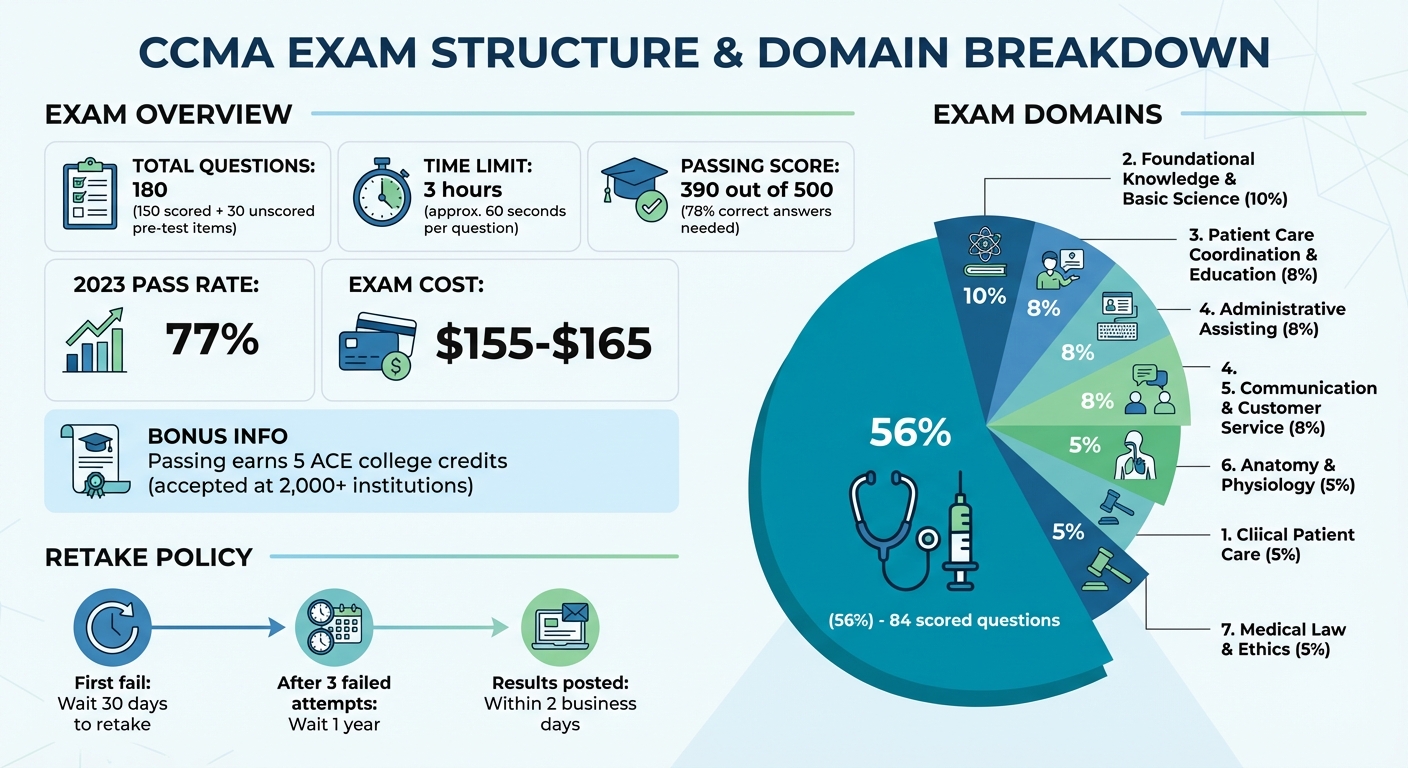
The CCMA exam is a computer-based test made up of 180 multiple-choice questions. Out of these, 150 questions are scored, while the other 30 are unscored pre-test items used to evaluate future exam content. Since there’s no way to identify which questions are unscored, it’s best to treat every question as if it matters.
You’ll have 3 hours to complete the exam, which gives you roughly 60 seconds per question. The test is graded on a scaled system ranging from 200 to 500, and you’ll need a minimum score of 390 to pass. To hit this mark, you’ll need to answer about 78% of the scored questions correctly. In 2023, the nationwide pass rate for the exam stood at 77%.
The test is divided into seven domains:
- Clinical Patient Care: 56% of the exam (84 scored questions)
- Foundational Knowledge & Basic Science: 10%
- Patient Care Coordination & Education: 8%
- Administrative Assisting: 8%
- Communication & Customer Service: 8%
- Anatomy & Physiology: 5%
- Medical Law & Ethics: 5%
Since Clinical Patient Care accounts for more than half the exam, focus your preparation on areas like vital signs, injections, EKGs, and phlebotomy. Scoring 80% or higher on NHA practice exams is a strong indicator that you’re ready for the actual test.
If you don’t pass, you’ll need to wait 30 days before retaking the exam. After three unsuccessful attempts, a one-year waiting period is required before trying again. Official results are typically posted to your NHA account within two business days. If you pass, you’ll earn 5 ACE college credits, which are accepted at over 2,000 institutions.
These details provide a clear understanding of the exam format and help you prioritize your study plan effectively.
Free Resources from the National Healthcareer Association (NHA)
The National Healthcareer Association (NHA) provides several free tools to help you prepare for the CCMA exam. A great starting point is downloading the official CCMA Test Plan. This document breaks down the seven domains covered on the exam, along with key knowledge and task statements. It’s like a roadmap that shows you what to focus on and how to organize your study time effectively.
The NHA also has a YouTube channel packed with prep videos. These include case studies and practice drills designed to reinforce clinical concepts. For more tips and advice, their Care + Career Blog offers study strategies and career insights for healthcare professionals. If you’re using Live Remote Proctoring for your exam, don’t forget to run the free system check at least 24 hours before your test.
Need to study on the go? The NHA’s mobile app includes flashcards that align with their course content, making it easy to review key concepts anytime, anywhere.
For those seeking even more robust preparation, the NHA offers additional paid resources.
NHA Online Study Guides and Practice Tests
Beyond the free tools, the NHA offers paid study materials designed to mimic the actual exam experience. Study guides start at $69, while practice tests are priced at $49 and can be taken up to five times. These resources simulate the 3-hour exam environment and include interactive drills, case study videos, audio narration, and detailed answer explanations. To boost your confidence, aim for at least an 80% score on these practice exams before booking your certification test.
Focused Review® Tool
The Focused Review® tool, included with NHA practice tests, is a powerful way to identify your weak areas. It analyzes your test results and creates a personalized study plan based on the seven exam domains. For example, if your Clinical Patient Care score needs improvement, the tool will direct you to core topics like phlebotomy and EKG procedures. After each practice test, review your Focused Report to guide your next study session efficiently.
These resources, whether free or paid, are designed to streamline your preparation and help you feel ready for exam day.
Free Practice Test Platforms
If you’re preparing for the CCMA exam, there are several free third-party platforms that can supplement official NHA resources. These platforms offer diverse tools, like video tutorials and systems for tagging questions by difficulty, to help you target your weak spots effectively.
Mometrix provides a free practice test that covers all seven CCMA domains, including medical law, ethics, and clinical patient care. It also includes video tutorials and detailed lessons that simplify complex topics.
Smarter MA allows users to tag and group questions into three understanding levels, making it easier to focus on challenging areas. Many users have noted that its questions closely resemble those on the actual exam. The platform also offers both text and video explanations for every answer.
iPREP offers a CCMA 3.0 practice test updated for 2026, complete with step-by-step video explanations and a detailed breakdown of domain weights. Since Clinical Patient Care represents 56% of the exam (84 questions), this feature helps you prioritize your study efforts.
Union Test Prep provides free practice tests, flashcards, lessons, and study guides. It supports preparation for various medical assistant certifications, giving you flexibility in your study plan. Similarly, PracticeCCMATest.com includes 200 free questions that progress from basic knowledge to advanced scenario-based challenges. Career Employer offers 220 practice questions, including specialized quizzes for each of the seven exam domains, with updates as recent as July 2024.
Practice Test Platform Comparison
Here’s a quick overview of these platforms to help you choose the best fit:
| Platform | Questions | Explanation Format | Key Features |
|---|---|---|---|
| Mometrix | Sample Set | Video & Text | Covers all 7 domains, includes "Study Secrets" course |
| Smarter MA | Question Bank | Text & Video | Tagging questions by difficulty, high-yield focus, realistic exam-like questions |
| iPREP | Sample Set | Step-by-step Video | Updated for 2026, domain weight breakdown, sample lessons |
| PracticeCCMATest.com | 200 | Not specified | Sequential progression from basic to advanced scenario-based questions |
| Career Employer | 220 | Not specified | Domain-specific quizzes, expert-developed content, updated July 2024 |
| Union Test Prep | Multiple | Not specified | Flashcards, lessons, study guides for multiple medical assistant exams |
To make the most of these resources, review all explanations carefully and practice under timed conditions to simulate the 60-second-per-question pace of the actual exam.
Video Learning Resources
Watching instructional videos can be a game-changer when preparing for the CCMA exam, especially since the Clinical Patient Care domain makes up a hefty 56% of the scored exam items. Seeing clinical demonstrations in action helps solidify your understanding of proper techniques and procedural sequences.
Platforms like iPREP provide in-depth video explanations for their CCMA 3.0 practice tests. These videos don’t just tell you the right answers – they explain the reasoning behind them, which helps you understand the logic instead of just memorizing facts. Similarly, the Clinical Skills Institute offers videos that break down clinical skills and review six official NHA practice exams, emphasizing question types and strategies for managing time effectively.
Another standout resource is HealthCareer Certs, which takes a more interactive approach. They use 3D animations and virtual clinical simulations to teach key skills like venipuncture, injections, and EKG lead placement. These tools are especially helpful for mastering the step-by-step processes that often appear on the exam.
When using video resources, prioritize high-frequency procedures like the phlebotomy order of draw, injection angles (IM, SQ, ID), measuring vital signs, and infection control protocols. Watching these repeatedly helps build the visual memory needed to tackle scenario-based questions confidently. Pairing these videos with other study methods can make your preparation even more effective.
Mobile Study Apps and Tools
Studying for the CCMA exam doesn’t have to mean being stuck at your desk. Mobile apps make it easy to squeeze in practice sessions during your lunch break, commute, or any free moment. Here are some of the top apps designed to help you prepare, no matter where you are.
The NHA Mobile app, created by the National Healthcareer Association, offers flashcards aligned with the CCMA test plan. It’s free and perfect for quick reviews on the go, though user reviews for the app are mixed.
For a more in-depth option, check out Medical CCMA CPC Exam 2026 by Prepia. This app boasts over 1,500 questions aligned with the 2026 exam standards and uses AI to identify your weak areas, creating personalized study plans. It’s highly rated with a 4.8-star score on the App Store, and pricing starts at $6.99 per week or $16.99 per month after a free trial.
Another strong contender is CCMA Practice Test 2025 by Md Tariqul Islam. With over 1,300 questions and a 4.8-star rating, it’s available for $5.99 monthly or $14.99 for unlimited access. If you’re looking for detailed analytics and timed simulations, CCMA Exam Prep Test Study 2026 by Exam Prep OU is worth considering. It also has a 4.8-star rating and is priced at $14.99 weekly or $39.99 monthly.
These apps are excellent tools for reinforcing key concepts covered in practice tests and video lessons. They feature useful options like bookmarking, offline mode, and timed mock exams that replicate real test conditions. Their progress dashboards let you track performance across all seven exam domains, helping you focus on high-priority areas like Clinical Patient Care, which makes up 56% of the scored items. Many apps also include gamified elements, like streaks and daily goals, to keep you motivated and consistent in your study efforts.
Additional Study Strategies
Preparing for the CCMA exam takes more than just memorizing facts – it requires a well-thought-out plan that blends different learning techniques with effective time management. Start by taking a full-length practice test early in your preparation. This will help you set a baseline and pinpoint which of the seven exam domains need the most focus.
Once you’ve identified your weaker areas, create a structured study plan. Allocate more time to the sections that carry greater weight. For instance, Clinical Patient Care accounts for 56% of the exam, or 84 out of 150 scored questions. You might dedicate two weeks to mastering this domain and one week to smaller sections like Medical Law and Ethics. Use digital tools to flag challenging questions, revisiting them during review sessions. Over time, aim to shift topics from your "don’t know" list to your "know" list.
For hands-on topics, such as phlebotomy or EKG lead placement, try active visualization. Walk through each step in your mind while describing it aloud. This technique helps connect theoretical knowledge with practical skills – an essential part of exam readiness. To maintain focus and avoid burnout, study in 90-minute sessions followed by short breaks, like a quick walk or some light exercise. This method helps build the endurance needed for tackling tougher sections.
Don’t overlook the benefits of peer support. Online communities, such as the "Medical Assistant Path" subreddit, can be great for sharing resources, asking questions, and learning from others’ experiences. Studying with a partner can also be incredibly helpful – two minds working together can make understanding tricky concepts easier.
Lastly, give yourself enough time to prepare – anywhere from 1 to 3 months. This approach not only reduces stress but also prevents the need for last-minute cramming, saving both time and money in the long run.
HealthCareer Certs: Online CCMA Certification Programs
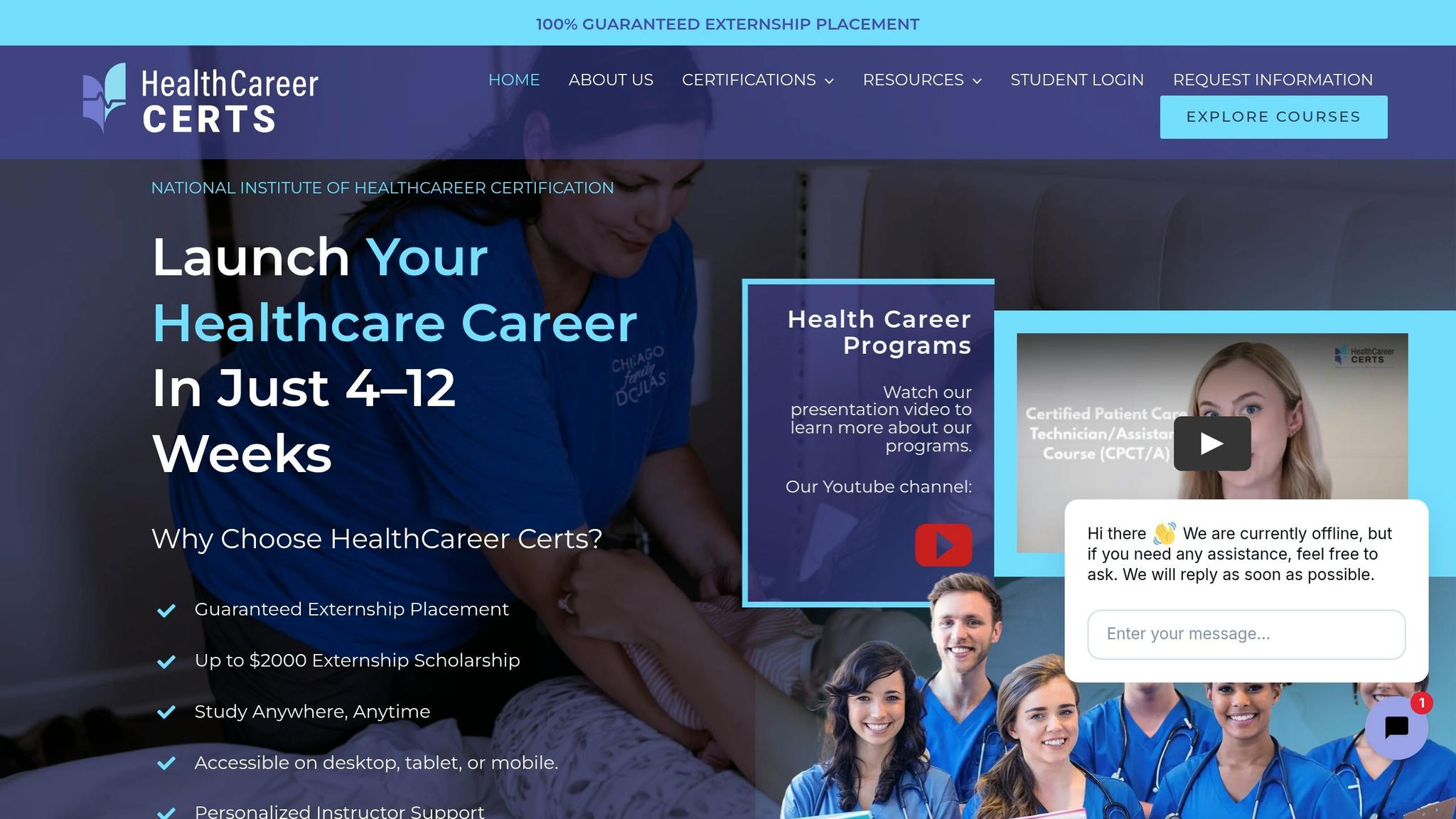
If you’re looking for more structured guidance than free study resources can provide, HealthCareer Certs offers a fully online CCMA certification program. It includes guaranteed externship placement and career support to help you succeed in the healthcare field.
The program is self-paced, available 24/7 on any device, and designed to fit into busy schedules. Most students finish in 6–12 weeks. Olivia, a recent student, shared her experience:
"I was able to get certified and pass the NHA exam on the first try in only 6 weeks, and I appreciated the ease of the entire process/course."
What sets this program apart is its hands-on approach. You’ll receive a home-delivered venipuncture and injection practice kit and participate in virtual simulations to build key clinical skills. The curriculum includes over 1,400 practice questions, 3D animated demonstrations, interactive games, and one-on-one Zoom sessions with instructors. Brianna M., another graduate, praised the program:
"HealthCareer Certs was overall 10 out of 10, instructors were so kind and willing to answer any questions throughout the course at any given time."
The program doesn’t stop at academics. It guarantees externship placement at a hospital or clinic at no additional cost and even offers an externship scholarship of up to $2,000 to support your clinical training. After passing the CCMA exam, you’ll also earn 5 American Council on Education (ACE) credits, which can transfer to over 2,000 colleges and universities.
For added peace of mind, the program includes a 100% tuition refund guarantee if you don’t land a healthcare job within six months of graduating – provided you meet the active job search requirements. The cost ranges from $2,600 to $2,700, with flexible payment plans available. Licensed by the New Hampshire Department of Education and aligned with NHA standards, the program boasts a 5.0 Google rating from over 5,000 students, showing its effectiveness in helping first-time test takers succeed. It’s an excellent choice for those seeking a well-rounded path to CCMA certification.
Conclusion: Your CCMA Exam Preparation Plan
Preparing for the CCMA exam doesn’t have to break the bank. The free tools mentioned here – like NHA’s official study guides, the Focused Review tool, practice test platforms, video tutorials, and mobile apps – offer a variety of ways to tailor your study plan to fit your needs and schedule.
To make the most of these resources, start by outlining a clear study schedule. Most candidates spend 1–3 months preparing for the exam. Begin with a practice test to pinpoint your weaker areas, then build a daily plan that focuses on the sections with the highest weight. For example, Clinical Patient Care makes up 56% of the exam (84 questions), so it’s wise to allocate extra time to this section. Study in focused 90-minute blocks with breaks, as research suggests that studying beyond three to four hours a day can reduce productivity.
Incorporate tools like flashcards, videos, and practice tests to strengthen your understanding of key concepts. Flashcards are great for memorizing medical terms, videos can help you visualize procedures like EKG lead placement and the phlebotomy tube order of draw, and practice tests build the endurance needed for the three-hour, 180-question exam. As Katie Miller from Smarter MA explains:
"It’s a marathon, not a sprint. This isn’t your typical test that you study for in a month. Most are going to study for 1-3 months."
As the exam date approaches, simulate the testing experience by taking full-length practice exams in a quiet, distraction-free space. Carefully review explanations for any missed questions and jot down key takeaways for improvement. Keep in mind that the exam requires a passing score of 390 out of 500 (roughly 78% correct) and that the fee typically ranges from $160 to $165 per attempt. With daily effort and diverse study methods, you’ll be well-prepared to join the 77% of candidates who pass the exam.
Whether you stick to the free resources outlined here or add structured programs like HealthCareer Certs to your plan, the key is to start early and stay consistent. Set your exam date, map out your strategy, and commit to the process – your CCMA certification is within reach.
FAQs
What topics should I study first for the CCMA exam?
To get started, focus on human anatomy and physiology and medical terminology. These topics are the backbone of understanding clinical concepts and procedures. A solid grasp of these areas will make it much easier to tackle other sections of the exam with confidence.
How can I tell when I’m ready to schedule the CCMA exam?
To determine if you’re ready for the CCMA exam, take a close look at your practice test results. If you’re consistently scoring at or above the passing mark on several practice exams that mirror the real test format, it’s a solid sign you’re on the right track. Pay extra attention to areas where your scores are weaker and work on improving them. Once your performance levels out at a high score and you feel confident across all topics, it’s probably time to schedule your exam.
What should I do if I fail the CCMA exam?
If you don’t pass the CCMA exam, don’t worry – you can take it again. You’ll need to wait at least 30 days before reapplying. During this time, review your score report carefully to pinpoint the areas where you struggled. Use this insight to focus your study efforts. Study guides and practice tests can be incredibly helpful tools to build your knowledge and boost your confidence for the next attempt.