Microlearning is reshaping how healthcare professionals meet their continuing education (CE) requirements. Here’s why it works:
- Short Sessions: Modules are just 2–10 minutes long, making them easy to fit into busy schedules.
- Improved Retention: Techniques like spaced repetition combat knowledge loss, helping learners retain up to 17% more information.
- On-Demand Access: Mobile-friendly content allows learning anywhere – during commutes, between patient visits, or on coffee breaks.
- Targeted Learning: Each module focuses on a single goal, from mastering new protocols to refreshing seldom-used skills.
- Increased Confidence: Professionals report a 20% boost in confidence and 15% better preparedness for patient care.
With burnout affecting nearly half of physicians in 2023, microlearning offers a practical way to stay updated without adding stress. Whether you’re a nurse refreshing sepsis protocols or an administrator managing CE programs, microlearning delivers flexibility and results.
Microlearning Benefits for Healthcare Professionals: Key Statistics and Outcomes
How to learn while caring: Microlearning in healthcare settings
sbb-itb-7a67ffa
What is Microlearning in Healthcare
Microlearning breaks down complex topics into short, focused modules lasting 5–15 minutes. Each module focuses on a single learning goal – whether it’s adopting a new infection control protocol, revisiting a rare procedure, or understanding updated patient safety guidelines. This approach aligns with Cognitive Load Theory, which explains that the brain can only process a limited amount of new information at a time.
What sets microlearning apart from traditional training is its timing and delivery. Instead of sitting through long, scheduled lectures, healthcare professionals can access concise, on-demand content. For instance, a nurse might review updated sepsis protocols before starting a shift, or a medical assistant could quickly refresh their knowledge of phlebotomy techniques between patient visits. Traditional training often results in cognitive overload and rapid knowledge loss – studies show that learners can lose over 80% of newly acquired information within a month if it isn’t reinforced.
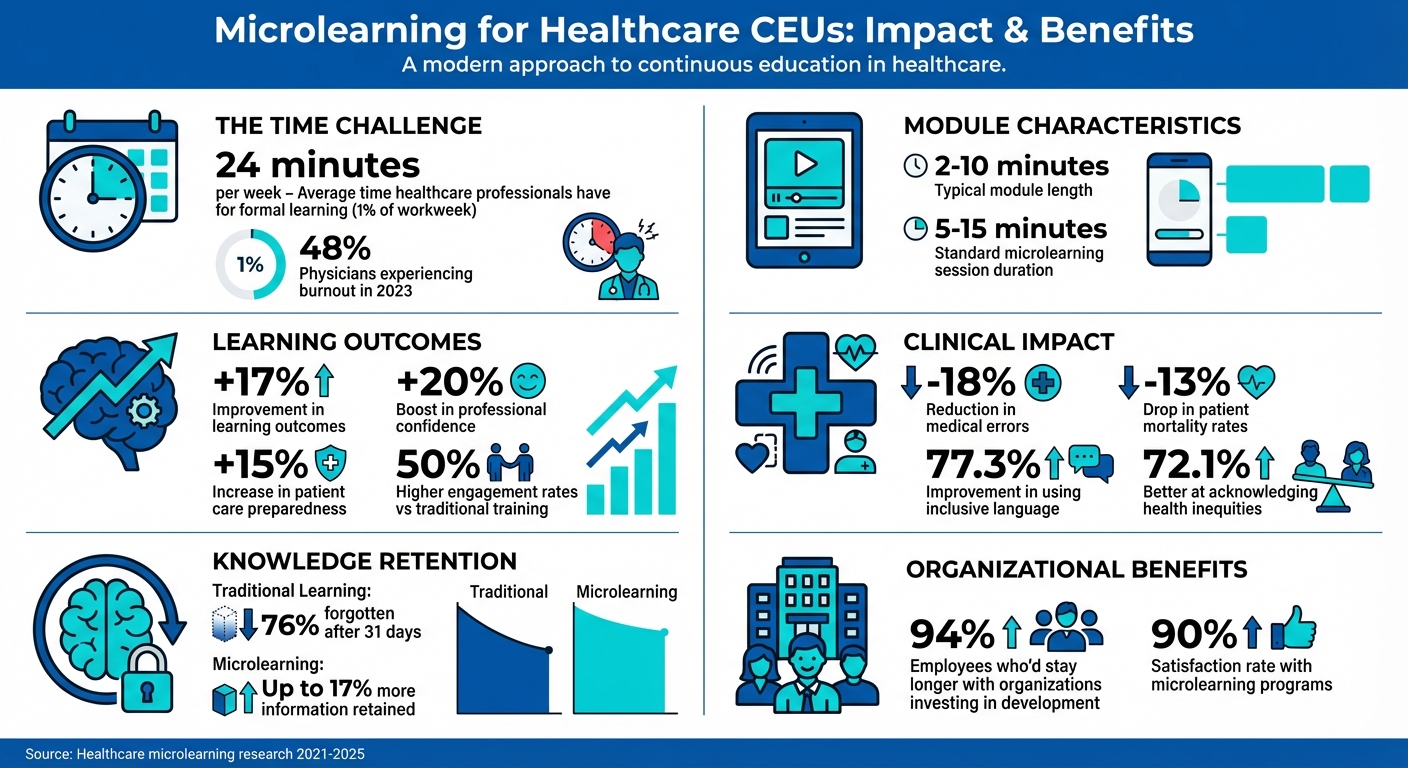
The demanding nature of healthcare further highlights the practicality of microlearning. On average, healthcare professionals have just 24 minutes per week – around 1% of their workweek – for formal learning. Microlearning makes use of those small windows of time, offering mobile-friendly, on-demand content that fits into the unpredictable pace of clinical work. These brief modules are designed to maximize both retention and engagement.
Core Features of Microlearning
Microlearning modules are crafted for easy access on smartphones, tablets, and computers. They often incorporate interactive elements like quizzes, case scenarios, gamified challenges, and multimedia presentations to engage diverse learning styles. For example:
- Visual learners benefit from infographics and video demonstrations.
- Auditory learners gain from podcasts or narrated content.
- Kinesthetic learners engage with interactive simulations and hands-on activities.
To ensure knowledge sticks, microlearning employs spaced repetition and active recall. These techniques help transform short-term understanding into long-term competence. For example, a medical assistant might complete a 10-minute module on specimen handling, followed by a quiz three days later and a practical scenario a week after. Each subsequent activity reinforces what was learned, building both confidence and clinical expertise.
Why Healthcare Professionals Need Microlearning
In healthcare, staying current is critical. With constant updates in research, protocols, and regulations, microlearning allows organizations to quickly create and distribute relevant modules. This agility is particularly useful during medical emergencies or when new guidelines are introduced.
Time constraints are another challenge. Nearly half (48%) of physicians reported burnout in 2023, making lengthy training sessions impractical. Microlearning integrates education into the natural flow of work. Laura Haselum, Learning Content Manager at Access Learning, explains:
"Microlearning shifts the power from ‘here’s what everyone must complete’ to ‘here’s a library you can navigate yourself.’ When learners can search, browse, and choose what’s relevant to them right now, learning stops being a one-size-fits-all mandate and starts being a personalised toolkit".
This approach also caters to the varied needs of healthcare professionals. A critical care nurse preparing for ECMO certification has very different learning requirements compared to a medical assistant working on phlebotomy techniques. Microlearning targets specific knowledge gaps, saving time and avoiding irrelevant material. Even accreditation bodies, like the AMA and RCP UK, recognize this flexibility by awarding "fractional" credits (e.g., 0.25 or 0.5 points) for short activities under 60 minutes. This makes earning CEU credits more manageable through multiple brief modules rather than full-day seminars.
Benefits of Microlearning for Healthcare CEUs
Microlearning offers clear, measurable benefits for healthcare professionals working toward continuing education units (CEUs). It tackles common challenges like information overload, tight schedules, and the need for immediate application – all while boosting retention and on-the-job performance.
Better Knowledge Retention
Let’s face it – traditional, long-form learning sessions often fail to stick. Research shows that learners forget more than half of new material within just 20 minutes, and up to 76% is gone after 31 days. This phenomenon, known as the Ebbinghaus forgetting curve, highlights the need for a different approach.
Microlearning combats this issue by using spaced repetition and scenario-based questions with instant feedback. These techniques encourage the brain to retrieve and cement information, improving long-term memory. As Mrigank S. Shail explains, "By breaking complex courses into manageable smaller lessons, micro-learning preserves the neurotransmitter cascade for steady neurochemical performance". Rich Lanchantin, CEO of Qstream, adds that microlearning leverages "spacing and testing effects" to counteract the forgetting curve.
Real-world examples back this up. In June 2021, Medscape Education tested a 15-minute ACCME-accredited audio summary on continuous glucose monitoring. Among 234 diabetologists and 241 primary care physicians, 19% and 26% respectively improved their pre-to-post test scores. Similarly, Children’s Healthcare of Atlanta piloted a game-based microlearning program where participants repeatedly answered scenario questions until they got them right. The result? A 100% success rate in achieving desired behaviors and applying skills on the job.
Time Efficiency and Flexibility
For healthcare professionals with packed schedules, long training sessions just aren’t practical. Microlearning offers a solution by fitting seamlessly into busy routines. Clinicians can complete short modules during patient visits, between shifts, or even while commuting.
Mobile access makes it even easier. With content available on smartphones or tablets, those idle moments – like waiting for an elevator or a coffee break – become opportunities to learn. Micah Goodman, Product Manager for Home-Based Care at Relias, highlights this convenience:
"Microlearning is a great way for healthcare professionals to quickly get the information they need when and where they need it".
And the results speak for themselves. Microlearning improves learning outcomes by up to 17%, with participants reporting a 20% boost in confidence and a 15% increase in their preparedness to deliver patient care. It also drives 50% higher engagement rates compared to traditional, longer training sessions.
Compliance and Professional Development
Microlearning doesn’t just enhance retention and flexibility – it also supports compliance and professional growth. By breaking down complex regulatory information into digestible chunks, it reduces mental fatigue and ensures healthcare workers stay current with evolving standards. This just-in-time delivery model allows access to specific protocols – like infection control procedures or updated safety guidelines – exactly when they’re needed. The results? An 18% reduction in medical errors and a 13% drop in patient mortality rates.
In August 2024, Brightline partnered with Violet to deliver microlearning-based cultural competence training. Healthcare providers reported impressive improvements: 77.3% in using inclusive language, 72.1% in acknowledging health inequities, and 71.4% in addressing race during care encounters. Another example comes from Inova Health System, which launched a "Leadership Moments" microlearning program in June 2025. This initiative achieved a 90% satisfaction rate and significantly improved timely performance check-ins. Additionally, 94% of employees stated they’d stay longer with an organization that invested in their professional development.
Applications of Microlearning in Healthcare Education
Microlearning is transforming healthcare education by offering concise, targeted lessons that fit seamlessly into the demanding schedules of healthcare professionals. This approach tackles key challenges like maintaining compliance and refreshing seldom-used skills, all while integrating naturally into daily workflows.
Compliance and Regulatory Training
Compliance training is one area where microlearning excels. Instead of lengthy seminars on topics like HIPAA or infection control, healthcare organizations can deliver 3–12 minute modules focusing on specific objectives – such as proper PPE usage or updated documentation practices. This method is particularly effective for recurring requirements, allowing for monthly or quarterly 10–15 minute refreshers throughout the year instead of overwhelming staff with a single, dense session.
Amber Ratcliffe from MedTrainer captures the essence of this approach:
"Microlearning is a concise, super-concentrated education that’s created to meet a particular learning outcome".
For compliance, this focused approach is critical. Modules often include mechanisms like pausing content if a user navigates away or requiring passing scores on quizzes to ensure the material is absorbed effectively.
In addition to regulatory updates, microlearning empowers clinicians with quick skill refreshers and protocol updates.
Skill Refreshers and Protocol Updates
When clinicians need to perform rarely practiced procedures, traditional manuals can be cumbersome. Microlearning steps in with 5–10 minute modules that deliver just-in-time refreshers for tasks like rare procedures, disaster response protocols, or specialized equipment usage. This targeted learning ensures professionals can quickly review essential skills when they need them most.
Microlearning is also ideal for rolling out new clinical protocols. For example, when a facility adopts a new triage method or updates patient communication guidelines, staff can access bite-sized tutorials on their smartphones during breaks or between shifts. Tutorials, checklists, and quizzes help them master tools like telehealth platforms or EHR systems without disrupting patient care.
The format extends beyond technical skills, supporting soft skill development as well. Context-driven scenarios – such as managing difficult patient interactions or addressing health disparities – help staff build critical thinking skills that traditional textbooks simply can’t replicate. These real-world scenarios make the lessons immediately relevant and actionable.
| Use Case Category | Specific Application Examples | Delivery Format |
|---|---|---|
| Compliance | Infection control, HIPAA, documentation standards | Infographics, videos |
| Clinical Skills | Rare procedures, PPE donning/doffing, triage | Tutorials, checklists |
| Technology | Telehealth software, EHR updates, AI tools | Demos, AI chatbots |
| Soft Skills | Patient communication, LGBTQ+ safe zones | Scenario quizzes, podcasts |
How to Implement Microlearning for Healthcare CEUs
Microlearning has shown its value across various fields, and healthcare is no exception. When it comes to Continuing Education Units (CEUs) for healthcare professionals, implementing microlearning effectively requires a thoughtful approach. Balancing well-designed content, the right technology, and accessible delivery ensures busy clinicians can meet their learning goals without disrupting their workflows.
Designing Effective Microlearning Content
The first step is to define a single, actionable learning objective for each module. Keeping modules focused prevents cognitive overload. For instance, instead of tackling a broad topic like dementia care in a single 30-minute session, break it into smaller, 3–7-minute segments. Each segment could focus on specific aspects, such as mealtime strategies, communication techniques, or behavioral management. Formats like short videos, interactive case studies, or gamified quizzes work well for these bite-sized lessons.
This approach, often called "chunking", enhances knowledge retention and supports just-in-time learning. For example, a Medscape Education study in July 2021 found that a 15-minute interactive, case-based microlearning activity significantly boosted confidence among infectious disease specialists (65%) and pulmonologists (40%) in diagnosing nontuberculous mycobacterial lung disease.
Once your content is ready, the next challenge is delivering it effectively, which brings us to the importance of the right platform.
Choosing the Right Delivery Platform
The delivery platform plays a critical role in microlearning’s success. A mobile-first design is particularly important for healthcare workers, who often need to learn during short breaks or while on the go. Many platforms now offer extensive course libraries and mobile apps, providing millions of CEUs to professionals each year. Some platforms even specialize in role-based training or focus on areas like improving communication skills, often earning high satisfaction ratings from users.
Key features to look for include CEU/CME integration with fractional credits, allowing learners to accumulate credits from multiple short modules until they reach a full credit. Platforms with capabilities like spaced repetition, multimedia support, and AI-powered summaries can further enhance the learning experience. Additionally, prioritize platforms that meet strict security standards, such as ISO 27001 or SOC 2 certification, and offer offline access for clinicians working in areas with limited internet connectivity.
With the right platform, healthcare professionals can access training anytime, anywhere. But accessibility goes beyond technology – it also involves equity.
Ensuring Accessibility and Equity
Microlearning’s flexibility makes it ideal for diverse clinical settings, but ensuring equitable access is essential. Use a variety of content formats – text, images, videos, audio, and interactive quizzes – to cater to different learning preferences. Modules should be mobile-responsive and available on demand, allowing clinicians to learn during a commute or between patient appointments.
Competency-based recognition is another key consideration. Credentials should reflect actual skills demonstrated during training. For instance, one case study showed that clinicians using 15-minute multimedia modules improved their use of inclusive language by 77.3% and their ability to address health inequities by 72.1%, all without interrupting their clinical duties. As Human Resources for Health highlights:
"Micro-credentials that recognise smaller units of learning have the potential to enhance lifelong learning with tailored learning pathways".
Affordability also matters. Many platforms offer free plans, with paid options starting as low as $5 per learner per month, ensuring that quality training is accessible to organizations with varying budgets.
How Microlearning Supports Self-Paced Certification Programs
Microlearning’s bite-sized, engaging format aligns perfectly with self-paced certification programs, giving clinicians the flexibility to manage their continuing education. By breaking down complex healthcare topics into 5–10 minute modules, these programs allow professionals to fit learning into their unpredictable schedules – whether it’s during a commute, between patient rounds, or over a quick lunch break. With demanding shifts, most healthcare workers only allocate 30–60 minutes to professional development each day.
Take HealthCareer Certs, for example. Their online CCMA and CPT programs incorporate interactive tools like 3D demos, quizzes, flashcards, and more. With over 1,400 practice questions and 700 self-checks, these programs are designed for maximum engagement. The mobile-friendly format ensures learners can dive into content whenever they have a spare moment, making certification achievable even for those with packed schedules. These features not only improve accessibility but also lead to real-world improvements in professional skills.
The results speak for themselves. Healthcare professionals in self-paced programs report a 20% boost in confidence and a 15% increase in preparedness, showcasing the tangible benefits of microlearning. A specific example comes from Medscape Education, which launched a 15-minute interactive module on diagnosing nontuberculous mycobacterial lung disease in July 2021. Among participants, 65% of infectious disease specialists (74 individuals) and 40% of pulmonologists (45 individuals) reported feeling more confident in their diagnostic abilities after completing the module. Moreover, just-in-time learning models within these programs emphasize skill demonstration through targeted assessments and simulations rather than just tracking hours.
The modular approach of microlearning also allows professionals to stack micro-credentials – such as infection control or phlebotomy techniques – into a robust professional portfolio. This approach benefits not only individuals but also healthcare organizations. With 94% of employees stating they would stay longer at companies that invest in their development, self-paced programs built on microlearning principles offer a win-win scenario. By combining focused micro-credentials into a cohesive portfolio, healthcare professionals and organizations alike can achieve sustained, skill-driven growth.
Conclusion
Microlearning is redefining continuing education (CE) in healthcare, offering a practical solution for professionals navigating a fast-paced environment. With nearly 48% of physicians experiencing burnout, concise 5–15 minute modules integrate seamlessly into their demanding routines – whether it’s between patient rounds, during commutes, or over quick breaks.
This method doesn’t just fit into busy schedules; it enhances outcomes. Studies show microlearning can improve learning results by up to 17% and boost engagement by 50%. Techniques like spaced repetition and active recall ensure critical updates – whether related to infection control or diagnostic protocols – are always accessible when needed.
Expert insight:
"Self-directed and self-determined microlearning will definitely add a new dimension to the future of CPD/CME." – Sushant Dahiya, Grant Development, Medscape Education Global
For healthcare workers, microlearning offers a dual advantage: it not only fits into tight schedules but also increases confidence by 20% and preparedness by 15%. Employers see benefits too, with 94% of employees saying they’d stay longer at organizations that invest in their growth. As accreditation bodies increasingly recognize fractional credits and micro-credentials, lifelong learning becomes more achievable than ever. This approach strengthens individual expertise while driving organizational success.
HealthCareer Certs builds on this momentum, offering self-paced, online certification programs tailored to the evolving needs of modern healthcare professionals. To explore these opportunities, visit HealthCareer Certs.
FAQs
How do microlearning modules count toward CEUs or CME credits?
Microlearning modules can contribute to CEUs or CME credits if they are included in an accredited program that adheres to established standards. These modules – whether they are videos, quizzes, or podcasts – must feature clear, measurable learning outcomes along with assessments to confirm knowledge or skill development. Accredited programs are responsible for reporting participation and outcomes to certifying organizations, ensuring that credits are granted correctly.
What’s the best way to use spaced repetition in microlearning?
Spaced repetition works best in microlearning when you revisit material at strategically timed intervals, ideally just before you’re about to forget it. This method helps solidify memory and boosts how well you retain information in the long run. The key is to figure out the perfect timing and frequency for these reviews, ensuring the learning sticks and becomes stronger over time.
How can a healthcare team roll out microlearning without disrupting patient care?
To weave microlearning into healthcare settings without interrupting patient care, consider using brief, targeted modules that take less than 10 minutes to complete. These can be slotted into natural pauses in the day, like during breaks, shift changes, or quieter moments. Prioritize essential topics such as infection control or accurate medication documentation to maximize impact. Making these modules accessible on mobile devices ensures staff can engage with them conveniently. Launching a pilot program is a smart way to fine-tune the process and showcase its benefits before rolling it out on a larger scale.