
If you’re preparing for healthcare exams like the CCMA or CPT, mastering multiple-choice questions (MCQs) is critical. These exams test not just memorization but your ability to apply clinical knowledge under pressure. To succeed, focus on these key strategies:
- Read the question stem carefully: Identify key details like patient symptoms, qualifiers (e.g., "most likely", "except"), and the lead-in question.
- Think of your answer first: Formulate your response before reviewing options to avoid being misled by distractors.
- Eliminate wrong answers: Rule out options systematically, focusing on relevance and clinical priorities.
- Learn from mistakes: Analyze errors to uncover gaps in knowledge or test-taking habits.
- Practice regularly: Simulate exam conditions with timed practice tests to build confidence and improve retention.
These methods help you navigate the challenges of MCQs, from time constraints to tricky phrasing, and improve your exam performance.
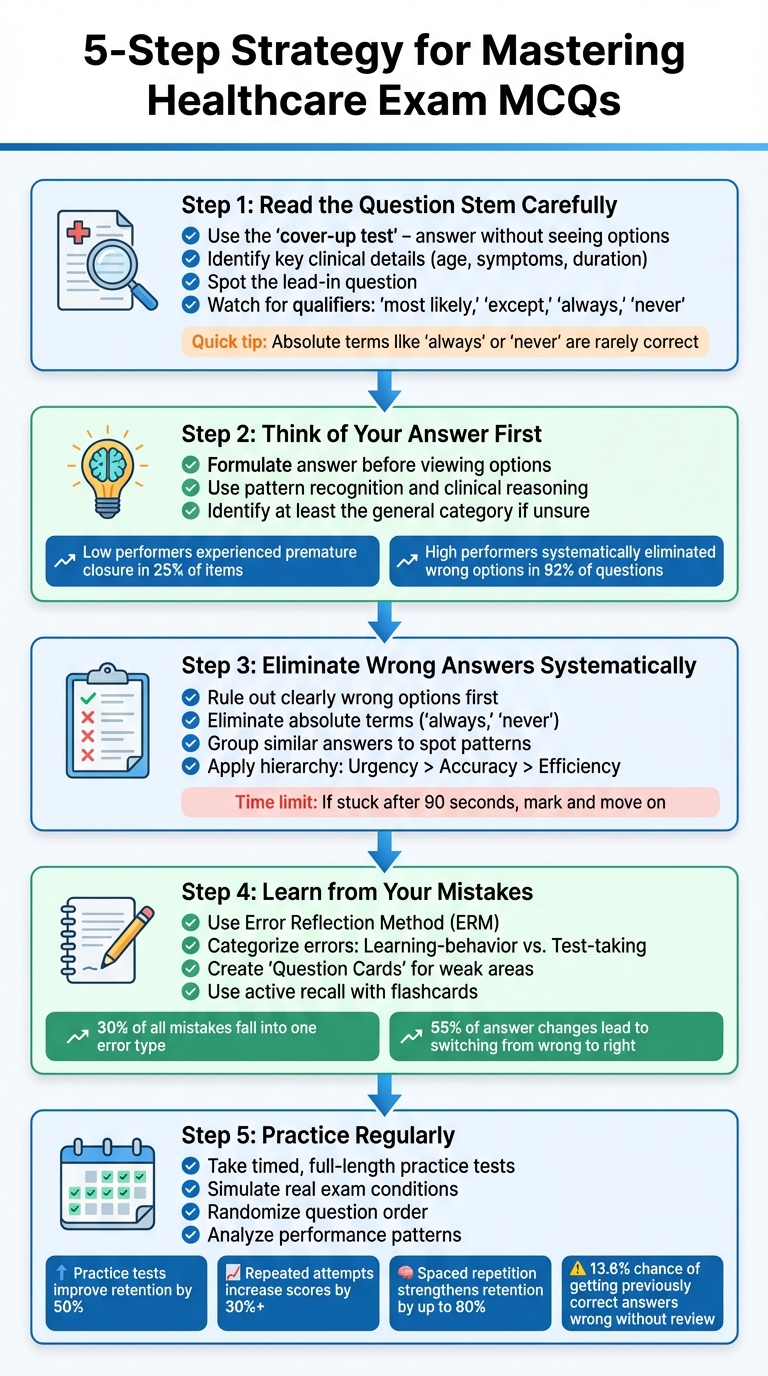
5-Step Strategy for Mastering Healthcare Exam Multiple-Choice Questions
Step 1: Read the Question Stem Carefully
The question stem is your starting point, providing the critical clinical details you need. As Zachary Britt, MPH, MBA, from PAEA News explains:
"Since the stem is the part of the test item that stimulates higher order thinking, a good question stem contains all of the information that a student would need".
Before jumping to the answer choices, try the "cover-up" test. This involves covering the answer options and attempting to answer the question based solely on the stem. High-quality exams, like the CCMA, are designed so that a well-written stem gives you enough information to identify the correct answer without relying on the options. This technique minimizes distractions from tempting but incorrect choices.
Once you’ve read the stem, focus on identifying the most important details.
How to Find Key Information in the Question
After understanding the stem, zero in on the clinical details that matter. Many healthcare exam questions use clinical vignettes that mirror real-life patient scenarios. Your task is to pick out crucial information such as the patient’s age, gender, care setting (e.g., outpatient clinic or emergency department), symptom duration, physical exam findings, and diagnostic results. These details will guide you toward the correct diagnosis or intervention.
Don’t overlook the lead-in question at the end of the stem. This is the specific question you need to answer, like "What is the most likely diagnosis?" or "What is the next best step?" Pinpointing the lead-in ensures you understand exactly what the question is asking. If the lead-in feels overwhelming, try rephrasing it in simpler terms to make it easier to tackle.
How Qualifier Words Change the Correct Answer
Qualifier words in the question stem set the tone for the correct answer. Words like "most likely", "always", "never", "except", and "most appropriate" define the scope of what you’re looking for. For instance, when the phrase "most likely" appears, your goal is to identify the most probable or common scenario – not every possibility, just the one best answer.
The National Board of Medication Therapy Management highlights:
"Adding the term ‘most’ to frequent or likely (e.g., The most likely diagnosis…) actually helps focus and clarify the item".
Be cautious with absolute terms such as "always" or "never", as these are rarely accurate in clinical medicine. Answers containing these terms are often incorrect. On the other hand, negative qualifiers like "except" or "not" require a different approach. Here, you’re looking for the option that doesn’t align with the others. Spotting these qualifiers early on can help you narrow down your choices and avoid picking an answer that seems plausible but doesn’t address the question’s true intent.
Step 2: Think of Your Answer Before Looking at Options
After reading the question stem carefully, resist the urge to immediately glance at the answer choices. Instead, take a moment to come up with your own answer based solely on the clinical details provided. This helps you rely on your clinical reasoning rather than being influenced by potentially misleading options. By doing this, you not only strengthen your independent thinking but also reduce the likelihood of common test-taking errors.
Why Pre-Thinking Answers Helps Avoid Mistakes
When you generate an answer on your own first, you tap into your intuitive clinical reasoning. As Animesh Jain and colleagues from The University of North Carolina at Chapel Hill School of Medicine explain:
"This step allows the student to fully engage their pattern recognition and clinical experiential knowledge (system 1)".
Jumping to the answer choices too soon can cause you to latch onto a familiar term that doesn’t fully align with the clinical scenario. The Learning Center at the University of North Carolina at Chapel Hill highlights this risk:
"Often, students are misled by distractors – choices that can look, sound or mean about the same thing as the correct answer, but are incorrect because they are either too specific or too general".
Research supports this approach. A study on physician trainees taking the USMLE Step 2 CK found that low performers experienced premature closure – failing to consider the correct alternative – in 25% of test items. High performers, on the other hand, avoided this pitfall and systematically ruled out incorrect options in 92% of questions, compared to just 17% for low performers. If your self-generated answer aligns with one of the choices, you can confidently select it, reducing the risk of second-guessing. This method not only shields you from distractors but also sharpens your clinical reasoning.
How Independent Thinking Improves Clinical Reasoning
Building on the careful reading of the question stem from Step 1, pre-thinking your answer mimics real-life clinical practice, where diagnoses and treatment plans are made without predefined options. This process shifts your focus from simple recall to applying knowledge in a meaningful way – moving from "first-order recall" to "second-order reasoning".
If you can’t pinpoint a specific answer, aim to identify at least the general category it belongs to. For instance, decide whether the situation calls for an IV antihypertensive or a diagnostic imaging test before reviewing the options. Even visualizing the patient described in the vignette – such as imagining someone acutely ill with fever and jaundice – can help you zero in on critical clinical details, keeping exam stress at bay. By combining these strategies – careful stem analysis and pre-thinking – you create a reliable system that enhances accuracy and builds confidence when tackling multiple-choice questions.
Washington University School of Medicine in St. Louis underscores the value of this technique:
"An excellent way to evaluate whether an item is focused is the ‘cover-up test’: cover up the answer options and determine if the question is clear and if a knowledgeable examinee could come up with the answer based only on the stem".
Step 3: Eliminate Wrong Answers Systematically
Once you’ve formulated your answer (as outlined in Step 2), it’s time to methodically eliminate incorrect options. Instead of immediately zeroing in on what you think is correct, work backward by crossing out choices you know are wrong. This approach transforms uncertainty into a deliberate strategy. As Kaplan advises:
"Eliminate only what you know is wrong. However, once you eliminate an answer choice, do not retrieve it for consideration".
This "once gone, stay gone" rule is designed to keep you from second-guessing based on gut feelings rather than logic. By sticking to this method, you can merge your initial reasoning with a more structured evaluation of the answer choices.
To do this effectively, assess each option against a rephrased version of the question stem. Many test-takers get distracted by irrelevant details – like a patient’s age or gender – rather than focusing on the core clinical question. For example, if the question asks, "What is the next best step?" and you’re down to two plausible interventions, rely on clinical hierarchies. Start with the basics, like addressing airway, breathing, circulation (ABCs), and prioritize assessment over action when appropriate. Below are some detailed techniques to help refine this process.
How to Spot Clearly Wrong Options
Begin by eliminating choices with absolute terms like "always", "never", or "only", as these are often red flags in healthcare scenarios, which are rarely black-and-white. Also, watch for grammatical mismatches between the question stem and the answer, as these can signal errors.
Another key strategy is to rule out answers that address chronic conditions when the question focuses on an acute emergency. For instance, a patient in septic shock requires immediate IV fluids, not a long-term diabetes management plan.
Be mindful of factually correct statements that don’t actually answer the question. For example, while it’s true that "Beta-blockers reduce heart rate", this information is irrelevant if the question is asking for a diagnosis rather than a treatment plan. These "true but wrong" options are common traps.
Group Similar Answers to Narrow Your Choices
Most well-designed healthcare exam questions group answers into similar categories – diagnoses, treatments, or lab tests. If three options involve diagnostic imaging and one is a medication, the outlier is likely incorrect. Recognizing these patterns can help you eliminate multiple wrong answers at once.
When you’ve narrowed it down to two similar options, apply the principle of Urgency > Accuracy > Efficiency. Choose the intervention that addresses the most immediate threat to the patient’s life. For example, in a patient in shock, administering IV fluids takes precedence over adjusting a mild electrolyte imbalance.
MDSteps summarizes this approach well:
"Step 2 CK answer elimination strategies convert uncertainty into probability management: the process of ruling out flawed choices using hierarchy, pattern recognition, and contextual reasoning".
If you’re unable to narrow the options within 90 seconds, mark the question and move on to save time and mental energy.
By using pattern recognition and these elimination techniques, you’ll be better equipped to handle subtle traps in the answer choices.
How to Avoid Trap Answers
Some distractors are designed to sound plausible while lacking clinical relevance. One common trap is the use of overly complex or unfamiliar terms. If an answer choice includes terminology you’ve never encountered, it’s often a deliberate distraction.
Another frequent pitfall is negative phrasing. Questions that include words like "except", "not", or "least" can trick you into selecting the first seemingly correct statement, rather than identifying the one that doesn’t fit. To avoid this, underline or mentally emphasize these negative qualifiers as you read the question.
Finally, be wary of "all of the above" options. While they might seem correct if you recognize two accurate statements, these are often designed to test partial knowledge. Emily WhiteHorse, Ph.D., PA-C Emeritus, explains:
"The savvy exam-taking student looks for these common flaws and uses them to determine the answer not from a knowledge base but rather from their ability to spot unintended cues".
This elimination process builds on the reasoning skills you’ve already developed and helps you avoid falling for common distractors. By staying alert and following these strategies, you can confidently identify the best answer.
sbb-itb-7a67ffa
Step 4: Learn from Your Mistakes
Making a wrong choice on a question isn’t just a setback – it’s an opportunity to uncover flaws in your reasoning. The Error Reflection Method (ERM), created by medical educator Linda L. Carr, Ph.D., encourages you to dig deeper into why you got it wrong. As Carr puts it:
"Understanding what you missed is important; analyzing why you missed it prevents future errors and improves your exam performance".
A study involving nearly 4,000 medical students revealed that most errors fall into two main categories: Learning-behavior errors (like knowledge gaps or shallow understanding) and Test-taking errors (such as misreading the question, jumping to conclusions, or falling prey to cognitive biases). Interestingly, the largest single error type made up 30% of all mistakes. Recognizing these patterns can sharpen your approach to multiple-choice questions (MCQs) in healthcare exams.
Figure Out Why You Picked Wrong Answers
After working on eliminating wrong options, it’s time to focus on understanding your mistakes. When you review a missed question, ask yourself targeted questions like: Did I miss a keyword such as "except" or "not"? Was my knowledge incomplete or superficial? Did I fall into a cognitive trap, like the recency effect (favoring the last piece of information) or premature closure? These questions help you figure out whether you need to strengthen your content knowledge or refine your test-taking strategies.
To make this process effective, track your errors and categorize them. If many of your mistakes stem from weak knowledge, focus on reviewing specific content areas. On the other hand, if you’re misreading questions or skipping over details like lab values, slow down and carefully analyze each question during practice. The ultimate goal is to turn what you learn into long-term memory.
Create Study Materials for Your Weak Areas
Once you’ve identified recurring mistakes, it’s time to address them with focused study tools. One helpful strategy is to create "Question Cards" for topics you struggle with. Write down the question, why the wrong answers seemed tempting, and why the correct answer is right. As Malcolm notes:
"This helps you consolidate key facts".
Instead of passively re-reading, use active recall techniques like flashcards and self-quizzing. Mark your notes with a small dot next to facts linked to missed questions – over time, you’ll see which areas come up most often. For example, if you frequently miss questions about electrolyte imbalances or pharmacology side effects, go beyond isolated facts and review the entire disease pathway or related conditions.
Here’s a practical tip: commit to an answer before checking it. Getting it wrong reinforces the correct information in your memory. And keep this in mind: about 55% of answer changes on board exams lead to switching from a wrong answer to a right one. Trust your preparation, and use every mistake as a stepping stone toward better performance.
Step 5: Take Practice Tests Regularly
To truly excel at multiple-choice question (MCQ) strategies, it’s not enough to just understand the approach – you need to practice consistently, simulating real exam conditions. Practice tests are powerful tools for building the mental pathways needed for exam success. Research shows they can improve memory retention by 50%, and repeated attempts can increase scores by over 30%. As The TrueLearn Team points out:
"The testing effect doesn’t just prepare them for exam formats – it actively builds the cognitive skills needed to apply knowledge under pressure."
Revisiting practice questions regularly strengthens memory retention by up to 80%. However, even if you initially answer a question correctly, there’s still a 13.6% chance you might get it wrong later if you don’t revisit it. This is why spacing out practice sessions is critical – it prevents overconfidence and ensures a deeper understanding of the material. A consistent routine of practice tests is key to long-term success.
Simulate Real Exam Conditions
Familiarity with the exam format is just as important as mastering the content itself. For example, the CCMA exam requires you to answer 150 multiple-choice questions in 2 hours. Taking timed, full-length practice tests helps you build the speed and stamina needed for the real thing, while also reducing test-day anxiety. If you’re prone to distractions, consider using earphones or earplugs, as Margaret A. Fitzgerald, DNP, FNP-BC, NP-C, FAANP, CSP, FAAN, DCC, FNAP, suggests:
"Use earphones or earplugs that are provided by the testing center if you are easily distracted."
It’s also important to get comfortable with digital testing features like highlighting keywords and flagging questions to revisit later. Randomizing practice questions – rather than grouping them by category – can better prepare you for exams that often jump between unrelated topics. This trains your brain to adapt quickly, a skill that’s crucial for success.
After completing a practice test in a simulated environment, take the time to analyze your performance and refine your study approach.
Analyze Your Practice Test Results to Pinpoint Weak Areas
Each practice test is an opportunity to uncover areas where you need improvement. Look for patterns in your mistakes. For instance, if you consistently struggle with questions on infection control or medical law, dedicate your next study session to those topics. The Oncology Nursing Certification Corporation (ONCC) advises:
"If you use practice tests, look for patterns in the items you answer incorrectly… If most of your incorrect answers are in one subject area, focus on that area."
Don’t just note what you got wrong – dig into why you made those mistakes. Errors at the beginning or end of a test might suggest issues with stamina or focus, while errors on questions you knew the answer to could point to misreading or rushing. Use the official test content outline to allocate your study time wisely. For example, if a section accounts for 22% of the exam, multiply the total number of questions by 0.22 to determine how much weight to give it. Concentrate on high-priority areas where your performance is weakest.
Tools that provide instant feedback and detailed explanations – like the 1,400+ practice questions available through HealthCareer Certs – can help you quickly address gaps in knowledge. By focusing on these areas, you’ll develop the clinical reasoning skills needed to succeed on exam day.
How HealthCareer Certs Supports Your Exam Preparation
Preparing for healthcare certification exams takes more than just memorizing material from textbooks – you need hands-on practice with exam-style questions. HealthCareer Certs provides tools and resources that help you tackle multiple-choice questions (MCQs) effectively and build the confidence to excel. Let’s dive into what makes their approach stand out.
Interactive Tools to Master MCQs
HealthCareer Certs offers a range of interactive features designed to enhance your learning experience. Their platform provides instant feedback, detailed explanations, and helpful hints for every question. This means you don’t just know if you got it right or wrong – you also learn the reasoning behind the correct answer.
The flashcard mode is ideal for memorizing medical terms, prefixes, and suffixes, while the randomized question feature keeps your study sessions varied and engaging. As learner Aisha K. shared:
"Studying using this resource was a game changer! I loved the ability to do random questions; it kept my study sessions fresh."
These tools are available on both mobile and web platforms, allowing you to study during quick breaks and seamlessly pick up where you left off.
Personalized One-on-One Sessions
HealthCareer Certs also offers one-on-one instructor sessions to help you refine your test-taking strategies. These sessions focus on analyzing and correcting errors in real time, making them an excellent complement to independent study. Instructors guide you through case-based questions and encourage a methodical approach to problem-solving, especially for scenarios where intuition alone isn’t enough.
Access to 1,400+ Practice Questions and Study Materials
With a question bank of over 1,400 MCQs and 700 self-checks, you’ll have ample opportunities to test your knowledge across all exam topics. These questions are aligned with official exam outlines, covering key areas such as anatomy, medical terminology, infection control, and medical law.
The platform’s Learning Insights Center tracks your performance, helping you identify and address knowledge gaps. This continuous feedback loop ensures you’re always improving. Emily S., another user, noted:
"The mixture of multiple-choice questions and flashcards made studying engaging, and I learned so much. I felt well-prepared walking into the exam room."
Thousands of students have successfully used these resources to prepare for certifications like CCMA and CPT.
Conclusion
Key Strategies for Tackling MCQs
Excelling at multiple-choice questions boils down to a few essential techniques. Start by carefully reviewing the question stem, paying close attention to key details and qualifiers. Try to determine your answer independently before looking at the options – this helps you avoid falling for misleading or "trap" answers.
When you’re uncertain, turn to systematic elimination. Rule out answers that are clearly incorrect, group similar ones together, and be wary of options with extreme language since healthcare decisions are rarely absolute. If you find valid reasons to change an answer, don’t hesitate – research shows that revising answers thoughtfully can improve your score.
Take the time to analyze your practice mistakes and focus your study efforts on areas where you struggle. Even a commitment of 5–8 days to these strategies can make them feel like second nature.
Commit to Consistent Preparation
By applying these techniques regularly, you’ll develop a well-rounded approach that incorporates everything we’ve discussed. As Margaret A. Fitzgerald, DNP, FNP-BC, NP-C, FAANP, wisely advises:
"Don’t respond to self-defeating thoughts that can creep into your mind… Recognize the time and energy you have invested in preparing for the exam".
Consistent practice with tools like those offered by HealthCareer Certs – featuring over 1,400 practice questions and one-on-one instructor sessions – can help you build the confidence and clinical reasoning skills you’ll need to succeed on exam day.
FAQs
What is the ‘cover-up’ method, and how can it help with multiple-choice questions?
The ‘cover-up’ method is a simple yet effective test-taking strategy: cover the answer choices while reading the question stem. Why? It forces you to focus entirely on the question itself, helping you grasp its core idea before being influenced by the provided options. By thinking through a potential answer on your own first, you’re less likely to fall for misleading distractors.
This approach is especially helpful in healthcare certification exams, where distractors are often included to challenge your attention to detail and ability to think critically.
What are the best strategies to spot and eliminate incorrect answers in healthcare multiple-choice exams?
To handle multiple-choice questions in healthcare exams effectively, the key is to focus on spotting and eliminating distractors. These are incorrect options designed to throw you off, often by mimicking the correct answer in structure or length but including subtle errors. Carefully analyze each option and compare it to the question, ruling out choices that are clearly wrong or less reasonable.
Pay close attention to the key terms in the question itself. Avoid falling into the trap of relying on superficial factors, like the length of an answer, as these cues can be misleading. Instead, prioritize the content’s accuracy and relevance. By practicing this method during your study sessions, you’ll fine-tune your ability to confidently dismiss incorrect options and zero in on the right choice. Over time, this approach will boost both your accuracy and speed when tackling these questions.
Why should I practice healthcare exam questions under real test conditions?
Practicing in conditions that mirror the real exam is a game-changer for building confidence and boosting performance when test day arrives. By recreating the actual testing environment, you can get familiar with the timing, structure, and overall pressure, which helps minimize anxiety and unexpected surprises.
This practice also sharpens your time management skills, fine-tunes your test-taking strategies, and highlights areas where you might need extra work. Simulating the real experience trains you to stay focused, handle breaks effectively, and maintain your energy throughout the test. It’s a powerful way to ensure you’re fully prepared to perform at your best when it counts.