Switching to a healthcare career without prior experience is entirely possible. The healthcare industry is growing fast, with 1.9 million new jobs projected by 2033. Many roles require only short certification programs – some as short as 4-12 weeks – and don’t need a medical background or a four-year degree. Entry-level positions like Certified Clinical Medical Assistant (CCMA) and Certified Phlebotomy Technician (CPT) offer starting salaries between $40,000 and $50,000 per year and provide opportunities for long-term growth.
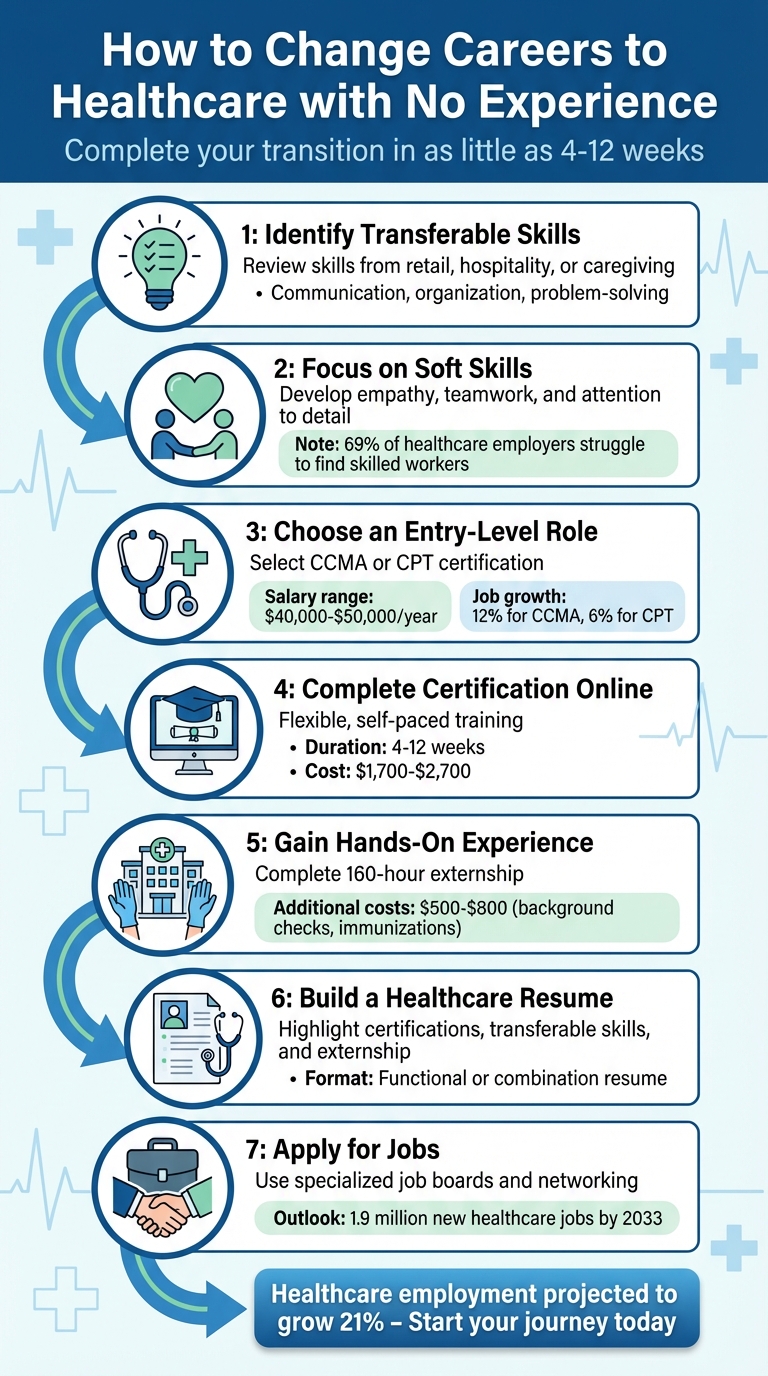
Key Steps to Start Your Healthcare Career:
- Identify Transferable Skills: Skills from retail, hospitality, or caregiving (like communication, organization, and problem-solving) are highly relevant.
- Focus on Soft Skills: Traits like empathy, teamwork, and attention to detail are highly valued in healthcare.
- Choose an Entry-Level Role: Options like CCMA or CPT require minimal training and offer hands-on patient care experience.
- Complete Certification Online: Flexible programs allow you to train at your own pace, often in just a few weeks, with costs ranging from $1,700 to $2,700.
- Gain Hands-On Experience: Programs often include externships to meet clinical requirements.
- Build a Healthcare Resume: Highlight certifications, transferable skills, and externship experience.
- Apply for Jobs: Use specialized job boards and networking to connect with employers.
With healthcare roles expected to grow by 21%, now is the perfect time to start your journey. Certification programs like HealthCareer Certs offer online training, externship placements, and job guarantees, making it easier than ever to transition into this rewarding field.
7 Steps to Start a Healthcare Career with No Experience
sbb-itb-7a67ffa
Identify Skills You Already Have
Before diving into training for a new healthcare role, take a moment to assess your current skill set. You might be surprised to find that experience from retail, hospitality, office work, or caregiving could translate seamlessly into healthcare. These roles often share core skills that are essential for patient care.
Review Your Current Skills
Start by listing the skills you’ve developed in previous jobs or educational experiences. For example:
- Handling customer complaints in retail? That demonstrates problem-solving and communication – key for patient interactions.
- Managing schedules, filing records, or processing paperwork? These organizational skills align with roles like Medical Receptionist or Medical Records Clerk.
- Experience in caregiving, whether paid or unpaid? That’s directly relevant to roles like Home Health Aide or Nursing Assistant.
Think back to times when your supervisors praised your leadership, reliability, or attention to detail. These qualities matter in healthcare. Tools like O*NET Online can help you match your skills to healthcare job descriptions. When highlighting your accomplishments, consider using the STAR framework (Situation, Task, Action, Result) to outline specific examples that show your abilities.
Recognizing both your technical know-how and interpersonal strengths will help you understand what healthcare employers are looking for.
Why Soft Skills Matter in Healthcare
Soft skills – like empathy, teamwork, and adaptability – are highly valued by healthcare employers. While clinical skills can often be taught on the job, the ability to build trust with patients or manage conflicts requires a more innate touch.
"Soft skills may be especially in demand today because employers are generally equipped to train new employees in a hard skill… but it’s much more difficult to teach an employee a soft skill such as developing rapport with coworkers or knowing how to manage conflict." – University of West Florida
With 69% of employers in healthcare and life sciences reporting difficulties finding skilled workers, strong interpersonal skills can often outweigh prior medical experience.
"An employer might prefer to hire an inexperienced worker that pays close attention to details rather than an experienced worker that may potentially cause problems on a work team." – University of West Florida
The patience, empathy, and clear communication skills you’ve honed in other roles can make all the difference. These traits help create the "bedside manner" patients need during stressful moments, whether it’s a blood draw or a routine exam.
Entry-Level Healthcare Jobs to Consider
If you’re ready to step into the healthcare field, there are several beginner-friendly roles that can help you get started quickly. Two of the most accessible roles are Certified Clinical Medical Assistant (CCMA) and Certified Phlebotomy Technician (CPT). These positions require minimal training and provide a solid foundation for a stable and rewarding career in patient care.
Certified Clinical Medical Assistant (CCMA)
Medical assistants are the backbone of many healthcare settings, juggling both clinical and administrative responsibilities. On the clinical side, they handle tasks like taking vital signs, administering vaccinations, assisting with patient exams, and performing basic lab procedures such as blood draws and EKGs. Administratively, they manage electronic health records (EHR), schedule appointments, and keep track of medical supplies.
The demand for medical assistants is on the rise, with employment expected to grow 12% from 2024 to 2034. This growth translates to about 112,300 job openings annually during this period. The median annual wage for this role is $44,200 as of May 2024. Certification plays a big role in landing these jobs, with 96% of employers requiring or encouraging it.
Jessica Aponte, a CCMA, highlights how certification can improve both career opportunities and work-life balance:
"My NHA certification has helped me financially advance my career. Most importantly it has given me opportunity to get a job that allows me to be a better mom by being home in the evenings and on the weekends".
This role also offers flexibility and the chance to specialize in areas like pediatrics, cardiology, or dermatology, making it a great starting point for a long-term healthcare career.
Certified Phlebotomy Technician (CPT)
If you’re looking for a more specialized role, becoming a phlebotomist might be the right fit. Phlebotomists focus on collecting blood samples for testing, donations, or research – a critical task in healthcare. They work in hospitals (where 36% of phlebotomists are employed), medical labs (32%), and physician offices (8%). Training for this role is relatively short, often taking just a few weeks to a few months.
The field is steadily growing, with employment projected to increase by 6% from 2024 to 2034, creating about 18,400 job openings annually. The median annual wage for phlebotomists is $43,660 as of May 2024. Certification is highly valued in this field as well, with 96% of employers requiring or encouraging it. To qualify for the NHA CPT exam, you’ll need to complete a training program and demonstrate proficiency with at least 30 venipunctures and 10 capillary sticks on live individuals. In some states – California, Colorado, Louisiana, and Nevada – certification is mandatory.
Both CCMA and CPT roles offer quick training paths and the chance to work directly with patients, making them excellent options for starting your healthcare journey. Up next, we’ll explore how online certification programs can make this process even more convenient.
Earn Your Certification Through Online Training
Once you’ve figured out which healthcare role aligns with your goals, the next step is earning your certification. Thanks to online training programs, this process is now more accessible than ever – especially for those juggling busy schedules. Let’s dive into why online certification programs might be the perfect fit for you.
Why Choose Online Certification Programs
Online certification programs bring unmatched flexibility. You can study whenever and wherever it suits you, using any device, and at your own pace.
These programs are designed to get you job-ready quickly, often in just 4 to 12 weeks. Plus, the cost is manageable, ranging from $1,700 to $2,700.
Take it from Brianna M., a student who completed her certification online:
"I was able to get certified while taking some time to travel, thanks to the course being online, I studied anywhere and everywhere."
Now, let’s explore how HealthCareer Certs makes the process even easier.
HealthCareer Certs Program Features
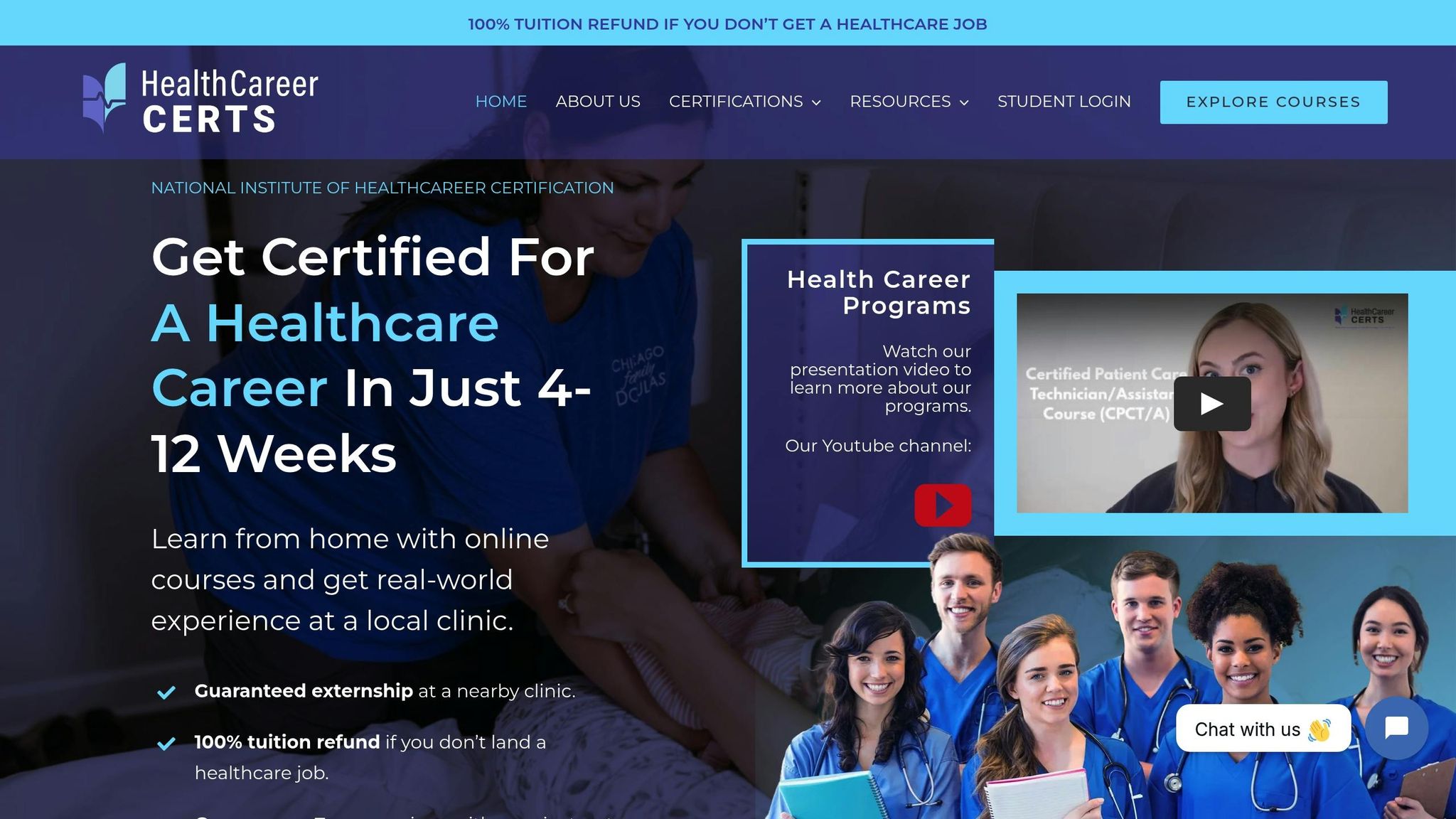
HealthCareer Certs takes the benefits of online learning to the next level with a program that’s both thorough and easy to navigate. Licensed and approved by the New Hampshire Department of Education, it offers training for CCMA and CPT certifications. The program includes more than 1,400 practice questions, 700 self-checks, and interactive 3D demos – tools designed to help you master the material and feel confident when it’s time for your certification exam. This preparation sets you up for immediate entry into healthcare roles.
One standout feature is the guaranteed clinical externship. HealthCareer Certs takes care of the externship placement for you, making sure you gain the hands-on experience employers look for and meet certification requirements.
Need extra support? The program offers one-on-one Zoom sessions with experts. Worried about financial risk? They’ve got you covered with a 100% tuition refund guarantee if you don’t secure a healthcare job within six months of passing your exam and finishing your externship. On top of that, passing your certification exam earns you American Council on Education (ACE) credits – 5 credits for CCMA and 2 for CPT. These credits can transfer to over 2,000 colleges and universities, giving you options to further your education.
With a perfect 5.0/5 Google review score from over 5,000 students, the program has clearly delivered results. Juliana J., a recent graduate, shared:
"I passed my certification exam on the first try because of them! All of the instructors were so helpful and amazing, everything is self-paced online."
Get Hands-On Experience and Pass Your Certification Exam
After completing online coursework, gaining practical experience is essential to solidify your skills.
Complete an Externship
Classroom learning alone isn’t enough – you need real-world clinical experience to feel confident on the job. Most respected programs require at least 160 hours of supervised clinical practice, where you’ll get hands-on training in tasks like checking vital signs, performing blood draws, and providing patient care.
HealthCareer Certs takes the hassle out of finding an externship by arranging placements for you through their dedicated department. Be prepared for standard industry requirements, which usually cost between $500 and $800. These fees typically cover background checks, drug tests, immunizations (like Hepatitis B and MMR), and scrubs.
"Legitimate online programs are actually hybrid models that deliver coursework virtually but require on-site skill labs and a minimum 160-hour clinical externship".
Jennifer Trimbee, RN, highlights how this blend of learning ensures you’re ready to work independently once certified.
How to Prepare for Your Certification Exam
To pass your certification exam on the first try, use focused study tools and stick to a structured plan. The exam includes 150 multiple-choice questions over three hours, with 56% of the content focusing on Clinical Patient Care. Start with a practice assessment to identify areas where you need improvement, then dive into the program’s resources, which include over 1,400 practice questions and 700 self-checks designed to mimic the actual exam format.
Refer to the official Candidate Handbook and test plan for detailed exam topics. If you’re taking the exam remotely with live proctoring, check your computer setup in advance – Chromebooks often aren’t compatible. Register using your legal name and primary email address to avoid any issues. Notably, schools using NHA exam prep materials found that 90% of students achieved higher pass rates.
Proper preparation not only helps you pass the exam but also sets you up to build a standout resume and start your healthcare career with confidence.
Build Your Resume and Apply for Healthcare Jobs
Once you’ve completed your certification and externship, it’s time to create a resume that highlights your new skills and experience in a way that stands out.
Write a Healthcare Resume
If you’re transitioning into healthcare, the format of your resume can make a big difference. For those just starting out, a functional resume is a great option because it emphasizes your skills rather than focusing on work history. A combination resume is another choice, blending your skills with any relevant experience you’ve gained in other fields.
Begin with a professional summary that highlights your certification and transferable skills. For instance, if you’ve worked in customer service, showcase how that experience demonstrates your ability to interact with patients. As Kaitlynn Arvidson, Director of Graduate and Professional Career Planning at Regis College, advises:
"Taking an inventory of all the skills mastered over the years, and the context in which they were learned can be so valuable when transitioning to healthcare."
Be sure to feature your CCMA or CPT credentials prominently in a Licenses and Certifications section near the top of your resume. Include your externship under Work Experience, using strong action verbs like "administered", "coordinated", or "performed." Highlight tasks such as managing patient care, conducting procedures, or working with healthcare technology.
Reframe your previous roles to fit healthcare. For example, customer service can translate to patient communication, and data entry can show proficiency with electronic medical records (EMR). Keep your resume clean and concise – aim for one page with a simple layout, using a 12-point font and one-inch margins.
Tailor your resume for each job application. If a job posting mentions specific skills like "vital signs monitoring" or "HIPAA compliance", make sure to include those exact terms in your resume.
| Skill Category | Examples to Include | Resume Section |
|---|---|---|
| Technical Skills | CPR/First Aid, HIPAA compliance, EMR software (Epic, eClinicalWorks), Vital signs, Phlebotomy | Dedicated skills section and summary |
| Soft Skills | Empathy, critical thinking, communication, multitasking, problem-solving | Integrated into work experience |
| Transferable Skills | Customer service, data entry, team leadership, language skills | Translated into healthcare context |
With your polished resume ready, you’re all set to start applying for healthcare jobs.
Find Jobs Through Job Boards and Networking
Now that your resume highlights your qualifications, start exploring job boards and networking opportunities tailored to healthcare roles. Your certification and externship provide a solid foundation for this next step.
Specialized job boards like the NHA Career Center focus on allied health positions and let you filter jobs by state, role, or work environment. Platforms like Incredible Health also allow employers to find you based on your certifications.
Staffing agencies, such as Manpower, can be a valuable resource for connecting with entry-level healthcare jobs like medical receptionist or patient transporter positions. Some agencies even offer free training programs to help you get started. With healthcare support roles expected to grow by over 1.9 million jobs in the next decade, there’s no shortage of opportunities.
Networking is another key tool. Reach out to instructors from your certification program, friends, family, or former colleagues who might know of job openings. Update your LinkedIn profile to reflect your new certification and career goals – this acts as a digital resume that recruiters can easily access.
When searching for jobs, keep an open mind about job titles. Your CCMA certification might qualify you for roles such as "Clinical Assistant", "Medical Office Assistant", or "Patient Care Technician." Even if you don’t meet all the "preferred" qualifications, remember that your 160-hour externship often counts as the experience many employers are looking for.
The job hunt takes time, so stay patient and persistent. With healthcare employment projected to grow by 13% from 2021 to 2031, your hard work will eventually lead to success.
Conclusion: Begin Your Healthcare Career Today
You’ve got everything you need to start a healthcare career – even without any prior experience. From pinpointing your transferable skills to earning a certification, gaining hands-on experience through an externship, and landing your first role, the steps are straightforward and achievable.
And the timing couldn’t be better. The healthcare industry is set to grow significantly, with 1.9 million new positions projected by 2033. This demand translates into real opportunities. Entry-level roles, such as Certified Clinical Medical Assistant (CCMA) and Certified Phlebotomy Technician (CPT), offer starting salaries between $40,000 and $50,000 annually. That means you’ll not only secure financial stability but also find purpose in meaningful work.
The key is to take that first step. HealthCareer Certs makes it easier than ever with 100% online, self-paced programs you can complete in just 4 to 12 weeks – even while working. Their offerings include guaranteed externship placements, extensive practice resources, personalized support, and a 100% tuition refund guarantee if you don’t land a job within six months.
The opportunity is clear, and the time to act is now. The healthcare field is ready for you, and the training has never been more accessible. Enroll today and turn your skills into a fulfilling healthcare career.
FAQs
What transferable skills are most valuable when starting a healthcare career?
Transferable skills such as strong communication, problem-solving, and customer service play a key role in healthcare. These skills enable professionals to connect with patients, collaborate with coworkers, and engage with other stakeholders, all of which are essential for providing high-quality care.
Equally important are abilities like teamwork, adaptability, and attention to detail. These are critical for navigating complex situations and ensuring precision in patient care and documentation. Skills gained in other industries – like leadership, organization, or time management – also translate well to healthcare, offering career changers a solid foundation to thrive in this field.
How can I start gaining practical experience in healthcare if I have no prior background?
Starting a career in healthcare without prior experience might seem challenging, but it’s absolutely doable with the right approach. One of the best ways to start is by exploring externships or job shadowing opportunities. These give you a chance to observe and assist professionals in real clinical settings, offering valuable insight into the field. Plus, these experiences can often open doors to entry-level jobs.
If you’re ready to dive in, consider entry-level positions like Certified Clinical Medical Assistant (CCMA) or Certified Phlebotomy Technician (CPT). Many of these roles include on-the-job training, making them perfect for beginners. They also help you develop essential skills while working directly in a healthcare environment.
Don’t overlook the power of transferable skills either. Abilities like customer service, communication, and teamwork from previous jobs can demonstrate to employers that you’re prepared to thrive in a healthcare setting. Pairing online certifications with hands-on learning opportunities – such as internships or shadowing – can be a smart way to build experience and kickstart your journey into healthcare.
What should I include on my resume when switching to a healthcare career?
When shifting into a healthcare career, your resume should spotlight transferable skills, certifications, and experiences that demonstrate your potential in the field. Focus on skills like communication, problem-solving, teamwork, and customer service – these are highly valued in healthcare roles.
If you hold certifications such as a Certified Clinical Medical Assistant (CCMA) or Certified Phlebotomy Technician (CPT), make sure they are prominently displayed. These credentials show your dedication and provide evidence of your foundational knowledge. Don’t forget to include relevant training, externships, or shadowing experiences to highlight your hands-on exposure to healthcare settings.
Also, showcase soft skills like empathy, attention to detail, and the ability to stay composed under pressure – qualities that healthcare employers look for in candidates. Tailor your resume to align with the specific requirements of the role you’re applying for to strengthen your chances of landing the job.